
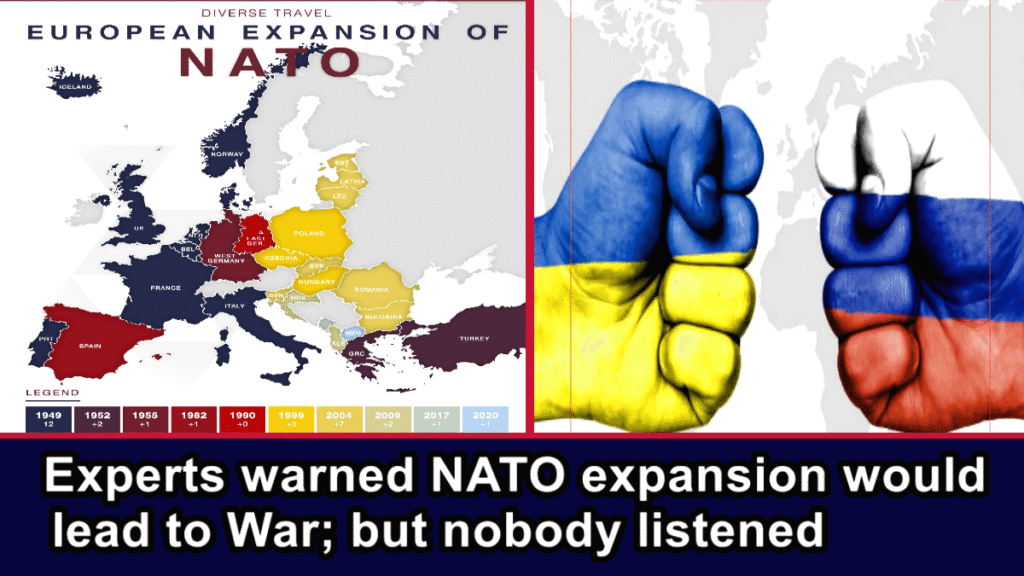
We Always Knew the Dangers of NATO Expansion

Ted Snider

April 5, 2023

In 2008, William Burns, who is now Biden’s director of the CIA but was then ambassador to Russia, warned that “Ukrainian entry into NATO is the brightest of all redlines for the Russian elite (not just Putin).” He warned Secretary of State Condoleezza Rice that “I have yet to find anyone who views Ukraine in NATO as anything other than a direct challenge to Russian interests.” Short even of expansion into Ukraine, Burns called NATO expansion into Eastern Europe “premature at best, and needlessly provocative at worst.” If it came to Ukraine, Burns warned, “There could be no doubt that Putin would fight back hard.”

But Burns was not the first Russia expert to flash that warning sign to the White House. In 1990, as the Soviet Union broke apart like a jigsaw puzzle into separate countries, the US and NATO were at a crucial crossroads confronted with two future changing choices. They could put the pieces of the puzzle back together in one inclusive picture of an integrated world that draws no new lines across Europe, welcomes Russia in, transcended blocs and creates a comprehensive European security structure, or they could attach the newly loosed pieces to NATO, exclude and isolate Russia and push a swollen NATO right up against Russia’s borders.

The US and NATO passed up a historic opportunity for cooperation and chose the latter. A pantheon of Russia experts bemoaned the lost chance and warned urgently against it. President Clinton’s secretary of defense, Bill Perry, called it “tragic” because “we had the opportunity in the 1990s to build a long-lasting cooperative relationship with Russia.”

A legion of the most knowledgeable and experienced US officials warned against that lost opportunity because, even then, they knew two things: that leaving Russia out of the EU and out of the new security arrangement and advancing on its borders would existentially threaten Russia’s security interests and that Russia’s red line was Ukraine.

Originally published at Antiwar.com on August 16, 2022

NATO Expansion East

As early as 1997, prior to any NATO expansion east, Jack Matlock, a former US ambassador to Russia, testified before the Senate Foreign Relations Committee that “I consider the Administration’s recommendation to take new members into NATO at this time misguided. If it should be approved by the United States Senate, it may well go down in history as the most profound strategic blunder made since the end of the Cold War.”

The same year, George Kennan, another former US ambassador to Russia and the architect of the US policy of containment and rollback of the Soviet Union, said that NATO expansion east “would be the most fateful error of American policy in the entire post-cold-war era.” He added that it would “restore the atmosphere of the cold war.” Kennan wrote that this view is “shared by a number of others with extensive and in most instances more recent experience in Russian matters.”

These warnings were neither subtle nor hedged: “most profound strategic blunder,” “most fateful error.” And they were coming from the people who best knew. US Ambassadors other than ambassadors to Russia seconded the warnings. In a 1995 article in New York Review of Books, former US ambassador to Poland Richard T. Davies warned that US policymakers were ignoring the best advice of their best advisors. But even these were not the earliest warnings. Warnings had been coming from within the Bush administration since the conversation about expansion started.

In October 1990, in perhaps the first warning, the State Department produced an analysis on “Eastern Europe and NATO. It concluded that “it is not in the best interest of NATO or the US that these states be granted full NATO membership.” It warned against “an anti-Soviet coalition whose frontier is the Soviet border.” That same month, the administrations’ European Strategy Steering Group reported that “all agencies agree that East European governments should not be invited to join NATO anytime in the immediate future.” All agencies included State, Defense, NSA, and the Joint Chiefs of Staff.

In 1992, the State Department, again considering NATO expansion, was advised by Assistant Secretary of State Thomas Niles that expanding east “would in effect tell Moscow that the end result of internal revolution and forsaking its Soviet/Warsaw Pact empire is the expansion of NATO to its border.” In Not One Inch, M.E. Sarotte says that “Niles advised ‘holding the line on NATO membership’.” The same year, according to Sarotte, Colin Powell, then chairman of the Joint Chiefs of Staff, cautioned that “he was personally reluctant to cross the bridge of Eastern European membership in NATO.”

In October 1995, scandal forced NATO Secretary General Willy Claes to resign. Ruud Lubbers was poised to replace him. But, in a less told story of US ignoring warnings and maneuvering to shape its goals, when it became clear that Lubbers opposed US plans to expand NATO east, the State Department’s director of policy planning, James Steinberg, says that the US decided to derail Lubber’s rise to the top of NATO. According to Sarotte, Steinberg reported that the US “‘decided afterward that we weren’t going to let’ Lubbers have the job.” Instead, the US escorted Javier Solana to the top of NATO. Solana made it clear that when it came to the issue of NATO expansion east, he “would track with the American view.”

The US knew that NATO expansion east would anger and threaten Moscow. They also knew that expansion to Ukraine was especially sensitive and threatening and constituted a special red line. Knowing the sensitivity of that red line, expansion to Ukraine had been especially debated.

In a moving 1991 appeal cited by Sarotte, US ambassador to Moscow Robert Strauss – another of those experts who, in Kennan’s words, had the most extensive and most recent experience – warned that “the most revolutionary event of 1991 for Russia may not be the collapse of Communism, but the loss of something Russians of all political stripes think of as part of their own body politic, and near to the heart at that: Ukraine.”

In his memoir, Duty, Robert Gates said, “trying to bring Georgia and Ukraine into NATO was truly overreaching.” He added that it was “recklessly ignoring what the Russians considered their own vital national interests.”

For these reasons, an internal 1991 draft paper recommended leaving “the possibility of Ukraine joining the NATO liaison program” for “a later time.”

Ukraine was also a sensitive case because they had former Soviet nuclear weapons on their territory that they were, at times, reluctant to surrender. But, even with NATO membership as the carrot for sending the nuclear weapons to Russia, experts were reluctant to offer NATO membership to Ukraine and cross Russia’s red line. In 1993, Clinton’s national security advisor, Anthony Lake, an aggressive proponent of NATO enlargement, told the British that if they admitted Ukraine into NATO, that would solve the nuclear problem. The record shows, according to Sarotte, that the British responded in disbelief. They reminded Lake that “expanding NATO to include Ukraine would cross the very reddest of Russian red lines.” That was known three decades ago.

Even Richard Holbrooke, who aggressively pushed expansion, knew that “Ukraine is the most delicate issue” and that it had to be treated differently. He knew that Ukraine was a red line that probably could not be crossed, calling NATO “an alliance it can probably never enter. . .” NATO Secretary General Javier Solana, who promised that his view on NATO expansion “would track with the American view,” knew that expansion into the Baltic States and Ukraine was “the most difficult part of enlargement.”

In December 1994, in a meeting attended by Clinton and Gore in the White House, the President and Vice-President secretly clarified that the time had come to expand NATO east. Sarotte reports that the decision was made, though, to focus on Central and Eastern Europe and not Ukraine.

Fourteen years later, Burns would send his warning to Washington that “Ukrainian entry into NATO is the brightest of all redlines” and that if NATO expanded into Ukraine, “There could be no doubt that Putin would fight back hard.”

Originally published at Antiwar.com on August 16, 2022

About the author
Ted Snider has a graduate degree in philosophy and writes on analyzing patterns in US foreign policy and history. Here are his many columns on AntiWar.com and on The American Conservative.

Please help TFF remain truly independent by contributing if you benefited from this article

[paypal-donation]

Share

Leave a Reply

Your email address will not be published. Required fields are marked *

Related Posts

Jan Oberg May 15, 2026 Go to this Fox News page and scroll the whole way down: President Donald Trump tells the world that his meeting with President Xi Jinping yielded a lot of very concrete political and economic results – of course, only where the Chinese side, according to him, agreed with him. He does not mention the Taiwan issue, but Secretary of State, Marco Rubio, says that it did not feature prominently in their talks and that the US policy on Taiwan has not changed. Then go to China Daily – or Global Times – and you will see that for the Chinese it is framework, principles, structure of cooperation etc. that matters – all embedded in the overall idea of “constructive bilateral relationship of strategic stability.” Nowhere is any concrete agreement or deal – all that Trump refers to – mentioned. At the general level, this gives you insights into the very different social...
Jan Oberg, TFF director April 9, 2026 I was recently invited to have a good, long talk about the world – and, of course, about peace too – with Boris Malagurski on his Weight of Chains Channel on YouTube. It was a real joy and seems to have been greatly appreciated by the viewers too. Mr Malagurski and I shall of course be grateful if you share this conversation in your circles – of course, only if you like what you see and hear  And remember that this one – like hundreds of others with TFF Associates – can be enjoyed at our TFF Video Collection.
The MSC’s closed groupthink militarism offers only one prescription — more weapons — even as record military expenditures, squeezed from taxpayers in economic crisis, destroy diplomacy and drive escalation to the highest war risks in decades. Jan Oberg TFF director February 13, 2026 From Dialogue Forum to Militarised Ritual For decades, the Munich Security Conference (MSC) – which opened today and runs till Sunday – was one of the few places where adversaries could meet without theatrics. Founded in 1963 as the Wehrkundetagung, it served as a discreet Cold War dialogue forum between NATO and the Warsaw Pact. Even at moments of high tension, Soviet and later Russian representatives were present, and Munich allowed uncomfortable messages to be delivered directly rather than through press releases or military manoeuvres. That era has vanished. The MSC has become something entirely different: a €13–20 million annual gathering of a closed Western security elite, a polished meeting...

Recent Articles

Jan Oberg May 15, 2026 Go to this Fox News page and scroll the whole way down: President Donald Trump tells the world that his meeting with President Xi Jinping yielded a lot of very concrete political and economic results – of course, only where the Chinese side, according to him, agreed with him. He does not mention the Taiwan issue, but Secretary of State, Marco Rubio, says that it did not feature prominently in their talks and that the US policy on Taiwan has not changed. Then go to China Daily – or Global Times – and you will see that for the Chinese it is framework, principles, structure of cooperation etc. that matters – all embedded in the overall idea of “constructive bilateral relationship of strategic stability.” Nowhere is any concrete agreement or deal – all that Trump refers to – mentioned. At the general level, this gives you insights into the very different social...
Lena Petrova of “World Affairs In Context” with more than half a million subscribers on YouTube wanted to explore what a peace researcher like me has to say about, among other things, the First and the Second Cold War and why eethics has disappeared from politics. I am particularly happy about this conversation that also yielded an amazing number of very appreciative comments on YouTube. No doubt, people are longing for alternatives, including peace perspectives.
The MIMAC – Military-Industrial-Media-Academic Complex – drives the world’s rampant militarism and wars without end. Here is a short reflection of how it works against all interests of humanity. #5 deals with why there is no real enemy or threat images/analysis. It’s all ex-post constructions. And, btw, theTFF Peace Pulse is now on Rumble.

TFF on Substack

Discover more from TFF Transnational Foundation & Jan Oberg.

Most Popular

Jan Oberg May 15, 2026 Go to this Fox News page and scroll the whole way down: President Donald Trump tells the world that his meeting with President Xi Jinping yielded a lot of very concrete political and economic results – of course, only where the Chinese side, according to him, agreed with him. He does not mention the Taiwan issue, but Secretary of State, Marco Rubio, says that it did not feature prominently in their talks and that the US policy on Taiwan has not changed. Then go to China Daily – or Global Times – and you will see that for the Chinese it is framework, principles, structure of cooperation etc. that matters – all embedded in the overall idea of “constructive bilateral relationship of strategic stability.” Nowhere is any concrete agreement or deal – all that Trump refers to – mentioned. At the general level, this gives you insights into the very different social...
Lena Petrova of “World Affairs In Context” with more than half a million subscribers on YouTube wanted to explore what a peace researcher like me has to say about, among other things, the First and the Second Cold War and why eethics has disappeared from politics. I am particularly happy about this conversation that also yielded an amazing number of very appreciative comments on YouTube. No doubt, people are longing for alternatives, including peace perspectives.
The MIMAC – Military-Industrial-Media-Academic Complex – drives the world’s rampant militarism and wars without end. Here is a short reflection of how it works against all interests of humanity. #5 deals with why there is no real enemy or threat images/analysis. It’s all ex-post constructions. And, btw, theTFF Peace Pulse is now on Rumble.
Read More
Screenshot-2026-05-15-103534
Jan Oberg May 15, 2026 Go to this Fox News page and scroll the whole way down: President Donald Trump tells the world that his meeting with President Xi Jinping yielded a lot of very concrete political and economic results – of course, only where the Chinese side, according to him, agreed with him. He does not mention the Taiwan issue, but Secretary of State, Marco Rubio, says that it did not feature prominently in their talks and that the US policy on Taiwan has not changed. Then go to China Daily – or Global Times – and you will see that for the Chinese it is framework, principles, structure of cooperation etc. that matters – all embedded in the overall idea of “constructive bilateral relationship of strategic stability.” Nowhere is any concrete agreement or deal – all that Trump refers to – mentioned. At the general level, this gives you insights into the very different social...
Screenshot-2026-05-12-104023
Lena Petrova of “World Affairs In Context” with more than half a million subscribers on YouTube wanted to explore what a peace researcher like me has to say about, among other things, the First and the Second Cold War and why eethics has disappeared from politics. I am particularly happy about this conversation that also yielded an amazing number of very appreciative comments on YouTube. No doubt, people are longing for alternatives, including peace perspectives.
Screenshot-2026-04-13-154551 (2)
The MIMAC – Military-Industrial-Media-Academic Complex – drives the world’s rampant militarism and wars without end. Here is a short reflection of how it works against all interests of humanity. #5 deals with why there is no real enemy or threat images/analysis. It’s all ex-post constructions. And, btw, theTFF Peace Pulse is now on Rumble.
Screenshot-2026-04-13-154551 (1)
Jan Oberg, TFF director April 28, 2026 In this third TFF Peace Pulse, I make the important distinction between the violence and the conflict that violence is a symptom of. If you want peace, focus on the underlying conflict because that is the key to resolution, peacemaking, and a better future for the parties. The West is obsessed with violence, just look around you – and 90+ per cent of the public debate is about military issues and other violence – totally wasted for peace. These Peace Pulses will only be published here a few times. You will also not find them on YouTube and Vimeo because both platforms have blocked TFF and me; you know, peace is dangerous these days. Most TFF’s videos since 2007 are now on Rumble.
Screenshot-2026-04-13-154551
In contrast to most, we’ll bring alternatives, solutions, hope and strategies for a better future. Times are dangerous, yes, but that only intensifies the need for constructive thinking and action! Jan Oberg, TFF director April 13, 2026 The new TFF Peace Pulse uses video messages in a new way: Max 3-5-minute-long comments, ideas or perhaps mini-lectures, all about peace – positive peace. We launch them today on April 13, 2026 with a carefully crafted visual aesthetic fitting the content. We hope to publish them regularly from now on. We launch Peace Pulse (PP) – for a number of reasons. The world is in chaos, and there are countless reasons to feel concerned, frustrated, even angry. The atmosphere is saturated with doom and gloom, with negative energy and rear‑mirror thinking, while vision, imagination, alternatives, strategies and genuine future‑mindedness remain in short supply. And without them, we simply can’t save the world. Looking at problems from a hundred angles will...
IMG_5165 (1)
PART II — Publishing Peace in a System That Prioritises Militarism Jan Oberg, TFF director April 10, 2026 How TFF Maintains a Daily Voice in a Digital World Built for Noise This article is part of the series “TFF at 40″ and it invites you to learn about Four Decades of Publishing Peace. It takes a look at how a small, people‑financed peace foundation has communicated across four generations of technology — from wax stencils and fax machines to mass email and Substack — and why TFF continues to publish every single day in a system that rewards noise, conflict, and militarism. ◆ What it means to publish peace every single day in a digital system built for 24/7 news and other noise, confrontation, and militarism. How TFF’s independence, continuity, and global readership defy algorithms, donor cycles, and Western media censorhip — and why the Majority World keeps listening. When the...

