
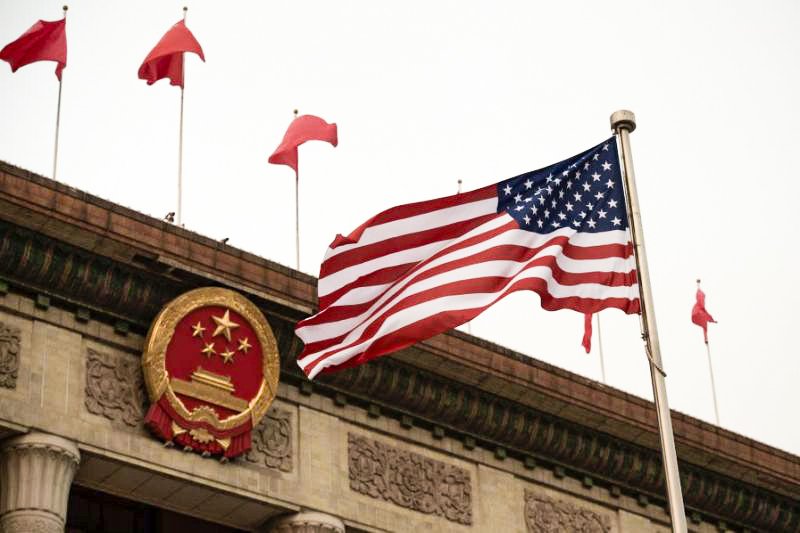
The anti-dollar awakening could be ruder and sooner than most economists predict


Thwarting the anti-dollar coalition should be Washington’s top national priority


By Gal Luft

August 30, 2018


The United States is currently waging economic warfare against one tenth of the world’s countries with cumulative population of nearly 2 billion people and combined gross domestic product (GDP) of more than $15 trillion.

These include Russia, Iran, Venezuela, Cuba, Sudan, Zimbabwe, Myanmar, the Democratic Republic of Congo, North Korea and others on which Washington has imposed sanctions over the years, but also countries like China, Pakistan and Turkey which are not under full sanctions but rather targets of other punitive economic measures.

In addition, thousands of individuals from scores of countries are included in the Treasury Department’s list of Specially Designated Nationals who are effectively blocked from the U.S.-dominated global financial system. Many of those designated are either part of or closely linked to their countries’ leadership.

Published by Yahoo Finance on August 27, 2018

From a U.S. perspective, each one of the economic entities is targeted for a good reason be it human rights violations, terrorism, crime, nuclear trade, corruption or in the case of China, unfair trade practices and intellectual property theft.

But in recent months it seems that America’s unwavering commitment to fight all of the world’s scourges has brought all those governments and the wealthy individuals who support them to a critical mass, joining forces to create a parallel financial system which would be out of reach of America’s long arm. Should they succeed, the impact on America’s global posture would be transformational.

America’s global supremacy has been made possible not only thanks to its military power and its alliance system but also due to its control over the plumbing of global finance and particularly the broad acceptance of the dollar as the world’s reserve currency. The unique status of the U.S. currency has anchored the global financial system since World War II.

Any transaction done in U.S. dollars or using a U.S. bank automatically brings the trading parties under American legal jurisdiction. When the U.S. decides to impose unilateral sanctions, as in the case of Iran, it essentially tells the world’s governments, corporations and individuals they must choose between halting business with the sanctioned country or be shut off from the world’s number one economy. This is a powerful stick.

Not many companies or banks can afford to give up on the U.S. market or be denied access to U.S. financial institutions.

Revisionist countries that wish to challenge the U.S.-led system see this as an affront to their economic sovereignty. Which is why both Russia and China have developed their own versions of the Society for Worldwide Interbank Financial Telecommunication (SWIFT), the global network that allows cross-border financial transactions among thousands of banks. Both countries are also urging their trading partners to ditch the dollar in their bilateral trade in favor of indigenous currencies.

This month Russia was quick to recruit Turkey into the anti-dollar bloc, announcing it would back non-dollar trade with it, after a financial feud between Ankara and Washington broke out. China for its part is using its trillion-dollar Belt and Road Initiative as a tool to compel countries to transact in yuan terms instead of dollars. Pakistan, the number one recipient of Belt and Road money, and Iran have already announced their intention to do just that.

Last month’s BRICS (Brazil, Russia, India, China, South Africa) summit in Johannesburg was a call to arms against the dollar hegemony with countries like Turkey, Jamaica, Indonesia, Argentina and Egypt invited to join in what is known as “BRICS plus” with the goal of creating a de-dollarized economy.

The main front where the future of the dollar will be decided is the global commodity market, especially the $1.7 trillion oil market. Ever since 1973, when President Richard Nixon unilaterally severed the U.S. dollar from the gold standard and convinced the Saudis and the rest of the OPEC countries to sell their oil only in dollars, the global oil trade has been linked to the American currency.

This paved the way for the rest of the commodities to be traded in dollars as well. The arrangement served America well. It created an ever growing demand for the greenback, which in turn enabled consecutive U.S. governments to freely run their growing deficits.

Not anymore. Because so many of the members of the anti-dollar alliance are exporters of commodities they no longer feel that their products should be either priced by a dollar-denominated benchmark like WTI and Brent or be traded in a currency they no longer crave.

For example, when China buys oil from Angola, gas from Russia, coal from Mongolia or soybeans from Brazil it prefers to do so in its own currency and thereby avoid unwanted exchange rate fees on both sides of the transaction. This is already beginning to happen.

Russia and China have agreed to transact some of their traded energy in yuan. China is pushing its main oil suppliers Saudi Arabia, Angola and Iran to receive yuans for their oil. And last year China introduced gold-backed futures contracts, dubbed “petro-yuan” in the Shanghai International Energy Exchange – the first non-dollar crude benchmark in Asia.

The gradual acceptance of digital currencies, backed by blockchain technology offers another way for the revisionists to ditch the dollar in their trading. The Russian central bank indicated that it was considering launching a national cryptocurrency called “cryptoruble” and in the interim it helped Venezuela’s launch of its own cryptocurrency, the “petro,” which is backed by the country’s vast oil reserves. Now BRICS members are discussing a BRICS-backed cryptocurrency.

All of those actions and others point to one direction: In the coming years the dollar will be facing a barrage of attacks with the goal of eroding its hegemony and the energy trading market will be one of the main battlefields where the future of America’s economic dominance will be decided. Any successful attempt to delink commodity trading from the dollar will have a cascading impact not only on the global economic system as we know it but also on America’s posture abroad.

With the overall positive state of the U.S. economy and the remarkable strength of the dollar compared to the currencies of the dollar-busters including the Russian ruble, the yuan, the Turkish lira and the Iranian rial it may be easy to sink into complacency and dismiss the actions of the revisionists as mere pinpricks.

But ignoring the growing anti-dollar coalition would be to America’s detriment. Bull markets eventually come to an end and with a national debt of $21 trillion and growing at a rate of a trillion dollars a year, the awakening could be ruder and sooner than most economists predict.

In the midst of America’s economic euphoria it is worth remembering that one of every four people on the planet lives today in a country whose government is committed to end the dollar hegemony.

Thwarting their effort should be Washington’s top national priority.


Gal Luft
– is co-director of the Institute for the Analysis of Global Security and senior advisor to the United States Energy Security Council.


Recommended reading

Cathrin Schaer
Making Europe financially independent, one transaction at a time



Share

Leave a Reply

Your email address will not be published. Required fields are marked *

Related Posts

Jan Oberg, TFF director April 9, 2026 I was recently invited to have a good, long talk about the world – and, of course, about peace too – with Boris Malagurski on his Weight of Chains Channel on YouTube. It was a real joy and seems to have been greatly appreciated by the viewers too. Mr Malagurski and I shall of course be grateful if you share this conversation in your circles – of course, only if you like what you see and hear  And remember that this one – like hundreds of others with TFF Associates – can be enjoyed at our TFF Video Collection.
Jan Oberg February 19, 2026 What a thrill to be interviewed by former British diplomat Ian Proud! Don’t waste a minute: acquaint yourself with him here on his homepage, which he elegantly calls “Proud Diplomat.” Notice also his book, A Misfit In Moscow. Ian is, of course, also on Substack, where he calls himself The Peace Monger, and recently he set up his own PeaceMonger Channel on YouTube. For once, I was not interviewed as if I were a military geopolitical expert, where I normally have to twist the whole thing in the direction of peace. No, we both had a focus on peace – why it has been disappeared by research, politics and the media, but also what can be done to shape a more peaceful future for us all. One idea we came up with was that of connecting people through citizens diplomacy – in an era where more or less authoritarian leaders meet frequently and confirm each other as members...
This is not another geopolitical commentary on the Arctic. It is a visionary peace proposal that can save the region from militarised rivalry and ecological ruin. A blueprint for shared security, sustainable development, and human dignity — benefitting Greenland, the Arctic, and the rest of us. Jan Oberg TFF director Lund, Sweden, February 17, 2026 I. Four Principles for a New Arctic Vision The Arctic is often framed as a cold arena of rivalry — a place where great powers test each other’s resolve. But this worldview is outdated, unimaginative, and ultimately self‑defeating. The Arctic is not a vacuum waiting to be militarised; it is a living region, a climate stabiliser, and a cultural homeland whose future will shape the future of humanity. If we begin from that understanding, a far more rational Arctic order becomes possible — one that is peaceful, cooperative, and centred on the people who actually live there. This vision rests...

Recent Articles

Jan Oberg May 15, 2026 Go to this Fox News page and scroll the whole way down: President Donald Trump tells the world that his meeting with President Xi Jinping yielded a lot of very concrete political and economic results – of course, only where the Chinese side, according to him, agreed with him. He does not mention the Taiwan issue, but Secretary of State, Marco Rubio, says that it did not feature prominently in their talks and that the US policy on Taiwan has not changed. Then go to China Daily – or Global Times – and you will see that for the Chinese it is framework, principles, structure of cooperation etc. that matters – all embedded in the overall idea of “constructive bilateral relationship of strategic stability.” Nowhere is any concrete agreement or deal – all that Trump refers to – mentioned. At the general level, this gives you insights into the very different social...
Lena Petrova of “World Affairs In Context” with more than half a million subscribers on YouTube wanted to explore what a peace researcher like me has to say about, among other things, the First and the Second Cold War and why eethics has disappeared from politics. I am particularly happy about this conversation that also yielded an amazing number of very appreciative comments on YouTube. No doubt, people are longing for alternatives, including peace perspectives.
The MIMAC – Military-Industrial-Media-Academic Complex – drives the world’s rampant militarism and wars without end. Here is a short reflection of how it works against all interests of humanity. #5 deals with why there is no real enemy or threat images/analysis. It’s all ex-post constructions. And, btw, theTFF Peace Pulse is now on Rumble.

TFF on Substack

Discover more from TFF Transnational Foundation & Jan Oberg.

Most Popular

Jan Oberg May 15, 2026 Go to this Fox News page and scroll the whole way down: President Donald Trump tells the world that his meeting with President Xi Jinping yielded a lot of very concrete political and economic results – of course, only where the Chinese side, according to him, agreed with him. He does not mention the Taiwan issue, but Secretary of State, Marco Rubio, says that it did not feature prominently in their talks and that the US policy on Taiwan has not changed. Then go to China Daily – or Global Times – and you will see that for the Chinese it is framework, principles, structure of cooperation etc. that matters – all embedded in the overall idea of “constructive bilateral relationship of strategic stability.” Nowhere is any concrete agreement or deal – all that Trump refers to – mentioned. At the general level, this gives you insights into the very different social...
Lena Petrova of “World Affairs In Context” with more than half a million subscribers on YouTube wanted to explore what a peace researcher like me has to say about, among other things, the First and the Second Cold War and why eethics has disappeared from politics. I am particularly happy about this conversation that also yielded an amazing number of very appreciative comments on YouTube. No doubt, people are longing for alternatives, including peace perspectives.
The MIMAC – Military-Industrial-Media-Academic Complex – drives the world’s rampant militarism and wars without end. Here is a short reflection of how it works against all interests of humanity. #5 deals with why there is no real enemy or threat images/analysis. It’s all ex-post constructions. And, btw, theTFF Peace Pulse is now on Rumble.
Read More
Screenshot-2026-05-15-103534
Jan Oberg May 15, 2026 Go to this Fox News page and scroll the whole way down: President Donald Trump tells the world that his meeting with President Xi Jinping yielded a lot of very concrete political and economic results – of course, only where the Chinese side, according to him, agreed with him. He does not mention the Taiwan issue, but Secretary of State, Marco Rubio, says that it did not feature prominently in their talks and that the US policy on Taiwan has not changed. Then go to China Daily – or Global Times – and you will see that for the Chinese it is framework, principles, structure of cooperation etc. that matters – all embedded in the overall idea of “constructive bilateral relationship of strategic stability.” Nowhere is any concrete agreement or deal – all that Trump refers to – mentioned. At the general level, this gives you insights into the very different social...
Screenshot-2026-05-12-104023
Lena Petrova of “World Affairs In Context” with more than half a million subscribers on YouTube wanted to explore what a peace researcher like me has to say about, among other things, the First and the Second Cold War and why eethics has disappeared from politics. I am particularly happy about this conversation that also yielded an amazing number of very appreciative comments on YouTube. No doubt, people are longing for alternatives, including peace perspectives.
Screenshot-2026-04-13-154551 (2)
The MIMAC – Military-Industrial-Media-Academic Complex – drives the world’s rampant militarism and wars without end. Here is a short reflection of how it works against all interests of humanity. #5 deals with why there is no real enemy or threat images/analysis. It’s all ex-post constructions. And, btw, theTFF Peace Pulse is now on Rumble.
Screenshot-2026-04-13-154551 (1)
Jan Oberg, TFF director April 28, 2026 In this third TFF Peace Pulse, I make the important distinction between the violence and the conflict that violence is a symptom of. If you want peace, focus on the underlying conflict because that is the key to resolution, peacemaking, and a better future for the parties. The West is obsessed with violence, just look around you – and 90+ per cent of the public debate is about military issues and other violence – totally wasted for peace. These Peace Pulses will only be published here a few times. You will also not find them on YouTube and Vimeo because both platforms have blocked TFF and me; you know, peace is dangerous these days. Most TFF’s videos since 2007 are now on Rumble.
Screenshot-2026-04-13-154551
In contrast to most, we’ll bring alternatives, solutions, hope and strategies for a better future. Times are dangerous, yes, but that only intensifies the need for constructive thinking and action! Jan Oberg, TFF director April 13, 2026 The new TFF Peace Pulse uses video messages in a new way: Max 3-5-minute-long comments, ideas or perhaps mini-lectures, all about peace – positive peace. We launch them today on April 13, 2026 with a carefully crafted visual aesthetic fitting the content. We hope to publish them regularly from now on. We launch Peace Pulse (PP) – for a number of reasons. The world is in chaos, and there are countless reasons to feel concerned, frustrated, even angry. The atmosphere is saturated with doom and gloom, with negative energy and rear‑mirror thinking, while vision, imagination, alternatives, strategies and genuine future‑mindedness remain in short supply. And without them, we simply can’t save the world. Looking at problems from a hundred angles will...
IMG_5165 (1)
PART II — Publishing Peace in a System That Prioritises Militarism Jan Oberg, TFF director April 10, 2026 How TFF Maintains a Daily Voice in a Digital World Built for Noise This article is part of the series “TFF at 40″ and it invites you to learn about Four Decades of Publishing Peace. It takes a look at how a small, people‑financed peace foundation has communicated across four generations of technology — from wax stencils and fax machines to mass email and Substack — and why TFF continues to publish every single day in a system that rewards noise, conflict, and militarism. ◆ What it means to publish peace every single day in a digital system built for 24/7 news and other noise, confrontation, and militarism. How TFF’s independence, continuity, and global readership defy algorithms, donor cycles, and Western media censorhip — and why the Majority World keeps listening. When the...

