
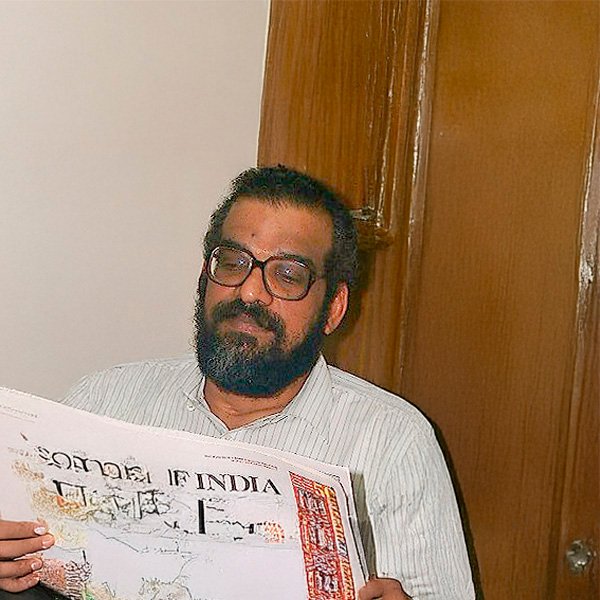
Falling in line: An Indian editor works at Chinese media

Working as a journalist in China’s newspapers can be an eye-opening and engaging experience, revealing unsuspected potential and unforeseen possibilities. Such work, more often than not, is with the state media. To make the most of the situation, it is necessary to leave behind a lifetime’s misconceptions and prejudices.

My life as an expatriate journalist in Beijing began with China Daily (CD) – the country’s oldest English daily brought out by a department of the Information Ministry. The Editor in Chief (EiC) is said to enjoy the rank of Vice Premier, with all the powers of that office, barring the one that allows issue of visas.

In his first circle of power are deputy editors in chief, though the designation could be anything. Title, authority, power, functions, responsibility are not necessarily matched as we know them to be in India, in the world of Anglo-American journalism, or in the continent. Beneath this layer are a large number of assistants to the EiC and the day and night editors. A notch above, but below the first rung, are editors who keep an eye on the day/night editors and the assistants.

These ubiquitous assistants are the eyes and ears of the EiC, and, perhaps, of the government, the party and the state, too. Some view them as competent editors and tested journalists who should not be trifled with merely because of their unflattering designation and unassuming disposition. Others see these assistants, at best, as factotums; and, at worst, as sheepdogs, who keep the flock, including expats (also called ‘foreign experts’), from ‘straying’; or, falling prey to journalistic practices for which CD has little use.

The assistants keep track of everything anddon’t miss a trick. They have at their command loyalist expats who do their every bidding, against their own countrymen. Servitude to these assistants is the surest way to survive and succeed – as “successful” expats, including from India, learned early on. These expats jealously guard their position by keeping out their other countrymen, unless these newcomers are willing to become as, if not more, abject as them in their “performance”. The expat’s journalistic competence does not decide his or her place/role in CD.

Yet this paper pays the best package and looks after its staff very well. If you are free of notions of journalism acquired elsewhere, carry out every wish of the Chinese bosses (Assistants to the EiC) as your command and feel pleased and privileged to perform like a flea – then you can collect a tidy sum and live it up. Nobody will tell you to your face that you suck; that you are a sly and sleazy lowlife; and that your ‘success’ (as a survivor) is because you, as the factotum’s pup, are a trusty doormat.

Inevitably, the journalist who values independence, integrity and self-esteem moves out of CD. S/he heads to Xinhua, the Chinese news agency, which is a state within the state. In today’s global conditions, Xinhua,the most powerful, successful and profitable news agency, is home to “economic refugees” from the West, who lost their jobs in leading media organisations particularly in the US and the UK.

The expat journalist barely stands out in Xinhua because this agency’s universe is huge and it pays less than CD. Yet Xinhua is the acme for the Chinese, and the expat here is a contented soul with the job not straining his self-respect. Xinhua’s brand of journalism may be alien, but s/he gladly does a job (editing text/copy, which does not call for his kind of journalistic values or judgment) to the institution’s satisfaction.

The expat has no complaint against Xinhua’s culture (as an organisation, not as a media/journalism entity). The hours are shorter, there’s more leave, a paid annual holiday, good cafeterias and, as a US journalist said, no pressure to “perform like a flea”. Xinhua may be an institution of state, but unlike other media biggies, it is a rule-maker. It lays down the line, not just abides by it.

The other magnet for expats is the English daily Global Times, from Party-run People’s Daily stable, which has for long been publishing the Chinese language Global Times. The pay is a shade lower than in CD, from where many expats moved to GT. They feel the pay cut is well worth the shift.

Often praised as the Fox News of China, Global Times is young, and has a robust journalistic air about it.The editors are visible, accessible, hands-on and in close daily working contact with the staff.It may be subject to the same limitations as CD and other Chinese media outlets, but it does not let the restrictions and opacity kill the buzz about the place.

I had a terrific time in GT. Most expats tend to assume censorship and restrictions even where they don’t exist. Expats told me that the signed editorial comment space was strictly for the Chinese to articulate what the bosses order. That may be true nine out of 10 times, but there’s the one-tenth chance at which you can take a shot. I did and was surprised that they welcomed my piece – on a topic at the centre of Chinese politics. I had pulled no punches, but the editors who keep an eagle eye against transgressions, said I was not critical enough – the subject called for sharper criticism.

Expats are so keen on their byline and, at the same time, wanting to please that most of them end up writing superficial, touristy and ‘lifestyle’ pieces. Rare is the expat who has not written about negotiating his way in China. They write about how they use chopsticks, make hand-pulled noodles, bargain over baubles and buy foodstuff, fruits and vegetables as if these are adventures unknown to humans.

The few who venture beyond such pathetic pieces are respected in GT. For instance, I wrote on the Bhopal gas leak judgment (after 26 years) not doing justice to the victims in contrast to how the US made BP pay billions for the oil spill in the Gulf of Mexico.

The comment questioned India’s claim to be a global power when it could not protect the interests of its people or raise their concerns at the world’s high tables such as the G-8. I had bracketed China in the same league for letting down developing countries and, at times, its own people on the world stage. When the piece did not come back immediately with the editor’s okay, I went in to ask whether the reference to China was holding it up.

On the contrary, he said, you have not hit China hard enough for its failure to speak up for the Bhopal victims and against US multinationals. Therefore, he was wondering whether my piece would “suffice in itself” or he should write another side piece on China’s lapses in this regard.

GT is the new kid on the block. Launched in April 2009, it has caused a stir and nudged a stodgy CD to re-invent itself. When GT announced a metro pull-out, CD came out with one a few days earlier.

Now there are journalists moving from GT to CD. This change in the air can only bring good – more vibrancy to the state media.

For all the media restrictions in China, there remain unexplored possibilities and spaces. The boundaries can be pushed a bit further, and tested.You never know how far you can go unless you try.

Share

Leave a Reply

Your email address will not be published. Required fields are marked *

Related Posts

Peace is promoted by constructive proposals and dialogue Four preceding PressInfos have expressed concern over — and criticised — the ongoing, militarisation of the EU. Some will say: but there are no alternatives. We believe that there are always alternatives, that democracies are characterised by alternatives and choice, and that openly discussed alternatives will improve the quality and legitimacy of society’s decision–making. In addition, it is an intellectual and moral challenge to not only criticise but also be constructive. If we only tell people that we think they are wrong, they are not likely to listen. However, if we say: what are your views on this set of ideas and steps? — we may sometimes engage them in dialogue and sow a seed. Most people in power circles live their daily lives in in a time frame and a social space where certain ideas, viewpoints and concepts are just not...
Photos © TFF 2000 Read PressInfo 90 “Lift the Sanctions and Bring More Aid to Yugoslavia” See Pictures from Belgrade © TFF 2000 Please reprint, copy, archive, quote or re-post this item, but please retain the source.
Av FRANK SØHOLM GREVIL 16 augusti 2004  Vi er nu nået til tredje akt i det absurde teaterstykke, der i analogi med de store skueprocesser i Moskva 1936-38 er blevet døbt ‘Grevil-sagen’. Første akt bestod i min anonyme fremlæggelse af egenhændigt nedklassificerede rapporter i Berlingske Tidende i februar og marts. Andet akt udgjordes af min fremtræden med navn og billede i Information i april samt den efterfølgende mediestorm, som uden min direkte medvirken kostede en forsvarsminister taburetten samt en sigtelse for brud på tavshedspligten. Tredje akt bliver en retssag, hvor jeg står tiltalt for at have overtrådt straffelovens bestemmelser om uberettiget videregivelse eller udnyttelse af fortrolige oplysninger. Statsanklageren har ovenikøbet valgt at påberåbe sig særligt skærpende omstændigheder. Da jeg aldrig har modtaget betaling for at stille rapporterne til rådighed eller lade mig interviewe, må det skærpende bestå i, at “videregivelsen eller udnyttelsen er sket under sådanne omstændigheder, at det påfører...

Recent Articles

Jan Oberg May 15, 2026 Go to this Fox News page and scroll the whole way down: President Donald Trump tells the world that his meeting with President Xi Jinping yielded a lot of very concrete political and economic results – of course, only where the Chinese side, according to him, agreed with him. He does not mention the Taiwan issue, but Secretary of State, Marco Rubio, says that it did not feature prominently in their talks and that the US policy on Taiwan has not changed. Then go to China Daily – or Global Times – and you will see that for the Chinese it is framework, principles, structure of cooperation etc. that matters – all embedded in the overall idea of “constructive bilateral relationship of strategic stability.” Nowhere is any concrete agreement or deal – all that Trump refers to – mentioned. At the general level, this gives you insights into the very different social...
Lena Petrova of “World Affairs In Context” with more than half a million subscribers on YouTube wanted to explore what a peace researcher like me has to say about, among other things, the First and the Second Cold War and why eethics has disappeared from politics. I am particularly happy about this conversation that also yielded an amazing number of very appreciative comments on YouTube. No doubt, people are longing for alternatives, including peace perspectives.
The MIMAC – Military-Industrial-Media-Academic Complex – drives the world’s rampant militarism and wars without end. Here is a short reflection of how it works against all interests of humanity. #5 deals with why there is no real enemy or threat images/analysis. It’s all ex-post constructions. And, btw, theTFF Peace Pulse is now on Rumble.

TFF on Substack

Discover more from TFF Transnational Foundation & Jan Oberg.

Most Popular

Jan Oberg May 15, 2026 Go to this Fox News page and scroll the whole way down: President Donald Trump tells the world that his meeting with President Xi Jinping yielded a lot of very concrete political and economic results – of course, only where the Chinese side, according to him, agreed with him. He does not mention the Taiwan issue, but Secretary of State, Marco Rubio, says that it did not feature prominently in their talks and that the US policy on Taiwan has not changed. Then go to China Daily – or Global Times – and you will see that for the Chinese it is framework, principles, structure of cooperation etc. that matters – all embedded in the overall idea of “constructive bilateral relationship of strategic stability.” Nowhere is any concrete agreement or deal – all that Trump refers to – mentioned. At the general level, this gives you insights into the very different social...
Lena Petrova of “World Affairs In Context” with more than half a million subscribers on YouTube wanted to explore what a peace researcher like me has to say about, among other things, the First and the Second Cold War and why eethics has disappeared from politics. I am particularly happy about this conversation that also yielded an amazing number of very appreciative comments on YouTube. No doubt, people are longing for alternatives, including peace perspectives.
The MIMAC – Military-Industrial-Media-Academic Complex – drives the world’s rampant militarism and wars without end. Here is a short reflection of how it works against all interests of humanity. #5 deals with why there is no real enemy or threat images/analysis. It’s all ex-post constructions. And, btw, theTFF Peace Pulse is now on Rumble.
Read More
Screenshot-2026-05-15-103534
Jan Oberg May 15, 2026 Go to this Fox News page and scroll the whole way down: President Donald Trump tells the world that his meeting with President Xi Jinping yielded a lot of very concrete political and economic results – of course, only where the Chinese side, according to him, agreed with him. He does not mention the Taiwan issue, but Secretary of State, Marco Rubio, says that it did not feature prominently in their talks and that the US policy on Taiwan has not changed. Then go to China Daily – or Global Times – and you will see that for the Chinese it is framework, principles, structure of cooperation etc. that matters – all embedded in the overall idea of “constructive bilateral relationship of strategic stability.” Nowhere is any concrete agreement or deal – all that Trump refers to – mentioned. At the general level, this gives you insights into the very different social...
Screenshot-2026-05-12-104023
Lena Petrova of “World Affairs In Context” with more than half a million subscribers on YouTube wanted to explore what a peace researcher like me has to say about, among other things, the First and the Second Cold War and why eethics has disappeared from politics. I am particularly happy about this conversation that also yielded an amazing number of very appreciative comments on YouTube. No doubt, people are longing for alternatives, including peace perspectives.
Screenshot-2026-04-13-154551 (2)
The MIMAC – Military-Industrial-Media-Academic Complex – drives the world’s rampant militarism and wars without end. Here is a short reflection of how it works against all interests of humanity. #5 deals with why there is no real enemy or threat images/analysis. It’s all ex-post constructions. And, btw, theTFF Peace Pulse is now on Rumble.
Screenshot-2026-04-13-154551 (1)
Jan Oberg, TFF director April 28, 2026 In this third TFF Peace Pulse, I make the important distinction between the violence and the conflict that violence is a symptom of. If you want peace, focus on the underlying conflict because that is the key to resolution, peacemaking, and a better future for the parties. The West is obsessed with violence, just look around you – and 90+ per cent of the public debate is about military issues and other violence – totally wasted for peace. These Peace Pulses will only be published here a few times. You will also not find them on YouTube and Vimeo because both platforms have blocked TFF and me; you know, peace is dangerous these days. Most TFF’s videos since 2007 are now on Rumble.
Screenshot-2026-04-13-154551
In contrast to most, we’ll bring alternatives, solutions, hope and strategies for a better future. Times are dangerous, yes, but that only intensifies the need for constructive thinking and action! Jan Oberg, TFF director April 13, 2026 The new TFF Peace Pulse uses video messages in a new way: Max 3-5-minute-long comments, ideas or perhaps mini-lectures, all about peace – positive peace. We launch them today on April 13, 2026 with a carefully crafted visual aesthetic fitting the content. We hope to publish them regularly from now on. We launch Peace Pulse (PP) – for a number of reasons. The world is in chaos, and there are countless reasons to feel concerned, frustrated, even angry. The atmosphere is saturated with doom and gloom, with negative energy and rear‑mirror thinking, while vision, imagination, alternatives, strategies and genuine future‑mindedness remain in short supply. And without them, we simply can’t save the world. Looking at problems from a hundred angles will...
IMG_5165 (1)
PART II — Publishing Peace in a System That Prioritises Militarism Jan Oberg, TFF director April 10, 2026 How TFF Maintains a Daily Voice in a Digital World Built for Noise This article is part of the series “TFF at 40″ and it invites you to learn about Four Decades of Publishing Peace. It takes a look at how a small, people‑financed peace foundation has communicated across four generations of technology — from wax stencils and fax machines to mass email and Substack — and why TFF continues to publish every single day in a system that rewards noise, conflict, and militarism. ◆ What it means to publish peace every single day in a digital system built for 24/7 news and other noise, confrontation, and militarism. How TFF’s independence, continuity, and global readership defy algorithms, donor cycles, and Western media censorhip — and why the Majority World keeps listening. When the...

