
March 18, 2022
After backing a far-right coup in 2014, the US has fueled a proxy war in Eastern Ukraine that has left 14,000 dead. Russia’s invasion is an illegal and catastrophic response.
“The United States aids Ukraine and her people,” Adam Schiff declared in January 2020, “so that we can fight Russia over there, and we don’t have to fight Russia here.”
Schiff made this statement during the opening of Donald Trump’s first impeachment trial, where the Democratic Party’s bid to ensure unimpeded US weapons sales to Ukraine was presented, and widely accepted, as a valiant defense of US democracy and national security.
Originally published at mate.substack.com
Two years later, the US use of Ukraine to “fight Russia over there” has reached its logical end-game: illegally, murderously, and catastrophically, Russia has invaded Ukraine to end the fight.
The Russian invasion of Ukraine is a violation of the UN Charter. Without UN authorization, states are allowed to use armed force only in cases of self-defense or to prevent an imminent attack. Although the US has used Ukraine as a proxy in its fight against Russian-backed Ukrainian rebels in the Donbas, that conflict is still within Ukraine’s sovereign borders.
Even if a case could be made that Russia has the right to defend besieged ethnic Russians, that argument is undercut by Russia’s decision to attack far deeper into Ukrainian territory. If defending the Donbas was Russia’s aim, then it could have pushed harder for an international peacekeeping force, or any number of non-military, diplomatic options.
Although Russia’s invasion cannot be excused, it also cannot be understood, and resolved, without acknowledging that the war in Ukraine did not start last month.
Putin has carried out a major escalation of a conflict that has raged for eight years, at the cost of more than 14,000 lives. It began with a US-backed, far-right-led 2014 coup that ousted Ukraine’s democratically elected government in Kiev. In its place came a regime chosen not by the Ukrainian people, but by Washington.
The coup government encouraged assaults on Ukraine’s Russian-speaking population, who took up arms to defend themselves with Moscow’s support. Rather than pressure its client in Kiev to implement a negotiated settlement under the 2015 Minsk Accords, the US has instead poured in weapons and military advisers to assist Ukraine’s fascist-infused armed forces in the proxy war that it helped initiate.
While now hailing Ukrainian President Volodymyr Zelensky as a national hero, the US has sided with far-right Ukrainian nationalists over the peace platform that Zelensky was elected on in 2019.
The US policy of using Ukraine as cannon fodder has accompanied a bid to incorporate it into NATO. Compounding the dangers of a hostile military alliance on Russia’s borders, the US has also methodically dismantled the Cold War-era arms control treaties that limited the arsenals of the world’s two top nuclear powers.
Since 2007, Russian President Vladimir Putin has repeatedly warned that US policies in Ukraine and other former Soviet states were crossing Russian red lines, and would force a Russian reaction.
After years of US-driven escalation, Putin’s warnings have been realized in the form of an illegal invasion that has placed the world in one of its most dangerous moments since the Second World War.
“Ukraine is the biggest prize”
In the United States, the Russian invasion is widely portrayed as a campaign by Putin to colonize Ukraine and subvert its effort to join the European Union. If that is indeed Putin’s goal now, then he is doing so only after a years-long effort, led by the US, to force the deeply divided country into the Western orbit.
By its own accounting, the US has spent $5 billion on this crusade since 1991, complemented with tens of millions more from the European Union.
The US agenda was made plain in September 2013, when Carl Gershman, head of the CIA-tied National Endowment for Democracy, declared that “Ukraine is the biggest prize.” If Ukraine could be pulled into the US-led order, Gershman explained, “Putin may find himself on the losing end not just in the near abroad but within Russia itself.” In short, in Washington’s eyes, regime change in Kiev could redound to Moscow as well.
An opportunity to claim the prize arrived two months later with the outbreak of Ukraine’s Maidan protests. The Maidan is commonly described in the US as a “democratic revolution.” That is a fair term for its initial weeks, when tens of thousands of Ukrainians gathered in Kiev’s Maidan square to protest rampant government corruption and to support European integration.
But these protests were soon co-opted by Ukraine’s far-right forces, who turned a people’s movement into a violent campaign for regime change. Maidan culminated in what George Friedman, head of the US intelligence-tied firm Stratfor, reportedly described as “the most blatant coup in history.”
The spark for the Maidan protests was a decision by President Viktor Yanukovych to back out of a trade deal offered by the European Union. The conventional narrative is that Yanukovych was bullied by his chief patron in Moscow. In reality, Yanukovych was hoping to develop ties to Europe, and “cajoled and bullied anyone who pushed for Ukraine to have closer ties to Russia,” Reuters reported at the time.
But the Ukrainian president got cold feet once he read the EU deal’s fine print. Ukraine would not only have to curb its deep cultural and economic ties to Russia, but accept harsh austerity measures such as “increasing the retirement age and freezing pensions and wages.” Far from improving the lives of average Ukrainians, these demands only would have ensured deprivation and Yanukovych’s political demise.
Russia capitalized on Yanukovych’s jitters by offering a more generous package of $15 billion and threatening to withhold payments if the EU’s terms were accepted. Contrary to subsequent Western narratives, Russia did not demand “a commitment to join the [Russian-led] customs union or any other evident quid pro quo,” according to the New York Times.
Unlike its Western counterparts, Russia also did not demand that Ukraine abandon its European ambitions. Yanukovich, the Times reported in December 2013, “has insisted that Ukraine would ultimately move toward Europe and even consider signing the accords at a later date.” But there was one obstacle: “a senior European Union official has said those discussions have been cut off.”
By that point, rather than help broker a compromise, the US had swung its weight behind far-right opposition figures who had taken command of the Maidan.
As far-right groups occupied government buildings across Ukraine, Washington’s bipartisan Cold Warriors swept in to claim the prize. Senators John McCain and Chris Murphy visited the central protest encampment in Kiev and stood beside Oleh Tyahnybok, leader of the far-right Svoboda party. Tyahnybok had once urged his supporters to fight the “Muscovite-Jewish mafia running Ukraine.”
“Ukraine will make Europe better and Europe will make Ukraine better,” McCain promised the crowd. Giving away the game, Murphy told CNN that the Senators’ mission was to “bring about a peaceful transition here.”
The Senators were joined in Kiev by senior State Department official Victoria Nuland, who now occupies a similar position under Biden. On February 4th, an intercepted phone call, presumably recorded and released by Russian or Ukrainian intelligence, exposed Nuland’s plan for bringing the “transition” about.
Speaking to Geoffrey Pyatt, the US Ambassador to Ukraine, Nuland laid out how the US would back a new Ukrainian government, fronted by Maidan leaders and handpicked by Washington. The State Department responded to the leak by dismissing it as “Russian tradecraft.”
Although Nuland had cavorted, along with McCain and Murphy, with Tyahnybok in Maidan square, the fascist leader was deemed unsuitable for office. The anti-Semitic Russophobe, Nuland worried, would be a “problem”, and better “on the outside.”
Also discussed was former boxer and opposition figure Vitaly Klitschko, but he was quickly ruled out. “I don’t think Klitsch should go into government,” Nuland said. “I don’t think it’s necessary. I don’t think it’s a good idea.” One reason was Klitschko’s proximity to the European Union. Despite McCain’s warm words for the EU before the Maidan crowd, the Europeans had annoyed Washington by supporting a compromise proposal that would leave Yanukovych in power. As Nuland put it to Pyatt: “Fuck the EU.”
The two US officials settled on technocrat Arseniy Yatsenyuk. “Yats is the guy,” Nuland decreed. The only outstanding matter was securing the blessing of the then-Vice President, Joe Biden and his then-senior advisor, Jake Sullivan, “for an atta-boy and to get the deets [details] to stick.”
The deets were realized days later. On February 20th, snipers fatally shot dozens of protesters in Maidan square. The massacre was blamed on Yanukovych’s forces, setting off a new round of violence and threats on Yanukovych’s life.
In another intercepted phone call that emerged weeks later, Estonian foreign minister Urmas Paet told EU foreign secretary Catherine Ashton that he suspected pro-Maidan forces of culpability. In Kiev, Paet reported, “there is now stronger and stronger understanding that behind the snipers, it was not Yanukovych, but it was somebody from the new [opposition] coalition.”
The University of Ottawa’s Ivan Katchanovski, who has conducted exhaustive research on the massacre, concurs with Paet’s initial suspicion. The attack, he concludes, was “perpetrated principally by members of the Maidan opposition, specifically its far-right elements.”
On February 21st, a European-brokered comprise agreement between Yanukovich and the opposition called for the formation of a new coalition government and early elections. Yanukovich’s security forces immediately withdrew from the Maidan area. But the encampment’s far-right base had no interest in compromise. “We don’t want to see Yanukovych in power,” Maidan squadron leader Vladimir Parasyuk declared. “… And unless this morning you come up with a statement demanding that he steps down, then we will take arms and go, I swear.” Yanukovich, no longer protected by his armed forces and under heavy threat, got the message and fled to Russia.
A new government was quickly formed, despite lacking the sufficient parliamentary majority. This violation of Ukrainian law was of little consequence: with the Nuland-anointed Yatsenyuk named Ukraine’s new Prime Minister, the United States got their “guy.”
The centrality of fascist elements to the Maidan coup was recently trumpeted by one of its key figures.
At a public event in Kiev last month, Yevhen Karas of the neo-Nazi C14 gang proclaimed that “Maidan was a victory for nationalist forces.” Dismissing what he called the “LGBT and foreign embassies” who “say ‘there were not many Nazis at Maidan,'” Karas offered a correction: “If not for those eight percent [of neo-Nazis] the effectiveness [of the Maidan coup] would have dropped by 90 percent.”
Without his far-right allies, Karas added, “that whole thing would have turned into a gay parade.” He did not mention the critical backing of Washington bureaucrats, who deserve equal credit for avoiding the parade and ensuring a coup instead.
Overcoming “the main obstacle”
By backing a far-right coup in Kiev, the US overcame the inconvenient hurdle of Ukrainian popular opinion.
Summarizing contemporaneous polls days before the Februrary 2014 coup, political scientists Keith Darden and Lucan Way observed in the Washington Post that “none show a significant majority of the population supporting the protest movement and several show a majority opposed.” The most accurate survey “shows the population almost perfectly divided in its support for the protest: 48 percent in favor, 46 percent opposed.” Despite being the target of the Maidan protests and deeply corrupt, Yanukovych “is still apparently the most popular political figure in the country,” they added.
The Ukrainian population’s division over the Maidan protests also extended to the issue that helped spark it: Yanukovych’s rejection of a trade deal with the European Union. According to Darden and Way, “there is little evidence that a clear majority of Ukrainians support integration into the European Union,” with most polls showing “around 40-45 percent support for European integration as compared to about 30 to 40 percent support for the [Russian-led] Customs Union – a plurality for Europe but hardly a clear mandate.”
The same could be said for membership in NATO. “The main obstacle” to Ukraine’s ascension to the alliance, F. Stephen Larrabee, a former Soviet specialist on the U.S. National Security Council wrote in 2011, “is not Russian opposition… but low public support for membership in Ukraine itself.” Ukrainian support for joining NATO “is much lower in Ukraine in comparison to other states in Eastern Europe,” he added, at just 22-25 percent overall.
A Gallup poll released in March 2014 found that “[m]ore Ukrainians saw NATO as a threat than as offering protection.” Although that trend has reversed since, Ukrainian support for NATO has increased to barely above 50% in polls that exclude the 3.8 million residents of rebel-held Donetsk and Luhansk.
Ukraine’s unworthy victims
While hailed by the US as an expression of Ukraine’s democratic aspirations, the post-coup Ukrainian government was dominated by the right-wing forces that had brought it to power. At least five key cabinet posts went to members of the far-right Svoboda and another right-wing party, Right Sector, including the national security, defense, and legal ministries. Andriy Parubiy, the far-right co-founder of Svoboda’s origin party, was appointed the head of Ukraine’s National Security and Defense Council. During the Maidan protests, Parubiy had served as the Maidan encampment’s “commandant” and head of its security.
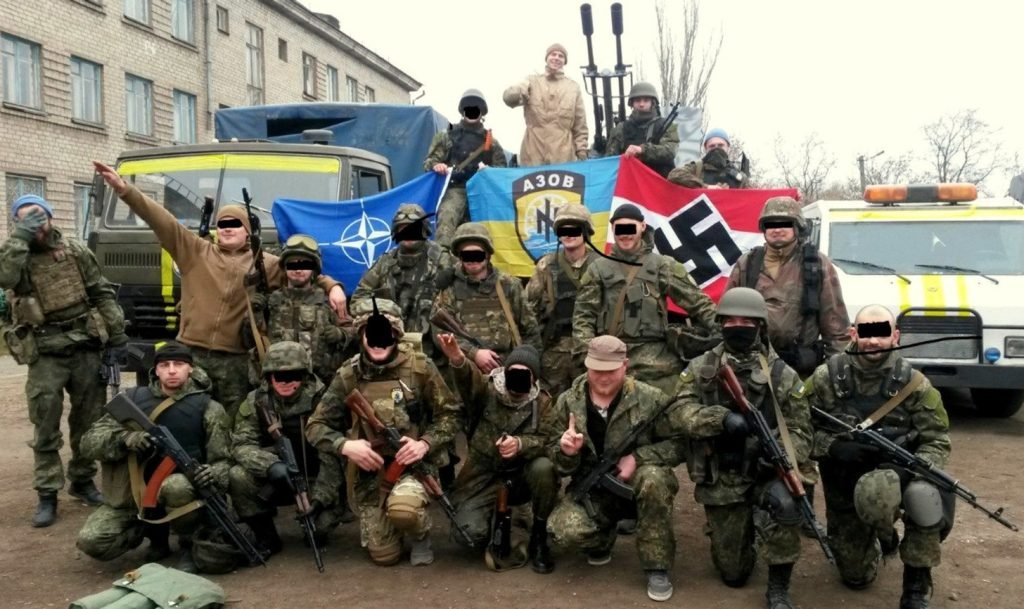
In the fall of 2014, the neo-Nazi Azov Battalion was formally incorporated into Ukraine’s National Guard, making post-Maidan Ukraine “the world’s only nation to have a neo-Nazi formation in its armed forces,” the Ukrainian-American journalist Lev Golinkin later observed.
Yatsenyuk, the Nuland-chosen technocrat, meanwhile presided over what NPR dubbed Ukraine’s “Spring Of Austerity” and what the prime minister himself described as a “kamikaze mission“, imposing the pension and heating subsidy cuts that the ousted Yanukovych had resisted.
While placating the “IMF Austerity Regime,” the coup government also set its sights on Ukraine’s ethnic Russian population, a major base of Yanukovych’s support. One of the post-coup parliament’s first votes was to rescind a law, long bitterly opposed by the far-right, granting regions the authority to declare a second official language.
The coup government’s anti-Russian sentiment culminated in a gruesome massacre in the city of Odessa. On May 2nd, a right-wing mob assaulted an anti-Maidan emplacement there, forcing the protesters into a nearby trade union building. Trapped inside, the anti-Maidan protesters were burned alive.
Those trying to escape the flames were brutally assaulted. The official state toll is 48 dead, but the actual number may be far higher. No credible investigation has ever been conducted. That might be related to the presence of Parubiy, who had traveled to Odessa to confront the anti-Maidan camp, with hundreds of Right Sector members in tow.
The Odessa massacre helped accelerate the then-growing insurgency in the Donbas region, the eastern Ukrainian region dominated by ethnic Russians. Unwilling to live under a US-installed coup government led by far-right nationalists, rebels in Donetsk and Luhansk took up arms in the spring of 2014 with Russia’s limited support.
The US-backed government responded with both economic warfare and a Nazi-infused “Anti-Terrorist Operation.” The US-backed Yatsenyuk, by then well-versed in Washington-friendly neoliberal austerity, decreed that all residents of rebel-held Donbas would lose their public sector payments and pensions.
Among those fighting the rebels, the New York Times quietly acknowledged in July 2015, were the “openly neo-Nazi” Azov battalion, as well as “an assortment of right-wing and Islamic militias” summoned from Chechnya. According to Ukraine’s interior ministry, Azov was among the first battalions to receive US military training for the war.
The war in Donbas has since left over 14,000 dead. According to UN figures, 81% of the civilian casualties since 2018 have occurred on the rebel-held, pro-Russian side.
These Russian-speaking Ukrainians, however, are what Noam Chomsky and Edward Herman described in “Manufacturing Consent” as “unworthy victims”: foreign civilians killed with US support, and thus unworthy of our sympathy or even attention.
No matter how deeply entrenched in the United States political establishment and media, no amount of whitewashing surrounding the 2014 coup and its aftermath can negate the reality that for millions of people in the Donbas, the war in Ukraine did not start with Putin’s invasion last month. This includes the use of illegal cluster munitions, allegedly by both Russia today and the Ukrainian military in 2014, to much different global reactions.
Rather than end the proxy war that it helped start in Ukraine, the US has only fueled it over the last eight years with billions in weapons, a drive to incorporate Ukraine into NATO, an expansion of US offensive weapons around Russia, and a rejection of diplomatic solutions, as we will turn to in the second part of this report.
Originally published at mate.substack.com
Part two of this report will be published later.
About the author
Aaron Maté is a journalist at The Grayzone, where he hosts “Pushback.” Contributor to Real Clear Investigations. Temporary co-host of “Useful Idiots.” In 2019, he won the Izzy Award for outstanding achievement in independent media for Russiagate coverage in The Nation.
Please support TFF’s work for peace through research and public education. We are all-volunteer, people-financed and do not accept money from governments or corporations. In other words, one of the very last free research think tanks in this world – and for a noble purpose: Peace by peaceful – intelligent – means. Thanks!
[paypal-donation]


