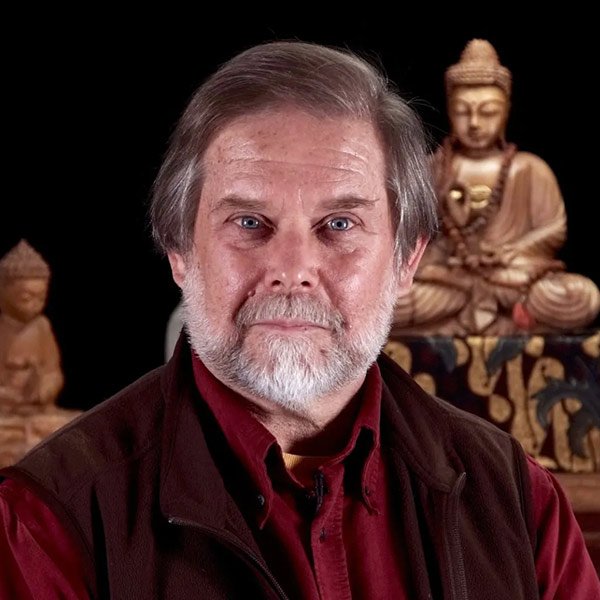
By David R. Loy
Buddhist Reflections on Occupy Wall Street

In a Buddhist blog about Occupy Wall Street, Michael Stone quotes the philosopher Slavoj Žižek, who spoke to the New York Occupiers at Zuccotti Park on October 9, 2011:
“They tell you we are dreamers. The true dreamers are those who think things can go on indefinitely the way they are. We are not dreamers. We are awakening from a dream which is turning into a nightmare. We are not destroying anything. We are only witnessing how the system is destroying itself. We all know the classic scenes from cartoons. The cat reaches a precipice. But it goes on walking. Ignoring the fact that there is nothing beneath. Only when it looks down and notices it, it falls down. This is what we are doing here. We are telling the guys there on Wall Street – Hey, look down!”
As Slavoj and Michael emphasize, we are beginning to awaken from that dream. That’s an interesting way to put it, because the Buddha also woke up from a dream: the Buddha means “the awakened one.” What dream did he wake up from? Is it related to the nightmare we are awakening from now?
From the beginning, Occupiers have been criticized for the vagueness of their demands: although clearly against the present system, it wasn’t clear what they were for. Since then more focus has developed: many protesters are calling for higher taxes on the wealthy, a “Robin Hood” (Tobin) tax on trades, and banking reform to separate commercial and investment banking.
These are worthy aims, yet it would be a mistake to think that such measures will by themselves resolve the basic problem. We should appreciate the general, unfocused dissatisfaction that so many people feel, because it reflects a general, unfocused realization that the roots of the crisis are very deep and require a more radical (literally, “going to the root”) transformation.
The nightmare: Politics and economics is one and they are wrong
Wall Street is the most concentrated and visible part of a much larger nightmare: the collective delusion that our present economic system – globalizing, consumerist, corporate capitalism – is not only the best possible system but the only viable one. As Margaret Thatcher famously put it, “There is no alternative.”
The events of the last few years have undermined that confidence. The events of the past few weeks are a response to the widespread realization that our economic system is rigged to benefit the wealthy (the “1%”) at the expense of the middle class (shrinking fast) and the poor (increasing fast).
And, of course, at the expense of many ecosystems, which will have enormous consequences for the lives of our grandchildren and their children. What we are waking up to is the fact that this unfair system is breaking down, and that it should break down, in order for better alternatives to develop.
It is not only the economy that needs to be transformed, because there is no longer any real separation between our economic and political systems. With the “Citizens United” Supreme Court decision last year – removing limits on corporate spending to influence elections – corporate power seems to have taken control of all the top levels of federal and state government, including the presidency. (Obama has received more campaign contributions from Wall Street than any other president since 1991, which helps explain his disappointing choice of economic advisors.)
Today the elite move back and forth easily – from CEO to cabinet position, and vice-versa – because both sides share the same entrenched worldview: the solution to all problems is unfettered economic growth. Of course, they are also the ones who benefit most from this blinkered vision, which means the challenge for the rest of us is that the people who control this economic/political system have the least motivation to make the fundamental changes necessary.
Although the Democrats have not become as loony as the Republicans, on this basic level there’s really not much difference between them. Dan Hamburg, a Democratic congressman from California, concluded from his years in the U.S. Congress that “the real government of our country is economic, dominated by large corporations that charter the state to do their bidding. Fostering a secure environment in which corporations and their investors can flourish is the paramount objective of both [political] parties.” We still have the best Congress money can buy, as Will Rogers noticed way back in the 1920s.
From a Buddhist perspective…
From a Buddhist perspective, the point is that this integrated system is incompatible with Buddhist teachings, because it encourages greed and delusion – the root causes of our dukkha “suffering.” At the heart of the present crisis is the economic, political, and social role of the largest (usually transnational) corporations, which have taken on a life of their own and pursue their own agenda.
Despite all the advertising and public relations propaganda we are exposed to, their best interests are quite different from what is best for the rest of us. We sometimes hear about “enlightened corporations” but that metaphor is deceptive – and the difference between such “enlightenment” and Buddhist enlightenment is instructive.
The burgeoning power of corporations became institutionalized in 1886, when the Supreme Court ruled that a private corporation is a “natural person” under the U.S. Constitution and thus entitled to all the protections of the Bill of Rights, including free speech. Ironically, this highlights the problem: as many Occupy Wall Street posters declare, corporations are not people, because they are social constructs.
Obviously, incorporation (from the Latin corpus, corporis “body”) does not mean gaining a physical body. Corporations are legal fictions created by government charter, which means they are inherently indifferent to the responsibilities that people experience. A corporation cannot laugh or cry. It cannot enjoy the world or suffer with it. It is unable to feel sorry for what it has done (it may occasionally apologize, but that is public relations).
Corporations cannot love
Most important, a corporation cannot love. Love is realizing our interconnectedness with others and living our concern for their well-being. Love is not an emotion but an engagement with others that includes responsibility for them, a responsibility that transcends our individual self-interest.
Corporations cannot experience such love or act according to it. Any CEOs who try to subordinate their company’s profitability to their love for the world will lose their position, for they are not fulfilling their primary – that is, financial — responsibility to its owners, the shareholders.
Buddhist enlightenment includes realizing that my sense of being a self separate from the world is a delusion that causes suffering on both sides. To realize that I am the world – that “I” am one of the many ways the world manifests – is the cognitive side of the love that an awakened person feels for the world and its creatures.
The realization (wisdom) and the love (compassion) are two sides of the same coin, which is why Buddhist teachers so often emphasize that genuine awakening is accompanied by spontaneous concern for all other sentient beings.
Conditioning greed
Corporations are “fuelled” by, and reinforce, a very different human trait. Our corporate-dominated economy requires greed in at least two ways: a desire for never-enough profit is the engine of the economic process, and in order to keep the economy growing consumers must be conditioned into always wanting more.
The problem with greed becomes much worse when institutionalized in the form of a legal construct that takes on privileges of its own quite independently of the personal values and motivations of the people employed by it.
Consider the stock market, for example. On the one side, investors want increasing returns in the form of dividends and higher stock prices. On the other side, this anonymous expectation translates into an impersonal but constant pressure for profitability and growth, preferably in the short run. Everything else, including the environment, employment, and the quality of life, becomes an “externality,” subordinated to this anonymous demand, a goal-that-can-never-be-satisfied.
We all participate in this process, as workers, employers, consumers, and investors, yet normally with little or no personal sense of moral responsibility for what happens, because such awareness is lost in the impersonality of the system.
There are caring companies, but it’s the system
One might argue, in reply, that some corporations (usually family-owned or small) take good care of their employees, are concerned about effects on the environment, and so forth. The same argument could be made for slavery: there were a few good slave owners who took care of their slaves, etc. This does not refute the fact that the institution of slavery is intolerable. It is just as intolerable today that our collective well-being, including the way the earth’s limited “resources” are shared, is determined by what is profitable for large corporations.
In short, we are waking up to the fact that although transnational corporations may be profitable economically, they are structured in a way that makes them defective socially. We cannot solve the problems they keep creating by addressing the conduct of this or that particular example (Morgan Stanley, Bank of America), because it is the institution itself that is the problem.
Given their enormous power over the political process, it won’t be easy to challenge their role, but they have an umbilical cord: corporate charters can be rewritten to require social and ecological responsibility. Groups such as the Network of Spiritual Progressives have been calling for an Environmental and Social Responsibility Amendment (ESRA) to the U.S. Constitution which would mandate that.
If our destiny is to remain in corporate hands, corporations must become accountable most of all not to anonymous investors but to the communities they function in. Perhaps Occupy Wall Street is the beginning of a movement which will accomplish that.
We’ve got to go further and face social Darwinism
If so, it won’t be enough. There’s something else at stake, even more basic: the worldview that encourages and rationalizes the kind of economic nightmare that we are beginning to awaken from. In Buddhist terms, the problem isn’t only greed, it’s also ignorance.
The theory most often used to justify capitalism is Adam Smith’s “invisible hand”: pursuing our own self-interest actually works to benefit society as a whole. I suspect, however, that CEOs are more often motivated by something less benign. It’s no coincidence that corporate influence grew at the same time as the popularity of social Darwinism, the ideology that misapplied Darwin’s theory of evolution to social and economic life: it’s a jungle out there, and only the strongest survive. If you don’t take advantage of others, they will take advantage of you. Darwinian evolution eliminated the need for a Creator and therefore the need to follow his commandments: now it’s every man for himself…
Social Darwinism created a feedback loop: the more people believed in it and acted according to it, the more society became a social Darwinist jungle. It’s a classic example of how we collectively co-create the world we live in. And this may be where Buddhism has the most to contribute, because Buddhism offers an alternative view of the world, based on a more sophisticated understanding of human nature that explains why we are unhappy and how to become happier. Recent psychological and economic studies confirm the destructive role of greed and the importance of healthy social relationships, which is consistent with Buddhist emphasis on generosity and interdependence.
Ignorance and faulty world views: Let’s wake up together!
In other words, the problem isn’t only our defective economic and political system, it’s also a faulty world view that encourages selfishness and competition rather than community and harmony. The modern West is split between a theism that’s become hard to believe in, and a dog-eat-dog ideology that makes life worse for all of us. Fortunately, now there are other options.
Buddhism also has something important to learn from Occupy Wall Street: that it’s not enough to focus on waking from our own individual dream. Today we are called upon to awaken together from what has become a collective nightmare. Is it time to bring our spiritual practice out into the streets?
If we continue abusing the earth this way, there is no doubt that our civilization will be destroyed. This turnaround takes enlightenment, awakening. The Buddha attained individual awakening. Now we need a collective enlightenment to stop this course of destruction.
Civilization is going to end if we continue to drown in the competition for power, fame, sex, and profit. (Thich Nhat Hahn)