
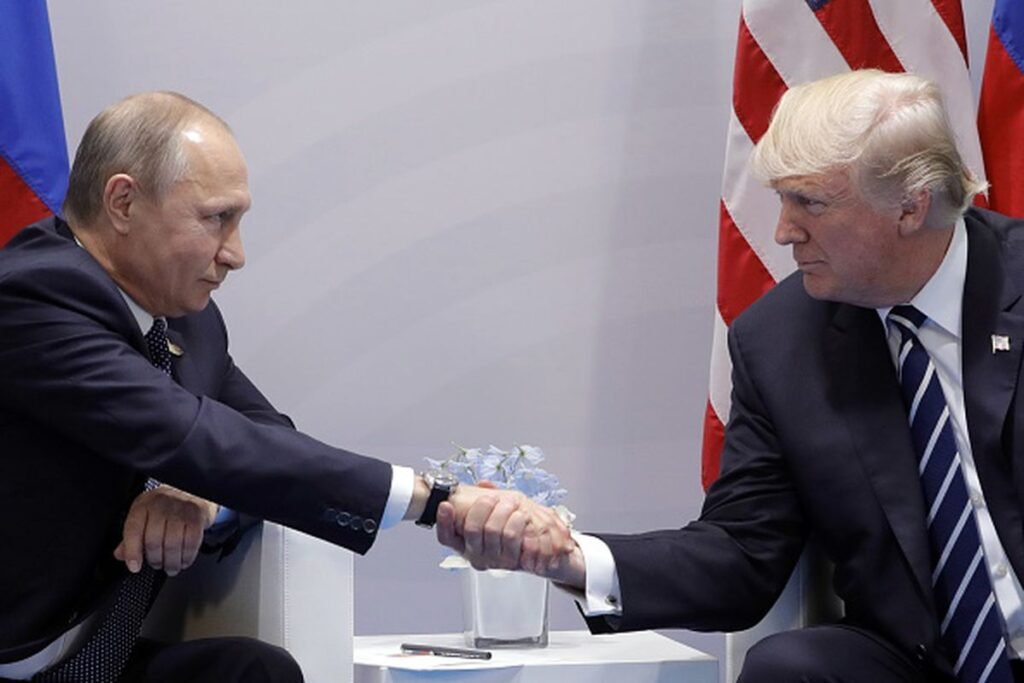
Trump-Putin Summit

(Russia President Vladimir Putin and US President Donald Trump shake hands during a bilateral meeting on the sidelines of the G20 summit in 2017. Photo: Mikhail Metzel/TASS via Getty Images)

By Gordon M. Hahn

5 July, 2018

The Trump-Putin summit was successfully delayed by the liberal/neocon, Washington/NATO deep state network. By the time, Trump fought his way free from the morass of the collapsing ‘Russiagate’ investigation, relations were so bad that Putin rejected Trump’s invitation to the White House and agreed to meet in neighboring Finland. This suggests the level of distrust Putin has towards Washington, his low expectations for a successful summit, and the high price he is likely to demand for concessions on his part.

With the summit at hand, it is important for the Trump administration to understand what are the key problems that have tightly wound the Russian-Western knot, for only by understanding the way the knot was tied can it be untied. This will be a long process that will take at least two US presidential terms to resolve. With half of one term already in the past and the knot only tied more tightly, it is imperative that significant progress on the most dangerous issues — Ukraine and Syria — be made and initial steps towards not a ‘grand bargain’ but rather a real reset be concluded with Moscow.

Originally published at gordonhahn.com

Change the Approach
The first thing that needs to change is the piecemeal approach to relations. Whether it is called ‘constructive engagement,’ limited engagement, or misleadingly a ‘reset,’ the approach of dealing with issues that are easiest to resolve or where we have common interests alone is insufficient and a non-starter as far as putting the relationship where it should be.

By definition, an approach that seeks to avoid areas where there are disagreements will not resolve a deeply troubled relationship that is putting international security and peace at risk. Only addressing the core differences complicating relations can a qualitatively new relationship be forged. Changing this approach requires abandoning 19th century geopolitical thinking, which dictates that the West seek to dominate the Eurasian ‘heartland’ (read: Russia) in order to dominate global politics.

More globally, the West has been and remains the ‘champion’ when it comes to interference in the politics of other states.

It also means abandoning the approach of designing policies from hubris rooted in the sense that Western democracy is morally superior to authoritarianism. Although the latter is true, it does not afford the West the right to interfere, not less destabilize other societies. However, any society has the right to influence with prudence others, and that can be done in less aggressive but ultimately more effective ways.

New Approach
Rather than dealing with secondary issues, those which are easiest to resolve, or those in which we have common interests, contacts must address the core problems in the inter-state US-Russian or larger Western-Russian relationship. Those issues are NATO expansion, EU expansion, U.S. missile defense, Ukraine, Syria, and interference in each other’s domestic politics. Rather, than expanding Western institutions in complete disregard of Russian interests, the West must work closely with Moscow.

The West must acknowledge its responsibility in the making of the original crisis which equals if not exceeds that of Moscow in its deepening in Crimea and Donbass. The crisis in Ukraine is a direct result of these two policies, which led NATO to declare Ukraine (and Georgia) will be NATO members at numerous NATO summits and in other fora, led the EU to push too hard and too early for an association agreement with the corrupt Viktor Yanukovych government, and which led the West, especially Washington, to lend opposition-promotion assistance to revolutionaries and endorse a clearly illegal oligarch-ultranationalist revolt in February 2014 despite an agreement that essentially ensured Yanukovych’s departure from the presidency in ten months.

In Syria, Putin’s Russia has won. Regime change is over. The U.S. in its hubris miscalculated in going a bridge too far. Ambition led to supply weapons either intentionally or accidentally — and in denial of the obvious — to Islamists and jihadists. This was a direct consequence of US President Barak Obama’s haste to carry forth his gravely misguided Muslim Brotherhood-based regime change strategy in the Islamic world. Syria’s longstanding ties to Moscow and the presence of North Caucasus-based mujahedin within the ranks first of the Al Qa`ida-affiliated ‘Jabhat al-Nusra’ jihadi group and then of the Islamic State or ISIS prompted Putin’s limited and strategically successful intervention.

More globally, the West has been and remains the ‘champion’ when it comes to interference in the politics of other states. For financial reasons alone, Russia cannot hold a candle to US efforts in this regard, no less those of the entire West. Rather than seeking to dominate or willfully ‘transforming’ Eurasia in the Western image, the West should more gently propose democratization and work on strengthening its own democratic order to serve as a model for non- and less democratic states to emulate. Those living in non- or less democratic states who want change have access to all the information they need on the Internet, except in the most authoritarian countries. Even in the latter, access is possible if more difficult. The native population and opposition leaders understand the intricacies of their nation’s culture far better than outsiders do and can therefore better fashion a peaceful, stable regime transformation. If this is not what they want, then they are unlikely to establish a democratic order when they seize power.

Change the Goal and Strategy
The core problem in Western-Russian relations has been Western, especially, NATO expansion. NATO expansion, carried forth on the back of EU expansion, effectively ‘militarized’ Western democracy-promotion and EU expansion, insulting Russian ‘honor’ and trust in the West in the wake of Cold War-ending Western promises that NATO would not expand beyond reunified Germany and turning Russia away from democracy. Washington and Brussels must discard, therefore, its basic goal of expanding the community of democracies in brinksmanship-like fashion–everywhere and immediately, regardless of those expansions’ effects on the Russian and Chinese geostrategic calculation. This means abandoning the strategy of achieving that goal: NATO and EU expansion. These two prongs of the main strategy, especially NATO expansion, have added greater cost of driving Russia into China’s increasingly powerful arms, as I predicted a quarter of a century ago.

New Goal and Strategy
Regarding security, the West should seek to integrate Europe and Eurasia first in the area of negotiating ongoing conflicts and preventing new conflicts by reinvigorating the Organization of Security and Cooperation in Europe (OSCE) as the main multilateral forum for Western-Eurasian relations. It should also become the locus of negotiations between NATO and the Collective Security Treaty Organization (CSTO) on building a new European security architecture (NESA).

During the life of the NESA negotiations, the West should institute an openly declared moratorium on NATO expansion. After such the NESA is in place negotiations might begin with the Shanghai Cooperation Organization (SCO) on a Eurasia-wide security architecture. Similarly, the European Union should learn from its misbegotten unilateral expansionism and ‘Eastern Partnership’ and seek to negotiate a gradual integration of the EU and the Eurasian Economic Union (EEU).
As in security integration, so too in economic integration, once an EU-EEU union or some other accommodation is reached, SCO and China perhaps can be brought into the mix in negotiating a free trade zone for Eurasia writ large, from Beijing to Belfast.

Thus, trade expansion would replace military-political expansion, and incentives should replace sanctions. Economic integration, development and growth will help grow democracy in non- and less democratic states more spontaneously and organically. In sum, it is better to have the Russians (and the Chinese) inside the tent pissing out, than outside the tent pissing in.

It is important to note, however, that I am talking about very long-term negotiations and integration processes, and the negotiations must not be approached with the idea that a major agreement or any agreements at all must be achieved at all costs to Western interests. Non-Western partners must also be willing to sacrifice some of their present interests for the sake of the benefits of stability and cooperation that will accrue in future.

Change the Tactics
In Ukraine, the U.S. must get more involved in the Minsk 2 negotiating process. Without a clear signal from Trump that Washington is not interested in expanding NATO to Ukraine or using the crisis to isolate Moscow through sanctions and the like and intends to lead the search for a solution, Moscow is unlikely to make any meaningful concessions. The Europeans are too divided and weak to concentrate Kiev’s mind on a peaceful settlement in Donbass and the reality that Crimea is lost forever. Moreover, as long as Washington remains at arm’s length from the process, Putin will suspect that any agreement can be easily scuttled by Kiev and/or Washington.

In Syria, de-confliction and stabilization in Syria, including the withdrawal of Iranian Revolutionary Guards (IRG) troops, is in the US interest, and these can benefit from greater US-Russian cooperation. Even Putin appears concerned about the threat to Israel posed by the IRG and Hezbollah. Putin undertook a limited intervention for a reason: he wants to limit the conflict and the need for any military role in the region if possible. Washington could be able to convince Moscow to abandon its support for the elements of the Iran presence in Syria and Lebanon that arrived in the context of the Syrian civil war.

Democracy-promotion has become too careless about the risk of destabilizing other societies, too centered on opposition-promotion, and too kinetically and broadly applied. Democracy-promotion should encourage only peaceful and cooperative forms of regime transformation, should be offered to both regime and opposition no matter how persistently a particular regime may refuse such advice, and more kinetic, potentially subversive assistance should be applied only to those states that intend to harm the most vital American and Western interests without previous, indeed recent provocations, which to the apparent surprise of some frequently occur.

The Summit: From Prescription to Prediction
Putting aside the above prescription for what should be the Trump administration’s ‘real reset’ and turning to what is more likely, we are likely to see any systematic unfolding of a grand strategy towards a grand bargain. The relationship is too antagonistic, distrustful, and complicated to achieve that without shutting down NATO expansion, and Trump appears to lack the courage to move in that direction. Instead we will see a summit of small steps towards potentially important but not game-changing agreements. There is very likely to be some agreement towards extending the START nuclear arms treaty by executive order as well as negotiating a replacement treaty to be signed at the end of the first or beginning of a second Trump term.

For the Ukrainian crisis, Trump might propose the creation of a US-Russian working group to assist the Minsk process. Should Trump be convinced that only US involvement can resolve the issue, perhaps the group could be incorporated into the Minsk process. He might also hint that in return for some Moscow concessions on Ukraine, such as backing a more expanded version of the proposed peacekeeping mission beyond the line of contact, he might be willing to put pressure on Kiev to finally fulfill its Minsk agreement obligation to engage a dialogue with the Donbass rebel regions’ representatives:

(1) on the modalities related to conducting elections in the Donbass, (2) on a Ukrainian law to be adopted according to Minsk-2 ‘On the temporary order of local government in certain areas of the Donetsk and the Lugansk regions,’ or (3) ‘with respect to the future operation of these areas on the basis of the Law,’ or, for that matter, (4) on any other subject related to the crisis. Washington pressure on Kiev to talk directly with the rebels may be possible now that four years too late some of the Washington institutions that supported the Maidan revolt and illegal overthrow of Yanukovych such as the Atlantic Council and Freedom House, are waking up to the neofascist threat on the edges of the Maidan regime and in society.

In Syria, the Trump administration has abandoned any attempt to salvage the mess or Obama’s Muslim Brotherhood strategy that made it. In addition, to discussions and perhaps new mechanism for de-confliction and joint efforts to ensure humanitarian assistance, Trump might try to address the Iranian issue in part by offering talks on a new nuclear treaty with Teheran co-sponsored with Moscow and in part by proposing some new negotiating mechanism co-sponsored with Moscow for the Israeli-Palestinian conflict towards creating a Palestinian state using the leverage over Israel garnered by way of the transfer of the US embassy to Jerusalem. Trump might offer assistance in stabilizing Syria or at least in not destabilizing Syria again along with sanctions relief in return for concessions from Putin on Ukraine. Working groups on mutual non-interference in each other’s domestic politics and cyber security might also emerge.

None of these measures can by themselves even if they achieved the final results can resolve the ultimate security dilemma that sits at the heart of the tattered US-Russian relationship, but they can begin to stop the bleeding, de-escalate the several crises at hand, and create a footing for a later turn towards better relations. But only an end to NATO expansion can untie knot of the ‘new cold war’ that has been creeping towards Russian-American military confrontation in Europe and forging the Sino-Russian Eurasian alliance.

Originally published at gordonhahn.com

Share

Leave a Reply

Your email address will not be published. Required fields are marked *

Related Posts

PART 2 — Diplomacy, Law and Nonviolent Power By Jan ObergTFF co-founder and director January 26, 2026 This is the second of four TFF-created idea portfolios designed to curb the global reach of the United States and, in both the short and long term, help catalyse a worldwide nonviolent resistance to what many observers describe as the Trump administration’s uniquely confrontational, destructive and world-threatening policies. These portfolios outline what governments and citizens across the world can do through dynamic diplomacy, creative initiatives, and strictly nonviolent means. They are typical TFF works in that we do not only tell what the problem is and how bad it will go – as 90+% of all commentators, experts and scholars do – we tell what we think can be done, inviting you to think of what you think you can do. It seems painfully clear to me that the current political dynamics in Washington increasingly resemble the most dangerous...
PART 1 — Media, Culture and Information Sovereignty By Jan ObergTFF co-founder and director January 20, 2026 This is the first of four TFF-created idea portfolios designed to curb the global reach of the United States and, in both the short and long term, help catalyse a worldwide nonviolent resistance to what many observers describe as the Trump administration’s uniquely confrontational, destructive and world-threatening policies. These portfolios outline what governments and citizens across the world can do through dynamic diplomacy, creative initiatives, and strictly nonviolent means. They are typical TFF works in that we do not only tell what the problem is and how bad it will go – as 90+% of all commentators, experts and scholars do – we tell what we think can be done, inviting you to think of what you think you can do. It seems painfully clear to me that the current political dynamics in Washington increasingly resemble the most...
Introduction to TFF’s forthcoming four Idea Portfolios of Diplomatic and Nonviolent Resistance By TFF’s Board & FoundersPascal Lottaz, Biljana Vankovska, Annette Schiffmann, Christina Spannar & Jan Oberg January 19, 2026 “America, you are too arrogant.” — Martin Luther King Jr. Over the course of Trump’s first term and now a year into his second, the world has witnessed a consistent pattern of actions that challenge the basic long-standing norms of international cooperation, weaken multilateral institutions, and ignore the global norms and legal frameworks established by the UN Charter. During these years, we have witnessed military operations in Iran, Syria and Ukraine without UN authorisation; the killing of Iranian General Qassem Soleimani; repeated strikes across the Middle East; and the launch of tariff wars against allies and competitors alike. We have seen a renewed emphasis on nuclearism and zero interest in arms control and disarmament negotiations. Pentagon is now The Department...

Recent Articles

In contrast to most, we’ll bring alternatives, solutions, hope and strategies for a better future. Times are dangerous, yes, but that only intensifies the need for constructive thinking and action! Jan Oberg, TFF director April 13, 2026 The new TFF Peace Pulse uses video messages in a new way: Max 3-5-minute-long comments, ideas or perhaps mini-lectures, all about peace – positive peace. We launch them today on April 13, 2026 with a carefully crafted visual aesthetic fitting the content. We hope to publish them regularly from now on. We launch Peace Pulse (PP) – for a number of reasons. The world is in chaos, and there are countless reasons to feel concerned, frustrated, even angry. The atmosphere is saturated with doom and gloom, with negative energy and rear‑mirror thinking, while vision, imagination, alternatives, strategies and genuine future‑mindedness remain in short supply. And without them, we simply can’t save the world. Looking at problems from a hundred angles will...
PART II — Publishing Peace in a System That Prioritises Militarism Jan Oberg, TFF director April 10, 2026 How TFF Maintains a Daily Voice in a Digital World Built for Noise This article is part of the series “TFF at 40″ and it invites you to learn about Four Decades of Publishing Peace. It takes a look at how a small, people‑financed peace foundation has communicated across four generations of technology — from wax stencils and fax machines to mass email and Substack — and why TFF continues to publish every single day in a system that rewards noise, conflict, and militarism. ◆ What it means to publish peace every single day in a digital system built for 24/7 news and other noise, confrontation, and militarism. How TFF’s independence, continuity, and global readership defy algorithms, donor cycles, and Western media censorhip — and why the Majority World keeps listening. When the...
Jan Oberg, TFF director April 10, 2026 How TFF Sent Peace Into the World Before the Internet Existed This article is part of the series “TFF at 40″ and it invites you to learn about Four Decades of Publishing Peace. It takes a look at how a small, people‑financed peace foundation has communicated across four generations of technology — from wax stencils and fax machines to mass email and Substack — and why TFF continues to publish every single day in a system that rewards noise, conflict, and militarism. ◆ Follow me on a journey through forty years of peace publishing — from wax stencils and hand‑cranked duplicators to the fax machine that never slept, and finally to the global reach of online publishing. This is the story of how TFF carried ideas across borders long before the internet made it easy, and why we chose independence over academic profit-making and...

TFF on Substack

Discover more from TFF Transnational Foundation & Jan Oberg.

Most Popular

In contrast to most, we’ll bring alternatives, solutions, hope and strategies for a better future. Times are dangerous, yes, but that only intensifies the need for constructive thinking and action! Jan Oberg, TFF director April 13, 2026 The new TFF Peace Pulse uses video messages in a new way: Max 3-5-minute-long comments, ideas or perhaps mini-lectures, all about peace – positive peace. We launch them today on April 13, 2026 with a carefully crafted visual aesthetic fitting the content. We hope to publish them regularly from now on. We launch Peace Pulse (PP) – for a number of reasons. The world is in chaos, and there are countless reasons to feel concerned, frustrated, even angry. The atmosphere is saturated with doom and gloom, with negative energy and rear‑mirror thinking, while vision, imagination, alternatives, strategies and genuine future‑mindedness remain in short supply. And without them, we simply can’t save the world. Looking at problems from a hundred angles will...
PART II — Publishing Peace in a System That Prioritises Militarism Jan Oberg, TFF director April 10, 2026 How TFF Maintains a Daily Voice in a Digital World Built for Noise This article is part of the series “TFF at 40″ and it invites you to learn about Four Decades of Publishing Peace. It takes a look at how a small, people‑financed peace foundation has communicated across four generations of technology — from wax stencils and fax machines to mass email and Substack — and why TFF continues to publish every single day in a system that rewards noise, conflict, and militarism. ◆ What it means to publish peace every single day in a digital system built for 24/7 news and other noise, confrontation, and militarism. How TFF’s independence, continuity, and global readership defy algorithms, donor cycles, and Western media censorhip — and why the Majority World keeps listening. When the...
Jan Oberg, TFF director April 10, 2026 How TFF Sent Peace Into the World Before the Internet Existed This article is part of the series “TFF at 40″ and it invites you to learn about Four Decades of Publishing Peace. It takes a look at how a small, people‑financed peace foundation has communicated across four generations of technology — from wax stencils and fax machines to mass email and Substack — and why TFF continues to publish every single day in a system that rewards noise, conflict, and militarism. ◆ Follow me on a journey through forty years of peace publishing — from wax stencils and hand‑cranked duplicators to the fax machine that never slept, and finally to the global reach of online publishing. This is the story of how TFF carried ideas across borders long before the internet made it easy, and why we chose independence over academic profit-making and...
Read More
Screenshot-2026-04-13-154551
In contrast to most, we’ll bring alternatives, solutions, hope and strategies for a better future. Times are dangerous, yes, but that only intensifies the need for constructive thinking and action! Jan Oberg, TFF director April 13, 2026 The new TFF Peace Pulse uses video messages in a new way: Max 3-5-minute-long comments, ideas or perhaps mini-lectures, all about peace – positive peace. We launch them today on April 13, 2026 with a carefully crafted visual aesthetic fitting the content. We hope to publish them regularly from now on. We launch Peace Pulse (PP) – for a number of reasons. The world is in chaos, and there are countless reasons to feel concerned, frustrated, even angry. The atmosphere is saturated with doom and gloom, with negative energy and rear‑mirror thinking, while vision, imagination, alternatives, strategies and genuine future‑mindedness remain in short supply. And without them, we simply can’t save the world. Looking at problems from a hundred angles will...
IMG_5165 (1)
PART II — Publishing Peace in a System That Prioritises Militarism Jan Oberg, TFF director April 10, 2026 How TFF Maintains a Daily Voice in a Digital World Built for Noise This article is part of the series “TFF at 40″ and it invites you to learn about Four Decades of Publishing Peace. It takes a look at how a small, people‑financed peace foundation has communicated across four generations of technology — from wax stencils and fax machines to mass email and Substack — and why TFF continues to publish every single day in a system that rewards noise, conflict, and militarism. ◆ What it means to publish peace every single day in a digital system built for 24/7 news and other noise, confrontation, and militarism. How TFF’s independence, continuity, and global readership defy algorithms, donor cycles, and Western media censorhip — and why the Majority World keeps listening. When the...
IMG_5165 (1)
Jan Oberg, TFF director April 10, 2026 How TFF Sent Peace Into the World Before the Internet Existed This article is part of the series “TFF at 40″ and it invites you to learn about Four Decades of Publishing Peace. It takes a look at how a small, people‑financed peace foundation has communicated across four generations of technology — from wax stencils and fax machines to mass email and Substack — and why TFF continues to publish every single day in a system that rewards noise, conflict, and militarism. ◆ Follow me on a journey through forty years of peace publishing — from wax stencils and hand‑cranked duplicators to the fax machine that never slept, and finally to the global reach of online publishing. This is the story of how TFF carried ideas across borders long before the internet made it easy, and why we chose independence over academic profit-making and...
Imagen-thumbnail-The-Transnational-1
A donors’ conference, co-sponsered by the Burundian government, the Belgian government and UNDP will be held in Brussels January 12-13, 2004. This PressInfo offers a perspective on its urgency. See also TFF’s new Burundi Forum. Imagine for a moment that politics is about goodness and generosity. Where could a few million dollars of government aid and a few civil society organisations – guaranteed – win the hearts of extremely poor millions who want peace and already work hard to achieve it after 10 years of war and genocide? The answer is Burundi, the heart-shaped country in the heart of Africa. Burundi makes a good story from Africa. But what does the world know about Burundi, its problems and struggles? Burundi’s tough reality Here are the basic facts. Burundi’s population is about 7 million and it is number 171 out of the 175 countries on the UNDP’s human development index. Their life...
Jan Oberg February 19, 2026 What a thrill to be interviewed by former British diplomat Ian Proud! Don’t waste a minute: acquaint yourself with him here on his homepage, which he elegantly calls “Proud Diplomat.” Notice also his book, A Misfit In Moscow. Ian is, of course, also on Substack, where he calls himself The Peace Monger, and recently he set up his own PeaceMonger Channel on YouTube. For once, I was not interviewed as if I were a military geopolitical expert, where I normally have to twist the whole thing in the direction of peace. No, we both had a focus on peace – why it has been disappeared by research, politics and the media, but also what can be done to shape a more peaceful future for us all. One idea we came up with was that of connecting people through citizens diplomacy – in an era where more or less authoritarian leaders meet frequently and confirm each other as members...
Arctic_North_Pole_Map
This is not another geopolitical commentary on the Arctic. It is a visionary peace proposal that can save the region from militarised rivalry and ecological ruin. A blueprint for shared security, sustainable development, and human dignity — benefitting Greenland, the Arctic, and the rest of us. Jan Oberg TFF director Lund, Sweden, February 17, 2026 I. Four Principles for a New Arctic Vision The Arctic is often framed as a cold arena of rivalry — a place where great powers test each other’s resolve. But this worldview is outdated, unimaginative, and ultimately self‑defeating. The Arctic is not a vacuum waiting to be militarised; it is a living region, a climate stabiliser, and a cultural homeland whose future will shape the future of humanity. If we begin from that understanding, a far more rational Arctic order becomes possible — one that is peaceful, cooperative, and centred on the people who actually live there. This vision rests...

