
The EU bows to ‘systemic rival’ China

Slowly but surely, the EU is shifting its priorities to the East

By Pepe Escobar

April 18, 2019

Let’s start with the essential background for the meeting in Paris on Tuesday between Chinese President Xi Jinping and three EU heavyweights – French President Emmanuel Macron, German Chancellor Angela Merkel and President of the European Commission (EC) Jean-Claude Juncker.

As imperfect as these figures may be, economic growth for the past 10 years after the 2008 financial crisis – which was a made in the West phenomenon – do tell an enlightening story.

China’s growth: 139%. India’s growth: 96%. The US’ growth: 34%. EU growth: negative2%.

Originally posted in Asia Times on March 27, 2019 here

French mainstream media, controlled by a rarified group of oligarchs, spun a risible narrative that Macron “imposed” this four-way meeting on Xi to press on him the new EC strategy aiming to “clarify” Chinese ambiguity in relation to the New Silk Roads, or Belt and Road Initiative (BRI).

As I previously reported, the EC now brands China a “systemic rival,” and seems to have realized that Beijing is an “economic competitor in search of technological leadership.” And that may translate as a threat to European values and norms.

Xi had just come from Rome – where the populist, eurosceptic Lega, Five Stars coalition government became the first G7 nation to sign a partnership with the BRI, igniting massive sparks of Atlanticist fear.

So in the end, what did we get from Chancellor Angela Merkel as the EU faced a process French elites describe as Sino-globalization?

We had realpolitik. Merkel stressed the BRI was an “important” project: “We, as Europeans, want to play an active part and that must lead to certain reciprocity and we are still wrangling over that a bit.” She added: “We are seeing the project as a good visualization of interaction, interrelation and interdependence.”

Merkel was essentially relaying the position of German business elites – as a trade powerhouse, the future of Germany lies in turbo-charging business with Asia, especially China.

So, instead of demonizing Rome, in practice Berlin will eventually embark on the same path. After all, Duisburg, in the Ruhr valley, is already the de facto top BRI terminal in northern Europe.

Xi and his EU partners did not fail to emphasize multilateralism. There could not be a more glaring contrast to the Trump administration’s narrative that China is a threat and the BRI is all about Chinese “vanity.” Juncker even tried to defuse the “systemic” tension: “We understand that China does not like the expression ‘rivals,’ but it is a compliment describing our shared ambitions.”

Add to it that Xi also felt the need to remind the EU leadership of the obvious. China will continue to “open up,” as it managed in only 40 years to accomplish what Europe did over the course of the entire industrial revolution.

New Silk Air, anyone?

On the – embattled – Macron front, more than New Silk Roads a de facto New Silk Air seems to be in effect.

No one – apart from Boeing – argues about a 30 billion Euro-plus Chinese order to buy 300 Airbuses. And that’s only the beginning. The fact that Beijing will use Airbus technology to enhance its aviation prowess under the framework of Made in China 2025 is another matter entirely.

So Paris may not have turned, like Rome, into an official partner to the New Silk Roads – at least not yet. But the promises are quite telling – on three fronts.

1) The emphasis on multilateralism – “strong and efficient.” That’s not exactly Trumpian rhetoric.

2) Common action with Beijing on climate change and biodiversity.

3) An economic-trade partnership that respects mutual interests. That is, in fact, New Silk Roads-BRI official policy since the beginning, in 2013.

So when we compare the different strategies by Rome and Paris, Xi has, in fact, come out with a win-win.
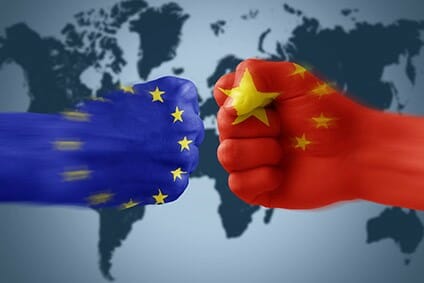
Merkel, predictably, was careful to hedge to the hilt: “The triangle between EU, China and US is very important. Without the US, we will not be able to have multilateralism.”

At the same time, she stressed, the US-China trade war was “hitting our German economy.”

As for Team Macron, with the leader obsessed with posing as the savior of the EU ahead of the European Parliament elections in May, they could not help but go after the administration in Rome.

According to a Macron acolyte: “There is this bad European habit to have 28 different policies, with countries competing against each other to attract investment. We need to speak with a common voice if we want to exist. We have the same approach on the 5G issue: avoiding 28 different decisions.”

The 5G Monaco Grand Prix

Which brings us to the case of Monaco, not exactly a shabby prize – and duly visited by Xi, who was received, literally, as royalty.

The principality is absolutely avid to gobble up the fast-growing Chinese luxury tourism market. And that explains why Monaco has already signed a deal with Huawei to be the first country to be entirely covered by 5G before the end of 2019.

Paris, by the way, has not ruled out using Huawei equipment. And as a cherry on the cake, guess which city Huawei chose to globally unveil its spectacular new P30 series of smartphones? Paris.

Make no mistake, for Beijing, in terms of trade and economic relations, Berlin is way more relevant than Paris. But these big three – Berlin, Paris and Rome – all have major roles to play.

The New Silk Roads being re-connected to Italy after half a millennium will accelerate Euro-Asia integration, and even, in the long run, more influence for both the Eurasia Economic Union (EAEU) and the Shanghai Cooperation Organization (SCO).

EU businesses, if not political Eurocrats, are starting to realize that Europe cannot afford to become a battlefield in Cold War 2.0 between the US and Russia, cannot afford to become a hostage of Washington tearing up international law – see, for instance, the destruction of the Iran nuclear deal and recognizing the occupied Golan Heights as part of Israel – and cannot afford to become a victim of Washington’s trade whims.

It’s no wonder that slowly but surely, the EU is shifting its priorities to the East – including to its “systemic rival.”

Pepe Escobar is a Brazilian journalist who has written for Asia Times for many years, covering events throughout Asia and the Middle East. He has also been an analyst for RT and Sputnik News, and previously worked for Al Jazeera.

Share

Leave a Reply

Your email address will not be published. Required fields are marked *

Related Posts

This is the third appeal from TFF. The first and the second here. On August 22, 2025, the UN officially declared famine in Gaza. The world’s top authority on food security called for help and said starvation will spread further within the Strip unless fighting stops and much more aid is allowed in. More than half a million people in the Gaza Strip are facing catastrophic hunger conditions, while more than a million more are in a food emergency phase, the report states. This man-made catastrophic famine could have been prevented by a steady flow of humanitarian aid into the enclave, relief chief Tom Fletcher pointed out. “Yet food stacks up at borders because of systematic obstruction by Israel,” Mr. Fletcher said. “It is a famine within a few 100 meters of food in a fertile land.” The UN’s top aid official underscored that the famine in Gaza is “caused by cruelty, justified...
TFF Associate and former Board member On 28 August 2025, France, Germany, and the United Kingdom (the EU Troika) decided to trigger the so-called “snapback mechanism” and reimpose stringent sanctions on Iran after 30 days for its alleged violation of the terms of the Iran nuclear deal, known as the Joint Comprehensive Plan of Action (JCPOA), if Iran did not give in to their demands within 30 days. In the lawless world in which we are living at the moment, discussing the principles of international law is futile and irrelevant. We have reverted to the age of imperial dictatorship and big power dominance. This state of affairs is dangerous for the whole world, especially the Global South, which is at the mercy of the dictates of the superpowers. However, a return to the rivalry between powerful empires outside the scope of international law, which led to the two world wars,...
Professor Zhang Weiwei is a highly respected Chinese intellectual and professor at Fudan University in Shanghai. He is the director of its China Institute and also runs a series of conversations with many different people around the world. Here is what came out of their meetings there and in Skopje, Macedonia in October 2024: & As you can see, also at the end of the second one, we both enjoy win-win exchanges like these about world order issues. Zhang Weiwei is known for using videos and social media to reach a large audience in China and worldwide. We suggest you see many more of Zhang Weiwei’s conversations – like recently with Professor Jeffrey Sachs – on the Thinkers’ Forum on YouTube. PSTFF posts hundreds of videos, its own and those of others, in our Video Collections on TFF Substack – including those that appear on YouTube. However, TFF has been cancelled by Google-owned...

Recent Articles

Jan Oberg May 15, 2026 Go to this Fox News page and scroll the whole way down: President Donald Trump tells the world that his meeting with President Xi Jinping yielded a lot of very concrete political and economic results – of course, only where the Chinese side, according to him, agreed with him. He does not mention the Taiwan issue, but Secretary of State, Marco Rubio, says that it did not feature prominently in their talks and that the US policy on Taiwan has not changed. Then go to China Daily – or Global Times – and you will see that for the Chinese it is framework, principles, structure of cooperation etc. that matters – all embedded in the overall idea of “constructive bilateral relationship of strategic stability.” Nowhere is any concrete agreement or deal – all that Trump refers to – mentioned. At the general level, this gives you insights into the very different social...
Lena Petrova of “World Affairs In Context” with more than half a million subscribers on YouTube wanted to explore what a peace researcher like me has to say about, among other things, the First and the Second Cold War and why eethics has disappeared from politics. I am particularly happy about this conversation that also yielded an amazing number of very appreciative comments on YouTube. No doubt, people are longing for alternatives, including peace perspectives.
The MIMAC – Military-Industrial-Media-Academic Complex – drives the world’s rampant militarism and wars without end. Here is a short reflection of how it works against all interests of humanity. #5 deals with why there is no real enemy or threat images/analysis. It’s all ex-post constructions. And, btw, theTFF Peace Pulse is now on Rumble.

TFF on Substack

Discover more from TFF Transnational Foundation & Jan Oberg.

Most Popular

Jan Oberg May 15, 2026 Go to this Fox News page and scroll the whole way down: President Donald Trump tells the world that his meeting with President Xi Jinping yielded a lot of very concrete political and economic results – of course, only where the Chinese side, according to him, agreed with him. He does not mention the Taiwan issue, but Secretary of State, Marco Rubio, says that it did not feature prominently in their talks and that the US policy on Taiwan has not changed. Then go to China Daily – or Global Times – and you will see that for the Chinese it is framework, principles, structure of cooperation etc. that matters – all embedded in the overall idea of “constructive bilateral relationship of strategic stability.” Nowhere is any concrete agreement or deal – all that Trump refers to – mentioned. At the general level, this gives you insights into the very different social...
Lena Petrova of “World Affairs In Context” with more than half a million subscribers on YouTube wanted to explore what a peace researcher like me has to say about, among other things, the First and the Second Cold War and why eethics has disappeared from politics. I am particularly happy about this conversation that also yielded an amazing number of very appreciative comments on YouTube. No doubt, people are longing for alternatives, including peace perspectives.
The MIMAC – Military-Industrial-Media-Academic Complex – drives the world’s rampant militarism and wars without end. Here is a short reflection of how it works against all interests of humanity. #5 deals with why there is no real enemy or threat images/analysis. It’s all ex-post constructions. And, btw, theTFF Peace Pulse is now on Rumble.
Read More
Screenshot-2026-05-15-103534
Jan Oberg May 15, 2026 Go to this Fox News page and scroll the whole way down: President Donald Trump tells the world that his meeting with President Xi Jinping yielded a lot of very concrete political and economic results – of course, only where the Chinese side, according to him, agreed with him. He does not mention the Taiwan issue, but Secretary of State, Marco Rubio, says that it did not feature prominently in their talks and that the US policy on Taiwan has not changed. Then go to China Daily – or Global Times – and you will see that for the Chinese it is framework, principles, structure of cooperation etc. that matters – all embedded in the overall idea of “constructive bilateral relationship of strategic stability.” Nowhere is any concrete agreement or deal – all that Trump refers to – mentioned. At the general level, this gives you insights into the very different social...
Screenshot-2026-05-12-104023
Lena Petrova of “World Affairs In Context” with more than half a million subscribers on YouTube wanted to explore what a peace researcher like me has to say about, among other things, the First and the Second Cold War and why eethics has disappeared from politics. I am particularly happy about this conversation that also yielded an amazing number of very appreciative comments on YouTube. No doubt, people are longing for alternatives, including peace perspectives.
Screenshot-2026-04-13-154551 (2)
The MIMAC – Military-Industrial-Media-Academic Complex – drives the world’s rampant militarism and wars without end. Here is a short reflection of how it works against all interests of humanity. #5 deals with why there is no real enemy or threat images/analysis. It’s all ex-post constructions. And, btw, theTFF Peace Pulse is now on Rumble.
Screenshot-2026-04-13-154551 (1)
Jan Oberg, TFF director April 28, 2026 In this third TFF Peace Pulse, I make the important distinction between the violence and the conflict that violence is a symptom of. If you want peace, focus on the underlying conflict because that is the key to resolution, peacemaking, and a better future for the parties. The West is obsessed with violence, just look around you – and 90+ per cent of the public debate is about military issues and other violence – totally wasted for peace. These Peace Pulses will only be published here a few times. You will also not find them on YouTube and Vimeo because both platforms have blocked TFF and me; you know, peace is dangerous these days. Most TFF’s videos since 2007 are now on Rumble.
Screenshot-2026-04-13-154551
In contrast to most, we’ll bring alternatives, solutions, hope and strategies for a better future. Times are dangerous, yes, but that only intensifies the need for constructive thinking and action! Jan Oberg, TFF director April 13, 2026 The new TFF Peace Pulse uses video messages in a new way: Max 3-5-minute-long comments, ideas or perhaps mini-lectures, all about peace – positive peace. We launch them today on April 13, 2026 with a carefully crafted visual aesthetic fitting the content. We hope to publish them regularly from now on. We launch Peace Pulse (PP) – for a number of reasons. The world is in chaos, and there are countless reasons to feel concerned, frustrated, even angry. The atmosphere is saturated with doom and gloom, with negative energy and rear‑mirror thinking, while vision, imagination, alternatives, strategies and genuine future‑mindedness remain in short supply. And without them, we simply can’t save the world. Looking at problems from a hundred angles will...
IMG_5165 (1)
PART II — Publishing Peace in a System That Prioritises Militarism Jan Oberg, TFF director April 10, 2026 How TFF Maintains a Daily Voice in a Digital World Built for Noise This article is part of the series “TFF at 40″ and it invites you to learn about Four Decades of Publishing Peace. It takes a look at how a small, people‑financed peace foundation has communicated across four generations of technology — from wax stencils and fax machines to mass email and Substack — and why TFF continues to publish every single day in a system that rewards noise, conflict, and militarism. ◆ What it means to publish peace every single day in a digital system built for 24/7 news and other noise, confrontation, and militarism. How TFF’s independence, continuity, and global readership defy algorithms, donor cycles, and Western media censorhip — and why the Majority World keeps listening. When the...

