Peace will not result from any “peace” plan circulated to date. Neither will it emerge from warfare – as the elites of NATO, EU, Russia, and Ukraine seem to finally recognise after avoidable, unspeakable losses of people, trust and physical, socio-economic destruction. And horse-trading based on military ‘security’ guarantees reveals only peace and conflict illiteracy.
TFF is critical of the widespread and severe misuse of the word peace – as if it did not require any knowledge. But we do not engage in geopolitical-military commentarism or dismissive criticism of present-day Realpolitik and its militarist mindset.
Indeed, we do not believe that mainstream political and media elites are aware that they know woefully little about peace and peace-making or see it as a professional field. Thus, we do not expect they would acquaint themselves with a portfolio like this.
TFF concentrates on constructive, visionary thinking grounded in the science and art of peace and in our 40 years of theoretical and on-the-ground experience. And we do believe this can be useful to citizens, civil society, democracy, and the pursuit of true peace.
By the TFF Founders & Board
Jan Oberg, Annette Schiffmann, Christina Spännar and Biljana Vankovska
November 23, 2025
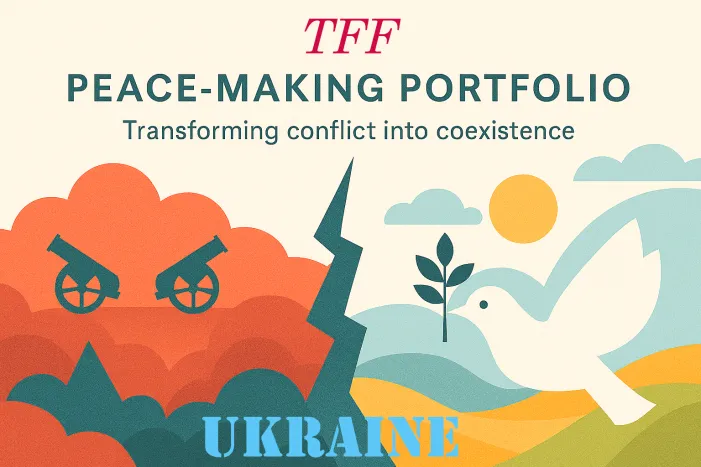
The Transnational Foundation for Peace & Future Research (TFF) today presents its Peace-Making Portfolio for Ukraine — a dynamic collection of proposals designed to inspire new approaches to conflict resolution and cooperation. Unlike conventional “peace plans” – both words are misplaced – this Portfolio is not a checklist of negotiations but a living set of visions and ideas that reframe the path from war to shared prosperity.
At the heart of the Portfolio are two cornerstone strategies:
- UNITE (United Nations Initiative for Trust-building & Engagement), a global effort to rebuild confidence and dialogue across divides.
- DREAM (Donbas Regional Economic Acceleration & Mediation), a forward-looking strategy to transform the Donbas region into a hub of reconciliation and prosperity.
Together, UNITE and DREAM embody the spirit of transformation: moving beyond transactional horsedealing toward genuine cooperation, creating conditions for a Ukraine that Russia and others can engage with in future win-win coexistence.
This Portfolio is not a plan – it is a call to rethink peacemaking itself, offering pathways that can inspire governments, institutions, and citizens to envision and discuss peace as a dynamic process of renewal. Thus, the word “Portfolio.”
Thinking Outside the Box: Peace as Realistic Strategy
In today’s geopolitico-militarist climate, peace is often dismissed as naïve – while war is treated as realistic and as statesmanship. But history tells a different story. The United Nations has successfully deployed peacekeeping missions in deeply divided regions, helping to end violence, rebuild trust, and lay the foundations for recovery. From Namibia to Cambodia, Mozambique to East Timor, and notably Croatia’s Krajina and Slavonia, UN missions have stabilised post-conflict zones and enabled transitions to peace.
In Croatia during the 1990s, the UN deployed peacekeepers to monitor ceasefires, disarm combatants, protect civilians, and facilitate reintegration. The UNTAES mission in Eastern Slavonia stands out as a model of peaceful conflict management under UN administration. These examples and experiences – hardly ever talked about – show that peacekeeping is not idealism; it is realism with imagination.
What’s missing today is the political will to think beyond militarism and embrace the UN Charter’s original vision. Peace has been cancelled in research, politics and media. What is also missing is creativity and vision – without which peace cannot come about.
Below, we present some ideas for international debate. But first, a little about why what has been discussed so far about peace in Ukraine has nothing to do with true peace. See also TFF’s earlier article about this here.
No true peace can be mediated by someone who is a party to a conflict. The US is a main party to the Russia-NATO expansion conflict and the violence in Ukraine. It instigated the 2014 regime change and what followed up to Russia’s invasion. In contrast, a mediator is a neutral actor who has no interest in a particular outcome but serves only to help the parties reach an arrangement they can live with in the future.
No peaceful future can be devised by taking into account only the present and history. Peace is made through dialogue with all sides and with a main focus on: What could you, more or less happily, accept to live with in the future that is more attractive to you than continuing the present situation, including warfare?
No true peace can be imposed by a few leaders top-down – particularly if they have no clue about conflict analysis and peacemaking as a science and an art – and behave like surgeons who have never opened a medical book. Civil society – the peoples of the conflict parties – must be involved in solving problems, stating their wishes for the future and in implementing the processes that lead to a new and better future.
No true peace will come about that focuses on more or less offensive/threatening weapons or security guarantees. By addressing and solving the underlying conflicts, true peace reduces the need for military security guarantees to a minimum – because, instead, true peace builds trust rather than the mistrust on which military threats are by definition based.
Every “peace” plan that has been discussed, including Trump’s 28-Point Plan, lacks vision, focusing only on what is and must be stopped (negative) rather than what could be (positive peace). They have no message for the people, present a zero-sum perspective instead of Plus-Sum ideas and are imposed from above, even by diktat – “Zelensky will have to like the plan” as Trump has said – instead of opening up for broad dialogue after a ceasefire. And every peace plan has given weapons a leading role in the future.
Professionals in the field of peace know that this geopolitical-military deal-making and militarised approach is a recipe for future conflict and violence. One criterion of good conflict resolution is that the same underlying conflict does not recur.
Trump’s Plan – which now seems basically accepted by Russia – will inevitably fail also in this respect.
True peace can only come about if a neutral mediator, through inclusive dialogue, help change all the parties’ perceptions of each other and the cause of the war, help them change attitudes to each other and see – above all – the potential benefits for all in shaping a new future as good neighbours, even collaborators, with shared benefits – as we suggest below.
We propose a four-leg strategy for Ukraine/Donbas that begins with a peacemaking vision and ends in shared prosperity. It is bold, yes – but it is also grounded in precedent, logic, and the urgent need to break the cycle of war.
We are not thereby snatching the conflict from the parties; we’re helping them get out of the tunnel vision every war creates, including hatred and self-righteousness, and to look at potential futures. Only the parties themselves can, at the end of the day and the violence, decide how they want to live in the future.
And to those who believe they know what is “realistic:” Don’t tell us, just come up with something better – for true peace, mind you than this. Otherwise, you’ll just be the average that pays tribute to the creative – to paraphrase Oscar Wilde.
Leg One: The UNITE Mission
United Nations Initiative for Trust-building & Engagement
This first leg focuses on creating the conditions for peace and stability:
- Deployment of, say, 100,000 UN classical Peacekeepers, Civil Affairs, and UN Police.
- Establishment of demilitarised zones and monitored ceasefires.
- Weapons collection and secure storage.
- Civilian protection, humanitarian access, and reconciliation efforts.
- Temporary UN Trusteeship administration of Donbas to ensure neutrality and governance until some kind of permanent future solution and arrangements engage all parties.
The UNITE Mission is not just about ending violence – it’s about rebuilding trust and laying the foundation for dialogues, transformation and negotiation. It draws directly from the UN’s experiences where peacekeeping helped prevent renewed conflict. It does not indicate what a long-term solution should be.
Leg Two: The DREAM Zone
Donbas Regional Economic Acceleration & Mediation
Once de-militarisation is secured, Donbas can begin to evolve into a European economic prosperity zone, jointly supported by Ukraine, Russia, and the international community. And this is not wishful thinking—Donbas has the raw potential to carry out such a transformation:
Economic foundations
Natural Resources: Donbas holds over 56% of Ukraine’s hard coal reserves, valued at an estimated $12 trillion. It also contains critical minerals like lithium, tantalum, and caesium, which are essential for green energy and high-tech industries.
Industrial Legacy: Before the war, Donbas accounted for 25% of Ukraine’s exports and nearly 15% of its GDP. Cities like Donetsk and Luhansk were hubs for metallurgy, chemicals, and machinery.
Agriculture & Water: The region’s water systems support farming across southern Ukraine and even supply Crimea. With fertile land and irrigation infrastructure, Donbas could become a centre for agro-industrial development.
Strategic Location: Bordering Russia and central Ukraine, Donbas is ideally placed to become an economic prosperity, logistics and energy corridor between East and West – a place to create cooperation that, over time, makes it unthinkable to start killing each other.
The DREAM Zone would:
Rebuild infrastructure and attract global investment.
Promote cross-border cooperation in energy, transport, culture and education.
Offer tax incentives and development grants to international firms.
Foster vocational training and innovation hubs for local populations.
This vision replaces territorial conflict with positive-sum cooperation, turning Donbas into a shared space of growth and opportunity.
Connectivity and strategic integration
Inspired by China’s Belt and Road Initiative, the DREAM Zone could link Donbas to other European growth corridors:
- Rail and energy connections to Central Europe and the Black Sea.
- Digital and logistics partnerships with Baltic and Russian cities.
- Cultural and educational exchanges across borders.
Donbas becomes not just a peace zone but a connectivity hub for East and West. This is what one would characterise as shared benefits through cooperation and peacemaking or win-win. Warfare and imposed militarised “peace” plans spell lose-lose.
Leg Three: Reconciliation as Method and Goal
Peace must be both the means and the end. To heal the wounds of war, we propose:
- A Truth and Reconciliation Commission tailored to the Donbas context – but also to the essential underlying conflict, which is not Russia-Ukraine but NATO-Russia.
- Peace education, curriculum reform, and youth exchanges. (Young people are the ones who must live longest with what the old people did and decided). The dissemination of educational materials on forgiveness and reconciliation from around the world must be central to this endeavour.
- Joint historical dialogue initiatives between Ukrainian and Russian scholars and civil society organisations.
- Restorative justice programs at the community level.
- Security sector reform and new thinking about what defence and security could mean.
These efforts ensure that peace is not imposed – it is cultivated.
In addition to these components, it is time to counter the “too much hate” argument.
While understandable, this view reflects warfare’s unavoidable tunnel vision, which always exaggerates differences, uses “them bad, we good” dichotomies and ignores similarities and potentials for cooperation.
Critics may dismiss this peace vision and its elements as “unrealistic,” citing deep animosity between Russians and Ukrainians. But this view ignores the complexity of identity and the resilience of human relationships, such as:
Shared historical and cultural roots
Both nations trace their origins to Kievan Rus, share Orthodox Christian traditions, and have centuries of intertwined cultural development. The Russian and Ukrainian languages are mutually intelligible and have coexisted in daily life, literature, and education.
This war is not a civilisational clash – it’s a political rupture atop a shared cultural foundation, driven by wider European developments.
Intermarriage and family ties
Millions of mixed Russian–Ukrainian families exist across both countries. These families often straddle both cultures, languages, and loyalties—making reconciliation not just possible, but personal.
You cannot bomb away blood ties. Peace must honour the complexity of identity, not erase it.
Bilingualism and identity fluidity
Before the war, most Ukrainians were bilingual, and many Russian-speaking Ukrainians identified strongly with Ukrainian sovereignty. Identity remains fluid and multifaceted, not binary.
The West’s “East versus West Ukraine” is not wrong, but it oversimplifies a society that is deeply mixed at its core. It’s time to look at similarities and compatibilities and not become blinded by the exaggerations that war propaganda, self-delusion, and hatred momentarily thrive on.
Grassroots resilience and reconciliation potentials
Ukrainians, like everybody else in warfare, respect and help “the other”, the neighbour who is a good person, no matter what is done in his/her name higher up. They preserve culture, and protect neighbours – showing that civil society also resists division, even under occupation. Post-conflict reconciliation models show that deep wounds can heal with truth-telling, reconciliation and forgiveness, education, and inclusive governance – and peace can be built into future cooperative structures.
Peace is not the absence of conflict—it’s the presence of processes that allow healing and reduce violence, all kinds of violence, to a minimum – in order to be able to look at a better future.
The dangers of elite-driven fatalism
Political elites often benefit from prolonging conflict. But ordinary people want safety, dignity, opportunity and peace. A top-down approach ignores the human cost and the bottom-up desire for normalcy.
When elites say “it’s impossible” or “unrealistic,” they mean “we never thought of it, and we have not tried it, and we do not like people to have better ideas than we have.” Peace-making is a science and a creative art. It is about seeing a better future for all the parties to the conflict, together.
Leg four: Reclaim the UN and focus your creativity on the future
In a time when the UN is sidelined, this strategy reasserts the UN’s relevance and that of international law; the UN Charter’s Article 1 states that peace shall be established by peaceful means.
The UN Charter remains the most visionary – and Gandhian – peace document ever signed by governments. Only militarists and other kakistocrats would prefer US “peace”making over UN peacemaking.
The UNITE–DREAM proposal and strategy calls on the global community to honour the UN Charter’s fundamental vision – not with words, but with action.
It is time to stop asking whether peace is possible. It’s time to explore what it would take to make peace inevitable.
Further ideas and vision for global discussion
Isn’t it mind-boggling that politics ranks so manifestly low on creativity and new thinking – in conspicuous contrast to scientists, business entrepreneurs, writers, composers, artists, and civil society leaders? Or to be more precise: so poor in creativity when it comes to peace, development, equality, justice, etc., with much higher creativity when it comes to militarism, conspiracies, regime-change, destabilisation, intrigue, inventing and messing with ‘enemies,’ killing, infiltrating and inventing narratives and telling lies.
With scores of failed wars and predictions and with the accumulation of weapons now manifestly producing ever higher war risks by always so-called ‘defensive’ measures, decision-makers keep repeating the same mantras about ‘stability, security and peace‘ – values that behave like Godot in Samuel Beckett’s absurd piece.
It’s time to turn our attention away from these kakistocratic policies – kakistocracy meaning government by the least able and least good people.
Here is what the world could start out with:
Start out by asking yourself who has suffered the most from the Russia-NATO conflict that has played out so tragically in the war in Ukraine.
We believe that those suffering most are the innocent, non-fighting people throughout Ukraine and those who were forced to fight and were wounded and handicapped by it for the rest of their lives. Ukraine will take many years to heal from its human, economic and cultural losses. There can be no peace without asking these Ukrainians – much more than Zelensky – what future they see, want or can at least live with. Then move forward and generate new constructive ideas for a better future for all.
We need a global peace brainstorm for the common good and common peace. Here is some of ours:
– See Ukraine’s future with inspiration from classical Switzerland, use cantonization or confederations in the most problematic areas. Instead of quarrelling about territory, use it together and make Ukraine neutral, a meeting place for the world.
– The Ukrainians have endured unspeakable suffering from NATO’s expansion, Russia’s invasion and their own leadership’s war-policy for years. Give them, therefore, some special advantages and privileges – not just economic aid but a vision they can engage in and will work hard for to see come true.
– Move the UN HQ to Kiev. It will bring the world to Ukraine, bring status, money and consumption, and it will stop Washington’s illegal misuse of its host role to deny visas to people it just doesn’t like.
– Think of Non-Aggression Pacts – binding documents that prevent NATO planning of and attack on Russia and vice-versa – in sharp contrast to the present war-planning. Put diplomacy and not only weapons on your shelves again.
– Use the India-China Five Principles for Peaceful Coexistence as a model for future Europe. It’s simple with proven, tremendous potential.
– Phase out all thoughts in Europe about offensive deterrence and long-range weapons and go for defensive deterrence and short-range, highly mobile weapons structures.
– Save tremendous amounts of money for militarisation – including the foolish 5% of GDP – to make all societies better and reduce the threats all parties feel because of offensive deterrence. We need threat reduction. Make NATO a true peace organisation that adheres to its treaty or abolish it.
– In Europe, set up permanent conflict-resolution mechanisms and forums with comprehensive early warning: When a future conflict threatens to blow up in violence, there should be a central European mechanism for dealing with it as early as possible – like a cold is easier to treat the first day than when it has become pneumonia.
– Start out dialogues on all levels about non-military defence: train citizens in what true peace is, in conflict-understanding and mediation, discuss society’s civil vulnerability and how to reduce it, build sustainability together with non-violent resistance and defence. In short, an alternative defence and trans-armament instead of the outdated dis-armament philosophy.
– Abolish all nuclear weapons. They are immoral and can not be used militarily – neither to conquer nor to defend – and they are part of the offensive deterrence regime that is psycho-philosophical nonsense. It should be a human right not to live in their shadow. And there have already been far too many accidents with them in peacetime.
– Move step-by-step from a culture of militarism and war to a culture of peace and trust. If so, advocating violence and planning war would be viewed by normal, healthy people the same way as cannibalism, slavery, rape, child molesting/pornography and murder is today.
– Build peace museums and monuments instead of promoting the values of nationalism and war – not to mention fascism.
– In summary, build peace first and then secure it – because building military ‘security’ first and then believing it will produce peace is the largest intellectual and moral mistake in all four corners of the world.
Imagine that the terrible war in Ukraine could, over the years, develop not only into Ukraine as a place of peace in the future but could also mark a turning point for all of Europe: Not only the banal “Never again” but “Yes, we always treat conflict intelligently” – which means by as little violence as possible.
Conflict will always exist in diverse societies. Violence and war, in contrast, have no place in humanity’s process of civilisation. Let’s make this NATO-Russia conflict and its violence in Ukraine a turning point toward true peace. Then it would have served at least one noble purpose.