
TFF at 40: Four Decades of Publishing Peace 1/2

Jan Oberg, TFF director

April 10, 2026

How TFF Sent Peace Into the World Before the Internet Existed

This article is part of the series “TFF at 40″ and it invites you to learn about Four Decades of Publishing Peace. It takes a look at how a small, people‑financed peace foundation has communicated across four generations of technology — from wax stencils and fax machines to mass email and Substack — and why TFF continues to publish every single day in a system that rewards noise, conflict, and militarism.

Follow me on a journey through forty years of peace publishing — from wax stencils and hand‑cranked duplicators to the fax machine that never slept, and finally to the global reach of online publishing. This is the story of how TFF carried ideas across borders long before the internet made it easy, and why we chose independence over academic profit-making and exploitation.

How new technologies have helped – and hindered – our peace publishing

There was a time — and it is not as distant as it feels — when publishing peace research and education materials meant sitting at a manual typewriter, striking each letter through a thin wax stencil that would become the master copy. One mistake, and the whole sheet had to be redone. Then came the duplicator: the smell of spirit fluid, the soft resistance of the hand‑cranked drum, the slow birth of each page. Ideas travelled by bicycle, by post office, by patience.

We were as proud as exhausted when, the next day, we had brought 1200 filled and address labelled envelopes to the post office.

Between that era and the digital one came a brief but unforgettable chapter: the fax machine. Now it wasn’t registers of street addresses that counted, it was telephone fax numbers. For years it stood in the office, ticking and humming day and night, spitting out tens of thousands of pages to ministries, embassies, NGOs, and media around the world. It was the first time TFF could send a message globally in seconds — and the first time the world could answer back just as fast. That’s how the TFF PressInfo was born, and we are now close to 800 of them.

Then the computer and email arrived and changed everything. The envelope disappeared, but the message still had to earn its way into someone’s attention. Few had emails to begin with. But the world sped up; inboxes filled; the peace perspective remained the quiet voice in a global room that preferred shouting.

The Internet was another technology that changed the world. The first TFF homepage appeared in 1997.

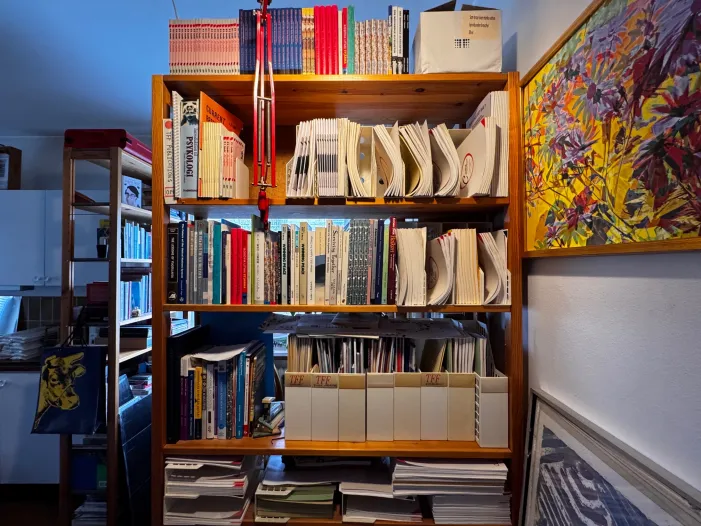
Up to 2004, TFF also published printed, newsletters, reports, anthologies, books and TFF Statements — boxes of them, heavy enough to reshape your spine, shipped across borders in the hope that someone would read past page three. But after two decades of experience, we made a decision: to publish exclusively online.

There were three reasons.

First, online publishing reaches far more people worldwide than any printed report ever could. A student in the Global South can access a TFF text instantly and freely — something no academic publisher would ever allow. Today, they shamelessly charge USD 25 or so if you want a copy of your own article.

Second, TFF online publishing will be free forever. Free for anyone who seeks knowledge, no paywalls, no library budgets, no gatekeepers, no profits made.

Third, we refused to continue feeding the ever‑growing, increasingly arrogant academic publishing industry. After some bad experiences — including spending more than 100 hours co‑editing a peace encyclopedia only to receive a single complimentary copy while the publisher pocketed the profits — we decided never again to let our work be exploited in that way.

And so TFF moved fully online, long before it became fashionable. The tools changed. The world changed. The noise increased. But the rhythm — the commitment — did not: Peace publishing for 1200 recipients of enveloped analyses till today’s global reach of tens of thousands.

Being a shoestring operation, our capital consisted of creativity and adopting every technology that could help us say the word ‘peace’ – locally and nationally to begin with, then also regionally and globally. It’s been one long learning process. The latest innovations that benefit TFF, of course, is AI – that has helped me make this text a slightly better reading experience for you – and video production (you’ll see soon).

And while we welcomed and used technological innovations with joy, we have also seen how high-tech companies like Google, Facebook, X, LinkedIn, etc. have planted nasty innovations into these technologies to censor and punish peace and reward war and militarism. But undeterred, TFF moves on.

But do people read?

From 1990 to 2010, I served as a visiting professor in several countries. Before that, I directed the Lund University Peace Research Institute (LUPRI) from 1983 to 1989. And before that, I was a student of sociology and peace at Lund University. My youth was spent reading, often ten hours per day and often thick, demanding books whose arguments required time, patience, and humility. There was no Internet.

Students read primary literature: the authors themselves, not summaries of summaries. Complex arguments about a complex world could not be compressed into a few pages, let alone a few lines. There were good lecturers around, and they were available, read your drafts, and took time to be both critical and constructive.

Today, my intuitive understanding — supported by countless observations — is that people read far less than they did three or four decades ago, especially when it comes to academic or non‑fiction literature. I recently came across an article claiming that 70% of Facebook users read only the headline and the author’s name. They do not read the article itself, not even when they press “Like.” Whether that number is exact or not is almost irrelevant. What matters is the trend: people increasingly shape their worldview through extremely short texts, photos, memes, and videos. The attention span has collapsed to historic lows, and so has critical assessment of sources.

As an “old‑timer,” I will say this plainly: this development breeds superficiality. It weakens the ability to understand complex issues, and the world is complex. It encourages black‑and‑white thinking. And worst of all, it makes societies far easier to deceive through simplified, emotionally charged media narratives designed to serve political and military interests.

From a TFF perspective, this is deeply worrying. Peace requires knowledge — real knowledge — about how the present system thinks, operates, and legitimises itself. You cannot meaningfully oppose offensive deterrence, arms races, or wars if you do not understand their driving forces, their intellectual foundations, and the theories that justify them. Likewise, you cannot propose viable alternatives without some familiarity with the theories of peace, nonviolence, alternative defence, and conflict transformation.

In other words, this is a double task. Those inside the militarist‑security system don’t have a double task because if they also knew the alternatives, their lives would become too complicated. And the public is increasingly unprepared to absorb complex arguments that challenge the dominant narrative. And visions about a better future have disappeared from public debate, at least in the Western world.

This raises a hard question: Is it meaningful to publish serious, research‑based peace analysis into a world with the shortest attention span in human history — a world that does not read long arguments and is therefore highly vulnerable to propaganda that favour war rather than peace?

How do we break through that layer of manipulation?

TFF has only four answers:

  1. We continue doing what we have always done — without compromising academic peace research quality; it may be implicit or explicit, and sometimes make our texts long and demanding.
  2. We use shorter formats on social media where appropriate, without diluting substance.
  3. We embrace video, both our own and those of others, because many people now learn primarily through visual media.
  4. We know from daily feedback that there are still people — study circles, teachers, older citizens who have more time, lifelong learners — who want the longer, deeper argument and refuse to surrender to the new illiteracy.

In conclusion: The new illiteracy is real and deeply worrying. But TFF will continue serving those who refuse to slide into it — and that is a mission of enormous importance.
Peace & future researcher + ‌Art Photographer

Share

Leave a Reply

Your email address will not be published. Required fields are marked *

Related Posts

Jan Oberg May 15, 2026 Go to this Fox News page and scroll the whole way down: President Donald Trump tells the world that his meeting with President Xi Jinping yielded a lot of very concrete political and economic results – of course, only where the Chinese side, according to him, agreed with him. He does not mention the Taiwan issue, but Secretary of State, Marco Rubio, says that it did not feature prominently in their talks and that the US policy on Taiwan has not changed. Then go to China Daily – or Global Times – and you will see that for the Chinese it is framework, principles, structure of cooperation etc. that matters – all embedded in the overall idea of “constructive bilateral relationship of strategic stability.” Nowhere is any concrete agreement or deal – all that Trump refers to – mentioned. At the general level, this gives you insights into the very different social...
Lena Petrova of “World Affairs In Context” with more than half a million subscribers on YouTube wanted to explore what a peace researcher like me has to say about, among other things, the First and the Second Cold War and why eethics has disappeared from politics. I am particularly happy about this conversation that also yielded an amazing number of very appreciative comments on YouTube. No doubt, people are longing for alternatives, including peace perspectives.
The MIMAC – Military-Industrial-Media-Academic Complex – drives the world’s rampant militarism and wars without end. Here is a short reflection of how it works against all interests of humanity. #5 deals with why there is no real enemy or threat images/analysis. It’s all ex-post constructions. And, btw, theTFF Peace Pulse is now on Rumble.

Recent Articles

“En dag som berättigar till fest”, utropade den London-baserade al-Quds al-Arabi efter FN:s eldupphörresolution, “eftersom detta är första gången som Israel accepterar ett FN-beslut från en position som besegrad och inte som segrare”. Att ett arabisk-israeliskt krig för en gångs skull slutat med arabisk seger, är en helt dominerade åsikt i arabiska medier. Al-Quds al-Arabi tillåter sig att drömma om att det israeliska nederlaget skall leda till massflykt från Israel. Men i nästa andetag påminner tidningen om att Israel aldrig brukar genomföra sina internationella åtaganden och varnar för att förlorarna, liksom tidigare, kan hämnas genom att provocera fram inbördeskrig i Libanon. Med tanke på de otaliga massmediala vittnesmålen om det libanesiska folkets eniga motståndskraft förefaller risken för inre stridigheter i det sargade landet just nu liten. Men visst kan man urskilja nyansskillnader i libanesiska tidningar. Vänsterorganet al-Safir uppfattar FN-resolutionen som en komplott i syfte att rädda Israel från ännu större...
Greenland – the world’s largest island, a continent of its own with only 57.000 inhabitants. I visited it for the first time in May 2005. I flew across the inland ice to Nuuk, the tiny capital with some 14.000 inhabitants. I was overwhelmed by the pride and kindness of everyone I met as well as by the unique natural beauty. Unfortunately, due to weather conditions during my ten-day stay I could get nowhere else but Nuuk. Fortunately, however, among those I met was Gitte Arvegaard, a Danish lawyer and negotiator employed by the local government, Greenland Home Rule. She turned out to be an enthusiastic photographer with a lot of pictures taken during various trips around Greenland. So this Greeland series is the result of our cooperative effort. We both hope you enjoy it and are stimulated to visit Greenland – about which you may read more here. Finally, if you want to...
 Jan Oberg’s storyof how he met Sir Paul Liverpool – where else to meet Paul McCartney? Paul’s old class mate and TFF Associate, Jonathan Power introduced me to Paul McCartney in Liverpool at an informal reception. It was held at what used to be their school, now the Liverpool Institute for Performing Arts and we were there to celebrate that Jonathan had written Amnesty International’s 40th Anniversary book. This happy event for “righting wrongs and writing songs” gave me an opportunity to meet Paul and tell him about TFF and get straight to the matter: would he consider making a donation in support of our work for peace? While I was probably the only one with such a wish that day, I was certainly not the only one who wanted to shake hands and talk with him. In the last minutes before Paul was to leave, Jonathan brought us together and we got about three...

TFF on Substack

Discover more from TFF Transnational Foundation & Jan Oberg.

Most Popular

“En dag som berättigar till fest”, utropade den London-baserade al-Quds al-Arabi efter FN:s eldupphörresolution, “eftersom detta är första gången som Israel accepterar ett FN-beslut från en position som besegrad och inte som segrare”. Att ett arabisk-israeliskt krig för en gångs skull slutat med arabisk seger, är en helt dominerade åsikt i arabiska medier. Al-Quds al-Arabi tillåter sig att drömma om att det israeliska nederlaget skall leda till massflykt från Israel. Men i nästa andetag påminner tidningen om att Israel aldrig brukar genomföra sina internationella åtaganden och varnar för att förlorarna, liksom tidigare, kan hämnas genom att provocera fram inbördeskrig i Libanon. Med tanke på de otaliga massmediala vittnesmålen om det libanesiska folkets eniga motståndskraft förefaller risken för inre stridigheter i det sargade landet just nu liten. Men visst kan man urskilja nyansskillnader i libanesiska tidningar. Vänsterorganet al-Safir uppfattar FN-resolutionen som en komplott i syfte att rädda Israel från ännu större...
Greenland – the world’s largest island, a continent of its own with only 57.000 inhabitants. I visited it for the first time in May 2005. I flew across the inland ice to Nuuk, the tiny capital with some 14.000 inhabitants. I was overwhelmed by the pride and kindness of everyone I met as well as by the unique natural beauty. Unfortunately, due to weather conditions during my ten-day stay I could get nowhere else but Nuuk. Fortunately, however, among those I met was Gitte Arvegaard, a Danish lawyer and negotiator employed by the local government, Greenland Home Rule. She turned out to be an enthusiastic photographer with a lot of pictures taken during various trips around Greenland. So this Greeland series is the result of our cooperative effort. We both hope you enjoy it and are stimulated to visit Greenland – about which you may read more here. Finally, if you want to...
 Jan Oberg’s storyof how he met Sir Paul Liverpool – where else to meet Paul McCartney? Paul’s old class mate and TFF Associate, Jonathan Power introduced me to Paul McCartney in Liverpool at an informal reception. It was held at what used to be their school, now the Liverpool Institute for Performing Arts and we were there to celebrate that Jonathan had written Amnesty International’s 40th Anniversary book. This happy event for “righting wrongs and writing songs” gave me an opportunity to meet Paul and tell him about TFF and get straight to the matter: would he consider making a donation in support of our work for peace? While I was probably the only one with such a wish that day, I was certainly not the only one who wanted to shake hands and talk with him. In the last minutes before Paul was to leave, Jonathan brought us together and we got about three...
Read More
Imagen-thumbnail-The-Transnational-1
“En dag som berättigar till fest”, utropade den London-baserade al-Quds al-Arabi efter FN:s eldupphörresolution, “eftersom detta är första gången som Israel accepterar ett FN-beslut från en position som besegrad och inte som segrare”. Att ett arabisk-israeliskt krig för en gångs skull slutat med arabisk seger, är en helt dominerade åsikt i arabiska medier. Al-Quds al-Arabi tillåter sig att drömma om att det israeliska nederlaget skall leda till massflykt från Israel. Men i nästa andetag påminner tidningen om att Israel aldrig brukar genomföra sina internationella åtaganden och varnar för att förlorarna, liksom tidigare, kan hämnas genom att provocera fram inbördeskrig i Libanon. Med tanke på de otaliga massmediala vittnesmålen om det libanesiska folkets eniga motståndskraft förefaller risken för inre stridigheter i det sargade landet just nu liten. Men visst kan man urskilja nyansskillnader i libanesiska tidningar. Vänsterorganet al-Safir uppfattar FN-resolutionen som en komplott i syfte att rädda Israel från ännu större...
Greenland – the world’s largest island, a continent of its own with only 57.000 inhabitants. I visited it for the first time in May 2005. I flew across the inland ice to Nuuk, the tiny capital with some 14.000 inhabitants. I was overwhelmed by the pride and kindness of everyone I met as well as by the unique natural beauty. Unfortunately, due to weather conditions during my ten-day stay I could get nowhere else but Nuuk. Fortunately, however, among those I met was Gitte Arvegaard, a Danish lawyer and negotiator employed by the local government, Greenland Home Rule. She turned out to be an enthusiastic photographer with a lot of pictures taken during various trips around Greenland. So this Greeland series is the result of our cooperative effort. We both hope you enjoy it and are stimulated to visit Greenland – about which you may read more here. Finally, if you want to...
p_mccartney_poem
 Jan Oberg’s storyof how he met Sir Paul Liverpool – where else to meet Paul McCartney? Paul’s old class mate and TFF Associate, Jonathan Power introduced me to Paul McCartney in Liverpool at an informal reception. It was held at what used to be their school, now the Liverpool Institute for Performing Arts and we were there to celebrate that Jonathan had written Amnesty International’s 40th Anniversary book. This happy event for “righting wrongs and writing songs” gave me an opportunity to meet Paul and tell him about TFF and get straight to the matter: would he consider making a donation in support of our work for peace? While I was probably the only one with such a wish that day, I was certainly not the only one who wanted to shake hands and talk with him. In the last minutes before Paul was to leave, Jonathan brought us together and we got about three...
Logo-Transnational
1942James Paul McCartney is born in Liverpool on June 18th. 1956Paul writes his first song, I Lost My Little Girl. 1957Paul meets John Lennon at St. Peter’s Church Fete, Woolton, Liverpool. He joins his first group, The Quarrymen and performs in his first gig at The New Clubmoor Hall, Liverpool, on October 18th. 1960Formation of The Beatles, who play residencies in Hamburg and at The Cavern in Liverpool. 1961First Beatles recordings issued in Germany, as the backing group for Tony Sheridan. 1962The first Beatles Parlophone recording, Love Me Do, reaches number 17 in the British charts. 1963The birth of Beatlemania. Please Please Me gives the group their first British Number 1. She Loves You cements their success. Please Please Me and With The Beatles albums released. 1964First triumphant American tour. The Beatles perform at the Royal Command Performance and release their first film, A Hard Day’s Night. Their single I...
Logo-Transnational
  Back to the series “Bujumbura, Burundi”
By JONATHAN POWER August 16, 2000 LONDON – Remember the summer of ’98? In the sweltering, torpid heat of a Roman august, charged with exhaust fumes, the international community gave its overwhelming approval to the establishment of an International Criminal Court that will enable those accused of “crimes against humanity” to be tried and, if convicted, sentenced. Only seven nations opposed or abstained from the motion, including Israel, China, India and the U.S.A. where the Pentagon had successfully waged bureaucratic guerrilla war to undermine the initially sympathetic stance of President Bill Clinton. Two years on we can now see what an epochal event that was. In a the stroke of 120 pens it changed the climate on political thuggery. After numerous half-starts and false starts ever since the Nuremberg and Tokyo trials that convicted the war criminals of the Second World War, the world at last had agreed en masse a common...


