
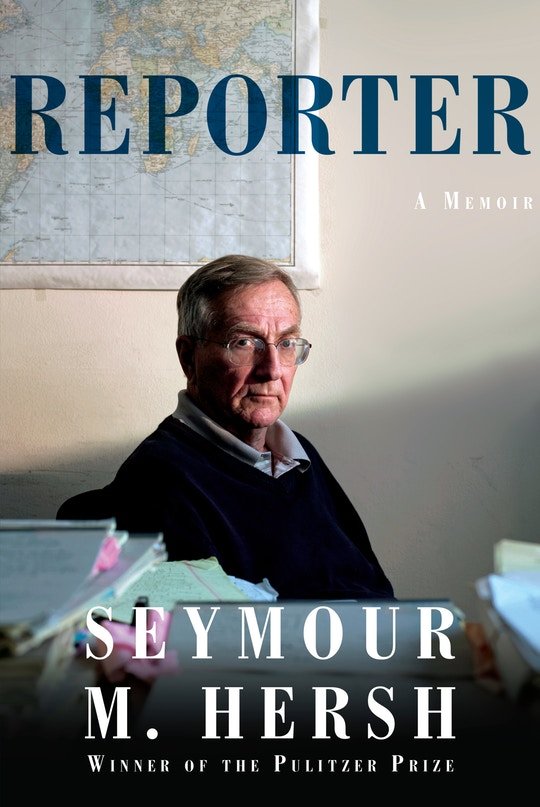
Seymour Hersh’s New Memoir Is a Fascinating, Flabbergasting Masterpiece

By John Schwarz

July 11, 2018

2 Jun 2018 – At the beginning of Seymour Hersh’s new memoir, “Reporter,” he tells a story from his first job in journalism, at the City News Bureau of Chicago.

City News stationed a reporter at Chicago’s police headquarters 24 hours a day to cover whatever incidents were radioed in. Hersh, then in his early 20s, was responsible for the late shift. One night, he writes, this happened:

Two cops called in to report that a robbery suspect had been shot trying to avoid arrest. The cops who had done the shooting were driving in to make a report. … I raced down to the basement parking lot in the hope of getting some firsthand quotes before calling in the story. The driver – white, beefy, and very Irish, like far too many Chicago cops then – obviously did not see me as he parked the car. As he climbed out, a fellow cop, who clearly had heard the same radio report I had, shouted something like, “So the guy tried to run on you?” The driver said, “Naw, I told the nigger to beat it and then I plugged him.”

What happened then? Did Hersh, who would go on to uncover the My Lai massacre in Vietnam and become one of the greatest investigative journalists in U.S. history, sprint to his publication and demand that it run this explosive scoop?

No. Hersh spoke to his editor, who told him to do nothing, since it would be his word against the police. He didn’t try to interview the responsible cop or his partner, or dig much further. Instead, he gave up on it and soon headed off to do his required service in the Army, “full of despair at my weakness and the weakness of a profession that dealt so easily with compromise and self-censorship.”

“I’ve spent most of my career writing stories that challenge the official narrative,” he writes in the last paragraph, “and have been rewarded mightily and suffered only slightly for it.” – Seymour M. Hersh in his book “Reporter”.

If Hersh were a superhero, this would be his origin story. Two hundred and seventy-four pages after the Chicago anecdote, he describes his coverage of a massive slaughter of Iraqi troops and civilians by the U.S. in 1991 after a ceasefire had ended the Persian Gulf War. America’s indifference to this massacre was, Hersh writes, “a reminder of the Vietnam War’s MGR, for Mere Gook Rule: If it’s a murdered or raped gook, there is no crime.” It was also, he adds, a reminder of something else: “I had learned a domestic version of that rule decades earlier” in Chicago.

“Reporter” demonstrates that Hersh has derived three simple lessons from that rule:

  • The powerful prey mercilessly upon the powerless, up to and including mass murder.
  • The powerful lie constantly about their predations.
  • The natural instinct of the media is to let the powerful get away with it.

Read the rest of the article at transcend.org

Photo: Courtesy of Knopf

Share

Leave a Reply

Your email address will not be published. Required fields are marked *

Related Posts

PART 1 — Media, Culture and Information Sovereignty By Jan ObergTFF co-founder and director January 20, 2026 This is the first of four TFF-created idea portfolios designed to curb the global reach of the United States and, in both the short and long term, help catalyse a worldwide nonviolent resistance to what many observers describe as the Trump administration’s uniquely confrontational, destructive and world-threatening policies. These portfolios outline what governments and citizens across the world can do through dynamic diplomacy, creative initiatives, and strictly nonviolent means. They are typical TFF works in that we do not only tell what the problem is and how bad it will go – as 90+% of all commentators, experts and scholars do – we tell what we think can be done, inviting you to think of what you think you can do. It seems painfully clear to me that the current political dynamics in Washington increasingly resemble the most...
Officially, the drones were not identified. By simply thinking critically – which journalists and selected experts no longer do – there may be a good reason for that. And this article will never be mentioned in Denmark… Drones over Denmark. No damage. No trace. No answers. Yet the headlines scream “Russian threat,” and Prime Minister Mette Frederiksen speaks with a certainty that defies logic: “We don’t know they were Russian—but we know Russia is the biggest threat to Europe.” It could be nobody else – unless you make an interest analysis which I did two days ago. This is not security policy. It’s theatre. And the audience is being played. Let’s rewind. These drones—unphotographed, untracked, unclaimed—appear and vanish like ghosts. Airports shut down. Panic spreads. Military budgets swell. And the narrative hardens: Russia is behind it. But what if that’s not just wrong but deliberately misleading? Here’s a hypothesis for...
Drones over Nordic airports. No damage. No trace. No answers. Most assume Russia—but what if that’s not so? Why is there so much we are not told? This article explores the strategic ambiguity behind recent drone incursions and asks: Who else might benefit from sending drones into NATO airspace? From Ukraine’s surprising drone supremacy to Russia’s possible signalling, the silence itself may be the loudest message. These are the kinds of questions decent, intelligent investigative journalists and commentators could easily research. Why don’t they? Did you, dear reader, know or think of this? That the most powerful weapon in today’s conflicts might be the one that leaves no trace – and no answers. Just enough fear to justify the next move? Recently, drones have repeatedly appeared over Nordic airports and near some military facilities. They cause no damage – for which reason the designation “hybrid attack” is misleading but serves a purpose. These...

Recent Articles

In contrast to most, we’ll bring alternatives, solutions, hope and strategies for a better future. Times are dangerous, yes, but that only intensifies the need for constructive thinking and action! Jan Oberg, TFF director April 13, 2026 The new TFF Peace Pulse uses video messages in a new way: Max 3-5-minute-long comments, ideas or perhaps mini-lectures, all about peace – positive peace. We launch them today on April 13, 2026 with a carefully crafted visual aesthetic fitting the content. We hope to publish them regularly from now on. We launch Peace Pulse (PP) – for a number of reasons. The world is in chaos, and there are countless reasons to feel concerned, frustrated, even angry. The atmosphere is saturated with doom and gloom, with negative energy and rear‑mirror thinking, while vision, imagination, alternatives, strategies and genuine future‑mindedness remain in short supply. And without them, we simply can’t save the world. Looking at problems from a hundred angles will...
PART II — Publishing Peace in a System That Prioritises Militarism Jan Oberg, TFF director April 10, 2026 How TFF Maintains a Daily Voice in a Digital World Built for Noise This article is part of the series “TFF at 40″ and it invites you to learn about Four Decades of Publishing Peace. It takes a look at how a small, people‑financed peace foundation has communicated across four generations of technology — from wax stencils and fax machines to mass email and Substack — and why TFF continues to publish every single day in a system that rewards noise, conflict, and militarism. ◆ What it means to publish peace every single day in a digital system built for 24/7 news and other noise, confrontation, and militarism. How TFF’s independence, continuity, and global readership defy algorithms, donor cycles, and Western media censorhip — and why the Majority World keeps listening. When the...
Jan Oberg, TFF director April 10, 2026 How TFF Sent Peace Into the World Before the Internet Existed This article is part of the series “TFF at 40″ and it invites you to learn about Four Decades of Publishing Peace. It takes a look at how a small, people‑financed peace foundation has communicated across four generations of technology — from wax stencils and fax machines to mass email and Substack — and why TFF continues to publish every single day in a system that rewards noise, conflict, and militarism. ◆ Follow me on a journey through forty years of peace publishing — from wax stencils and hand‑cranked duplicators to the fax machine that never slept, and finally to the global reach of online publishing. This is the story of how TFF carried ideas across borders long before the internet made it easy, and why we chose independence over academic profit-making and...

TFF on Substack

Discover more from TFF Transnational Foundation & Jan Oberg.

Most Popular

In contrast to most, we’ll bring alternatives, solutions, hope and strategies for a better future. Times are dangerous, yes, but that only intensifies the need for constructive thinking and action! Jan Oberg, TFF director April 13, 2026 The new TFF Peace Pulse uses video messages in a new way: Max 3-5-minute-long comments, ideas or perhaps mini-lectures, all about peace – positive peace. We launch them today on April 13, 2026 with a carefully crafted visual aesthetic fitting the content. We hope to publish them regularly from now on. We launch Peace Pulse (PP) – for a number of reasons. The world is in chaos, and there are countless reasons to feel concerned, frustrated, even angry. The atmosphere is saturated with doom and gloom, with negative energy and rear‑mirror thinking, while vision, imagination, alternatives, strategies and genuine future‑mindedness remain in short supply. And without them, we simply can’t save the world. Looking at problems from a hundred angles will...
PART II — Publishing Peace in a System That Prioritises Militarism Jan Oberg, TFF director April 10, 2026 How TFF Maintains a Daily Voice in a Digital World Built for Noise This article is part of the series “TFF at 40″ and it invites you to learn about Four Decades of Publishing Peace. It takes a look at how a small, people‑financed peace foundation has communicated across four generations of technology — from wax stencils and fax machines to mass email and Substack — and why TFF continues to publish every single day in a system that rewards noise, conflict, and militarism. ◆ What it means to publish peace every single day in a digital system built for 24/7 news and other noise, confrontation, and militarism. How TFF’s independence, continuity, and global readership defy algorithms, donor cycles, and Western media censorhip — and why the Majority World keeps listening. When the...
Jan Oberg, TFF director April 10, 2026 How TFF Sent Peace Into the World Before the Internet Existed This article is part of the series “TFF at 40″ and it invites you to learn about Four Decades of Publishing Peace. It takes a look at how a small, people‑financed peace foundation has communicated across four generations of technology — from wax stencils and fax machines to mass email and Substack — and why TFF continues to publish every single day in a system that rewards noise, conflict, and militarism. ◆ Follow me on a journey through forty years of peace publishing — from wax stencils and hand‑cranked duplicators to the fax machine that never slept, and finally to the global reach of online publishing. This is the story of how TFF carried ideas across borders long before the internet made it easy, and why we chose independence over academic profit-making and...
Read More
Screenshot-2026-04-13-154551
In contrast to most, we’ll bring alternatives, solutions, hope and strategies for a better future. Times are dangerous, yes, but that only intensifies the need for constructive thinking and action! Jan Oberg, TFF director April 13, 2026 The new TFF Peace Pulse uses video messages in a new way: Max 3-5-minute-long comments, ideas or perhaps mini-lectures, all about peace – positive peace. We launch them today on April 13, 2026 with a carefully crafted visual aesthetic fitting the content. We hope to publish them regularly from now on. We launch Peace Pulse (PP) – for a number of reasons. The world is in chaos, and there are countless reasons to feel concerned, frustrated, even angry. The atmosphere is saturated with doom and gloom, with negative energy and rear‑mirror thinking, while vision, imagination, alternatives, strategies and genuine future‑mindedness remain in short supply. And without them, we simply can’t save the world. Looking at problems from a hundred angles will...
IMG_5165 (1)
PART II — Publishing Peace in a System That Prioritises Militarism Jan Oberg, TFF director April 10, 2026 How TFF Maintains a Daily Voice in a Digital World Built for Noise This article is part of the series “TFF at 40″ and it invites you to learn about Four Decades of Publishing Peace. It takes a look at how a small, people‑financed peace foundation has communicated across four generations of technology — from wax stencils and fax machines to mass email and Substack — and why TFF continues to publish every single day in a system that rewards noise, conflict, and militarism. ◆ What it means to publish peace every single day in a digital system built for 24/7 news and other noise, confrontation, and militarism. How TFF’s independence, continuity, and global readership defy algorithms, donor cycles, and Western media censorhip — and why the Majority World keeps listening. When the...
IMG_5165 (1)
Jan Oberg, TFF director April 10, 2026 How TFF Sent Peace Into the World Before the Internet Existed This article is part of the series “TFF at 40″ and it invites you to learn about Four Decades of Publishing Peace. It takes a look at how a small, people‑financed peace foundation has communicated across four generations of technology — from wax stencils and fax machines to mass email and Substack — and why TFF continues to publish every single day in a system that rewards noise, conflict, and militarism. ◆ Follow me on a journey through forty years of peace publishing — from wax stencils and hand‑cranked duplicators to the fax machine that never slept, and finally to the global reach of online publishing. This is the story of how TFF carried ideas across borders long before the internet made it easy, and why we chose independence over academic profit-making and...
Imagen-thumbnail-The-Transnational-1
A donors’ conference, co-sponsered by the Burundian government, the Belgian government and UNDP will be held in Brussels January 12-13, 2004. This PressInfo offers a perspective on its urgency. See also TFF’s new Burundi Forum. Imagine for a moment that politics is about goodness and generosity. Where could a few million dollars of government aid and a few civil society organisations – guaranteed – win the hearts of extremely poor millions who want peace and already work hard to achieve it after 10 years of war and genocide? The answer is Burundi, the heart-shaped country in the heart of Africa. Burundi makes a good story from Africa. But what does the world know about Burundi, its problems and struggles? Burundi’s tough reality Here are the basic facts. Burundi’s population is about 7 million and it is number 171 out of the 175 countries on the UNDP’s human development index. Their life...
Jan Oberg February 19, 2026 What a thrill to be interviewed by former British diplomat Ian Proud! Don’t waste a minute: acquaint yourself with him here on his homepage, which he elegantly calls “Proud Diplomat.” Notice also his book, A Misfit In Moscow. Ian is, of course, also on Substack, where he calls himself The Peace Monger, and recently he set up his own PeaceMonger Channel on YouTube. For once, I was not interviewed as if I were a military geopolitical expert, where I normally have to twist the whole thing in the direction of peace. No, we both had a focus on peace – why it has been disappeared by research, politics and the media, but also what can be done to shape a more peaceful future for us all. One idea we came up with was that of connecting people through citizens diplomacy – in an era where more or less authoritarian leaders meet frequently and confirm each other as members...
Arctic_North_Pole_Map
This is not another geopolitical commentary on the Arctic. It is a visionary peace proposal that can save the region from militarised rivalry and ecological ruin. A blueprint for shared security, sustainable development, and human dignity — benefitting Greenland, the Arctic, and the rest of us. Jan Oberg TFF director Lund, Sweden, February 17, 2026 I. Four Principles for a New Arctic Vision The Arctic is often framed as a cold arena of rivalry — a place where great powers test each other’s resolve. But this worldview is outdated, unimaginative, and ultimately self‑defeating. The Arctic is not a vacuum waiting to be militarised; it is a living region, a climate stabiliser, and a cultural homeland whose future will shape the future of humanity. If we begin from that understanding, a far more rational Arctic order becomes possible — one that is peaceful, cooperative, and centred on the people who actually live there. This vision rests...

