Liberate yourself from NATO’s anti-intellectual
and militarist fearmongering today!
Why the omnipresent, massive, and uniform propagation of Russia as a threat against NATO is humbug. How a credible professional quality threat analysis is made instead. Why deciding military expenditures as a percentage of GDP is exemplary nonsense. Why NATO cannot be called ‘defensive’ and 17 reasons why Russia is not a threat to NATO or to neutral states.
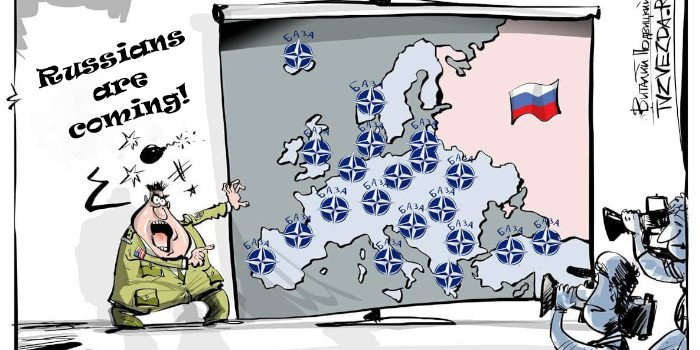
NATO soon turns 75 – amid its deepest crisis ever, no matter what they say. During all these years, we have heard repeatedly that the ” Russians” – the Soviet Union/Warsaw Pact and today’s Russia – are coming!
But while the Soviets/Russians have invaded other countries, they’ve never invaded a NATO or a neutral country in Europe. And when the First Cold War ended a good 30 years ago, and archives were opened, allegedly no plans were found for an out-of-the-blue attack on and occupation of any such country – but there were plans for how to roll back attacking Western forces if they should try.
If your predictions have been so consistently wrong over seven decades, wouldn’t it be common sense to ask: Why is it that we’ve been wrong all the time? Why do we spend trillions on guarding ourselves against a permanent threat that never happens – a bit like waiting for Godot in Beckett’s equally absurd drama?
The intellectually nonsensical (see later) NATO goal that all members must spend at least 2% of the GDP that used to be seen as a ceiling has rapidly turned into the floor.
And why do NATO countries these years move in the direction of a war economy where guns take priority over butter to such an extent that their economies and welfare will be fundamentally undermined? This will be a main reason they will lose out more quickly than otherwise to the up-and-coming new actors in the emerging multi-polar world, China, India and Africa in particular?
Virtually all that is needed to support those militarism-promoting and dangerously wrong predictions and policies are one or more of these four assertions or mantras:
- The Russians are coming.
- Putin is a dictator, an evil man.
- Look at his full-scale invasion in Ukraine – out-of-the-blue and unprovoked.
- After Putin has taken Ukraine, he will not be satisfied but will move on to take other countries.
This is repeatedly stated without any evidence or probability, simply postulated. This is also the scenario stated by the US Secretary of Defence, Lloyd Austin, in early March 2024 – from which he concluded that “if Ukraine fell, NATO would be in a fighting Russia.” The Swedish Chief of Defence has argued that Putin could do a partial invasion of Southern Sweden (Skåne).

Instead of today’s fear propaganda: How to make a decent threat analysis?
The above four mantras carry no validity. The politicians, media people and academic experts who promote them consistently state them with no plausible scenario, argument or probability. That is because they are not based on any analysis; their function is not to tell any truth but to frighten citizens enough and make them a) support ‘our’ armament and confrontational policies and b) accept ever higher military expenditures drawn from their tax payments.
Additionally, most citizens are not able to look through the propaganda. The Russian threat is stated by elites, some high-ranking in military uniform, all civilians with an inner politically correct uniform: Who would have enough knowledge to stand up and say that the Emperor wears no clothes?
There is a term for this: fearology. Instilling fear in people makes it much easier to make them believe what they hear and accept policies that – allegedly – shall protect them against what they are made to fear. It has the character of perpetuum mobile and serves neither the security of people but the elites in what I call the Military-Industrial-Media-Academic Complex, MIMAC.
Let’s now contrast this fearological humbug with a real threat analysis. How should such an analysis be carried out?
1 • You gather your country’s best civilian and military expertise and have them work as a commission for at least a year.
2 • You look at all the factors, risks, trends and events that could threaten your country – from the inside and from the outside, by both civilian and military means (thus, it’s a 4-fold table).
3 • You develop scenarios about where the world, your surroundings and your own country is more or like to move – from the best to the worst of cases, perhaps 5-10 different such scenarios of what is it we can expect under these or those circumstances, to have to meet and guard ourselves against – and, even though it is difficult: what can we imagine will be very surprising?
4 • You decide the time frame – say you look at 5, 10, 20 or 50 years into the future.
5 • You then decide which types of threats are most likely within each time frame. You also assess which threats are so huge (if becoming reality) that it is not meaningful to guard against them – such as all-out nuclear war or total ecological catastrophe. Further, you decide which likely threats are so small that you can disregard them and handle them with short notice.
6 • At this point, you have a series of more or less complex threat scenarios, each with its own probability: What is the probability that X will happen within the next 5 or 20 years?
7 • You then decide which of them to plan for. That is, you select those that are within a mid-range of probability and your resources permit you to do something about preventing or meeting them.
8 • The next step is to investigate what resources we have today – and can mobilise if need be. All countries have to economise with what they have (scarce resources) and make priorities – they only have so much to spend on their stability, defence, security and peace – not unlimited resources since other sectors also need funds.
9 • Through political dialogue throughout society and democratic decision-making – a defence policy is devised and financed given the comprehensive threat analysis that the politicians have been handed by the experts mentioned in point 1. A decision is then made on what, within the country’s means, can be done to guard against threats, when and by whom.
This is how a quality national threat analysis is made, here simplified in 9 points.
All other threat constructions like the mantras above are – simply put – foolish. You’ll either spend a lot to meet threats that have no reality or probability, or you’ll overlook real risks and threats because you did not do what it takes – and lose the day an unforeseen threat unfolds and comes your way.
Emotionalism and panic decisions by small ‘group thinking’ elites who think the same kinds of thoughts make up a complete recipe for being hit, sooner or later, by unforeseen disaster.
However, tragically, NATO countries are now going for the foolish/emotional rather than rational-analytical threat determination. It needs to a) cover up for its blunder of trying to get Ukraine into NATO and b) it lacks the necessary intellectual capacity to do otherwise – for reasons I have dealt with in detail in “Abolish NATO Or Convert It To Serve Peace – 30 Arguments and 100s of Inspirations.”
Military expenditures tied to economic performance is intellectual nonsense
One of many indicators of that incapacity within NATO is that they bind their investments in the military to GDP, i.e. economic performance. Thus, a country that does well in its civilian economy automatically allocates more to its—or the alliance’s—coffers. Conversely, a country in economic crisis yields less than when it did well.
The absurdity of this is that a percentage of GDF is totally divorced from any threat analysis – and certainly from the nine-point comprehensive, classical method above.
It is tied, instead, to economic performance, not to a serious complex threat analysis and therefore the military expenditures will – potentially at least – have nothing to do with whether or not the general threat level goes up or down. The only relevant thing is whether the economy goes up or down.
Again, this is predicated on the equally absurd idea, or implicit assumption, that spending more money to acquire more weapons is the only or best road to security. It’s also based on the dubious assumption that more means better. If you invest all your extra money in weapons but do nothing to secure your energy import or production, you cannot fuel your fighter planes, and they will be stuck on the ground.
All this is as nonsensical as it would be to argue that the more we invest in medicine, the more healthy our society shall automatically be. It is possible, both empirically and philosophically, to argue that there is no immediate or automatic correlation between weapons investment and security or medicine investment and health – it could, actually, be just the opposite – the more weapons (particularly of the offensive other-threatening types) will make oneself less secure simply because they will be perceived as threatening by the adversaries and stimulate or force these adversaries to arm even more against us – of course in the name of their defence.
The percentage-of-GDP measure is expressive of market economy thinking. More money means solving a problem. Everything becomes a price at a market, not a question about thinking, analytical assessments, or possible alternative solutions – and it is quantitative, not qualitative as a measure. One is reminded of the character in one of Oscar Wilde’s plays who says something like: We are now a society in which people know the price of everything and the value of nothing – quantity versus quality.
Furthermore, if there is one thing the history of war tells us, it is that countries with huge forces and military expenditures have systematic lost wars to smaller adversaries – e.g Vietnam. Why, because these smaller countries were attacked, had better morale, better strategies and doctrines, knew their own cultures and society better than the invader – and knew the invader better than the invader knew them.
In parenthesis, this may repeat itself with Russia in Ukraine (although Russia knows Ukraine for very good historical and cultural reasons – but still) and with the vastly superior NATO fighting Russia (directly or indirectly via Ukraine). Time will tell.
The simple conclusion is that such binding of military expenditures to economic performance is indicative of intellectual disarmament and mechanical thinking and will – in all likelihood – lead to self-deception. After all, it is the quality/value of what we do and not only the price of it that will determine survival, security and peace.
Did you see a critique of the GDP percentage anywhere else?
Why is Russia not a threat to NATO or neutral states?
Let’s now go back to the Russian threat that isn’t. Here follow some arguments – with no priority intended.
1 • Russia lost at least 25 million people in the 2nd world war. The Russians know better than most what war means.
2 • Russia sees a need for a security zone of some kind because it is Russia that has been invaded three times since 1812 – Napoleon, the White Revolution and Hitler – not the other way around, but handling an occupied NATO member is not productive or possible.
3 • Russia has the largest reservoir in terms of natural resources and does not need to try to grab those of others – like the US and others the oil in the Middle East.
4 • Russia has learnt from the collapse of the Soviet Union and the Warsaw Pact around 1990-91 that you cannot follow the NATO countries in terms of military expenditures without militarising yourself to death, i.e. undermining your civilian economy.
5 • That points to the fact that Russia’s economy is very small in comparison with those of the 32 NATO countries.
6 • Russia’s military expenditures were 8% of NATO’s up to its invasion of Ukraine. It is true that military expenditures do not translate directly into capabilities to start wars, fight and sustain them. On the famous other hand, starting a war against an adversary with 12 times larger military expenditures and a vastly bigger economy would be madness, suicide or a Himalayan, fatal miscalculation based on complete irrationality. Putin and the people around him do not suffer from such diseases.
7 • These limitations make it extremely unlikely that Russia would succeed, if it tried, in building anything faintly similar to the US global empire or be an imperialist’ as it is often called. It has a few bases abroad, but not 600+ like the US. Russia is not an imperialist power.
8 • If it invaded a NATO country (or any other for that matter), it would face a new problem: Occupied people will invariably work against their occupiers. How would Russia, with its relatively limited military resources, be able to administer, secure and develop a series of countries – and have none of them or a “Rest-NATO” arm to get them back?
9 • If aggression against NATO or neutral states – or against states around the world – was, so to speak, in the Russians’ genes, why haven’t they done much more of it? In the 1960s and 1970s, the Soviet Union’s global reach, particularly in Africa as well as the Middle East—politically and militarily—was much bigger than Russia’s today.
10 • Putin’s post-Cold War Russia has invested predominantly in getting Russia back on its feet after the complete and disastrous disintegration back then – and it has created a society that is admirable with a stronger economy than most have predicted – and also remained quite resistant to history’s most intense and wide-ranging sanctions imposed by EU and NATO countries. Invading a NATO country would undermine or destroy all that.
11 • Vladimir Putin has been president for more than 20 years. If he was a true expansionist or “imperialist,” how come he has not invaded one country after the other – also inspired by the US and NATO countries that have been doing that sort of thing permanently, not the least in the wake of 9/11?
12 • If Russia is such a formidable threat, why has it not built over 600 military bases worldwide like the US and hundreds more to match France and the UK in that field? (See the answer in 13).
13 • While the Soviet Union represented another competing ideology until its dissolution – Soviet Communism, planned state economy, one Communist Party, etc. – Russia today can not possibly be perceived as a systemic or ideological threat.
14 • All Russian leaders, including Gorbachev, Yeltsin, Putin, and Medvedev have expressed an interest in working with NATO, building ‘a European’ house’ as Gorbachev called it. Former NATO S-G Robertson has informed us how he discussed a sort of NATO membership with the Soviet Union, and when Putin raised the issue, he was told by NATO that Russia would have to queue up after little Montenegro. The Soviet Union asked to become a NATO member in 1954, was turned down and then established the Warsaw Pact in 1955. These Russian attempts – in vain, however – can hardly be seen as only negative, more perhaps like a little Western brother who wants to join the larger brother rather than kill him.
15 • President Putin has repeatedly stated that he sees Russia as – at least also – a European culture and state, that without interchanges between Western Europe and Russia throughout history, Russia would not have been what it is today. Western Europeans in NATO and the EU have never had a similar attitude to Russian culture; they had no problem or hesitancy cutting it off after the invasion of Ukraine.
16 • Vladimir Putin has never said to NATO that “if so and so happens – or if you do this or that – Russia will invade your country.” His style has been to appeal to NATO not to continue the policy of expansion; one example is his speech at the Munich Security Conference in 2007. Overall, Russia’s attitude to NATO has been much more defensive after the end of the end of the Cold War than during it.
17 • Whatever you may think of Russia’s President, he is neither inexperienced nor a hothead or a suicidal fool. And he did not fall ill or become a maniac during the day of February 23, 2022.
[More reasons may be added as time goes by. Readers are invited to submit other reasons and arguments in the comment field below.]
NATO is not ‘defensive’ and has operated for the last 25 years in gross violation of its own Treaty.
If some or all of the 17 points above are reasonable, NATO has only one task now: Mind its own business.
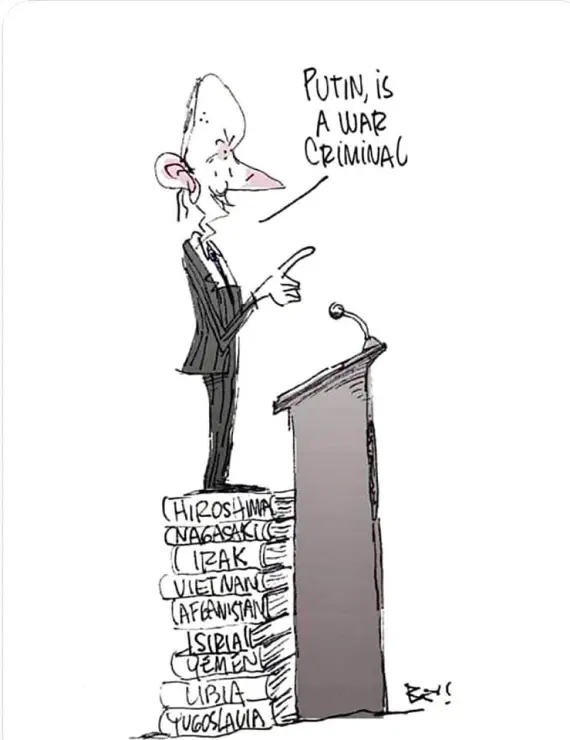
If you read NATO’s Treaty of 1949 – and you may do that here – it is basically a copy of the UN Charter. It argues that conflicts shall be transferred to the UN and solved by peaceful means, and then it adds Article 5, which states that if one NATO member is attacked, the others shall come to its defence. The alliance’s words are indeed defensive, but since its first out-of-area operation – the ruthless 78 days of bombing of Yugoslavia from March 24 to June 10, 1999 – it has pursued offensive policies and operations in gross violation of its own Treaty.
NATO countries’ massive involvement in Ukraine, using it as a bridgehead or proxy for weakening Russia – or trying to defeat it once and for all – is the peak point of this criminal policy down the slippery slope.
Those who call NATO ‘defensive’ lack basic insights in these matters – or practise opportune ignorance.
An alliance – and members of it – that
1) acts way outside its own membership circle,
2) conducts offensive military operations far away,
3) lacks a legal mandate as in Yugoslavia,
4) builds on offensive rather than defensive deterrence,
5) pursues forward defence and deployment,
6) bases itself on nuclear weapons, and
7) insists on using nuclear weapons also against a conventional attack
– simply can not by any definition of the concept be characterised as ‘defensive.’
This is another example of a militarist humbug. ‘Defensive’ is for domestic consumption; of course, you cannot admit to your citizens that you’re offensive and threatening to others. And no country facing NATO confrontation would perceive it as ‘defensive.’ So, ‘defensive’ is for the NATO world, not the rest of the world.
So why do we hear that Russia is anyhow a formidable threat to NATO?
What do we make of that formidable Russian threat when we also listen to former NATO Secretary-General Anders Fogh Rasmussen’s blunt and sensational statement from after the Ukraine war started: “Putin will be beaten to a pulp by NATO. Once NATO moves, it will be with enormous force. You have to remember that the investments we make in defence are ten times greater than Putin’s,” he says – to Denmark’s TV 2.
So much for NATO’s formidable adversary’s threat. Something simply does not make sense.
To paraphrase Shakespeare, there is something rotten in NATO’s ‘defensive’ alliance. And that rottenness could well end us in Not To Be rather than To Be.
About that in a second article.