
Retrogression in Human Rights

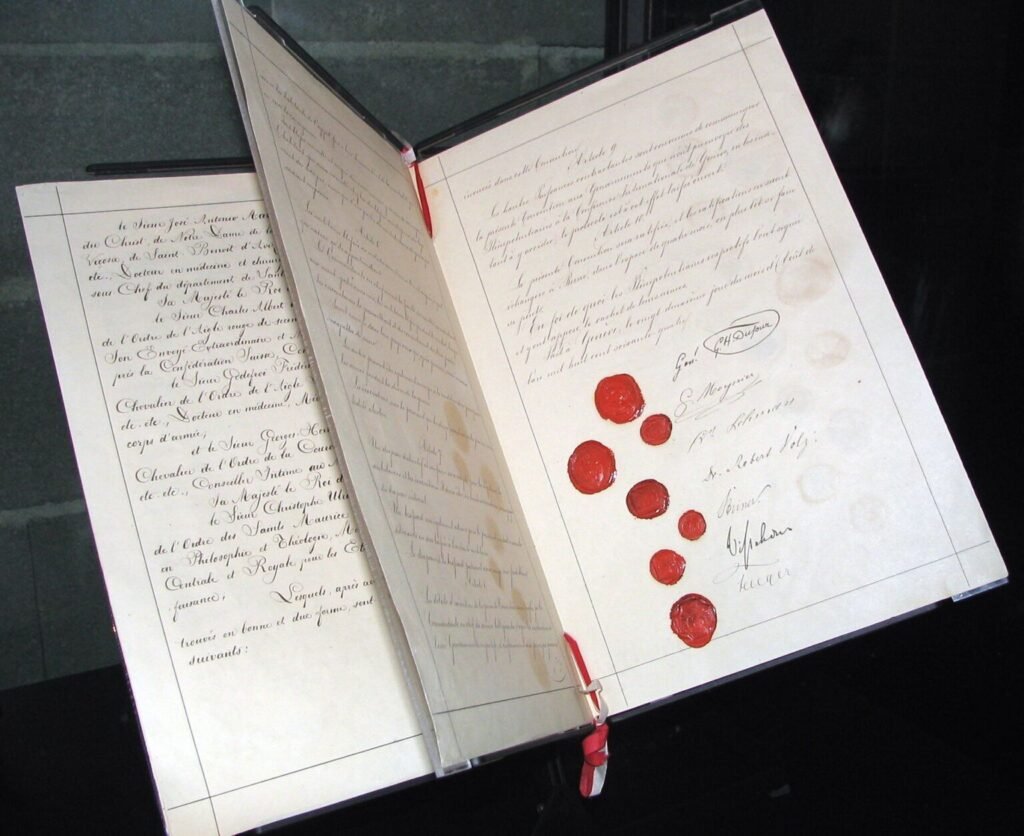
A facsimile of the signature-and-seals page of the 1864 Geneva Convention. Photograph Source: Kevin Quinn, Ohio, US – CC BY 2.0

Alfred De Zayas

September 26, 2023

Progress and retrogression characterize the reality of international law, international relations, and the concrete enjoyment of human rights by women and men throughout the planet. We hail the tides of opportunity, the times of liberation and expansion, but we should not be blind to recurrent abuses, crimes, and moments of disgrace.

Today our world is experiencing chaos, but not more so than in the 18th, 19th and 20th centuries. At least we are not burning witches or massacring indigenous Hopi, Pequots, Sioux, Quechua and Taínos, the slave trade is abolished, colonialism is drastically reduced. We welcome the landmark resolution 48/7 adopted by the UN Human Rights Council on 8 October 2021 concerning the legacies of colonialism in Africa, Asia and Latin America, particularly concerning indigenous peoples whose suffering over the centuries has not been assuaged and who continue to suffer from the sequels of structural violence[1].

Originally published on Counterpunch, September 26, 2023

On the positive side, we have witnessed a phenomenal codification of legal norms, the UN Charter, the UDHR, the Covenant on Civil and Political Rights (ICCPR), the Vienna Convention on the Law of Treaties, the Vienna Convention on Diplomatic Relations, the Geneva Red Cross Conventions, the establishment of national human rights institutions and regional human rights courts. Proposals for the creation of an International Court of Human Rights whose judgments would be enforceable[2]are under discussion.

We are justified in applauding the growing recognition of the rights of half the population of the planet – women — we hail concrete measures being taken on behalf of persons with disabilities. We welcome the entry into force in January 2021 of the Treaty on the Prohibition of Nuclear Weapons[3], the Declaration of October 2021 by the Human Rights Council recognizing the Environment as a Human Right[4].  We express relief over the gradual abolition of the aberration of “capital punishment”[5].

Notwithstanding the self-congratulatory celebrations around the 75th anniversary of the adoption of the UDHR, we must admit that there is significant retrogression in many fields, including the erosion of the concept of Peace as a Human Right, the backsliding from General Assembly Resolution 39/11 of 12 November 1984[6], the belligerent intransigence of many countries and their unwillingness to talk with each other, in spite of their hard law obligation to do so pursuant to Article 2(3) UN Charter.

We denounce the continued practice of torture in many countries, the disgrace of Abu Ghraib, Guantanamo[7], “extraordinary renditions”, secret CIA prisons, indefinite detention[8], the glorification of war, the social acceptance of war propaganda, notwithstanding the fact that it is specifically prohibited in article 20 of the ICCPR, the weaponization of the administration of justice in many countries and the breakdown of the rule of law in some countries ostensibly committed to human rights, e.g. in the US, UK, Sweden, Ecuador, as meticulously documented by UN Rapporteur on Torture, Professor Nils Melzer, in his well-sourced book on the persecution of whistleblower Julian Assange[9]. Indeed, the scandalous treatment of Assange constitutes torture under article 7 ICCPR, a gross violation of the rights of journalists, and a violation of our right to know under article 19 ICCPR.  What Professor Melzer reveals is far worse than the Dreyfus Affair of 1898. Melzer is the Emile Zola of the 21st century.

We deplore the scourge of 25 million victims of human trafficking, including 3.4 million children. We denounce the escalation of urban violence and mass-killings, the rise of international terrorism.  Notwithstanding the many institutions established to monitor adherence to human rights treaties, notwithstanding the regular meetings of the Human Rights Council, Human Rights Committee, Committee Against Torture, national human rights institutions, civil society organizations, outrageous violations of human dignity continue to occur.  Is this perhaps partly attributable to the fact that some of these institutions have been hijacked by geopolitical players, display selective indignation and practice double-standards?

Today there is scarce protection of the democratic right to know, the right to access information, the right to freedom of opinion and expression[10]. We see censorship by governments and the private sector, arbitrariness in Facebook and YouTube, the blocking of news services including RT, Sputnik and Tass in EU countries, the Orwellian new Digital Services Act, the brazen brainwashing practiced by the media, the excesses of “cancel culture”, the epidemic of self-censorship, the social acceptance of Russophobia and Sinophobia, the weaponization of sports so that sportswomen and men can be banned from competition merely on account of their nationalities.

Serious retrogression becomes evident in the weakened protection of privacy, the Orwellian surveillance of NSA and other government institutions as revealed by Edward Snowden in his watershed book Permanent Record[11]. We deplore the failure of governments to protect family life and family values, the concerted attacks on the concept of the family and parental authority, the denigration and ridicule of religious beliefs.

Retrogression is also apparent in the actions and omissions of institutions established to protect our rights. Many institutions, rapporteurs, “independent commissions”  are demonstrably in the service of certain powerful countries and lobbies, have become hostage to donors who pretend to set the agendas of monitoring bodies and mechanisms that should be rigorously neutral and professional[12].

Quis custodiet ipsos custodes?[13] Who guards over the guardians? Crucial institutions such as the UN Human Rights Council, ECHR, IACHR, OPCW, ICC are betraying their mandates, instrumentalizing human rights for purposes of geopolitical confrontation, instead of devising preventive strategies and mechanisms to secure human dignity for all women and men on the planet.

Only we can be the guardians! While we realize that governments lie to us on a daily basis, we must push back and reclaim democracy. We do not need any Ministry of Truth as in 1984. Alas, it appears that we have gradually entered the dystopia of Aldous Huxley’s Brave New World.

Among the gravest instances of retrogression is the degradation of international criminal law into a political tool of “lawfare”.  One observes an unhealthy obsession with punishment, an aggressive self-righteousness that invites us to lapidate the adulteress (John VIII, 1-11). If Christianity taught us anything, it is that we must forgive to be forgiven: et dimite nobis debita nostra sicut et nos dimitimus debitoribus nostris.  The recognition that the world is not black and white is not just a religious tenet but actually belongs to civilization.  It is easy to understand that sometimes there is bad in the good and even some good in the bad. Revenge is surely not conducive to reconciliation, and in order to live together in mutual respect, we must practice understanding and caritas.

Alas, the mainstream NGOs – with the complicity of the media — have transformed the concept of “amnesty” into a curse word. Yet, amnesties are not bad per se. Sometimes amnesties are necessary for peace. Article 6 of the Second Additional Protocol of 1977 to the Geneva Conventions stipulates “the authorities in power shall endeavour to grant the broadest possible amnesty to persons who have participated in the armed conflict”.  Article 2 of the Peace of Westphalia stipulates “there shall be on the one side and the other a perpetual Oblivion, Amnesty, or Pardon of all that has been committed since the beginning of these Troubles, in what place, or what manner soever the Hostilities have been practiced, in such a manner, that nobody, under any pretext whatsoever, shall practice any Acts of Hostility, entertain any Enmity, or cause any Trouble to each other other…”[14] Similar amnesties were agreed upon in countless peace treaties e.g. the Peace of Rijkswijk of 1697, the Congress of Vienna of 1814-15, and more recently the Evian Accords of 1962.

We are told that the establishment of the International Criminal Court in 2002 represents progress.  Some, however, consider it a significant step back to the primitive age of the law of revenge, lex talionis. Indeed, vengeance is incompatible with the acquis of civilization. Punishment is hardly a civilized answer to problems, inter alia because punishment is ex post facto, after the fact, and frequently does nothing at all for the victims. Moreover, there is scarce evidence that international criminal law has generated any deterrence.

What society really needs is prevention of crime, prevention of war, prevention of hatred. A Global Pact on Education for peace and empathy would be a way forward.  The United Nations should champion such an initiative and place all UN agencies in the service of peace, notably UNESCO.  Conflict-prevention depends on good faith, mutual respect, international solidarity – and, yes, intellectual honesty.

The Universal Declaration of Human Rights, adopted 75 years ago at the Palais Chaillot in Paris, was indeed a high point in the tide of human rights. Hitherto we have failed to implement its provisions, particularly Article 28: “Everyone is entitled to a social and international order in which the rights and freedoms set forth in this Declaration can be fully realized”. That remains our challenge, to rediscover the spirituality of the UDHR and revive the legacy of Eleanor Roosevelt[15].

Notes

[1] https://undocs.org/Home/Mobile?FinalSymbol=A%2FHRC%2FRES%2F48%2F7&Language=E&DeviceType=Desktop&LangRequested=False

[2] https://www.deepdyve.com/lp/brill/an-international-court-of-human-rights-N0d0HxEk8H

https://www.ohchr.org/en/special-procedures/ie-international-order/mr-alfred-maurice-de-zayas-former-independent-expert-2012-2018

[3] https://disarmament.unoda.org/wmd/nuclear/tpnw/

[4] https://digitallibrary.un.org/record/3945636

[5] https://www.cambridge.org/core/books/abolition-of-the-death-penalty-in-international-law/28291346A4A68C4CA2097E813007EC3A

[6] https://www.ohchr.org/en/instruments-mechanisms/instruments/declaration-right-peoples-peace

[7] https://opil.ouplaw.com/display/10.1093/law:epil/9780199231690/law-9780199231690-e301

https://searchlibrary.ohchr.org/record/6182

[8] https://www.icrc.org/en/doc/assets/files/other/irrc_857_zayas.pdf

[9] Nils Melzer, The Trial of Julian Assange, Verso Books, New York 2022.

[10] https://www.cambridge.org/core/journals/netherlands-international-law-review/article/abs/freedom-of-opinion-and-freedom-of-expression-some-reflections-on-general-comment-no-34-of-the-un-human-rights-committee/ADCD74F635F688851788E9079E1ABB76

[11] Metropolitan Books, New York, 2019.

[12] Alfred de Zayas, The Human Rights Industry, Clarity Press, 2023.

[13] Juvenal, 6th Satire.

[14] https://theranddaily.com/the-peace-of-westfalia-treaties

[15] www.eleanorlives.org

Alfred de Zayas is a law professor at the Geneva School of Diplomacy and served as a UN Independent Expert on International Order 2012-18. He is the author of twelve books, including “Building a Just World Order” (2021) “Countering Mainstream Narratives” 2022, and “The Human Rights Industry” (Clarity Press, 2021).


Share

Leave a Reply

Your email address will not be published. Required fields are marked *

Related Posts

PART 2 — Diplomacy, Law and Nonviolent Power By Jan ObergTFF co-founder and director January 26, 2026 This is the second of four TFF-created idea portfolios designed to curb the global reach of the United States and, in both the short and long term, help catalyse a worldwide nonviolent resistance to what many observers describe as the Trump administration’s uniquely confrontational, destructive and world-threatening policies. These portfolios outline what governments and citizens across the world can do through dynamic diplomacy, creative initiatives, and strictly nonviolent means. They are typical TFF works in that we do not only tell what the problem is and how bad it will go – as 90+% of all commentators, experts and scholars do – we tell what we think can be done, inviting you to think of what you think you can do. It seems painfully clear to me that the current political dynamics in Washington increasingly resemble the most dangerous...
TFF’s comprehensive proposal for dialogue about true peace in Ukraine is due in a day or two Jan Oberg November 20, 2025 What is being whispered through diplomatic corridors today is not peace, but quackery. The alleged 28‑point plan drafted in Washington and Moscow is mentioned as a solution to the Ukraine war. It is being negotiated by US businessman, real estate developer and Trump ally, Steve Witkoff, and by Kirill Dmitriev, who is CEO of the Russian Direct Investment Fund and a close ally of Putin, according to India’s Economic Times. For presumably good reasons, their education, qualifications and experience in international conflict analysis and peace-making remain untold. They look like surgeons who have never opened a medical textbook. It is nothing more than a mirage: a framework of concessions imposed on Ukraine’s citizens, negotiated without Kyiv, and excluding Europe. Like Gaza, it promises “peace” while institutionalising injustice. If half of what is available about...
PRESS RELEASE – 6 OCTOBER 2025 LAY DOWN YOUR ARMSPEACE PRIZE FOR 2025 is awarded Francesca Albanese The United Nations Special Rapporteur on the occupied Palestinian territories – as the person who, in accordance with Alfred Nobel’s will, has “done the most or the best work for fraternity between nations and for the abolition or reduction of standing armies as well as for the holding and promotion of peace congresses.” Francesca Albanese has forcefully and unwaveringly worked against Israel’s full-scale war on the occupied Palestinian territories, in particular Israel´s ongoing genocide against the Palestinian people. She has confronted Israel’s systematic war crimes and crimes against humanity in a truly global outreach. Further, she has brought governments, international organisations and people’s groups together to underline the responsibility of the world at large to act and to stop arming, enabling, and profiting from Israel’s ongoing criminal actions. But first of all, Albanese...

Recent Articles

“En dag som berättigar till fest”, utropade den London-baserade al-Quds al-Arabi efter FN:s eldupphörresolution, “eftersom detta är första gången som Israel accepterar ett FN-beslut från en position som besegrad och inte som segrare”. Att ett arabisk-israeliskt krig för en gångs skull slutat med arabisk seger, är en helt dominerade åsikt i arabiska medier. Al-Quds al-Arabi tillåter sig att drömma om att det israeliska nederlaget skall leda till massflykt från Israel. Men i nästa andetag påminner tidningen om att Israel aldrig brukar genomföra sina internationella åtaganden och varnar för att förlorarna, liksom tidigare, kan hämnas genom att provocera fram inbördeskrig i Libanon. Med tanke på de otaliga massmediala vittnesmålen om det libanesiska folkets eniga motståndskraft förefaller risken för inre stridigheter i det sargade landet just nu liten. Men visst kan man urskilja nyansskillnader i libanesiska tidningar. Vänsterorganet al-Safir uppfattar FN-resolutionen som en komplott i syfte att rädda Israel från ännu större...
Greenland – the world’s largest island, a continent of its own with only 57.000 inhabitants. I visited it for the first time in May 2005. I flew across the inland ice to Nuuk, the tiny capital with some 14.000 inhabitants. I was overwhelmed by the pride and kindness of everyone I met as well as by the unique natural beauty. Unfortunately, due to weather conditions during my ten-day stay I could get nowhere else but Nuuk. Fortunately, however, among those I met was Gitte Arvegaard, a Danish lawyer and negotiator employed by the local government, Greenland Home Rule. She turned out to be an enthusiastic photographer with a lot of pictures taken during various trips around Greenland. So this Greeland series is the result of our cooperative effort. We both hope you enjoy it and are stimulated to visit Greenland – about which you may read more here. Finally, if you want to...
 Jan Oberg’s storyof how he met Sir Paul Liverpool – where else to meet Paul McCartney? Paul’s old class mate and TFF Associate, Jonathan Power introduced me to Paul McCartney in Liverpool at an informal reception. It was held at what used to be their school, now the Liverpool Institute for Performing Arts and we were there to celebrate that Jonathan had written Amnesty International’s 40th Anniversary book. This happy event for “righting wrongs and writing songs” gave me an opportunity to meet Paul and tell him about TFF and get straight to the matter: would he consider making a donation in support of our work for peace? While I was probably the only one with such a wish that day, I was certainly not the only one who wanted to shake hands and talk with him. In the last minutes before Paul was to leave, Jonathan brought us together and we got about three...

TFF on Substack

Discover more from TFF Transnational Foundation & Jan Oberg.

Most Popular

“En dag som berättigar till fest”, utropade den London-baserade al-Quds al-Arabi efter FN:s eldupphörresolution, “eftersom detta är första gången som Israel accepterar ett FN-beslut från en position som besegrad och inte som segrare”. Att ett arabisk-israeliskt krig för en gångs skull slutat med arabisk seger, är en helt dominerade åsikt i arabiska medier. Al-Quds al-Arabi tillåter sig att drömma om att det israeliska nederlaget skall leda till massflykt från Israel. Men i nästa andetag påminner tidningen om att Israel aldrig brukar genomföra sina internationella åtaganden och varnar för att förlorarna, liksom tidigare, kan hämnas genom att provocera fram inbördeskrig i Libanon. Med tanke på de otaliga massmediala vittnesmålen om det libanesiska folkets eniga motståndskraft förefaller risken för inre stridigheter i det sargade landet just nu liten. Men visst kan man urskilja nyansskillnader i libanesiska tidningar. Vänsterorganet al-Safir uppfattar FN-resolutionen som en komplott i syfte att rädda Israel från ännu större...
Greenland – the world’s largest island, a continent of its own with only 57.000 inhabitants. I visited it for the first time in May 2005. I flew across the inland ice to Nuuk, the tiny capital with some 14.000 inhabitants. I was overwhelmed by the pride and kindness of everyone I met as well as by the unique natural beauty. Unfortunately, due to weather conditions during my ten-day stay I could get nowhere else but Nuuk. Fortunately, however, among those I met was Gitte Arvegaard, a Danish lawyer and negotiator employed by the local government, Greenland Home Rule. She turned out to be an enthusiastic photographer with a lot of pictures taken during various trips around Greenland. So this Greeland series is the result of our cooperative effort. We both hope you enjoy it and are stimulated to visit Greenland – about which you may read more here. Finally, if you want to...
 Jan Oberg’s storyof how he met Sir Paul Liverpool – where else to meet Paul McCartney? Paul’s old class mate and TFF Associate, Jonathan Power introduced me to Paul McCartney in Liverpool at an informal reception. It was held at what used to be their school, now the Liverpool Institute for Performing Arts and we were there to celebrate that Jonathan had written Amnesty International’s 40th Anniversary book. This happy event for “righting wrongs and writing songs” gave me an opportunity to meet Paul and tell him about TFF and get straight to the matter: would he consider making a donation in support of our work for peace? While I was probably the only one with such a wish that day, I was certainly not the only one who wanted to shake hands and talk with him. In the last minutes before Paul was to leave, Jonathan brought us together and we got about three...
Read More
Imagen-thumbnail-The-Transnational-1
“En dag som berättigar till fest”, utropade den London-baserade al-Quds al-Arabi efter FN:s eldupphörresolution, “eftersom detta är första gången som Israel accepterar ett FN-beslut från en position som besegrad och inte som segrare”. Att ett arabisk-israeliskt krig för en gångs skull slutat med arabisk seger, är en helt dominerade åsikt i arabiska medier. Al-Quds al-Arabi tillåter sig att drömma om att det israeliska nederlaget skall leda till massflykt från Israel. Men i nästa andetag påminner tidningen om att Israel aldrig brukar genomföra sina internationella åtaganden och varnar för att förlorarna, liksom tidigare, kan hämnas genom att provocera fram inbördeskrig i Libanon. Med tanke på de otaliga massmediala vittnesmålen om det libanesiska folkets eniga motståndskraft förefaller risken för inre stridigheter i det sargade landet just nu liten. Men visst kan man urskilja nyansskillnader i libanesiska tidningar. Vänsterorganet al-Safir uppfattar FN-resolutionen som en komplott i syfte att rädda Israel från ännu större...
Greenland – the world’s largest island, a continent of its own with only 57.000 inhabitants. I visited it for the first time in May 2005. I flew across the inland ice to Nuuk, the tiny capital with some 14.000 inhabitants. I was overwhelmed by the pride and kindness of everyone I met as well as by the unique natural beauty. Unfortunately, due to weather conditions during my ten-day stay I could get nowhere else but Nuuk. Fortunately, however, among those I met was Gitte Arvegaard, a Danish lawyer and negotiator employed by the local government, Greenland Home Rule. She turned out to be an enthusiastic photographer with a lot of pictures taken during various trips around Greenland. So this Greeland series is the result of our cooperative effort. We both hope you enjoy it and are stimulated to visit Greenland – about which you may read more here. Finally, if you want to...
p_mccartney_poem
 Jan Oberg’s storyof how he met Sir Paul Liverpool – where else to meet Paul McCartney? Paul’s old class mate and TFF Associate, Jonathan Power introduced me to Paul McCartney in Liverpool at an informal reception. It was held at what used to be their school, now the Liverpool Institute for Performing Arts and we were there to celebrate that Jonathan had written Amnesty International’s 40th Anniversary book. This happy event for “righting wrongs and writing songs” gave me an opportunity to meet Paul and tell him about TFF and get straight to the matter: would he consider making a donation in support of our work for peace? While I was probably the only one with such a wish that day, I was certainly not the only one who wanted to shake hands and talk with him. In the last minutes before Paul was to leave, Jonathan brought us together and we got about three...
Logo-Transnational
1942James Paul McCartney is born in Liverpool on June 18th. 1956Paul writes his first song, I Lost My Little Girl. 1957Paul meets John Lennon at St. Peter’s Church Fete, Woolton, Liverpool. He joins his first group, The Quarrymen and performs in his first gig at The New Clubmoor Hall, Liverpool, on October 18th. 1960Formation of The Beatles, who play residencies in Hamburg and at The Cavern in Liverpool. 1961First Beatles recordings issued in Germany, as the backing group for Tony Sheridan. 1962The first Beatles Parlophone recording, Love Me Do, reaches number 17 in the British charts. 1963The birth of Beatlemania. Please Please Me gives the group their first British Number 1. She Loves You cements their success. Please Please Me and With The Beatles albums released. 1964First triumphant American tour. The Beatles perform at the Royal Command Performance and release their first film, A Hard Day’s Night. Their single I...
Logo-Transnational
  Back to the series “Bujumbura, Burundi”
By JONATHAN POWER August 16, 2000 LONDON – Remember the summer of ’98? In the sweltering, torpid heat of a Roman august, charged with exhaust fumes, the international community gave its overwhelming approval to the establishment of an International Criminal Court that will enable those accused of “crimes against humanity” to be tried and, if convicted, sentenced. Only seven nations opposed or abstained from the motion, including Israel, China, India and the U.S.A. where the Pentagon had successfully waged bureaucratic guerrilla war to undermine the initially sympathetic stance of President Bill Clinton. Two years on we can now see what an epochal event that was. In a the stroke of 120 pens it changed the climate on political thuggery. After numerous half-starts and false starts ever since the Nuremberg and Tokyo trials that convicted the war criminals of the Second World War, the world at last had agreed en masse a common...
