
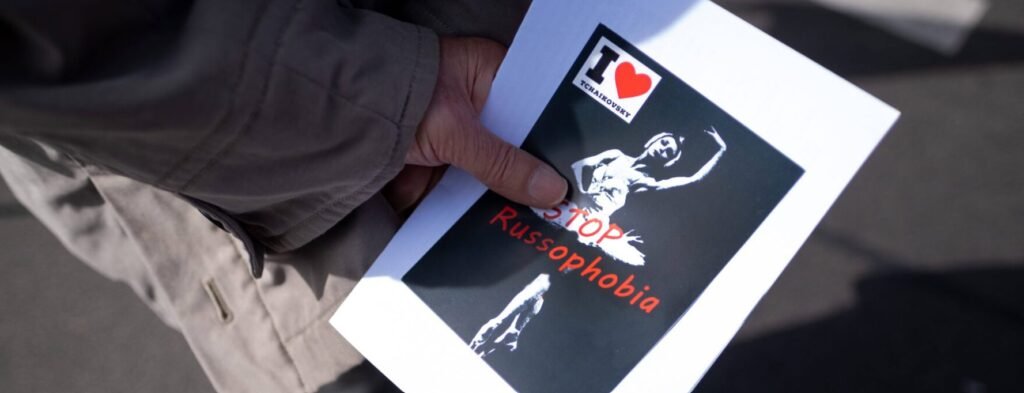
Rampant Russophobia takes us down a dangerous path

Joint demonstration of the trade unions on May Day in Berlin under the slogan Unbroken Solidarity. Photography K.M.Krause via Reuters

Anatol Lieven & George Beebe

August 23, 2023

A deeply sinister and dangerous tendency has made its appearance in Western writing about the war in Ukraine. This is the extension of hatred for the Putin regime and its crimes to the entire Russian people, the Russian national tradition, and Russian culture. This tendency is of course bitterly familiar from the history of hostile propaganda, but precisely for that reason we should have learned to shun it. The banning of Russian cultural events and calls for the “decolonization” of Russian literature and Russian studies recall the propaganda of all sides during the First World War, which did so much to embitter that war and make its peaceful resolution all but impossible. 

Originally published at Responsible Statecraft on June 21, 2023

The latest manifestation of this has been the successful pressure on American author Elizabeth Gilbert to cancel the publication of her latest book, not because it is in any way pro-Putin or pro-war, but merely because it is set in Russia. In another recent case, Masha Gessen, the U.S.-based Russian political émigré, fierce Putin critic and strong opponent of the Russian invasion, felt obliged to resign from the board of PEN America, created as a union of writers to defend free expression, after it barred two Russian writers — themselves emigres who had denounced the war.

The Chair of the Foreign Affairs Committee of the British parliament, Tom Tugendhat, has called for the expulsion of all Russian citizens from Britain, irrespective of their legal residency. The Czech president has referenced approvingly the internment of Japanese Americans during World War II.

Demonization of this sort is morally wrong in itself; it is generally intellectually wrong in its details; it is incompatible with liberal internationalism; it betrays pluralist democracy in Ukraine; it is disastrous for the future peace of Europe; it fuels the paranoia and violent self-righteous extremism that has done so much damage to U.S. policy over the years; and, by helping to block moves towards a reasonable settlement of the conflict, it increases the dangers to the United States, Europe, the world, and Ukraine itself that stem from a continuation of the war.

Perhaps craziest of all, while the people who express such feelings about Russia claim to be opposing the Putin regime, their actions and writings in fact provide better domestic propaganda for Putin than he himself could ever have devised.

A particularly egregious example of this sort of chauvinism was written last week by Peter Pomerantsev, whose Russian-speaking family emigrated from Soviet Ukraine when he was a baby, and who now lives in Britain. This article is worth paying attention to both for the wider tendency that it represents, and for where it appeared — in the British liberal newspaper The Guardian.

It is fair to say that The Guardian would never have published this kind of hate-filled attack on an entire people if it were directed at any other people but the Russians, and, if it had appeared elsewhere, The Guardian would have (correctly) denounced it as racism. Pomerantsev takes his cue from the destruction of the Kakhovka Dam, which he automatically blames on Russia — despite the fact that, as Kelley Vlahos pointed out in Responsible Statecraft, it remains completely unproven who blew up the dam, and the results could chiefly benefit either the Ukrainian or the Russian side. Adding a whole litany of exaggerated or wholly invented Russian atrocities, he uses this to declare that:

“Beneath the veneer of Russian military ‘tactics,’ you see the stupid leer of destruction for the sake of it…In Russia’s wars the very senselessness seems to be the sense…To Russian genocide add ecocide.”


Does “literary critic” Ogarkova really think that Dostoyevsky approved of Raskolnikov’s crime, and did not show him being justly punished for it? Or is she relying on a belief that her Western audience will be willing to hate Russian authors without having read them? Pomerantsev follows this up with an almost unbelievable passage:

“Ogarkova and Yermolenko note the difference between Hitler and Stalin: while Nazis had some rules about who they punished (non-Aryans; communists) in Stalin’s terror anyone could be a victim at any moment. Random violence runs through Russian history.”

This is the same old nauseating hypocrisy. They are nationalists; we are patriots. Their bombing of civilians reflects a blind urge to destruction rooted in their national character, ours is either purely accidental or an unfortunate part of a just struggle. Their torture of suspected enemies is due to their innate collective savagery. Ours is “not who we are.”

This is a classic example of what psychologists call the “fundamental attribution error” — the tendency to rationalize our own transgressions as the product of difficult circumstances, while explaining the sins of others as the result of their malevolent nature. 

In attributing Russian atrocities in Ukraine to permanent, quasi-racial aspects of the Russian national character, these writers seek to present Russia as uniquely mad and evil; whereas in fact the crimes committed by Russia during the Ukraine War have also been committed by several Western states in modern wars, the United States among them. Some were indeed wholly gratuitous. Others, as General Sherman reminded us, are innate to war itself. Pomerantsev and his like do not need to be professional historians to know that. They could simply watch the film “The Battle of Algiers,” or any good film about the Vietnam War.

Those who have attributed this to unique features of American and European traditional culture and called for the whole of that culture to be junked as a result, have been rightly rejected by majority opinion in these countries. Would anyone with an atom of decency or common sense suggest that we should not read Herman Melville and Nathaniel Hawthorne because the U.S. military bombed civilians in Vietnam and illegally invaded Iraq? 

It might be noted by the way that at the height of the Cold War, Hollywood produced films of “War and Peace” and “Dr. Zhivago,” and Soviet cinema produced fine versions of “Hamlet” and “King Lear.”

Eruptions like Pomerantsev’s in The Guardiancan be attributed to blind but understandable anger at Russia’s invasion and the destruction it has caused. However, they also have very practical and disastrous results. They not merely discourage the search for a compromise peace today, but by presenting Russia as permanently evil, they suggest that any future peaceful co-existence with any future Russian state will be morally wrong, and therefore should be permanently impossible.

In his great work “The Treason of the Intellectuals” (La Trahison des Clercs), written in the aftermath of the First World War, Julien Benda denounced the willingness of too many liberal intellectuals to succumb — whether from emotion or opportunism — to political and especially national hatred; and he warned, all too presciently, that this fostering of hatred could lead to still greater disasters in the years to come. He predicted that the 20th Century “will properly be called the century of the intellectual organization of political hatred.” 

We should take care that our descendants, if there are any, do not say that of the present century.

Originally published at Responsible Statecraft on June 21, 2023

About the authors

Anatol Lieven is the Director of the Eurasia Program at the Quincy Institute for Responsible Statecraft. He was formerly a professor at Georgetown University in Qatar and in the War Studies Department of King’s College London. He is a member of the advisory committee of the South Asia Department of the British Foreign and Commonwealth Office. He holds a BA and PhD from Cambridge University in England.

George Beebe is the Director of Grand Strategy at the Quincy Institute. He spent more than two decades in government as an intelligence analyst, diplomat, and policy advisor, including as director of the CIA’s Russia analysis and as a staff advisor on Russia matters to Vice President Cheney. His book, The Russia Trap: How Our Shadow War with Russia Could Spiral into Nuclear Catastrophe (2019), warned how the United States and Russia could stumble into a dangerous military confrontation.

Click here now. Thanks!

Share

Leave a Reply

Your email address will not be published. Required fields are marked *

Related Posts

Jan Oberg May 15, 2026 Go to this Fox News page and scroll the whole way down: President Donald Trump tells the world that his meeting with President Xi Jinping yielded a lot of very concrete political and economic results – of course, only where the Chinese side, according to him, agreed with him. He does not mention the Taiwan issue, but Secretary of State, Marco Rubio, says that it did not feature prominently in their talks and that the US policy on Taiwan has not changed. Then go to China Daily – or Global Times – and you will see that for the Chinese it is framework, principles, structure of cooperation etc. that matters – all embedded in the overall idea of “constructive bilateral relationship of strategic stability.” Nowhere is any concrete agreement or deal – all that Trump refers to – mentioned. At the general level, this gives you insights into the very different social...
Jan Oberg, TFF director April 9, 2026 I was recently invited to have a good, long talk about the world – and, of course, about peace too – with Boris Malagurski on his Weight of Chains Channel on YouTube. It was a real joy and seems to have been greatly appreciated by the viewers too. Mr Malagurski and I shall of course be grateful if you share this conversation in your circles – of course, only if you like what you see and hear  And remember that this one – like hundreds of others with TFF Associates – can be enjoyed at our TFF Video Collection.
By Jan ObergTFF co-founder and director February 11, 2026 PART 3 — ECONOMICS, TRADE & FINANCIAL SOVEREIGNTY A. Trade Measures & Market Signaling Economic pressure can be applied instantly and scaled without violence. Immediate Measures (within a week) Government boycott US goods and services  A very powerful signal which over time will be felt. Targeted tariffs on selected U.S. goods Symbolic but high-visibility sectors send a clear message. Suspend trade facilitation talks A peaceful pause that signals deep concern. Freeze U.S. participation in public procurement – military procurement in particular A nonviolent way to reduce influence. Competition law review of U.S. corporations A legal tool to scrutinise market dominance. Longer-Term Measures EU–Asia–Africa trade corridors Reducing reliance on U.S. markets. European supply chains for critical minerals Strategic autonomy in resource access. European Strategic Trade Authority Monitoring coercive practices globally. Euro-denominated commodity markets Weakening the dollar’s pricing monopoly. The EU must resume contacts and negotiations with Russia, focusing on energy cooperation To...

Recent Articles

Jan Oberg May 15, 2026 Go to this Fox News page and scroll the whole way down: President Donald Trump tells the world that his meeting with President Xi Jinping yielded a lot of very concrete political and economic results – of course, only where the Chinese side, according to him, agreed with him. He does not mention the Taiwan issue, but Secretary of State, Marco Rubio, says that it did not feature prominently in their talks and that the US policy on Taiwan has not changed. Then go to China Daily – or Global Times – and you will see that for the Chinese it is framework, principles, structure of cooperation etc. that matters – all embedded in the overall idea of “constructive bilateral relationship of strategic stability.” Nowhere is any concrete agreement or deal – all that Trump refers to – mentioned. At the general level, this gives you insights into the very different social...
Lena Petrova of “World Affairs In Context” with more than half a million subscribers on YouTube wanted to explore what a peace researcher like me has to say about, among other things, the First and the Second Cold War and why eethics has disappeared from politics. I am particularly happy about this conversation that also yielded an amazing number of very appreciative comments on YouTube. No doubt, people are longing for alternatives, including peace perspectives.
The MIMAC – Military-Industrial-Media-Academic Complex – drives the world’s rampant militarism and wars without end. Here is a short reflection of how it works against all interests of humanity. #5 deals with why there is no real enemy or threat images/analysis. It’s all ex-post constructions. And, btw, theTFF Peace Pulse is now on Rumble.

TFF on Substack

Discover more from TFF Transnational Foundation & Jan Oberg.

Most Popular

Jan Oberg May 15, 2026 Go to this Fox News page and scroll the whole way down: President Donald Trump tells the world that his meeting with President Xi Jinping yielded a lot of very concrete political and economic results – of course, only where the Chinese side, according to him, agreed with him. He does not mention the Taiwan issue, but Secretary of State, Marco Rubio, says that it did not feature prominently in their talks and that the US policy on Taiwan has not changed. Then go to China Daily – or Global Times – and you will see that for the Chinese it is framework, principles, structure of cooperation etc. that matters – all embedded in the overall idea of “constructive bilateral relationship of strategic stability.” Nowhere is any concrete agreement or deal – all that Trump refers to – mentioned. At the general level, this gives you insights into the very different social...
Lena Petrova of “World Affairs In Context” with more than half a million subscribers on YouTube wanted to explore what a peace researcher like me has to say about, among other things, the First and the Second Cold War and why eethics has disappeared from politics. I am particularly happy about this conversation that also yielded an amazing number of very appreciative comments on YouTube. No doubt, people are longing for alternatives, including peace perspectives.
The MIMAC – Military-Industrial-Media-Academic Complex – drives the world’s rampant militarism and wars without end. Here is a short reflection of how it works against all interests of humanity. #5 deals with why there is no real enemy or threat images/analysis. It’s all ex-post constructions. And, btw, theTFF Peace Pulse is now on Rumble.
Read More
Screenshot-2026-05-15-103534
Jan Oberg May 15, 2026 Go to this Fox News page and scroll the whole way down: President Donald Trump tells the world that his meeting with President Xi Jinping yielded a lot of very concrete political and economic results – of course, only where the Chinese side, according to him, agreed with him. He does not mention the Taiwan issue, but Secretary of State, Marco Rubio, says that it did not feature prominently in their talks and that the US policy on Taiwan has not changed. Then go to China Daily – or Global Times – and you will see that for the Chinese it is framework, principles, structure of cooperation etc. that matters – all embedded in the overall idea of “constructive bilateral relationship of strategic stability.” Nowhere is any concrete agreement or deal – all that Trump refers to – mentioned. At the general level, this gives you insights into the very different social...
Screenshot-2026-05-12-104023
Lena Petrova of “World Affairs In Context” with more than half a million subscribers on YouTube wanted to explore what a peace researcher like me has to say about, among other things, the First and the Second Cold War and why eethics has disappeared from politics. I am particularly happy about this conversation that also yielded an amazing number of very appreciative comments on YouTube. No doubt, people are longing for alternatives, including peace perspectives.
Screenshot-2026-04-13-154551 (2)
The MIMAC – Military-Industrial-Media-Academic Complex – drives the world’s rampant militarism and wars without end. Here is a short reflection of how it works against all interests of humanity. #5 deals with why there is no real enemy or threat images/analysis. It’s all ex-post constructions. And, btw, theTFF Peace Pulse is now on Rumble.
Screenshot-2026-04-13-154551 (1)
Jan Oberg, TFF director April 28, 2026 In this third TFF Peace Pulse, I make the important distinction between the violence and the conflict that violence is a symptom of. If you want peace, focus on the underlying conflict because that is the key to resolution, peacemaking, and a better future for the parties. The West is obsessed with violence, just look around you – and 90+ per cent of the public debate is about military issues and other violence – totally wasted for peace. These Peace Pulses will only be published here a few times. You will also not find them on YouTube and Vimeo because both platforms have blocked TFF and me; you know, peace is dangerous these days. Most TFF’s videos since 2007 are now on Rumble.
Screenshot-2026-04-13-154551
In contrast to most, we’ll bring alternatives, solutions, hope and strategies for a better future. Times are dangerous, yes, but that only intensifies the need for constructive thinking and action! Jan Oberg, TFF director April 13, 2026 The new TFF Peace Pulse uses video messages in a new way: Max 3-5-minute-long comments, ideas or perhaps mini-lectures, all about peace – positive peace. We launch them today on April 13, 2026 with a carefully crafted visual aesthetic fitting the content. We hope to publish them regularly from now on. We launch Peace Pulse (PP) – for a number of reasons. The world is in chaos, and there are countless reasons to feel concerned, frustrated, even angry. The atmosphere is saturated with doom and gloom, with negative energy and rear‑mirror thinking, while vision, imagination, alternatives, strategies and genuine future‑mindedness remain in short supply. And without them, we simply can’t save the world. Looking at problems from a hundred angles will...
IMG_5165 (1)
PART II — Publishing Peace in a System That Prioritises Militarism Jan Oberg, TFF director April 10, 2026 How TFF Maintains a Daily Voice in a Digital World Built for Noise This article is part of the series “TFF at 40″ and it invites you to learn about Four Decades of Publishing Peace. It takes a look at how a small, people‑financed peace foundation has communicated across four generations of technology — from wax stencils and fax machines to mass email and Substack — and why TFF continues to publish every single day in a system that rewards noise, conflict, and militarism. ◆ What it means to publish peace every single day in a digital system built for 24/7 news and other noise, confrontation, and militarism. How TFF’s independence, continuity, and global readership defy algorithms, donor cycles, and Western media censorhip — and why the Majority World keeps listening. When the...


