

PressInfo #225 - The Real Threat is Nuclear Terrorism

The four terrorist bombs that exploded in London on July 7, 2005, caused immense suffering and grief. This crime rightly received nearly universal condemnation. Violence does not solve any problems, it only aggravates them.

Yet this tragedy only foreshadows much worse future catastrophes if the world continues on its current course.
Tricycle and helmet found 1,500 m from hypocenter
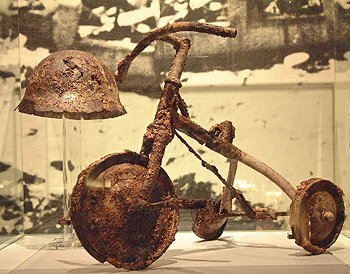
Tricycle and helmet found 1,500 m from hypocenter
Hiroshima Memorial Museum 
©
 Jan Oberg 2004

The trappings of nuclearism

As long as the big powers insist on maintaining nuclear weapons, claiming they need them to protect their security, they cannot expect to prevent other countries and terrorist organizations from acquiring such weapons–and some day using them.

The atomic bomb dropped on Hiroshima killed over 200,000 people.Today’s nuclear bombs are vastly more powerful. If even one nuclear device had been detonated in a parked car or a boat on the Thames, the Center of London would be strewn with smoking, radioactive rubble and over a million people might have been killed outright, and scores more would die slowly from radiation disease.

The double standard, “Nuclear weapons are good for us, but bad for you”, is stupid and unconvincing. Believing that nuclear weapons technology can be kept secret forever is naive.

Those who still believe in the fairy-tale of “deterrence theory” better wake up to the age of suicide bombers. Anyone convinced to go straight to paradise if blown up cannot be “deterred” by the threat of horrendous retaliation.

Governments that order tons of bombs to be rained on Iraq and Afghanistan should not be surprised if they plant ideas in the minds of eager imitators. Osama bin Laden once benefitted from support and training financed by the CIA.

Richard Falk, long a Professor of International Law at Princeton University, rightly pointed out: “The greatest utopians are those who call themselves ‘realists,’ because they falsely believe that we can survive the nuclear age with politics as usual. The true realists are those who recognize the need for change.”

Four changes we must make

What changes must we make if we want humanity to survive?

[1] We must stop believing that problems can be solved by applying offensive military force.

That only encourages others to pay back in kind. Policing to stop criminals, and defense against a foreign attack, are justified, but not military interventions abroad, except peacekeeping operations ordered by the UN security council to stop genocide or humanitarian disasters.

Hiroshima Memorial Dome © Jan Oberg 2004

[2] Thirty-seven years after signing the Nuclear Non-Proliferation Treaty, it is time for the nuclear powers to fulfill their commitment to nuclear disarmament.

We also need a vastly more open world, where all nuclear weapons are verifiably destroyed, and the manufacturing of new ones cannot be hidden.

The International Atomic Energy Agency (IAEA) can now inspect only sites that member countries voluntarily place under its supervision. If a suspected weapons smuggler could tell a border guard, “You may check under my seat, but don’t open the trunk,” such an “inspection” would be meaningless. The IAEA must have the power to inspect any suspected nuclear facilities, anywhere in the world, without advance warning, otherwise it is impossible to prevent the spread of nuclear weapons.

The governments that now possess nuclear weapons object to such intrusive inspections as a “violation of their sovereignty.” Yet many airline passengers also protested at first against having their luggage searched for guns or explosives, when such searches were introduced after a series of fatal hijackings. Today, passengers realize that such inspections protect their own security.

Those who have nothing to hide have nothing to fear. Sooner or later, governments will reach the same conclusion. The question is only whether this will happen before or after the first terrorist nuclear bomb explodes.

[3] We need to address the root causes of terrorism: long festering unresolved conflicts.

Particularly in situations of asymmetric power relations, the weaker side may be tempted to resort to random attacks against vulnerable targets of the more powerful antagonist, as in the 1970s the Red Brigades in Italy, the Red Army Faction in West Germany and the Irish Republican Army in Britain. More recently the Tamil Tigers have set off bombs in public places in their fight against the militarily superior Sri Lankan army and government. Today, car bombs explode almost daily in Iraq.

Of course, the killing of civilians with bombs dropped from the air, instead of being transported in cars and backpacks, also represents a form of “state terrorism” that stimulates violent popular resistance, which is then used as justification for an intensified hunt for terrorists, in a vicious cycle.

The meeting between President Franklin Delano Roosevelt and King Ibn Saud of Saudi Arabia aboard the cruiser USS Quincy in Egypt on 14 February 1945, in which Roosevelt committed the United States to support the Saudi Royal Family against internal opposition, in return for guaranteed access to oil, may partly explain why 15 of the 19 suicide bombers of 11 September 2001 in New York and Washington were Saudi citizens.

Arms exports to oppressive, dictatorial regimes produce dissatisfaction among those who suffer as a result.

The Middle East conflict, where Palestinians have lived for generations in refugee camps and suffer from high unemployment, is a breeding ground for suicide bombers.

At a broader level, a world economic system in which every day over 100,000 people, mostly children, die needlessly from hunger and preventable diseases, while there is enormous luxury and waste in wealthy countries, breeds discontent.

The fact that the United States has undertaken 67 foreign military interventions since World War II, in which an estimated 12 million people have been killed (3 million in vietnam alone) has not endeared it in many parts of the world.

Terrorism cannot be ended by killing terrorists. Doing so only enrages their admirers and provokes them to seek revenge. It is necessary to redress the sources of grievance and great injustice that drives people to sacrifice their own life in order to seek revenge.

The West must enter into dialogue with those who fight against it, to remove the motivation for resort to violence, including random violence against innocent citizens. The violence in the Northern Ireland conflict ended when the British government agreed to talks, instead of relying exclusively on the army to silence the grievances of the opposition.

[4] It is also important to transform conflicts peacefully before they erupt in violence.

This is a skill that can be taught and learned. For example, Johan Galtung, widely regarded as founder of the field of peace research, was able to help end a longstanding border conflict between Ecuador and Peru over which they had fought four wars by suggesting to make the disputed territory into a “binational zone with a natural park”, jointly administered. This peaceful intervention cost nearly nothing compared with a military peacekeeping operation.

We need a UN Organization for Mediation, with several hundred trained mediators who can help prevent conflicts from erupting into violence. This is a very inexpensive, worthwhile investment in human survival, compared with the trillion dollars the world spends each year to arm millions of troops, which only make the world collectively less secure.

If we cling to obsolete ways of thinking — that threatening others will make us safe –we face extinction as a human species, like other species that failed to adapt to new conditions.

It is realistic to get rid of nuclear weapons

Is it a realistic prospect to get rid of all nuclear weapons? Certainly more realistic than waiting until they are used, whether deliberately or by accident.

Some have argued that we cannot disinvent nuclear weapons and therefore will have to live with them as long as civilization exists. But nobody has disinvented cannibalism either, we have simply learned to abhor it.

Can’t we learn to abhor equally the incineration of entire cities with nuclear weapons?

Dietrich Fischer, a TFF Associate, is Academic Director of the European University Center for Peace Studies in Stadtschlaining, Austria, and Co-Director of TRANSCEND, a peace and development network.

© TFF and the author 2005

Share

Leave a Reply

Your email address will not be published. Required fields are marked *

Related Posts

“En dag som berättigar till fest”, utropade den London-baserade al-Quds al-Arabi efter FN:s eldupphörresolution, “eftersom detta är första gången som Israel accepterar ett FN-beslut från en position som besegrad och inte som segrare”. Att ett arabisk-israeliskt krig för en gångs skull slutat med arabisk seger, är en helt dominerade åsikt i arabiska medier. Al-Quds al-Arabi tillåter sig att drömma om att det israeliska nederlaget skall leda till massflykt från Israel. Men i nästa andetag påminner tidningen om att Israel aldrig brukar genomföra sina internationella åtaganden och varnar för att förlorarna, liksom tidigare, kan hämnas genom att provocera fram inbördeskrig i Libanon. Med tanke på de otaliga massmediala vittnesmålen om det libanesiska folkets eniga motståndskraft förefaller risken för inre stridigheter i det sargade landet just nu liten. Men visst kan man urskilja nyansskillnader i libanesiska tidningar. Vänsterorganet al-Safir uppfattar FN-resolutionen som en komplott i syfte att rädda Israel från ännu större...
A friendly quarrel while we agree that the US sanctions are a weapon of mass destruction and kill more people than wars do. And that we must talk much more about sanctions than we have so far. Jan Oberg, TFF director March 16, 2026 John Mearsheimer recently stated that U.S. sanctions murdered around 38 million people between 1971 and 2021 – see the video below. It is a dramatic figure, and it has spread quickly because it captures, in one sentence, the enormous human cost of modern sanctions. I share his concern about the destructive effects of economic coercion. But the specific number he cites — and the way he attributes it — deserves a friendly academic clarification. The figure comes from a 2023 Lancet Global Health article estimating the mortality effects of unilateral U.S. and EU sanctions over the past half‑century. This is the first point where Mearsheimer’s shorthand diverges from the text: the study...
Jan Oberg May 15, 2026 Go to this Fox News page and scroll the whole way down: President Donald Trump tells the world that his meeting with President Xi Jinping yielded a lot of very concrete political and economic results – of course, only where the Chinese side, according to him, agreed with him. He does not mention the Taiwan issue, but Secretary of State, Marco Rubio, says that it did not feature prominently in their talks and that the US policy on Taiwan has not changed. Then go to China Daily – or Global Times – and you will see that for the Chinese it is framework, principles, structure of cooperation etc. that matters – all embedded in the overall idea of “constructive bilateral relationship of strategic stability.” Nowhere is any concrete agreement or deal – all that Trump refers to – mentioned. At the general level, this gives you insights into the very different social...

Recent Articles

“En dag som berättigar till fest”, utropade den London-baserade al-Quds al-Arabi efter FN:s eldupphörresolution, “eftersom detta är första gången som Israel accepterar ett FN-beslut från en position som besegrad och inte som segrare”. Att ett arabisk-israeliskt krig för en gångs skull slutat med arabisk seger, är en helt dominerade åsikt i arabiska medier. Al-Quds al-Arabi tillåter sig att drömma om att det israeliska nederlaget skall leda till massflykt från Israel. Men i nästa andetag påminner tidningen om att Israel aldrig brukar genomföra sina internationella åtaganden och varnar för att förlorarna, liksom tidigare, kan hämnas genom att provocera fram inbördeskrig i Libanon. Med tanke på de otaliga massmediala vittnesmålen om det libanesiska folkets eniga motståndskraft förefaller risken för inre stridigheter i det sargade landet just nu liten. Men visst kan man urskilja nyansskillnader i libanesiska tidningar. Vänsterorganet al-Safir uppfattar FN-resolutionen som en komplott i syfte att rädda Israel från ännu större...
Greenland – the world’s largest island, a continent of its own with only 57.000 inhabitants. I visited it for the first time in May 2005. I flew across the inland ice to Nuuk, the tiny capital with some 14.000 inhabitants. I was overwhelmed by the pride and kindness of everyone I met as well as by the unique natural beauty. Unfortunately, due to weather conditions during my ten-day stay I could get nowhere else but Nuuk. Fortunately, however, among those I met was Gitte Arvegaard, a Danish lawyer and negotiator employed by the local government, Greenland Home Rule. She turned out to be an enthusiastic photographer with a lot of pictures taken during various trips around Greenland. So this Greeland series is the result of our cooperative effort. We both hope you enjoy it and are stimulated to visit Greenland – about which you may read more here. Finally, if you want to...
 Jan Oberg’s storyof how he met Sir Paul Liverpool – where else to meet Paul McCartney? Paul’s old class mate and TFF Associate, Jonathan Power introduced me to Paul McCartney in Liverpool at an informal reception. It was held at what used to be their school, now the Liverpool Institute for Performing Arts and we were there to celebrate that Jonathan had written Amnesty International’s 40th Anniversary book. This happy event for “righting wrongs and writing songs” gave me an opportunity to meet Paul and tell him about TFF and get straight to the matter: would he consider making a donation in support of our work for peace? While I was probably the only one with such a wish that day, I was certainly not the only one who wanted to shake hands and talk with him. In the last minutes before Paul was to leave, Jonathan brought us together and we got about three...

TFF on Substack

Discover more from TFF Transnational Foundation & Jan Oberg.

Most Popular

“En dag som berättigar till fest”, utropade den London-baserade al-Quds al-Arabi efter FN:s eldupphörresolution, “eftersom detta är första gången som Israel accepterar ett FN-beslut från en position som besegrad och inte som segrare”. Att ett arabisk-israeliskt krig för en gångs skull slutat med arabisk seger, är en helt dominerade åsikt i arabiska medier. Al-Quds al-Arabi tillåter sig att drömma om att det israeliska nederlaget skall leda till massflykt från Israel. Men i nästa andetag påminner tidningen om att Israel aldrig brukar genomföra sina internationella åtaganden och varnar för att förlorarna, liksom tidigare, kan hämnas genom att provocera fram inbördeskrig i Libanon. Med tanke på de otaliga massmediala vittnesmålen om det libanesiska folkets eniga motståndskraft förefaller risken för inre stridigheter i det sargade landet just nu liten. Men visst kan man urskilja nyansskillnader i libanesiska tidningar. Vänsterorganet al-Safir uppfattar FN-resolutionen som en komplott i syfte att rädda Israel från ännu större...
Greenland – the world’s largest island, a continent of its own with only 57.000 inhabitants. I visited it for the first time in May 2005. I flew across the inland ice to Nuuk, the tiny capital with some 14.000 inhabitants. I was overwhelmed by the pride and kindness of everyone I met as well as by the unique natural beauty. Unfortunately, due to weather conditions during my ten-day stay I could get nowhere else but Nuuk. Fortunately, however, among those I met was Gitte Arvegaard, a Danish lawyer and negotiator employed by the local government, Greenland Home Rule. She turned out to be an enthusiastic photographer with a lot of pictures taken during various trips around Greenland. So this Greeland series is the result of our cooperative effort. We both hope you enjoy it and are stimulated to visit Greenland – about which you may read more here. Finally, if you want to...
 Jan Oberg’s storyof how he met Sir Paul Liverpool – where else to meet Paul McCartney? Paul’s old class mate and TFF Associate, Jonathan Power introduced me to Paul McCartney in Liverpool at an informal reception. It was held at what used to be their school, now the Liverpool Institute for Performing Arts and we were there to celebrate that Jonathan had written Amnesty International’s 40th Anniversary book. This happy event for “righting wrongs and writing songs” gave me an opportunity to meet Paul and tell him about TFF and get straight to the matter: would he consider making a donation in support of our work for peace? While I was probably the only one with such a wish that day, I was certainly not the only one who wanted to shake hands and talk with him. In the last minutes before Paul was to leave, Jonathan brought us together and we got about three...
Read More
Imagen-thumbnail-The-Transnational-1
“En dag som berättigar till fest”, utropade den London-baserade al-Quds al-Arabi efter FN:s eldupphörresolution, “eftersom detta är första gången som Israel accepterar ett FN-beslut från en position som besegrad och inte som segrare”. Att ett arabisk-israeliskt krig för en gångs skull slutat med arabisk seger, är en helt dominerade åsikt i arabiska medier. Al-Quds al-Arabi tillåter sig att drömma om att det israeliska nederlaget skall leda till massflykt från Israel. Men i nästa andetag påminner tidningen om att Israel aldrig brukar genomföra sina internationella åtaganden och varnar för att förlorarna, liksom tidigare, kan hämnas genom att provocera fram inbördeskrig i Libanon. Med tanke på de otaliga massmediala vittnesmålen om det libanesiska folkets eniga motståndskraft förefaller risken för inre stridigheter i det sargade landet just nu liten. Men visst kan man urskilja nyansskillnader i libanesiska tidningar. Vänsterorganet al-Safir uppfattar FN-resolutionen som en komplott i syfte att rädda Israel från ännu större...
Greenland – the world’s largest island, a continent of its own with only 57.000 inhabitants. I visited it for the first time in May 2005. I flew across the inland ice to Nuuk, the tiny capital with some 14.000 inhabitants. I was overwhelmed by the pride and kindness of everyone I met as well as by the unique natural beauty. Unfortunately, due to weather conditions during my ten-day stay I could get nowhere else but Nuuk. Fortunately, however, among those I met was Gitte Arvegaard, a Danish lawyer and negotiator employed by the local government, Greenland Home Rule. She turned out to be an enthusiastic photographer with a lot of pictures taken during various trips around Greenland. So this Greeland series is the result of our cooperative effort. We both hope you enjoy it and are stimulated to visit Greenland – about which you may read more here. Finally, if you want to...
p_mccartney_poem
 Jan Oberg’s storyof how he met Sir Paul Liverpool – where else to meet Paul McCartney? Paul’s old class mate and TFF Associate, Jonathan Power introduced me to Paul McCartney in Liverpool at an informal reception. It was held at what used to be their school, now the Liverpool Institute for Performing Arts and we were there to celebrate that Jonathan had written Amnesty International’s 40th Anniversary book. This happy event for “righting wrongs and writing songs” gave me an opportunity to meet Paul and tell him about TFF and get straight to the matter: would he consider making a donation in support of our work for peace? While I was probably the only one with such a wish that day, I was certainly not the only one who wanted to shake hands and talk with him. In the last minutes before Paul was to leave, Jonathan brought us together and we got about three...
Logo-Transnational
1942James Paul McCartney is born in Liverpool on June 18th. 1956Paul writes his first song, I Lost My Little Girl. 1957Paul meets John Lennon at St. Peter’s Church Fete, Woolton, Liverpool. He joins his first group, The Quarrymen and performs in his first gig at The New Clubmoor Hall, Liverpool, on October 18th. 1960Formation of The Beatles, who play residencies in Hamburg and at The Cavern in Liverpool. 1961First Beatles recordings issued in Germany, as the backing group for Tony Sheridan. 1962The first Beatles Parlophone recording, Love Me Do, reaches number 17 in the British charts. 1963The birth of Beatlemania. Please Please Me gives the group their first British Number 1. She Loves You cements their success. Please Please Me and With The Beatles albums released. 1964First triumphant American tour. The Beatles perform at the Royal Command Performance and release their first film, A Hard Day’s Night. Their single I...
Logo-Transnational
  Back to the series “Bujumbura, Burundi”
By JONATHAN POWER August 16, 2000 LONDON – Remember the summer of ’98? In the sweltering, torpid heat of a Roman august, charged with exhaust fumes, the international community gave its overwhelming approval to the establishment of an International Criminal Court that will enable those accused of “crimes against humanity” to be tried and, if convicted, sentenced. Only seven nations opposed or abstained from the motion, including Israel, China, India and the U.S.A. where the Pentagon had successfully waged bureaucratic guerrilla war to undermine the initially sympathetic stance of President Bill Clinton. Two years on we can now see what an epochal event that was. In a the stroke of 120 pens it changed the climate on political thuggery. After numerous half-starts and false starts ever since the Nuremberg and Tokyo trials that convicted the war criminals of the Second World War, the world at last had agreed en masse a common...


