

Peace Studies: Inspiration, Objectives, Achievement

The 1987 Right Livelihood Award Acceptance Speech

 Peace appeals to the hearts; studies to the brain. Both are needed, indeed indispensable. But equally indispensable is a valid link between brain and heart.

The history of peace studies is, of course, a collective story, and it did not start in the 1950s – it is as old as humankind, as is the history of war studies, the study of war with warlike means.

Originally published at Transcend

I guess the same applies to what today is called security studies, or the study of peace with warlike means, balance of power, balance of terror, deterrence through credible retaliation etc. Needless to say, that is not what peace studies are about.

Peace studies are about peace with peaceful means, and I think it is generally accepted today that this has to be done in a holistic manner and with a global perspective, or – with more narrow terminology – interdisciplinary and international.

I am asked to say something about what brought me into this field. And it is quickly done. I owe it to three factors that loomed large when I was 18 years old:

  • The Norwegian military and the institution of general conscription – to that little letter calling on me to serve in the armed forces of my country, a founding NATO country, tied to one of the world’s superpowers.
  • A very gentle, very sweet and very cultured father who had spoilt his only son for many years by always permitting me, even encouraging me to ask that essential question why and patiently trying to answer increasingly inquisitive inquiries.
  • The German occupation of Norway 1940-45, soldiers with Gott mit uns, that same god they praise in Norway, on their buckles, leaving all Norwegians with two basic questions: what do we do to avoid anything like this in the future? And, if we should be occupied again, is there a nonviolent, peaceful alternative to armed resistance? Two questions, that had added urgency to me because my father one night in February 1944 was hauled off to a concentration camp from which he returned when the war was over, but marked by the experience.

So, nothing mysterious, simple sources of inspiration. When after three years of reflection on this I finally applied for status as conscientious objector, I added as an afterthought that I would like to devote my life to peace studies, a term hardly with any meaning, including to me.

However, by that time I had read quite a lot of literature that was not included in the mathematics curriculum I was supposed to study, like Gandhi, Freud, Einstein etc.

Out of sheer tenacity I nevertheless finally got my PhD in mathematics. And had become a very poor mathematician indeed working on some mathematics that has never been heard from since, but a reasonably good peace researcher.

So much for inspiration. What about objectives?

They are two, neither of them modest.

The first is the goal and it is exactly the same as for the peace movement: the abolition of war as a social institution. It sounds naive, doesn’t it? Well, so did the talk of those people who wanted to abolish slavery as a social institution, and those who wanted to abolish colonialism as a social institution – they were all told they were working against something very dark and mysterious called human nature.

And yet they somehow succeeded; there are still elements of slavery and colonialism around, but not as legitimate social institutions, and that is a very basic point. For this to happen alternatives have to be found. And this is a very sticky point.

In one sense plantation colonialism was the alternative to slavery, and neo-colonialism of the Third world the alternative to colonialism, both highly unacceptable.

A peace researcher should be mindful of this point lest we end up with an equally unacceptable alternative to war, something that could qualify for the fourth and missing category above: War with peaceful means. A world government referring to its belligerence as police action, for instance?

The second is more like a means: to make peace studies academically acceptable. Here great progress has been made from the first beginnings in the late 1950s.

Peace studies are taught at more than one hundred universities and colleges in the US, for instance. More importantly: we have something to teach, a great pool of knowledge on which the two important qualifiers, holistic and global, may increasingly be applied – not to the single piece of research, but to the totality.

In short, we have something to teach. Hence, it is very obvious what the next step is: degrees in peace studies, from as many universities in the world as possible.

We need thousands of them, holding an MPS, Master of Peace Studies diploma, serving international organizations, governmental and nongovernmental, transnational corporations with a conscience – and they exist governments with a conscience and they also exist, voluntary organizations such as religious bodies and trade unions and above all that new major peace actor on the world scene: the municipality.

And, if this list is still not convincing: think of the many positions that have to be opened to teach peace studies at the level of elementary schools and high schools!

Time has passed when peace studies could only lead to more peace studies as a job opportunity – but there is still much work to do. The School of Peace Studies at Bradford University has blazed the trail, the United Nations University for Peace in Costa Rica does important work in the same direction, so does the Section for peace research at Uppsala University, and the Peace and Conflict Studies program at University of California, Berkeley, just to mention some.

But much, much more is needed and at a much larger scale. A major task for an institution like the University of Hawaii for the Pacific Hemisphere, or the Austrian Peace Research and Education Institute for the European region. For this can only be done at places with an imaginative, creative leadership.

Let me try at this point to give a very brief summary of where we stand in peace studies – in my view. If peace is the reduction of violence, like the abolition of war and related phenomena, then we have to start with a better conceptualization of violence than the word “war” alone. I have found it useful to distinguish between three types of violence:

  • Direct Violence, often expressed as military power, usually killing quickly, and intended to do so;
  • Structural Violence, often expressed as economic power, usually unintended, killing slowly;
  • Cultural Violence, often expressed as cultural power, legitimizing the other two types of power, telling those who wield power that they have a right to do so, even a duty – for instance because the victims of direct and/or structural power are pagans, savages, atheists, kulaks, communists, what not.
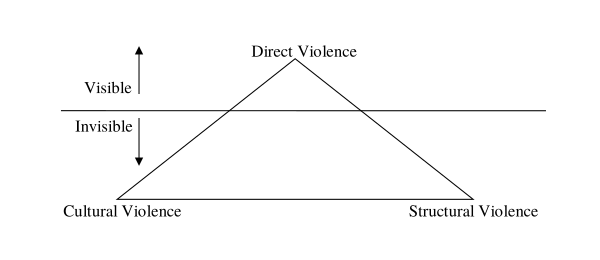
I have come to see the first two as relatively simple. There are ways of reducing large-scale abuses of military and economic power, such as deterrence through non-provocative, defensive defense as an alternative to the long range weapons systems underlying deterrence by retaliation which to the other side looks suspiciously like an offensive capability.

And there are ways of reducing large-scale abuses of economic power through economic self-reliance, at the regional (Third World), national and local levels, using own production factors rather than becoming dependent on somebody else (“internalizing externalities and “sharing externalities equally” would be the more technical formulations). Rethinking military and economic science!

But cultural violence, in the form of religions and ideologies that announce themselves as the only valid faiths, for the whole world and in addition with a Chosen People appointed to spread that faith to others, not only as a right, but as a duty, is more difficult to handle.

Here we are touching a cornerstone of many people’s identity; a lie, for sure, but as Ibsen said, take that lie away from the average person and you remove his happiness at the same time. Would that not itself be violence? A key problem for peace studies, certainly not solved by rejecting it.

I let that do as examples, hopefully appetizing. Peace appeals to the heart; studies to the brain. Both are needed, indeed indispensable.

But equally indispensable is a valid link between brain and heart. And that, in a nutshell, is what peace studies and peace practice are all about.

Originally published at Transcend
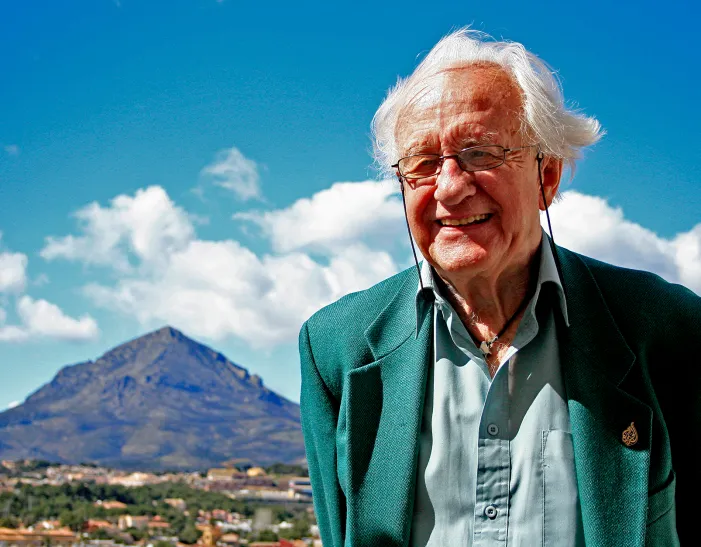
Johan Galtung, a professor of peace studies, dr hc mult, is founder of TRANSCEND International and rector of TRANSCEND Peace University. He was awarded among others the 1987 Right Livelihood Award, known as the Alternative Nobel Peace Prize (see above). Galtung has mediated in over 150 conflicts in more than 150 countries, and written more than 170 books on peace and related issues, 96 as the sole author. More than 40 have been translated to other languages, including 50 Years-100 Peace and Conflict Perspectives published by TRANSCEND University Press.
His book, Transcend and Transform, was translated into 25 languages. He has published more than 1700 articles and book chapters and over 500 editorials for TRANSCEND Media Service
More information about Prof. Galtung and all of his publications can be found at transcend.org/galtung. Johan is also a TFF Associate since 1986.

Please help TFF remain truly independent by contributing if you benefited from this article

[paypal-donation]
Share

Leave a Reply

Your email address will not be published. Required fields are marked *

Related Posts

Lena Petrova of “World Affairs In Context” with more than half a million subscribers on YouTube wanted to explore what a peace researcher like me has to say about, among other things, the First and the Second Cold War and why eethics has disappeared from politics. I am particularly happy about this conversation that also yielded an amazing number of very appreciative comments on YouTube. No doubt, people are longing for alternatives, including peace perspectives.
The MIMAC – Military-Industrial-Media-Academic Complex – drives the world’s rampant militarism and wars without end. Here is a short reflection of how it works against all interests of humanity. #5 deals with why there is no real enemy or threat images/analysis. It’s all ex-post constructions. And, btw, theTFF Peace Pulse is now on Rumble.
Jan Oberg, TFF director April 28, 2026 In this third TFF Peace Pulse, I make the important distinction between the violence and the conflict that violence is a symptom of. If you want peace, focus on the underlying conflict because that is the key to resolution, peacemaking, and a better future for the parties. The West is obsessed with violence, just look around you – and 90+ per cent of the public debate is about military issues and other violence – totally wasted for peace. These Peace Pulses will only be published here a few times. You will also not find them on YouTube and Vimeo because both platforms have blocked TFF and me; you know, peace is dangerous these days. Most TFF’s videos since 2007 are now on Rumble.

Recent Articles

Jan Oberg May 15, 2026 Go to this Fox News page and scroll the whole way down: President Donald Trump tells the world that his meeting with President Xi Jinping yielded a lot of very concrete political and economic results – of course, only where the Chinese side, according to him, agreed with him. He does not mention the Taiwan issue, but Secretary of State, Marco Rubio, says that it did not feature prominently in their talks and that the US policy on Taiwan has not changed. Then go to China Daily – or Global Times – and you will see that for the Chinese it is framework, principles, structure of cooperation etc. that matters – all embedded in the overall idea of “constructive bilateral relationship of strategic stability.” Nowhere is any concrete agreement or deal – all that Trump refers to – mentioned. At the general level, this gives you insights into the very different social...
Lena Petrova of “World Affairs In Context” with more than half a million subscribers on YouTube wanted to explore what a peace researcher like me has to say about, among other things, the First and the Second Cold War and why eethics has disappeared from politics. I am particularly happy about this conversation that also yielded an amazing number of very appreciative comments on YouTube. No doubt, people are longing for alternatives, including peace perspectives.
The MIMAC – Military-Industrial-Media-Academic Complex – drives the world’s rampant militarism and wars without end. Here is a short reflection of how it works against all interests of humanity. #5 deals with why there is no real enemy or threat images/analysis. It’s all ex-post constructions. And, btw, theTFF Peace Pulse is now on Rumble.

TFF on Substack

Discover more from TFF Transnational Foundation & Jan Oberg.

Most Popular

Jan Oberg May 15, 2026 Go to this Fox News page and scroll the whole way down: President Donald Trump tells the world that his meeting with President Xi Jinping yielded a lot of very concrete political and economic results – of course, only where the Chinese side, according to him, agreed with him. He does not mention the Taiwan issue, but Secretary of State, Marco Rubio, says that it did not feature prominently in their talks and that the US policy on Taiwan has not changed. Then go to China Daily – or Global Times – and you will see that for the Chinese it is framework, principles, structure of cooperation etc. that matters – all embedded in the overall idea of “constructive bilateral relationship of strategic stability.” Nowhere is any concrete agreement or deal – all that Trump refers to – mentioned. At the general level, this gives you insights into the very different social...
Lena Petrova of “World Affairs In Context” with more than half a million subscribers on YouTube wanted to explore what a peace researcher like me has to say about, among other things, the First and the Second Cold War and why eethics has disappeared from politics. I am particularly happy about this conversation that also yielded an amazing number of very appreciative comments on YouTube. No doubt, people are longing for alternatives, including peace perspectives.
The MIMAC – Military-Industrial-Media-Academic Complex – drives the world’s rampant militarism and wars without end. Here is a short reflection of how it works against all interests of humanity. #5 deals with why there is no real enemy or threat images/analysis. It’s all ex-post constructions. And, btw, theTFF Peace Pulse is now on Rumble.
Read More
Screenshot-2026-05-15-103534
Jan Oberg May 15, 2026 Go to this Fox News page and scroll the whole way down: President Donald Trump tells the world that his meeting with President Xi Jinping yielded a lot of very concrete political and economic results – of course, only where the Chinese side, according to him, agreed with him. He does not mention the Taiwan issue, but Secretary of State, Marco Rubio, says that it did not feature prominently in their talks and that the US policy on Taiwan has not changed. Then go to China Daily – or Global Times – and you will see that for the Chinese it is framework, principles, structure of cooperation etc. that matters – all embedded in the overall idea of “constructive bilateral relationship of strategic stability.” Nowhere is any concrete agreement or deal – all that Trump refers to – mentioned. At the general level, this gives you insights into the very different social...
Screenshot-2026-05-12-104023
Lena Petrova of “World Affairs In Context” with more than half a million subscribers on YouTube wanted to explore what a peace researcher like me has to say about, among other things, the First and the Second Cold War and why eethics has disappeared from politics. I am particularly happy about this conversation that also yielded an amazing number of very appreciative comments on YouTube. No doubt, people are longing for alternatives, including peace perspectives.
Screenshot-2026-04-13-154551 (2)
The MIMAC – Military-Industrial-Media-Academic Complex – drives the world’s rampant militarism and wars without end. Here is a short reflection of how it works against all interests of humanity. #5 deals with why there is no real enemy or threat images/analysis. It’s all ex-post constructions. And, btw, theTFF Peace Pulse is now on Rumble.
Screenshot-2026-04-13-154551 (1)
Jan Oberg, TFF director April 28, 2026 In this third TFF Peace Pulse, I make the important distinction between the violence and the conflict that violence is a symptom of. If you want peace, focus on the underlying conflict because that is the key to resolution, peacemaking, and a better future for the parties. The West is obsessed with violence, just look around you – and 90+ per cent of the public debate is about military issues and other violence – totally wasted for peace. These Peace Pulses will only be published here a few times. You will also not find them on YouTube and Vimeo because both platforms have blocked TFF and me; you know, peace is dangerous these days. Most TFF’s videos since 2007 are now on Rumble.
Screenshot-2026-04-13-154551
In contrast to most, we’ll bring alternatives, solutions, hope and strategies for a better future. Times are dangerous, yes, but that only intensifies the need for constructive thinking and action! Jan Oberg, TFF director April 13, 2026 The new TFF Peace Pulse uses video messages in a new way: Max 3-5-minute-long comments, ideas or perhaps mini-lectures, all about peace – positive peace. We launch them today on April 13, 2026 with a carefully crafted visual aesthetic fitting the content. We hope to publish them regularly from now on. We launch Peace Pulse (PP) – for a number of reasons. The world is in chaos, and there are countless reasons to feel concerned, frustrated, even angry. The atmosphere is saturated with doom and gloom, with negative energy and rear‑mirror thinking, while vision, imagination, alternatives, strategies and genuine future‑mindedness remain in short supply. And without them, we simply can’t save the world. Looking at problems from a hundred angles will...
IMG_5165 (1)
PART II — Publishing Peace in a System That Prioritises Militarism Jan Oberg, TFF director April 10, 2026 How TFF Maintains a Daily Voice in a Digital World Built for Noise This article is part of the series “TFF at 40″ and it invites you to learn about Four Decades of Publishing Peace. It takes a look at how a small, people‑financed peace foundation has communicated across four generations of technology — from wax stencils and fax machines to mass email and Substack — and why TFF continues to publish every single day in a system that rewards noise, conflict, and militarism. ◆ What it means to publish peace every single day in a digital system built for 24/7 news and other noise, confrontation, and militarism. How TFF’s independence, continuity, and global readership defy algorithms, donor cycles, and Western media censorhip — and why the Majority World keeps listening. When the...


