
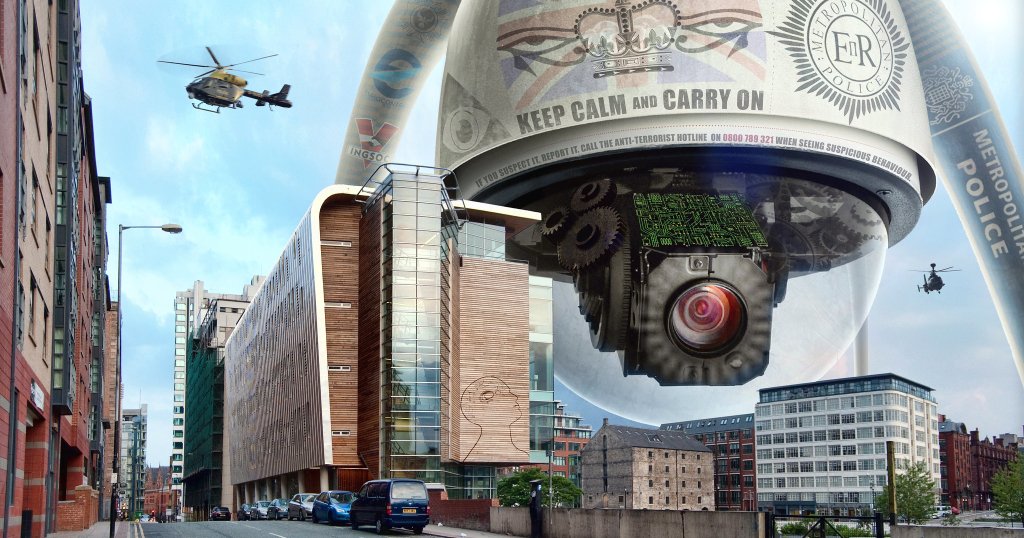
Normalising the exceptional as a serious security threat

Jørgen Johansen argues that, like terrorism before it, the Covid-19 pandemic is being used by politicians across the world to normalise exceptional restrictions on basic rights with political consequences that will long outlast the health emergency.

In his book State of Exception, Giorgio Agamben examined the consequences of policies and regulations introduced in exceptional circumstances, which then become institutionalised as ’normal’, the state of exception becomes the rule.

An illustration might be the USA’s Patriot Act of 2001, enacted after the 9/11 attack, which resulted in a massive expansion of government surveillance.

Likewise, the Guantanamo Bay detention camp set up in 2002 as part of George W. Bush’s war on terror, where detainees have been held for indefinite periods without trial and subjected to torture.

Originally published at rethinkingsecurity.org

Proponents of such exceptional measures justified them by reference to the extraordinary context in which they were introduced – they were deemed necessary to save the lives of tens of thousands of innocent people around the world.

But over time they have become ’normalised’, they have gained a certain level of acceptance as the state of emergency in which they were introduced has been prolonged.

Moreover, such practices have been ’extended’ to apply to other perceived threats. So we have learned of the many secret prisons set up by the CIA as part of the war on terror at black sites around the globe, where prisoners were subjected to regimes of torture that were in contravention of all the norms and regulations of international law.  

We have seen how the definition of acts of terror has expanded over time, until today it includes ‘economic terrorism’ – actions by transnational or non-state actors to disrupt the economic and financial stability of a state, as defined at a round-table held at the Geneva Centre for Security Policy in 2005. 

Such a broad definition, of course, helps legitimate the Israeli government’s attempts to undermine the global movement for boycott, divestment and sanctions (BDS) by branding such action a form of terrorism.

When a campaign urging us not to buy products from illegal settlements is defined as an act of terror we know we are in abnormal ‘normal times’.

Covid-19 and state surveillance

A similar ‘normalisation of the exceptional’ is now seen in the extreme means being used to track people infected by the virus leading to Covid-19. New tools developed by states and the surveillance industry have been approved and deemed necessary and legitimate by legislators, health professionals, scientific bodies and police forces around the world.  

A pandemic is by definition a global threat. As such it will dominate all sorts of media. As consumption of news from media without the traditional editorial responsibilities (so called ‘social media’) grows, and more serious outlets get a smaller audience, the information presented about the threats can often convey an unrealistic portrayal of the dangers involved.

Conspiracy theories flow freely around the web and are regularly backed up by re-tweets from state leaders and other people in influential positions.

The result is a fear that might be perceived as out-of-proportion compared with other causes of death.

And, of course, when people are afraid they are likely to accept ever-more infringements on their civil liberties as necessary, in order to keep the threats within reasonable limits.

We see politicians all over the world supporting a number of proposals for new legislation that directly threaten open and democratic societies.

What they have got approval to use in these times of political panic will certainly be used for very different purposes in the future.

Secret services and special police forces in many countries are employing huge programmes for mobile data tracking, apps to record personal contact with others, CCTV networks equipped with facial recognition,forms to be completed before you can go outside, and drones to enforce social isolation regimes.

Such methods have been adopted by authoritarian states and democracies alike and have opened lucrative new markets for companies that extract, sell, and analyse private data.

Some even brag about it. In a Washington Post  op-ed (20 April 2020), Mark Zuckerberg from Facebook referred to an opt-in symptom survey being shown on Facebook that could help researchers at Carnegie Mellon University to forecast Covid-19 cases, based on location.

If successful, the project would offer county-by-county insights and be eminently useful to public health officials and hospitals that need to prepare for potential surges in patients.

Surely such extraordinary surveillance is justified if it helps control and manage the virus?

Exceptionalism and technology

But history is full of cases where extraordinary situations have opened the doors to the use of exceptional means, and they have a tendency to stick with our societies long into the future. New means of control easily become normalised, and get used in situations and circumstances far removed from those anticipated at the time of their introduction.

The problem with normalising the exceptional arises in particular when the technology and associated rules of use are applied to political surveillance. Then it becomes a threat to all sorts of social movements, political campaigns and nonviolent actions.

Looking back in history we can just imagine the consequences of these powerful surveillance tools in the hands of Hitler, Mussolini, Mao, Stalin or the apartheid regime in South Africa.

Who knows how the political map of the world will change over the next few decades?

Throughout Europe and beyond there are neo-fascist, ultra-nationalist political movements emerging – Jobbik in Hungary, National Revival of Poland, the Lega in Italy, Vox in Spain and similar parties marching in the streets in far too many countries around the world.

Parliaments full of Alternative für Deutschland-type politicians seem certain to employ the surveillance systems developed to track and trace Covid-19 cases as a means of tackling their political opponents and critics.

Contact tracing might be helpful to map contagious diseases, but what about when it is used for mapping activist networks of today and the future?

With right-wing populist politicians marching and entering so many parliaments in the world there is a difficult task ahead to prevent the same tools from being used to identify ‘troublemakers’ who do not share their views of how society should be organised.

It is in theory impossible to un-invent a tool or prevent it from being used for a different purpose than originally intended.

Biopolitics and freedom

The seeds of an upsurge in the enduring conflict between ‘effective policing’ and the protection of civil rights, individual integrity, and political freedom are being laid by well-meaning liberal and democratic-minded politicians who uncritically endorse new legislation and associated technologies that can easily be misused.

We need to think seriously about how to make these tools less open to misuse.

In this endeavour we should bear in mind the cautionary insight of the German sociologist Max Weber regarding the cultural consequences of secularisation and the advance of scientific rationality.

His concern was that as we freed ourselves from traditional world-views and associated mumbo-jumbo there was an accompanying impoverishment of our world – the loss of that sense of wonder at supernatural forces beyond our control, the loss of magic.

In other words, as we advanced our capacity to control our environment, the iron cage of rationality becomes ever-more confining and restricting.

Might we see a comparable process in play at the moment – as we take steps to free ourselves from the fear of the virus, we strengthen the iron cage of surveillance and elite-control?

We need to have an open discussion about how to make these tools less open to misuse. The systems may be hard to scale back after the pandemic, but some steps might be taken:

  • Emergency legislation must be in place only for a short period of time and then ended.
  • Data collected and stored should be made anonymous and later deleted completely.
  • Independent commissions should have full access to the process and ensure that the rules are followed as transparently as possible.

Without some serious actions taken to prevent exploitation of the hasty decisions taken in panic this spring, the first half of 2020 will be remembered in future history books not for a pandemic but for the rise of new surveillance mechanisms globally.

Originally published at rethinkingsecurity.org

Share

Leave a Reply

Your email address will not be published. Required fields are marked *

Related Posts

Lena Petrova of “World Affairs In Context” with more than half a million subscribers on YouTube wanted to explore what a peace researcher like me has to say about, among other things, the First and the Second Cold War and why eethics has disappeared from politics. I am particularly happy about this conversation that also yielded an amazing number of very appreciative comments on YouTube. No doubt, people are longing for alternatives, including peace perspectives.
The MIMAC – Military-Industrial-Media-Academic Complex – drives the world’s rampant militarism and wars without end. Here is a short reflection of how it works against all interests of humanity. #5 deals with why there is no real enemy or threat images/analysis. It’s all ex-post constructions. And, btw, theTFF Peace Pulse is now on Rumble.
Jan Oberg, TFF director April 28, 2026 In this third TFF Peace Pulse, I make the important distinction between the violence and the conflict that violence is a symptom of. If you want peace, focus on the underlying conflict because that is the key to resolution, peacemaking, and a better future for the parties. The West is obsessed with violence, just look around you – and 90+ per cent of the public debate is about military issues and other violence – totally wasted for peace. These Peace Pulses will only be published here a few times. You will also not find them on YouTube and Vimeo because both platforms have blocked TFF and me; you know, peace is dangerous these days. Most TFF’s videos since 2007 are now on Rumble.

Recent Articles

Jan Oberg May 15, 2026 Go to this Fox News page and scroll the whole way down: President Donald Trump tells the world that his meeting with President Xi Jinping yielded a lot of very concrete political and economic results – of course, only where the Chinese side, according to him, agreed with him. He does not mention the Taiwan issue, but Secretary of State, Marco Rubio, says that it did not feature prominently in their talks and that the US policy on Taiwan has not changed. Then go to China Daily – or Global Times – and you will see that for the Chinese it is framework, principles, structure of cooperation etc. that matters – all embedded in the overall idea of “constructive bilateral relationship of strategic stability.” Nowhere is any concrete agreement or deal – all that Trump refers to – mentioned. At the general level, this gives you insights into the very different social...
Lena Petrova of “World Affairs In Context” with more than half a million subscribers on YouTube wanted to explore what a peace researcher like me has to say about, among other things, the First and the Second Cold War and why eethics has disappeared from politics. I am particularly happy about this conversation that also yielded an amazing number of very appreciative comments on YouTube. No doubt, people are longing for alternatives, including peace perspectives.
The MIMAC – Military-Industrial-Media-Academic Complex – drives the world’s rampant militarism and wars without end. Here is a short reflection of how it works against all interests of humanity. #5 deals with why there is no real enemy or threat images/analysis. It’s all ex-post constructions. And, btw, theTFF Peace Pulse is now on Rumble.

TFF on Substack

Discover more from TFF Transnational Foundation & Jan Oberg.

Most Popular

Jan Oberg May 15, 2026 Go to this Fox News page and scroll the whole way down: President Donald Trump tells the world that his meeting with President Xi Jinping yielded a lot of very concrete political and economic results – of course, only where the Chinese side, according to him, agreed with him. He does not mention the Taiwan issue, but Secretary of State, Marco Rubio, says that it did not feature prominently in their talks and that the US policy on Taiwan has not changed. Then go to China Daily – or Global Times – and you will see that for the Chinese it is framework, principles, structure of cooperation etc. that matters – all embedded in the overall idea of “constructive bilateral relationship of strategic stability.” Nowhere is any concrete agreement or deal – all that Trump refers to – mentioned. At the general level, this gives you insights into the very different social...
Lena Petrova of “World Affairs In Context” with more than half a million subscribers on YouTube wanted to explore what a peace researcher like me has to say about, among other things, the First and the Second Cold War and why eethics has disappeared from politics. I am particularly happy about this conversation that also yielded an amazing number of very appreciative comments on YouTube. No doubt, people are longing for alternatives, including peace perspectives.
The MIMAC – Military-Industrial-Media-Academic Complex – drives the world’s rampant militarism and wars without end. Here is a short reflection of how it works against all interests of humanity. #5 deals with why there is no real enemy or threat images/analysis. It’s all ex-post constructions. And, btw, theTFF Peace Pulse is now on Rumble.
Read More
Screenshot-2026-05-15-103534
Jan Oberg May 15, 2026 Go to this Fox News page and scroll the whole way down: President Donald Trump tells the world that his meeting with President Xi Jinping yielded a lot of very concrete political and economic results – of course, only where the Chinese side, according to him, agreed with him. He does not mention the Taiwan issue, but Secretary of State, Marco Rubio, says that it did not feature prominently in their talks and that the US policy on Taiwan has not changed. Then go to China Daily – or Global Times – and you will see that for the Chinese it is framework, principles, structure of cooperation etc. that matters – all embedded in the overall idea of “constructive bilateral relationship of strategic stability.” Nowhere is any concrete agreement or deal – all that Trump refers to – mentioned. At the general level, this gives you insights into the very different social...
Screenshot-2026-05-12-104023
Lena Petrova of “World Affairs In Context” with more than half a million subscribers on YouTube wanted to explore what a peace researcher like me has to say about, among other things, the First and the Second Cold War and why eethics has disappeared from politics. I am particularly happy about this conversation that also yielded an amazing number of very appreciative comments on YouTube. No doubt, people are longing for alternatives, including peace perspectives.
Screenshot-2026-04-13-154551 (2)
The MIMAC – Military-Industrial-Media-Academic Complex – drives the world’s rampant militarism and wars without end. Here is a short reflection of how it works against all interests of humanity. #5 deals with why there is no real enemy or threat images/analysis. It’s all ex-post constructions. And, btw, theTFF Peace Pulse is now on Rumble.
Screenshot-2026-04-13-154551 (1)
Jan Oberg, TFF director April 28, 2026 In this third TFF Peace Pulse, I make the important distinction between the violence and the conflict that violence is a symptom of. If you want peace, focus on the underlying conflict because that is the key to resolution, peacemaking, and a better future for the parties. The West is obsessed with violence, just look around you – and 90+ per cent of the public debate is about military issues and other violence – totally wasted for peace. These Peace Pulses will only be published here a few times. You will also not find them on YouTube and Vimeo because both platforms have blocked TFF and me; you know, peace is dangerous these days. Most TFF’s videos since 2007 are now on Rumble.
Screenshot-2026-04-13-154551
In contrast to most, we’ll bring alternatives, solutions, hope and strategies for a better future. Times are dangerous, yes, but that only intensifies the need for constructive thinking and action! Jan Oberg, TFF director April 13, 2026 The new TFF Peace Pulse uses video messages in a new way: Max 3-5-minute-long comments, ideas or perhaps mini-lectures, all about peace – positive peace. We launch them today on April 13, 2026 with a carefully crafted visual aesthetic fitting the content. We hope to publish them regularly from now on. We launch Peace Pulse (PP) – for a number of reasons. The world is in chaos, and there are countless reasons to feel concerned, frustrated, even angry. The atmosphere is saturated with doom and gloom, with negative energy and rear‑mirror thinking, while vision, imagination, alternatives, strategies and genuine future‑mindedness remain in short supply. And without them, we simply can’t save the world. Looking at problems from a hundred angles will...
IMG_5165 (1)
PART II — Publishing Peace in a System That Prioritises Militarism Jan Oberg, TFF director April 10, 2026 How TFF Maintains a Daily Voice in a Digital World Built for Noise This article is part of the series “TFF at 40″ and it invites you to learn about Four Decades of Publishing Peace. It takes a look at how a small, people‑financed peace foundation has communicated across four generations of technology — from wax stencils and fax machines to mass email and Substack — and why TFF continues to publish every single day in a system that rewards noise, conflict, and militarism. ◆ What it means to publish peace every single day in a digital system built for 24/7 news and other noise, confrontation, and militarism. How TFF’s independence, continuity, and global readership defy algorithms, donor cycles, and Western media censorhip — and why the Majority World keeps listening. When the...


