
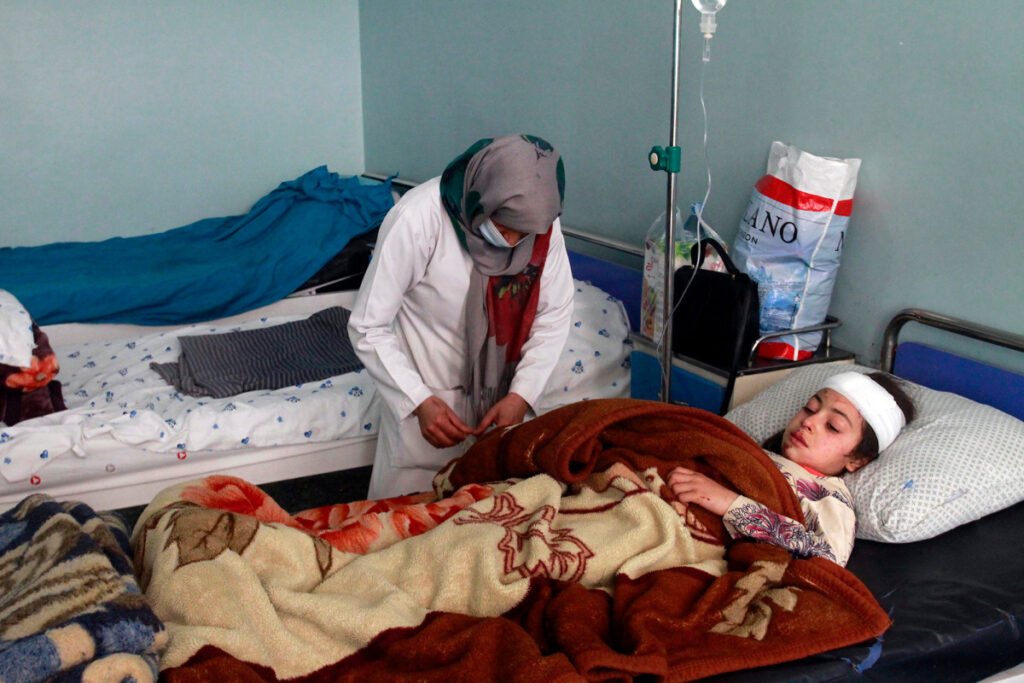
Neta C. Crawford: Calculating the costs of the Afghanistan War in lives, dollars and years

Neta C. Crawford

Listen to this article here

September 24, 2021

The U.S. invaded Afghanistan in late 2001 to destroy al-Qaida, remove the Taliban from power and remake the nation. On Aug. 30, 2021, the U.S. completed a pullout of troops from Afghanistan, providing an uncertain punctuation mark to two decades of conflict.

For the past 11 years I have closely followed the post-9/11 conflicts for the Costs of War Project, an initiative that brings together more than 50 scholars, physicians and legal and human rights experts to provide an account of the human, economic, budgetary and political costs and consequences of the Iraq and Afghanistan wars.

Originally published by The Conversation

Of course, by themselves figures can never give a complete picture of what happened and what it means, but they can help put this war in perspective.

The 20 numbers highlighted below, some drawn from figures released on Sept. 1, 2021, by the Costs of War Project, help tell the story of the Afghanistan War.

From 2001 to 2021

On Sept. 18, 2001, the U.S. House of Representatives voted 420-1 and the Senate 98-0 to authorize the United States to go to war, not just in Afghanistan, but in an open-ended commitment against “those responsible for the recent attacks launched against the United States.” U.S. Rep. Barbara Lee of California cast the only vote opposed to the war.

In other words, the U.S. Congress took 7 days after the 9/11 attacks to deliberate on and authorize the war.

At 7,262 days from the first attack on Afghanistan to the final troop pullout, Afghanistan is said to be the U.S.‘s longest war. But it isn’t – the U.S. has not officially ended the Korean War. And U.S. operations in Vietnam, which began in the mid-1950s and included the declared war from 1965-1975, also rival Afghanistan in longevity.

U.S. President George W. Bush told members of Congress in a joint session on Sept. 20, 2001 that the war would be global, overt, covert and could last a very long time.

“Our war on terror begins with al-Qaida, but it does not end there. It will not end until every terrorist group of global reach has been found, stopped and defeated. … Americans should not expect one battle, but a lengthy campaign, unlike any other we have ever seen,” he said.
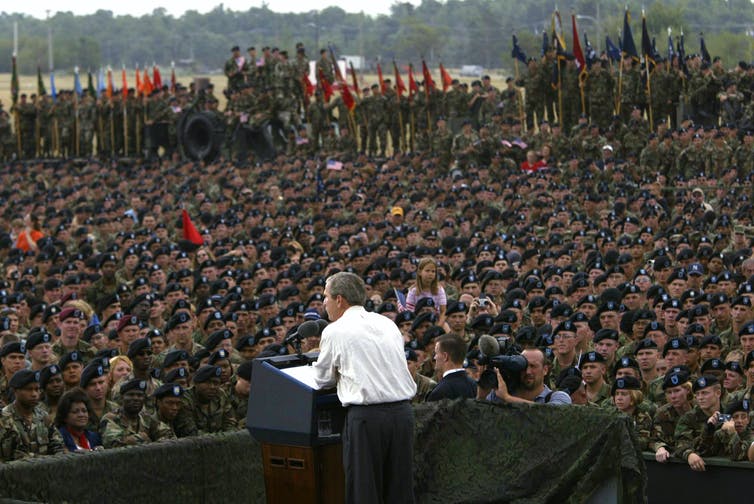
President George W. Bush speaks to soldiers from the 10th Mountain Division at Fort Drum. 
Brooks Kraft LLC/Corbis via Getty Images

The U.S. started bombing Afghanistan a few weeks later. The Taliban surrendered in Kandahar on Dec. 9, 2001. The U.S. began to fight them again in earnest in March 2002. In April 2002, President Bush promised to help bring “true peace” to Afghanistan: “Peace will be achieved by helping Afghanistan develop its own stable government. Peace will be achieved by helping Afghanistan train and develop its own national army. And peace will be achieved through an education system for boys and girls which works.”

The global war on terror was not confined to operations in Iraq and Afghanistan. The U.S. now has counterterrorism operations in 85 countries.

The human cost

Most Afghans alive today were not born when the U.S. war began. The median age in Afghanistan is just 18.4 years old. Including their country’s war with the Soviet Union from 1979 to 1989 and civil war in the 1990s, most Afghans have lived under nearly continuous war.

There are, according to the U.S. Bureau of Labor Statistics, 980,000 U.S. Afghanistan war veterans. Of these men and women, 507,000 served in both Afghanistan and Iraq.

As of mid-August 2021, 20,722 members of the U.S. military had been wounded in action in Afghanistan, not including the 18 who were injured in the attack by ISIS-K outside the airport in Kabul on Aug. 26, 2021.

Of the veterans who were injured and lost a limb in the post-9/11 wars, many lost more than one. According to Dr. Paul Pasquina of the Uniformed Services University of the Health Sciences, of these veterans, “About 40% to 60% also sustained a brain injury. Because of some of the lessons learned and the innovations that have taken place on the battlefield … we were taking care of service members who in previous conflicts would have died.”

In fact, because of advances in trauma care, more than 90% of all soldiers in Afghanistan and Iraq who were injured in the field survived. Many of the seriously injured survived wounds that in the past might have killed them.

In all, 2,455 U.S. service members were killed in the Afghanistan War. The figure includes 13 U.S. troops who were killed by ISIS-K in the Kabul airport attack on Aug. 26, 2021.
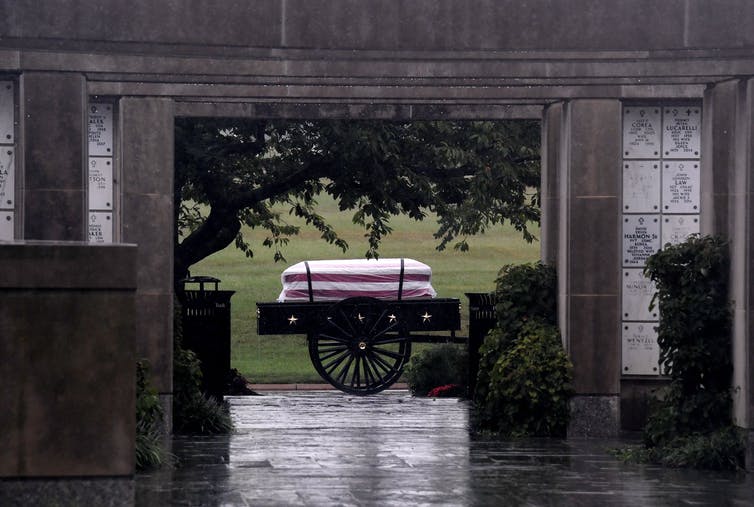
A burial for one of 2,455 U.S. troops who died in Afghanistan. 
Olivier Douliery/AFP via Getty Images

U.S. deaths in Operation Enduring Freedom also include 130 service members who died in other locations besides Afghanistan, including Guantanamo Bay in Cuba, Djibouti, Eritrea, Ethiopia, Jordan, Kenya, Kyrgyzstan, Pakistan, Philippines, Seychelles, Sudan, Tajikistan, Turkey, Uzbekistan and Yemen.

The U.S. has paid US$100,000 in a “death gratuity to the survivors of each of the service members killed in the Afghanistan war, totaling $245.5 million.

More than 46,000 civilians have been killed by all sides in the Afghanistan conflict. These are the direct deaths from bombs, bullets, blasts and fire. Thousands more have been injured, according to the United Nations Assistance Mission in Afghanistan.

And while the number of Afghans leaving the country has increased in recent weeks, more than 2.2 million displaced Afghans were living in Iran and Pakistan at the end of 2020. The United Nations Refugee Agency reported in late August 2021 that since the start of that year, more than 558,000 people have been internally displaced, having fled their homes to escape violence.

According to the United Nations, in 2021 about a third of people remaining in Afghanistan are malnourished. About half of all children under 5 years old experience malnutrition.

The human toll also includes the hundreds of Pakistani civilians who were killed in more than 400 U.S. drone strikes since 2004. Those strikes happened as the U.S. sought to kill Taliban and al-Qaida leaders who fled and sheltered there in late 2001 after the U.S. invasion of Afghanistan. Pakistani civilians have also been killed in crossfire during fighting between militants and the Pakistani military.

The financial cost

In terms of the federal budget, Congress has allocated a bit over $1 trillion to the Department of Defense for the Afghanistan War. But all told, the Afghanistan War has cost much more than that. Including the Department of Defense spending, more than $2.3 trillion has been spent so far, including increases to the Pentagon’s base military budget due to the fighting, State Department spending to reconstruct and democratize Afghanistan and train its military, interest on borrowing to pay for the war, and spending for veterans in the Veteran Affairs system.

The total costs so far for all post-9/11 war veterans’ disability and medical care costs are about $465 billion through fiscal 2022. And this doesn’t include the future costs of all the post-9/11 veterans’ medical and disability care, which Harvard University scholar Linda Bilmes estimates will likely add about $2 trillion to the overall cost of care for veterans of the Iraq and Afghanistan wars between now and 2050.

The war in Afghanistan, like many other wars before it, began with optimistic assessments of a quick victory and the promise to rebuild at war’s end. Despite Bush’s warning of a lengthy campaign, few thought then that would mean decades. But 20 years later, the U.S is still counting the costs.

Neta C. Crawford receives funding from the Carnegie Corporation of New York. She is co-director of the Costs of War Project based at Brown University.

Originally published at The Conversation

About the author

Neta C. Crawford is a professor of Political Science where her teaching focuses on international relations theory, international ethics, and normative change.

Her research interests include international relations theory, normative theory, foreign policy decision making, sanctions, peace movements, discourse ethics, post-conflict peacebuilding, research design, utopian science fiction, and emotion. Crawford is also interested in methods for understanding the costs and consequences of war and is co-director of the Eisenhower Study Group “Costs of War” study (www.costsofwar.org).

Dr. Crawford is the author of Accountability for Killing: Moral Responsibility for Collateral Damage in America’s Post-9/11 Wars (Oxford University Press, 2013) about and Argument and Change in World Politics: Ethics, Decolonization, Humanitarian Intervention (Cambridge University Press, 2002), which was a co-winner of the 2003 American Political Science Association Jervis and Schroeder Award for best book in International History and Politics. She is co-editor of How Sanctions Work: Lessons from South Africa (St. Martin’s, 1999).

Please help TFF remain truly independent by contributing if you benefited from this article

[paypal-donation]

Share

Leave a Reply

Your email address will not be published. Required fields are marked *

Related Posts

Jan Oberg May 15, 2026 Go to this Fox News page and scroll the whole way down: President Donald Trump tells the world that his meeting with President Xi Jinping yielded a lot of very concrete political and economic results – of course, only where the Chinese side, according to him, agreed with him. He does not mention the Taiwan issue, but Secretary of State, Marco Rubio, says that it did not feature prominently in their talks and that the US policy on Taiwan has not changed. Then go to China Daily – or Global Times – and you will see that for the Chinese it is framework, principles, structure of cooperation etc. that matters – all embedded in the overall idea of “constructive bilateral relationship of strategic stability.” Nowhere is any concrete agreement or deal – all that Trump refers to – mentioned. At the general level, this gives you insights into the very different social...
The MIMAC – Military-Industrial-Media-Academic Complex – drives the world’s rampant militarism and wars without end. Here is a short reflection of how it works against all interests of humanity. #5 deals with why there is no real enemy or threat images/analysis. It’s all ex-post constructions. And, btw, theTFF Peace Pulse is now on Rumble.
Jan Oberg, TFF director April 28, 2026 In this third TFF Peace Pulse, I make the important distinction between the violence and the conflict that violence is a symptom of. If you want peace, focus on the underlying conflict because that is the key to resolution, peacemaking, and a better future for the parties. The West is obsessed with violence, just look around you – and 90+ per cent of the public debate is about military issues and other violence – totally wasted for peace. These Peace Pulses will only be published here a few times. You will also not find them on YouTube and Vimeo because both platforms have blocked TFF and me; you know, peace is dangerous these days. Most TFF’s videos since 2007 are now on Rumble.

Recent Articles

Jan Oberg May 15, 2026 Go to this Fox News page and scroll the whole way down: President Donald Trump tells the world that his meeting with President Xi Jinping yielded a lot of very concrete political and economic results – of course, only where the Chinese side, according to him, agreed with him. He does not mention the Taiwan issue, but Secretary of State, Marco Rubio, says that it did not feature prominently in their talks and that the US policy on Taiwan has not changed. Then go to China Daily – or Global Times – and you will see that for the Chinese it is framework, principles, structure of cooperation etc. that matters – all embedded in the overall idea of “constructive bilateral relationship of strategic stability.” Nowhere is any concrete agreement or deal – all that Trump refers to – mentioned. At the general level, this gives you insights into the very different social...
Lena Petrova of “World Affairs In Context” with more than half a million subscribers on YouTube wanted to explore what a peace researcher like me has to say about, among other things, the First and the Second Cold War and why eethics has disappeared from politics. I am particularly happy about this conversation that also yielded an amazing number of very appreciative comments on YouTube. No doubt, people are longing for alternatives, including peace perspectives.
The MIMAC – Military-Industrial-Media-Academic Complex – drives the world’s rampant militarism and wars without end. Here is a short reflection of how it works against all interests of humanity. #5 deals with why there is no real enemy or threat images/analysis. It’s all ex-post constructions. And, btw, theTFF Peace Pulse is now on Rumble.

TFF on Substack

Discover more from TFF Transnational Foundation & Jan Oberg.

Most Popular

Jan Oberg May 15, 2026 Go to this Fox News page and scroll the whole way down: President Donald Trump tells the world that his meeting with President Xi Jinping yielded a lot of very concrete political and economic results – of course, only where the Chinese side, according to him, agreed with him. He does not mention the Taiwan issue, but Secretary of State, Marco Rubio, says that it did not feature prominently in their talks and that the US policy on Taiwan has not changed. Then go to China Daily – or Global Times – and you will see that for the Chinese it is framework, principles, structure of cooperation etc. that matters – all embedded in the overall idea of “constructive bilateral relationship of strategic stability.” Nowhere is any concrete agreement or deal – all that Trump refers to – mentioned. At the general level, this gives you insights into the very different social...
Lena Petrova of “World Affairs In Context” with more than half a million subscribers on YouTube wanted to explore what a peace researcher like me has to say about, among other things, the First and the Second Cold War and why eethics has disappeared from politics. I am particularly happy about this conversation that also yielded an amazing number of very appreciative comments on YouTube. No doubt, people are longing for alternatives, including peace perspectives.
The MIMAC – Military-Industrial-Media-Academic Complex – drives the world’s rampant militarism and wars without end. Here is a short reflection of how it works against all interests of humanity. #5 deals with why there is no real enemy or threat images/analysis. It’s all ex-post constructions. And, btw, theTFF Peace Pulse is now on Rumble.
Read More
Screenshot-2026-05-15-103534
Jan Oberg May 15, 2026 Go to this Fox News page and scroll the whole way down: President Donald Trump tells the world that his meeting with President Xi Jinping yielded a lot of very concrete political and economic results – of course, only where the Chinese side, according to him, agreed with him. He does not mention the Taiwan issue, but Secretary of State, Marco Rubio, says that it did not feature prominently in their talks and that the US policy on Taiwan has not changed. Then go to China Daily – or Global Times – and you will see that for the Chinese it is framework, principles, structure of cooperation etc. that matters – all embedded in the overall idea of “constructive bilateral relationship of strategic stability.” Nowhere is any concrete agreement or deal – all that Trump refers to – mentioned. At the general level, this gives you insights into the very different social...
Screenshot-2026-05-12-104023
Lena Petrova of “World Affairs In Context” with more than half a million subscribers on YouTube wanted to explore what a peace researcher like me has to say about, among other things, the First and the Second Cold War and why eethics has disappeared from politics. I am particularly happy about this conversation that also yielded an amazing number of very appreciative comments on YouTube. No doubt, people are longing for alternatives, including peace perspectives.
Screenshot-2026-04-13-154551 (2)
The MIMAC – Military-Industrial-Media-Academic Complex – drives the world’s rampant militarism and wars without end. Here is a short reflection of how it works against all interests of humanity. #5 deals with why there is no real enemy or threat images/analysis. It’s all ex-post constructions. And, btw, theTFF Peace Pulse is now on Rumble.
Screenshot-2026-04-13-154551 (1)
Jan Oberg, TFF director April 28, 2026 In this third TFF Peace Pulse, I make the important distinction between the violence and the conflict that violence is a symptom of. If you want peace, focus on the underlying conflict because that is the key to resolution, peacemaking, and a better future for the parties. The West is obsessed with violence, just look around you – and 90+ per cent of the public debate is about military issues and other violence – totally wasted for peace. These Peace Pulses will only be published here a few times. You will also not find them on YouTube and Vimeo because both platforms have blocked TFF and me; you know, peace is dangerous these days. Most TFF’s videos since 2007 are now on Rumble.
Screenshot-2026-04-13-154551
In contrast to most, we’ll bring alternatives, solutions, hope and strategies for a better future. Times are dangerous, yes, but that only intensifies the need for constructive thinking and action! Jan Oberg, TFF director April 13, 2026 The new TFF Peace Pulse uses video messages in a new way: Max 3-5-minute-long comments, ideas or perhaps mini-lectures, all about peace – positive peace. We launch them today on April 13, 2026 with a carefully crafted visual aesthetic fitting the content. We hope to publish them regularly from now on. We launch Peace Pulse (PP) – for a number of reasons. The world is in chaos, and there are countless reasons to feel concerned, frustrated, even angry. The atmosphere is saturated with doom and gloom, with negative energy and rear‑mirror thinking, while vision, imagination, alternatives, strategies and genuine future‑mindedness remain in short supply. And without them, we simply can’t save the world. Looking at problems from a hundred angles will...
IMG_5165 (1)
PART II — Publishing Peace in a System That Prioritises Militarism Jan Oberg, TFF director April 10, 2026 How TFF Maintains a Daily Voice in a Digital World Built for Noise This article is part of the series “TFF at 40″ and it invites you to learn about Four Decades of Publishing Peace. It takes a look at how a small, people‑financed peace foundation has communicated across four generations of technology — from wax stencils and fax machines to mass email and Substack — and why TFF continues to publish every single day in a system that rewards noise, conflict, and militarism. ◆ What it means to publish peace every single day in a digital system built for 24/7 news and other noise, confrontation, and militarism. How TFF’s independence, continuity, and global readership defy algorithms, donor cycles, and Western media censorhip — and why the Majority World keeps listening. When the...

