

Martin Luther King Jr. spent the last year of his life detested by the liberal establishment

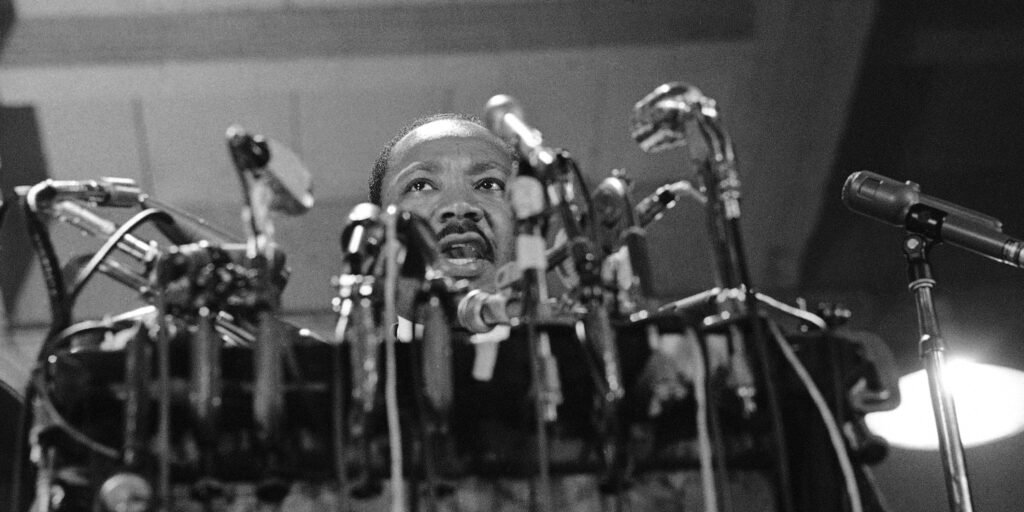
Dr. Martin Luther King, head of the Southern Christian Leadership Conference (SCLC), delivers his speech that opened the National Conference for New Politico Convention in Chicago, Sept. 1, 1967. King, facing a battery of microphones, called for an end to the Vietnam fighting.

February 22, 2021

Zaid Jilani

Martin Luther King Jr. was much more radical than he is often portrayed.

IN 1999, The polling agency Gallup set out to determine the individual American’s most admired in the 20th century.

Mother Teresa came in first, with 49 percent of Americans putting her at the top; the Rev. Dr. Martin Luther King Jr. ranked second, with 34 percent placing him on the same list. But, the polling agency would later write, “King was far from universally revered during his lifetime.”

Originally published by The Intercept

They noted that in 1966, 63 percent of Americans held a negative view of the civil rights leader, while just 32 percent held a positive one. This was a marked reversal from five years earlier, when 41 percent of Americans gave King a positive rating and 37 percent a negative one.

King’s slide in popularity coincided with his activism taking a turn from what Americans largely know him for — his campaign for civil rights in the American South — to a much more radical one aimed at the war in Vietnam and poverty.

Refusing to choose between civil rights for African-Americans and peace for Vietnamese

For years, King had been troubled by the war in Vietnam and raised it privately in conversations with the Democratic President Lyndon Johnson. As the conflict dragged on, King felt he had no choice but to publicly denounce the war.

In an April 1967 speech at Riverside Church in New York City, the civil rights leader publicly denounced American involvement in Indochina.

“This business of burning human beings with napalm, of filling our nation’s homes with orphans and widows, of injecting poisonous drugs of hate into the veins of peoples normally humane, of sending men home from dark and bloody battlefields physically handicapped and psychologically deranged, cannot be reconciled with wisdom, justice, and love,” he warned. “A nation that continues year after year to spend more money on military defense than on programs of social uplift is approaching spiritual death.”

Many in King’s inner circle warned against making the speech and publicly campaigning against the war. Their argument was that Johnson had risked his neck for the African-American community on issues like civil rights, health care, and welfare, and publicly condemning his foreign policy would irreparably harm the relationship between black activists and the president.

King reserved a section of his remarks to address these critics. He labeled the war an “enemy of the poor,” saying that its budget was draining anti-poverty programs; he also pointed out that it was hypocritical for him to preach nonviolence to activists at home, while watching his government reject that principle abroad.

But ultimately his stance came from personal moral conviction and his devoted Christian beliefs. “Beyond the calling of race or nation or creed is this vocation of sonship and brotherhood. Because I believe that the Father is deeply concerned, especially for His suffering and helpless and outcast children, I come tonight to speak for them,” he said. “This I believe to be the privilege and the burden of all of us who deem ourselves bound by allegiances and loyalties, which are broader and deeper than nationalism and which go beyond our nation’s self-defined goals and positions. We are called to speak for the weak, for the voiceless, for the victims of our nation, for those it calls ‘enemy,’ for no document from human hands can make these humans any less our brothers.”
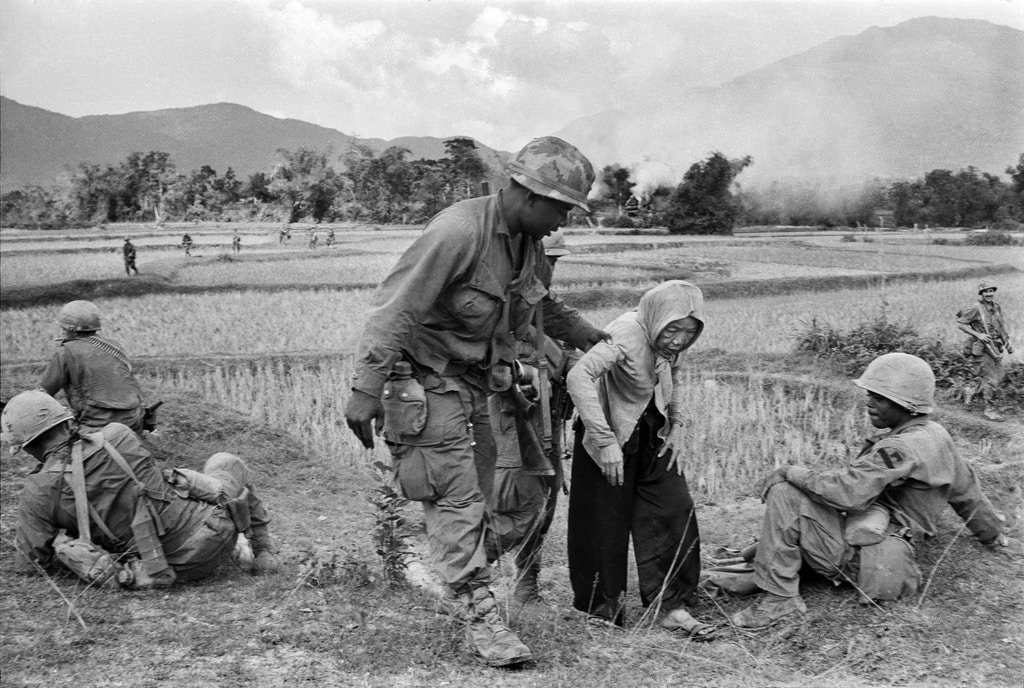
A U.S. air cavalryman lends a helping hand to an aged Vietnamese woman who grew tired as she and her neighbors were being resettled from their village to a refugee camp, Jan. 5, 1968.
 Photo: Dang Van Phuoc/AP

The liberal backlash

The backlash from a liberal establishment that had once praised King for his civil rights campaign came as hard and fast as his allies had feared.

The New York Times editorial board lambasted King for linking the war in Vietnam to the struggles of civil rights and poverty alleviation in the United States, saying it was “too facile a connection” and that he was doing a “disservice” to both causes. It concluded that there “are no simple answers to the war in Vietnam or to racial injustice in this country.”

The Washington Post editorial board said King had “diminished his usefulness to his cause, his country and his people.” A political cartoon in the Kansas City Star depicted the civil rights movement as a young black girl crying and begging for her drunk father King, who is consuming the contents of a bottle labeled “Anti-Vietnam.”

In all, 168 newspapers denounced him the next day. Johnson ended his formal relationship with King. “What is that goddamned nigger preacher doing to me?” Johnson reportedly remarked after the Riverside speech. “We gave him the Civil Rights Act of 1964, we gave him the Voting Rights Act of 1965, we gave him the war on poverty. What more does he want?”

The African-American establishment, fearful of Johnson’s reaction, also distanced itself from King.

The NAACP – National Association for the Advancement of Colored People – under the leadership of Roy Wilkins refused to oppose the war and explicitly condemned the effort to link the peace and civil rights movements.

Whitney Young, the leader of the National Urban League, warned that “Johnson needs a consensus. If we are not with him on Vietnam, then he is not going to be with us on civil rights.” Jackie Robinson, the celebrated African-American baseball player and civil rights advocate, wrote to Johnson two weeks after King’s speech to distance himself from the civil rights leader: 

“While I am certain your faith has been shaken by demonstrations against the Viet Nam war, I hope the actions of any one individual does not make you feel as Vice President Humphrey does, that Dr. King’s stand will hurt the civil rights movement. It would not be fair to the thousands of our Negro fighting men who are giving their lives because they believe, in most instances, that our Viet Nam stand is just.”

Many donors to the Southern Christian Leadership Conference wrote to King announcing they were pulling their support.
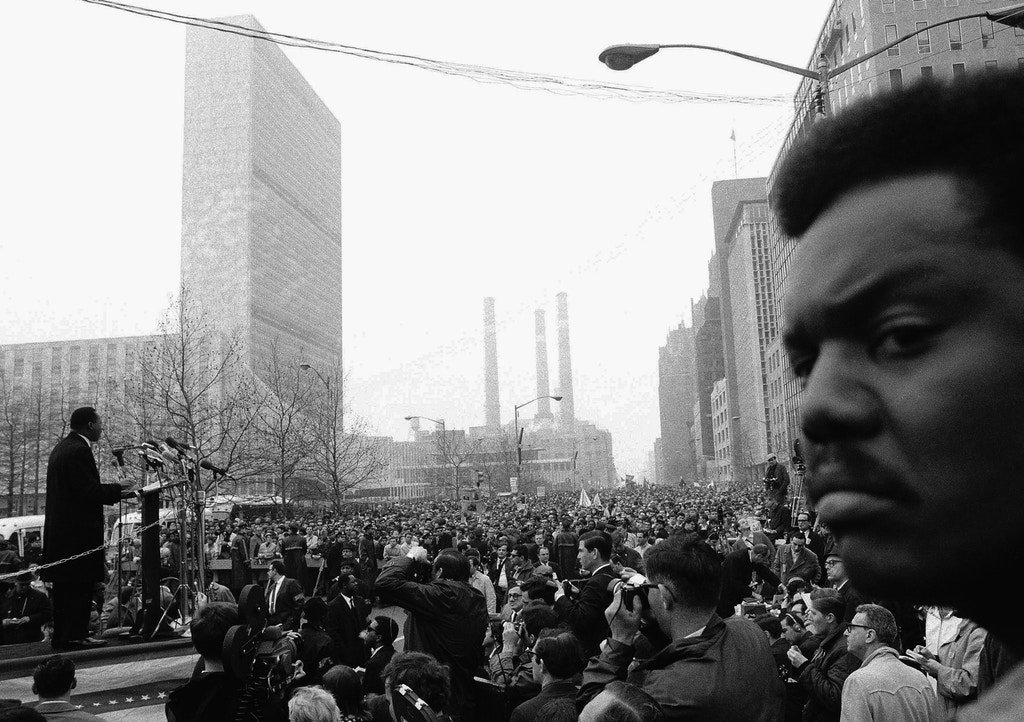
Dr. Martin Luther King on the platform talks to thousands of demonstrators on United Nations Plaza on April 15. 1967 in New York City. Photo: AP

Tolerance for civil disobedience ends at the Mason-Dixon Line

As he alienated the liberal establishment for his campaign against the Vietnam War, King also planned to mobilize mass demonstrations and civil disobedience aimed not at his old foes in the segregationist South, but politicians north of the Mason Dixon line who he believed were failing to act to stop endemic poverty.

In August 1967, he told the SCLC that he was calling for activists to “dislocate” northern cities with nonviolent civil disobedience campaigns demanding action on federal aid.

He said he would consider tactics, such as school boycotts, blocking plant gates with unemployed African-Americans, and mass sit-ins in federal buildings.

The New York Times, a steady ally of King’s civil disobedience campaign in the South, was furious. Two days after King’s SCLC address, the editorial board called his idea a “formula for discord.” The paper complained that there is an “inherent contradiction in Dr. King’s summons to Negroes to act ‘peacefully but forcefully to cripple the operations of an oppressive society.’ He himself has acknowledged that nonviolence is losing its appeal; once the spark of massive law-defiance is applied in the present overheated atmosphere, the potential for disaster becomes overwhelming.”

But King was never an advocate for violence. Although some on the left in King’s time and today argue about the utility of violence, King spent much of the end of his life trying to prevent the rioting and violent unrest that the Times was so concerned about.

In February 1968, he warned during a tour through Alabama that increased rioting could lead to a “right-wing takeover.” He pointed to segregationist George Wallace’s presidential bid, saying, “Every time a riot develops, it helps George Wallace.”

Defending his threat to take poverty protests to the doorsteps of the Democratic and Republican National Conventions, he portrayed  nonviolence as a sort of middle path between acquiescence and violence. “We need an alternative to riots and to timid supplication,” he said.

Also that year, he launched the Poor People’s Campaign, aimed at providing good jobs, housing, and a decent standard of living to all Americans. More than 40 years before American protesters took to the streets of New York City and other locales to “occupy” space to protest inequality, King proposed a massive tent encampment in Washington, D.C. to demand action on poverty.

King was assassinated during a campaign to organize sanitation workers in Tennessee in April of that year before he was able to set up the encampment. His widow Coretta Scott King, as well as fellow civil rights leader Ralph David Abernathywent ahead with the plan to create what they called Resurrection City.

The camp lasted six weeks until police moved in to shut it down and evict all of its inhabitants, pointing to sporadic acts of hooliganism as justification.

Andrew Young, the young civil rights leader who later went on to be Jimmy Carter’s U.N. ambassador and a mayor of Atlanta, was horrified, saying the crushing of the camp was worse than the police violence he saw in the South.

“It was worse than anything I saw in Mississippi or Alabama,” he said. “You don’t shoot tear gas into an entire city because two or three hooligans are throwing rocks.”

Following King’s assassination, the mood shifted quickly. Johnson, who had once terminated all communication with King and privately cursed his name, issued a statement saying the “heart of America is heavy, the spirit of America weeps” following the activist’s death.

Georgia’s segregationist Gov. Lester Maddox, a frequent critic of King, even begrudgingly allowed Georgia’s flag to fly at half mast following his death. Bobby Kennedy, who once authorized the wiretaps of King’s phones, attended the funeral.

Coretta Scott King’s greatest concern was not for her husband’s image, but how his legacy would be carried on after his death. Rioting rocked major American cities following King’s assassination, and she feared that the nonviolence he had preached would be lost in the embers.

The Sunday following the assassination, she spoke at Ebenezer Baptist Church in Atlanta and implored his movement to continue to act as he would for the causes he believed in:

Our concern now is that his work does not die. He gave his life for the poor of the world — the garbage workers of Memphis and the peasants of Vietnam. Nothing could hurt him more than that man could attempt no way to solve problems except through violence. He gave his life in search of a more excellent way, a more effective way, a creative way rather than a destructive way.

We intend to go on in search of that way, and I hope that you who loved and admired him would join us in fulfilling his dream.

The day that Negro people and others in bondage are truly free, on the day want is abolished, on the day wars are no more, on that day I know my husband will rest in a long-deserved peace.

Originally published by The Intercept

About the author:

Zaid Jilani is a journalist who hails from Atlanta, Georgia. He has previously worked as a reporter-blogger for ThinkProgress, United Republic, the Progressive Change Campaign Committee, and Alternet.

He graduated from the University of Georgia in 2009 with a bachelor of arts in international affairs and received his master’s in public administration from Syracuse University in 2014.

Please help TFF remain truly independent by contributing if you benefited from this article. Then we can also bring you more quality articles on important issues such as this. Thanks!

[paypal-donation]

Share

Leave a Reply

Your email address will not be published. Required fields are marked *

Related Posts

By Jan ObergTFF co-founder and director February 11, 2026 PART 3 — ECONOMICS, TRADE & FINANCIAL SOVEREIGNTY A. Trade Measures & Market Signaling Economic pressure can be applied instantly and scaled without violence. Immediate Measures (within a week) Government boycott US goods and services  A very powerful signal which over time will be felt. Targeted tariffs on selected U.S. goods Symbolic but high-visibility sectors send a clear message. Suspend trade facilitation talks A peaceful pause that signals deep concern. Freeze U.S. participation in public procurement – military procurement in particular A nonviolent way to reduce influence. Competition law review of U.S. corporations A legal tool to scrutinise market dominance. Longer-Term Measures EU–Asia–Africa trade corridors Reducing reliance on U.S. markets. European supply chains for critical minerals Strategic autonomy in resource access. European Strategic Trade Authority Monitoring coercive practices globally. Euro-denominated commodity markets Weakening the dollar’s pricing monopoly. The EU must resume contacts and negotiations with Russia, focusing on energy cooperation To...
PART 2 — Diplomacy, Law and Nonviolent Power By Jan ObergTFF co-founder and director January 26, 2026 This is the second of four TFF-created idea portfolios designed to curb the global reach of the United States and, in both the short and long term, help catalyse a worldwide nonviolent resistance to what many observers describe as the Trump administration’s uniquely confrontational, destructive and world-threatening policies. These portfolios outline what governments and citizens across the world can do through dynamic diplomacy, creative initiatives, and strictly nonviolent means. They are typical TFF works in that we do not only tell what the problem is and how bad it will go – as 90+% of all commentators, experts and scholars do – we tell what we think can be done, inviting you to think of what you think you can do. It seems painfully clear to me that the current political dynamics in Washington increasingly resemble the most dangerous...
Introduction to TFF’s forthcoming four Idea Portfolios of Diplomatic and Nonviolent Resistance By TFF’s Board & FoundersPascal Lottaz, Biljana Vankovska, Annette Schiffmann, Christina Spannar & Jan Oberg January 19, 2026 “America, you are too arrogant.” — Martin Luther King Jr. Over the course of Trump’s first term and now a year into his second, the world has witnessed a consistent pattern of actions that challenge the basic long-standing norms of international cooperation, weaken multilateral institutions, and ignore the global norms and legal frameworks established by the UN Charter. During these years, we have witnessed military operations in Iran, Syria and Ukraine without UN authorisation; the killing of Iranian General Qassem Soleimani; repeated strikes across the Middle East; and the launch of tariff wars against allies and competitors alike. We have seen a renewed emphasis on nuclearism and zero interest in arms control and disarmament negotiations. Pentagon is now The Department...

Recent Articles

“En dag som berättigar till fest”, utropade den London-baserade al-Quds al-Arabi efter FN:s eldupphörresolution, “eftersom detta är första gången som Israel accepterar ett FN-beslut från en position som besegrad och inte som segrare”. Att ett arabisk-israeliskt krig för en gångs skull slutat med arabisk seger, är en helt dominerade åsikt i arabiska medier. Al-Quds al-Arabi tillåter sig att drömma om att det israeliska nederlaget skall leda till massflykt från Israel. Men i nästa andetag påminner tidningen om att Israel aldrig brukar genomföra sina internationella åtaganden och varnar för att förlorarna, liksom tidigare, kan hämnas genom att provocera fram inbördeskrig i Libanon. Med tanke på de otaliga massmediala vittnesmålen om det libanesiska folkets eniga motståndskraft förefaller risken för inre stridigheter i det sargade landet just nu liten. Men visst kan man urskilja nyansskillnader i libanesiska tidningar. Vänsterorganet al-Safir uppfattar FN-resolutionen som en komplott i syfte att rädda Israel från ännu större...
Greenland – the world’s largest island, a continent of its own with only 57.000 inhabitants. I visited it for the first time in May 2005. I flew across the inland ice to Nuuk, the tiny capital with some 14.000 inhabitants. I was overwhelmed by the pride and kindness of everyone I met as well as by the unique natural beauty. Unfortunately, due to weather conditions during my ten-day stay I could get nowhere else but Nuuk. Fortunately, however, among those I met was Gitte Arvegaard, a Danish lawyer and negotiator employed by the local government, Greenland Home Rule. She turned out to be an enthusiastic photographer with a lot of pictures taken during various trips around Greenland. So this Greeland series is the result of our cooperative effort. We both hope you enjoy it and are stimulated to visit Greenland – about which you may read more here. Finally, if you want to...
 Jan Oberg’s storyof how he met Sir Paul Liverpool – where else to meet Paul McCartney? Paul’s old class mate and TFF Associate, Jonathan Power introduced me to Paul McCartney in Liverpool at an informal reception. It was held at what used to be their school, now the Liverpool Institute for Performing Arts and we were there to celebrate that Jonathan had written Amnesty International’s 40th Anniversary book. This happy event for “righting wrongs and writing songs” gave me an opportunity to meet Paul and tell him about TFF and get straight to the matter: would he consider making a donation in support of our work for peace? While I was probably the only one with such a wish that day, I was certainly not the only one who wanted to shake hands and talk with him. In the last minutes before Paul was to leave, Jonathan brought us together and we got about three...

TFF on Substack

Discover more from TFF Transnational Foundation & Jan Oberg.

Most Popular

“En dag som berättigar till fest”, utropade den London-baserade al-Quds al-Arabi efter FN:s eldupphörresolution, “eftersom detta är första gången som Israel accepterar ett FN-beslut från en position som besegrad och inte som segrare”. Att ett arabisk-israeliskt krig för en gångs skull slutat med arabisk seger, är en helt dominerade åsikt i arabiska medier. Al-Quds al-Arabi tillåter sig att drömma om att det israeliska nederlaget skall leda till massflykt från Israel. Men i nästa andetag påminner tidningen om att Israel aldrig brukar genomföra sina internationella åtaganden och varnar för att förlorarna, liksom tidigare, kan hämnas genom att provocera fram inbördeskrig i Libanon. Med tanke på de otaliga massmediala vittnesmålen om det libanesiska folkets eniga motståndskraft förefaller risken för inre stridigheter i det sargade landet just nu liten. Men visst kan man urskilja nyansskillnader i libanesiska tidningar. Vänsterorganet al-Safir uppfattar FN-resolutionen som en komplott i syfte att rädda Israel från ännu större...
Greenland – the world’s largest island, a continent of its own with only 57.000 inhabitants. I visited it for the first time in May 2005. I flew across the inland ice to Nuuk, the tiny capital with some 14.000 inhabitants. I was overwhelmed by the pride and kindness of everyone I met as well as by the unique natural beauty. Unfortunately, due to weather conditions during my ten-day stay I could get nowhere else but Nuuk. Fortunately, however, among those I met was Gitte Arvegaard, a Danish lawyer and negotiator employed by the local government, Greenland Home Rule. She turned out to be an enthusiastic photographer with a lot of pictures taken during various trips around Greenland. So this Greeland series is the result of our cooperative effort. We both hope you enjoy it and are stimulated to visit Greenland – about which you may read more here. Finally, if you want to...
 Jan Oberg’s storyof how he met Sir Paul Liverpool – where else to meet Paul McCartney? Paul’s old class mate and TFF Associate, Jonathan Power introduced me to Paul McCartney in Liverpool at an informal reception. It was held at what used to be their school, now the Liverpool Institute for Performing Arts and we were there to celebrate that Jonathan had written Amnesty International’s 40th Anniversary book. This happy event for “righting wrongs and writing songs” gave me an opportunity to meet Paul and tell him about TFF and get straight to the matter: would he consider making a donation in support of our work for peace? While I was probably the only one with such a wish that day, I was certainly not the only one who wanted to shake hands and talk with him. In the last minutes before Paul was to leave, Jonathan brought us together and we got about three...
Read More
Imagen-thumbnail-The-Transnational-1
“En dag som berättigar till fest”, utropade den London-baserade al-Quds al-Arabi efter FN:s eldupphörresolution, “eftersom detta är första gången som Israel accepterar ett FN-beslut från en position som besegrad och inte som segrare”. Att ett arabisk-israeliskt krig för en gångs skull slutat med arabisk seger, är en helt dominerade åsikt i arabiska medier. Al-Quds al-Arabi tillåter sig att drömma om att det israeliska nederlaget skall leda till massflykt från Israel. Men i nästa andetag påminner tidningen om att Israel aldrig brukar genomföra sina internationella åtaganden och varnar för att förlorarna, liksom tidigare, kan hämnas genom att provocera fram inbördeskrig i Libanon. Med tanke på de otaliga massmediala vittnesmålen om det libanesiska folkets eniga motståndskraft förefaller risken för inre stridigheter i det sargade landet just nu liten. Men visst kan man urskilja nyansskillnader i libanesiska tidningar. Vänsterorganet al-Safir uppfattar FN-resolutionen som en komplott i syfte att rädda Israel från ännu större...
Greenland – the world’s largest island, a continent of its own with only 57.000 inhabitants. I visited it for the first time in May 2005. I flew across the inland ice to Nuuk, the tiny capital with some 14.000 inhabitants. I was overwhelmed by the pride and kindness of everyone I met as well as by the unique natural beauty. Unfortunately, due to weather conditions during my ten-day stay I could get nowhere else but Nuuk. Fortunately, however, among those I met was Gitte Arvegaard, a Danish lawyer and negotiator employed by the local government, Greenland Home Rule. She turned out to be an enthusiastic photographer with a lot of pictures taken during various trips around Greenland. So this Greeland series is the result of our cooperative effort. We both hope you enjoy it and are stimulated to visit Greenland – about which you may read more here. Finally, if you want to...
p_mccartney_poem
 Jan Oberg’s storyof how he met Sir Paul Liverpool – where else to meet Paul McCartney? Paul’s old class mate and TFF Associate, Jonathan Power introduced me to Paul McCartney in Liverpool at an informal reception. It was held at what used to be their school, now the Liverpool Institute for Performing Arts and we were there to celebrate that Jonathan had written Amnesty International’s 40th Anniversary book. This happy event for “righting wrongs and writing songs” gave me an opportunity to meet Paul and tell him about TFF and get straight to the matter: would he consider making a donation in support of our work for peace? While I was probably the only one with such a wish that day, I was certainly not the only one who wanted to shake hands and talk with him. In the last minutes before Paul was to leave, Jonathan brought us together and we got about three...
Logo-Transnational
1942James Paul McCartney is born in Liverpool on June 18th. 1956Paul writes his first song, I Lost My Little Girl. 1957Paul meets John Lennon at St. Peter’s Church Fete, Woolton, Liverpool. He joins his first group, The Quarrymen and performs in his first gig at The New Clubmoor Hall, Liverpool, on October 18th. 1960Formation of The Beatles, who play residencies in Hamburg and at The Cavern in Liverpool. 1961First Beatles recordings issued in Germany, as the backing group for Tony Sheridan. 1962The first Beatles Parlophone recording, Love Me Do, reaches number 17 in the British charts. 1963The birth of Beatlemania. Please Please Me gives the group their first British Number 1. She Loves You cements their success. Please Please Me and With The Beatles albums released. 1964First triumphant American tour. The Beatles perform at the Royal Command Performance and release their first film, A Hard Day’s Night. Their single I...
Logo-Transnational
  Back to the series “Bujumbura, Burundi”
By JONATHAN POWER August 16, 2000 LONDON – Remember the summer of ’98? In the sweltering, torpid heat of a Roman august, charged with exhaust fumes, the international community gave its overwhelming approval to the establishment of an International Criminal Court that will enable those accused of “crimes against humanity” to be tried and, if convicted, sentenced. Only seven nations opposed or abstained from the motion, including Israel, China, India and the U.S.A. where the Pentagon had successfully waged bureaucratic guerrilla war to undermine the initially sympathetic stance of President Bill Clinton. Two years on we can now see what an epochal event that was. In a the stroke of 120 pens it changed the climate on political thuggery. After numerous half-starts and false starts ever since the Nuremberg and Tokyo trials that convicted the war criminals of the Second World War, the world at last had agreed en masse a common...

