
December 20, 2022
“No matter how large the tissue of falsehood that an experienced liar has to offer, it will never be large enough … to cover the immensity of actuality.”
The possibilities that exist between two people, or among a group of people,” Adrienne Rich wrote in her beautiful 1975 speech on lying and what truth really means, “are a kind of alchemy. They are the most interesting thing in life. The liar is someone who keeps losing sight of these possibilities.” Nowhere is this liar’s loss of perspective more damaging to public life, human possibility, and our collective progress than in politics, where complex social, cultural, economic, and psychological forces conspire to make the assault on truth traumatic on a towering scale.
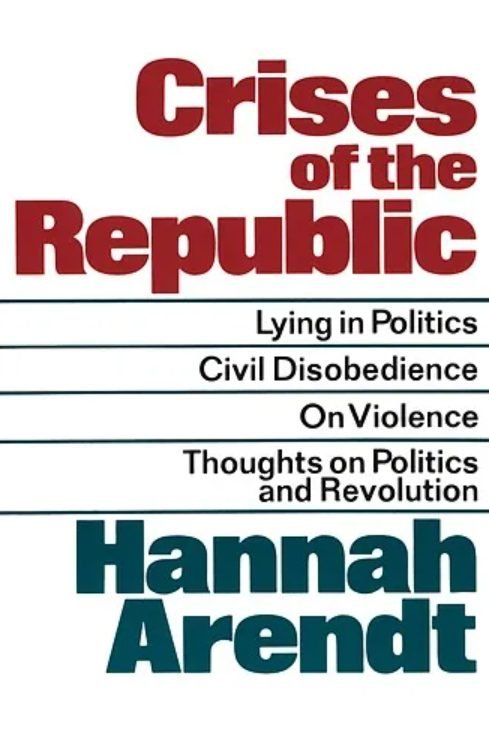
Those forces are what Hannah Arendt (October 14, 1906–December 4, 1975), one of the most incisive thinkers of the past century, explores in a superb 1971 essay titled “Lying in Politics,” written shortly after the release of the Pentagon Papers and later included in Crises of the Republic (public library) — a collection of Arendt’s timelessly insightful and increasingly timely essays on politics, violence, civil disobedience, and the pillars of a sane and stable society.
Originally published at The Marginalian
Out of the particular treachery the Pentagon Papers revealed, Arendt wrests a poignant meditation on the betrayal we feel at every revelation that our political leaders — those we have elected to be our civil servants — have deceived and disappointed us. With the release of the Pentagon Papers, Arendt argues, “the famous credibility gap … suddenly opened up into an abyss” — an abyss rife with the harrowing hollowness of every political disappointment that ever was and ever will be. In a quest to illuminate the various “aspects of deception, self-deception, image-making, ideologizing, and defactualization,” she writes:
“
Truthfulness has never been counted among the political virtues, and lies have always been regarded as justifiable tools in political dealings. Whoever reflects on these matters can only be surprised by how little attention has been paid, in our tradition of philosophical and political thought, to their significance, on the one hand for the nature of action and, on the other, for the nature of our ability to deny in thought and word whatever happens to be the case. This active, aggressive capability is clearly different from our passive susceptibility to falling prey to error, illusion, the distortions of memory, and to whatever else can be blamed on the failings of our sensual and mental apparatus.
A defender of the contradictory complexity of the human experience and its necessary nuance, Arendt reminds us that the human tendency toward deception isn’t so easily filed into a moral binary. Two millennia after Cicero argued that the human capacities for envy and compassion have a common root, Arendt argues that our moral flaws and our imaginative flair spring from the same source:
“
A characteristic of human action is that it always begins something new, and this does not mean that it is ever permitted to start ab ovo, to create ex nihilo. In order to make room for one’s own action, something that was there before must be removed or destroyed, and things as they were before are changed. Such change would be impossible if we could not mentally remove ourselves from where we physically are located and imagine that things might as well be different from what they actually are. In other words, the deliberate denial of factual truth — the ability to lie — and the capacity to change facts — the ability to act — are interconnected; they owe their existence to the same source: imagination. It is by no means a matter of course that we can say, “The sun shines,” when it actually is raining (the consequence of certain brain injuries is the loss of this capacity); rather, it indicates that while we are well equipped for the world, sensually as well as mentally, we are not fitted or embedded into it as one of its inalienable parts. We are free to change the world and to start something new in it. Without the mental freedom to deny or affirm existence, to say “yes” or “no” — not just to statements or propositions in order to express agreement or disagreement, but to things as they are given, beyond agreement or disagreement, to our organs of perception and cognition — no action would be possible; and action is of course the very stuff politics are made of.
Hence, when we talk about lying … let us remember that the lie did not creep into politics by some accident of human sinfulness. Moral outrage, for this reason alone, is not likely to make it disappear.
Since history is a form of collective memory woven of truth-by-consensus, it is hardly surprising that our collective memory should be so imperfect and fallible given how error-prone our individual memory is. Arendt captures this elegantly:
“
The deliberate falsehood deals with contingent facts; that is, with matters that carry no inherent truth within themselves, no necessity to be as they are. Factual truths are never compellingly true. The historian knows how vulnerable is the whole texture of facts in which we spend our daily life; it is always in danger of being perforated by single lies or torn to shreds by the organized lying of groups, nations, or classes, or denied and distorted, often carefully covered up by reams of falsehoods or simply allowed to fall into oblivion. Facts need testimony to be remembered and trustworthy witnesses to be established in order to find a secure dwelling place in the domain of human affairs. From this, it follows that no factual statement can ever be beyond doubt.
In a sentiment that calls to mind Maria Konnikova’s fascinating inquiry into the psychology of why cons work on even the most rational of us, Arendt adds:
“
It is this fragility that makes deception so very easy up to a point, and so tempting. It never comes into a conflict with reason, because things could indeed have been as the liar maintains they were. Lies are often much more plausible, more appealing to reason, than reality, since the liar has the great advantage of knowing beforehand what the audience wishes or expects to hear. He has prepared his story for public consumption with a careful eye to making it credible, whereas reality has the disconcerting habit of confronting us with the unexpected, for which we were not prepared.
Under normal circumstances the liar is defeated by reality, for which there is no substitute; no matter how large the tissue of falsehood that an experienced liar has to offer, it will never be large enough, even if he enlists the help of computers, to cover the immensity of factuality. The liar, who may get away with any number of single falsehoods, will find it impossible to get away with lying on principle.
Arendt considers one particularly pernicious breed of liars — “public-relations managers in government who learned their trade from the inventiveness of Madison Avenue.” In a sentiment arguably itself defeated by reality — a reality in which someone like Donald Trump sells enough of the public on enough falsehoods to get gobsmackingly close to the presidency — she writes:
“
The only limitation to what the public-relations man does comes when he discovers that the same people who perhaps can be “manipulated” to buy a certain kind of soap cannot be manipulated — though, of course, they can be forced by terror — to “buy” opinions and political views. Therefore the psychological premise of human manipulability has become one of the chief wares that are sold on the market of common and learned opinion.
In what is possibly the finest parenthetical paragraph ever written, and one of particularly cautionary splendor today, Arendt adds:
“
(Oddly enough, the only person likely to be an ideal victim of complete manipulation is the President of the United States. Because of the immensity of his job, he must surround himself with advisers … who “exercise their power chiefly by filtering the information that reaches the President and by interpreting the outside world for him.” The President, one is tempted to argue, allegedly the most powerful man of the most powerful country, is the only person in this country whose range of choices can be predetermined. This, of course, can happen only if the executive branch has cut itself off from contact with the legislative powers of Congress; it is the logical outcome in our system of government when the Senate is being deprived of, or is reluctant to exercise, its powers to participate and advise in the conduct of foreign affairs. One of the Senate’s functions, as we now know, is to shield the decision-making process against the transient moods and trends of society at large — in this case, the antics of our consumer society and the public-relations managers who cater to it.)
Arendt turns to the role of falsehood, be it deliberate or docile, in the craftsmanship of what we call history:
“
Unlike the natural scientist, who deals with matters that, whatever their origin, are not man-made or man-enacted, and that therefore can be observed, understood, and eventually even changed only through the most meticulous loyalty to factual, given reality, the historian, as well as the politician, deals with human affairs that owe their existence to man’s capacity for action, and that means to man’s relative freedom from things as they are. Men who act, to the extent that they feel themselves to be the masters of their own futures, will forever be tempted to make themselves masters of the past, too. Insofar as they have the appetite for action and are also in love with theories, they will hardly have the natural scientist’s patience to wait until theories and hypothetical explanations are verified or denied by facts. Instead, they will be tempted to fit their reality — which, after all, was man-made to begin with and thus could have been otherwise — into their theory, thereby mentally getting rid of its disconcerting contingency.
This squeezing of reality into theory, Arendt admonishes, is also a centerpiece of the political system, where the inherent complexity of reality is flattened into artificial oversimplification:
“
Much of the modern arsenal of political theory — the game theories and systems analyses, the scenarios written for imagined “audiences,” and the careful enumeration of, usually, three “options” — A, B, C — whereby A and C represent the opposite extremes and B the “logical” middle-of-the-road “solution” of the problem — has its source in this deep-seated aversion. The fallacy of such thinking begins with forcing the choices into mutually exclusive dilemmas; reality never presents us with anything so neat as premises for logical conclusions. The kind of thinking that presents both A and C as undesirable, therefore settles on B, hardly serves any other purpose than to divert the mind and blunt the judgment for the multitude of real possibilities.
But even more worrisome, Arendt cautions, is the way in which such flattening of reality blunts the judgment of government itself — nowhere more aggressively than in the overclassification of documents, which makes information available only to a handful of people in power and, paradoxically, not available to the representatives who most need that information in order to make decisions in the interest of the public who elected them. Arendt writes:
“
Not only are the people and their elected representatives denied access to what they must know to form an opinion and make decisions, but also the actors themselves, who receive top clearance to learn all the relevant facts, remain blissfully unaware of them. And this is so not because some invisible hand deliberately leads them astray, but because they work under circumstances, and with habits of mind, that allow them neither time nor inclination to go hunting for pertinent facts in mountains of documents, 99½ per cent of which should not be classified and most of which are irrelevant for all practical purposes.
[…]
If the mysteries of government have so befogged the minds of the actors themselves that they no longer know or remember the truth behind their concealments and their lies, the whole operation of deception, no matter how well organized its “marathon information campaigns,” in Dean Rusk’s words, and how sophisticated its Madison Avenue gimmickry, will run aground or become counterproductive, that is, confuse people without convincing them. For the trouble with lying and deceiving is that their efficiency depends entirely upon a clear notion of the truth that the liar and deceiver wishes to hide. In this sense, truth, even if it does not prevail in public, possesses an ineradicable primacy over all falsehoods.
She extrapolates the broader human vulnerability to falsehood:
“
The deceivers started with self-deception.
[…]
The self-deceived deceiver loses all contact with not only his audience, but also the real world, which still will catch up with him, because he can remove his mind from it but not his body.
Crises of the Republic is a spectacular and spectacularly timely read in its totality. Complement it with Arendt on the crucial difference between truth and meaning, the power of outsiderdom, our impulse for self-display, what free will really means, and her beautiful love letters, then revisit Walt Whitman on how literature bolsters democracy and Carl Sagan on why science is a tool of political harmony.
Originally published at The Marginalian
Please help TFF remain truly independent by contributing if you benefited from this article
[paypal-donation]


