
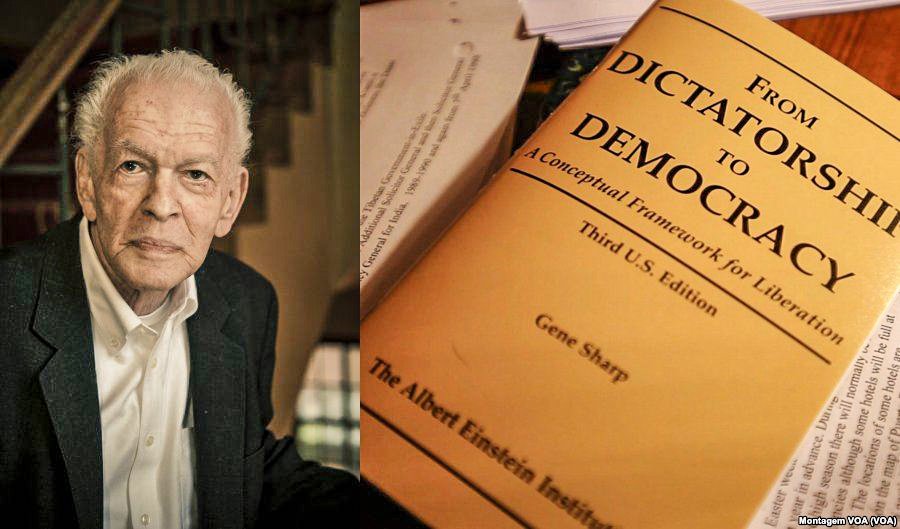
Gene Sharp has died and the world has lost a global educator

Obituary

Just a week after his 90th birthday Gene Sharp passed away.

The journal New Statesman once described Gene Sharp as the “Machiavelli of Nonviolence” and Thomas Weber labelled him “the Clausewitz of Nonviolent Action.”

Who was this man and what is his contribution to our understanding of the possibilities to use nonviolent actions in large scale societal conflicts?

Gene Sharp completed his baccalaureate in 1949, just a few scant years after the close of World War II, and quickly turned his attention to the study of nonviolence.

After serving nine months in prison for being a conscientious objector to the Korean War, Sharp worked as secretary for A.J. Muste. He next joined the editorial team of Peace News in London before accepting an invitation from Arne Næss to join him in Oslo with Johan Galtung and others to study the philosophy and practice of Mohandas Gandhi.

Throughout this time, Sharp exchanged letters with Albert Einstein, deepening his understanding of and commitment to nonviolence.

While in Oslo, Sharp devoted much time to interviewing teachers who resisted the Quisling government during the Nazi occupation of Norway. Through these interviews, Sharp began to formulate the ideas that would come to constitute his major contribution to nonviolence theory.

Moving away from a strictly philosophical, moral, or spiritual nonviolence in the vein of Gandhi, Sharp turned instead to a pragmatic nonviolence. The rest of his life would be spent delineating and analyzing the practical tools of effective nonviolent action.

After his years in Oslo, Sharp pursued his PhD at Oxford University. In 1968 he defended his thesis, The Politics of Nonviolent Action: A study in the control of political power.

He continued to develop his thesis work and five years later Porter Sargent published his monumental The Politics of Nonviolent Action, from which “198 Methods of Nonviolent Action” is taken. This book from 1973 has been called “the bible for nonviolent activists” and is still in print nearly 50 years later.

Through this and myriads other writings, Sharp contended against a normative approach to nonviolence, where the practice of nonviolence is formulated as a spiritual directive.

Nonviolent action need have no moral impetus to be effective; nonviolent actions may be pursued on a purely practical basis on the ground that they are simply the most effective tools available to social and political movements.

Indeed, much research by Sharp and others has shown that in the long term nonviolent revolutionary achievements are far more permanent than those fought with kalashnikovs and guerrilla warfare.

Taking this a step further, Sharp maintained that nonviolence could not only resist and overthrow dictatorships or occupations, but could effectively replace all militaries. By thoroughly training the civilian populace in nonviolent strategies and tactics, a nation could make itself ungovernable at will.

If such a nation were to be invaded, it could never be subjugated. Those in powerful positions can punish but not force individuals to follow their orders without a certain level of cooperation. As history has shown, people practicing total noncooperation will only serve to drag down their oppressor. The burden of an inoperative state outweighs the benefits of its occupation.

This part of the heritage from Sharp is less known and accepted than his works on nonviolent actions by actors outside the state.

Sharp worked hard to convince politicians around the world of his position. Despite some positive feedback from Sweden, Norway and the Baltic states, however, the discussions never moved from the fringe to the central political agenda in any country. The main argument against a national, civilian-based defense might be that such an “army” could also be used against its own state.

Does the government trust its own people enough to enable their use of nonviolent actions on a massive scale?

Many doubt that they could!

We may hope, however, that these ideas came at the wrong time in history and that future discussions will give them the credit they deserve.

The revitalization of research on nonviolent actions after the so-called “Arab Spring” might make such discussions possible.

Though he may not have convinced governments to adopt nonviolent training, it is clear that grassroots political and social movements have taken up Sharp’s writings with a passion. The last fifty years has seen the steady spread of Sharp’s fingerprint in movements around the world.

When Gandhi and his movement liberated India from the British colonizers in 1947, their use of nonviolent actions was an exception among revolutionary groups. An important shift in strategy took place in the late seventies and early eighties, however. When the Shah was forced to leave Iran in 1979 and Solidarity organized the workers in Poland in 1980, we saw some exiting examples of movements that based their struggle on nonviolent strategies and tactics.

To what degree these movements were familiar with the works of Gene Sharp we do not know.

What is clear, however, is that revolutionary movements in the next four decades adopted a broad and ever-broadening range of nonviolent actions and strategies—those same strategies Sharp had been elucidating.

Later, when several of Sharp’s key works were translated into dozens of languages, his ideas indisputably inspired thousands of suppressed people searching for ways to fight for their freedom, rights, and for democracy.

The removal of president Marcos in the Philippines in 1986, the liberation of Eastern Europe and dismantling of the Soviet Union after 1989, the first Intifada in Palestine in 1990-91, the Colored Revolutions following the fall of Milosevic in Serbia in 2000, and the uprising in the MENA (Middle East and Northern Africa) region from 2011 onwards all evidenced deep understanding of practical nonviolent revolution.

Journalists, activists, academics, and politicians then found a new interest in these fascinating regime changes and their theoretical sources. For each and all of them the works of Gene Sharp now became obligatory – and enlightening – reading.

When Sharp began his study, peace research was a small, odd branch on the academic oak. A hardly visible twig on that branch focused on nonviolence. Seventy years later the field has expanded to be a significant part of several academic disciplines. It has also moved beyond the university campus, reaching suppressed people around the world and turning theoretical ideas into practical tools for social movements.

Sharp’s lifelong research and voluminous writings have played a crucial role in this development.

When, at the age of 84, Sharp received the 2012 Right Livelihood Award, he humbly played-down his role as a source of inspiration for the twentieth century’s swell – and the twenty-first century’s tsunami – of unarmed revolutions and social movements.

He did note, however, that for the first time in his entire life he found himself interviewed by journalists who at least understood what is was that he was talking about.

His contribution to the field of nonviolent actions will for ever be seen as the equivalent to the first humans landing on the moon. A majority of present researchers in the field of nonviolence have benefited enormously by building on the works and theories published by Gene. Many of us have now lost a friend and many more lost an important source of inspiration.

More sources
Gene Sharp on Hard Talk on BBC 2015

Books by Sharp on GoodReads

GeneSharpFilm

Gene Sharp on Wikipedia

Share

Leave a Reply

Your email address will not be published. Required fields are marked *

Related Posts

Lena Petrova of “World Affairs In Context” with more than half a million subscribers on YouTube wanted to explore what a peace researcher like me has to say about, among other things, the First and the Second Cold War and why eethics has disappeared from politics. I am particularly happy about this conversation that also yielded an amazing number of very appreciative comments on YouTube. No doubt, people are longing for alternatives, including peace perspectives.
The MIMAC – Military-Industrial-Media-Academic Complex – drives the world’s rampant militarism and wars without end. Here is a short reflection of how it works against all interests of humanity. #5 deals with why there is no real enemy or threat images/analysis. It’s all ex-post constructions. And, btw, theTFF Peace Pulse is now on Rumble.
Jan Oberg, TFF director April 28, 2026 In this third TFF Peace Pulse, I make the important distinction between the violence and the conflict that violence is a symptom of. If you want peace, focus on the underlying conflict because that is the key to resolution, peacemaking, and a better future for the parties. The West is obsessed with violence, just look around you – and 90+ per cent of the public debate is about military issues and other violence – totally wasted for peace. These Peace Pulses will only be published here a few times. You will also not find them on YouTube and Vimeo because both platforms have blocked TFF and me; you know, peace is dangerous these days. Most TFF’s videos since 2007 are now on Rumble.

Recent Articles

Jan Oberg May 15, 2026 Go to this Fox News page and scroll the whole way down: President Donald Trump tells the world that his meeting with President Xi Jinping yielded a lot of very concrete political and economic results – of course, only where the Chinese side, according to him, agreed with him. He does not mention the Taiwan issue, but Secretary of State, Marco Rubio, says that it did not feature prominently in their talks and that the US policy on Taiwan has not changed. Then go to China Daily – or Global Times – and you will see that for the Chinese it is framework, principles, structure of cooperation etc. that matters – all embedded in the overall idea of “constructive bilateral relationship of strategic stability.” Nowhere is any concrete agreement or deal – all that Trump refers to – mentioned. At the general level, this gives you insights into the very different social...
Lena Petrova of “World Affairs In Context” with more than half a million subscribers on YouTube wanted to explore what a peace researcher like me has to say about, among other things, the First and the Second Cold War and why eethics has disappeared from politics. I am particularly happy about this conversation that also yielded an amazing number of very appreciative comments on YouTube. No doubt, people are longing for alternatives, including peace perspectives.
The MIMAC – Military-Industrial-Media-Academic Complex – drives the world’s rampant militarism and wars without end. Here is a short reflection of how it works against all interests of humanity. #5 deals with why there is no real enemy or threat images/analysis. It’s all ex-post constructions. And, btw, theTFF Peace Pulse is now on Rumble.

TFF on Substack

Discover more from TFF Transnational Foundation & Jan Oberg.

Most Popular

Jan Oberg May 15, 2026 Go to this Fox News page and scroll the whole way down: President Donald Trump tells the world that his meeting with President Xi Jinping yielded a lot of very concrete political and economic results – of course, only where the Chinese side, according to him, agreed with him. He does not mention the Taiwan issue, but Secretary of State, Marco Rubio, says that it did not feature prominently in their talks and that the US policy on Taiwan has not changed. Then go to China Daily – or Global Times – and you will see that for the Chinese it is framework, principles, structure of cooperation etc. that matters – all embedded in the overall idea of “constructive bilateral relationship of strategic stability.” Nowhere is any concrete agreement or deal – all that Trump refers to – mentioned. At the general level, this gives you insights into the very different social...
Lena Petrova of “World Affairs In Context” with more than half a million subscribers on YouTube wanted to explore what a peace researcher like me has to say about, among other things, the First and the Second Cold War and why eethics has disappeared from politics. I am particularly happy about this conversation that also yielded an amazing number of very appreciative comments on YouTube. No doubt, people are longing for alternatives, including peace perspectives.
The MIMAC – Military-Industrial-Media-Academic Complex – drives the world’s rampant militarism and wars without end. Here is a short reflection of how it works against all interests of humanity. #5 deals with why there is no real enemy or threat images/analysis. It’s all ex-post constructions. And, btw, theTFF Peace Pulse is now on Rumble.
Read More
Screenshot-2026-05-15-103534
Jan Oberg May 15, 2026 Go to this Fox News page and scroll the whole way down: President Donald Trump tells the world that his meeting with President Xi Jinping yielded a lot of very concrete political and economic results – of course, only where the Chinese side, according to him, agreed with him. He does not mention the Taiwan issue, but Secretary of State, Marco Rubio, says that it did not feature prominently in their talks and that the US policy on Taiwan has not changed. Then go to China Daily – or Global Times – and you will see that for the Chinese it is framework, principles, structure of cooperation etc. that matters – all embedded in the overall idea of “constructive bilateral relationship of strategic stability.” Nowhere is any concrete agreement or deal – all that Trump refers to – mentioned. At the general level, this gives you insights into the very different social...
Screenshot-2026-05-12-104023
Lena Petrova of “World Affairs In Context” with more than half a million subscribers on YouTube wanted to explore what a peace researcher like me has to say about, among other things, the First and the Second Cold War and why eethics has disappeared from politics. I am particularly happy about this conversation that also yielded an amazing number of very appreciative comments on YouTube. No doubt, people are longing for alternatives, including peace perspectives.
Screenshot-2026-04-13-154551 (2)
The MIMAC – Military-Industrial-Media-Academic Complex – drives the world’s rampant militarism and wars without end. Here is a short reflection of how it works against all interests of humanity. #5 deals with why there is no real enemy or threat images/analysis. It’s all ex-post constructions. And, btw, theTFF Peace Pulse is now on Rumble.
Screenshot-2026-04-13-154551 (1)
Jan Oberg, TFF director April 28, 2026 In this third TFF Peace Pulse, I make the important distinction between the violence and the conflict that violence is a symptom of. If you want peace, focus on the underlying conflict because that is the key to resolution, peacemaking, and a better future for the parties. The West is obsessed with violence, just look around you – and 90+ per cent of the public debate is about military issues and other violence – totally wasted for peace. These Peace Pulses will only be published here a few times. You will also not find them on YouTube and Vimeo because both platforms have blocked TFF and me; you know, peace is dangerous these days. Most TFF’s videos since 2007 are now on Rumble.
Screenshot-2026-04-13-154551
In contrast to most, we’ll bring alternatives, solutions, hope and strategies for a better future. Times are dangerous, yes, but that only intensifies the need for constructive thinking and action! Jan Oberg, TFF director April 13, 2026 The new TFF Peace Pulse uses video messages in a new way: Max 3-5-minute-long comments, ideas or perhaps mini-lectures, all about peace – positive peace. We launch them today on April 13, 2026 with a carefully crafted visual aesthetic fitting the content. We hope to publish them regularly from now on. We launch Peace Pulse (PP) – for a number of reasons. The world is in chaos, and there are countless reasons to feel concerned, frustrated, even angry. The atmosphere is saturated with doom and gloom, with negative energy and rear‑mirror thinking, while vision, imagination, alternatives, strategies and genuine future‑mindedness remain in short supply. And without them, we simply can’t save the world. Looking at problems from a hundred angles will...
IMG_5165 (1)
PART II — Publishing Peace in a System That Prioritises Militarism Jan Oberg, TFF director April 10, 2026 How TFF Maintains a Daily Voice in a Digital World Built for Noise This article is part of the series “TFF at 40″ and it invites you to learn about Four Decades of Publishing Peace. It takes a look at how a small, people‑financed peace foundation has communicated across four generations of technology — from wax stencils and fax machines to mass email and Substack — and why TFF continues to publish every single day in a system that rewards noise, conflict, and militarism. ◆ What it means to publish peace every single day in a digital system built for 24/7 news and other noise, confrontation, and militarism. How TFF’s independence, continuity, and global readership defy algorithms, donor cycles, and Western media censorhip — and why the Majority World keeps listening. When the...


