
By Caroline Davies
February 17, 2020
Extinction Rebellion (XR) US has four Demands for our governments, local and national, the first of which is “Tell the Truth”. One truth that is not being told or spoken about openly, is the carbon footprint and other sustainability impacts of the US Military.
Originally posted on WorldBeyondWar on February 4, 2020 here
I was born in the UK and, although I am now a US citizen, I have noticed that people are very uncomfortable saying anything negative about the US Military here. Having worked with many injured veterans as a physical therapist, I know how important it is for us to support our veterans; many Vietnam veterans still feel hurt about being blamed and discriminated against when they came home from that war.
As horrific as wars are for everyone involved, especially the civilians in the countries we are attacking, the soldiers follow our orders – through the representatives we elect. Criticism of our military is not criticism of our soldiers; it is a criticism of us: we are all collectively responsible for the size of our military and what it does.
We cannot stay silent about what we are ordering our soldiers to do, that causes suffering to them and to countless unknown others across the globe, or how much our military is contributing to our climate crisis. A number of veterans are speaking up themselves. As a result of their own experiences, they are trying to get our attention about the devastating humanitarian and environmental impacts of war and the moral injury to the soldiers involved.
Veterans For Peace have been talking about all of these issues since 1985 and About Face, which formed after 9/11, has described itself as, “Veterans taking action against militarism and endless wars”. Both of these groups have been speaking up loudly against any war with Iran.
The US Military is speaking about climate change and planning for how it will affect them. The US Army War College issued a report in August of this year, “Implications for Climate Change for the US Army”. The second paragraph of this 52-page report said “The study did not look to ascribe causation to climate change (man-made or natural), as causation is distinct from effects and not pertinent to the approximately 50-year horizon considered for the study”.
Imagine a fire department pointing a number of high-pressure blow torches at a burning house; then imagine that that same department would write a report on how they were going to manage this emergency, without mentioning (or planning) to switch off their blowtorches. I was incensed when I read this.
The rest of the report predicts an imminent future of civil unrest, disease and mass migration and describes climate change as a “threat multiplier”. Despite their intention to avoid any self-scrutiny, the report, somewhat cavalierly, describes the Army’s massive carbon spewing, munition poisoning and soil erosion, and summarizes it as follows:
“In short, the Army is
an environmental disaster”
If the US Army can say this in their own report, then why aren’t we talking about it? In 2017 “the Air Force purchased $4.9 billion worth of fuel and the Navy $2.8 billion, followed by the Army at $947 million and Marines at $36 million”. The US Airforce uses five times more fossil fuel than the US Army, so what does that make it? An environmental disaster x 5?
After reading the US Army War College Report, I was ready to “confront a general”. It turned out that a retired Air Force Lt. General was speaking at an upcoming Sustainability Event, co-sponsored by the Julie Anne Wrigley Global Institute of Sustainability and the American Security Project on “Salute to Service: Climate Change and National Security”. Perfect!
I have noticed that there are several talks a year at Arizona State University (ASU) by members of the armed services presenting their latest and greatest sustainability solutions, yet the elephant in the room is never mentioned.
I wasn’t the only XR member who wanted to speak up at this event. Between us, we were able to raise many, if not all, of the following issues:
(Please take the time to digest the following figures – they are shocking when you do.)
- The US military carbon footprint is larger than any other single organization in the world, and based on its fuel usage alone, it is the 47th largest emitter of greenhouse gases in the world
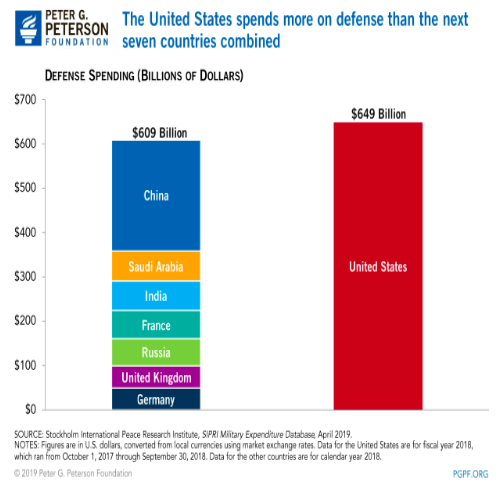
- Our 2018 military budget was equivalent to the next 7 countries combined.
- 11% of the military budget could fund renewable energy for every home in the US.
- The interest on National Debt for 2020 is $479 billion. Although we spent massively on the Iraq and Afghanistan Wars, we used debt to fund them and meanwhile lowered our taxes.
Our Discretionary Budget for 2020 ($1426 billion) is divided as follows:
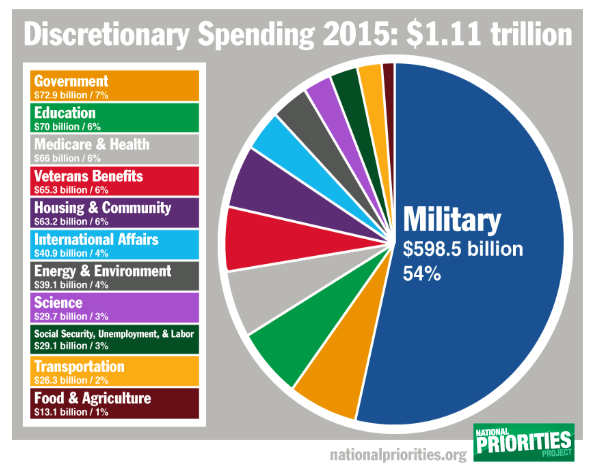
- 52% or $750 billion to the Military, and $989 billion, when you add in the budgets for Veterans Affairs, the State Department, National Security, Cybersecurity, National Nuclear Security and the FBI.
- 0.028% or $343 million to renewable energy.
- 2% or $31.7 billion to energy and environment.
In case you missed it, the percentage of what we spent on Renewable Energy is 0.028% or $343 million compared to what we spend on the military which was 52% or $734 billion: we spend almost 2000 times more on our military than we do on renewable energy.
Does this make sense to you given the crisis we are in? Both of our Senators and almost all of our house representatives voted for this budget in the National Defense Authorization Act for 2020, with a few notable exceptions.
In case you missed it, the percentage of what we spent on Renewable Energy is 0.028% or $343 million compared to what we spend on the military which was 52% or $734 billion: we spend almost 2000 times more on our military than we do on renewable energy.
The General’s talk at ASU was definitely aimed to alert the public about the climate emergency and its implications for our security; we were in total agreement with him over this, even if we may have differed on the solutions. He was very gracious about giving us time to speak and, at the end of the talk said “this talk has been in the top 1-2% that I have given around the country”. Maybe, he, like us, felt better for starting this difficult conversation.
Every so often I meet people who really know what they are talking about in regards to our climate crisis; they have studied sustainability in depth, they often come from engineering or scientific backgrounds, and they tell me these same two things: “the most important thing we can do is to spend less overall and stop burning fossil fuels” – shouldn’t that also apply to the US Military?
Many of us in Extinction Rebellion have already taken steps to cut back our carbon footprint such as downsizing our homes or going without a vehicle, and some of us have stopped flying. But the fact is, that even a homeless person in the US has double the carbon emission of the global per-capita, in large part because of our massive military spending.
It isn’t even that our military spending is making us safer or improving the world, as evidenced by so many examples.
Here are just a few from the Iraq War (which was contrary to the UN charter and therefore actually, an illegal war) and the war in Afghanistan, both of which are ongoing.
- The Iraqi government just shot 319 civilians (15,000 injured!) who were protesting the corruption and lack of jobs in their country.
- The displacement of 1 in 10 Iraqis by this war and the opening up of Iraq to Iranian influence, as a result of the subsequent regional instability.
- ISIS was, in large part, created by the invasion and occupation of Iraq, confirming that “foreign military occupations tend to radicalize local populations and breed violent insurgencies”
- 182,000 Iraqis (up to Nov 2018) died since the US invasion and over 4,500 US soldiers died. This does not include contractor deaths which were considerable, too.
- 38,000 Afghani civilians died violent deaths since we invaded in 2001.
- In September of this year, a drone attack killed 30 pine nut harvesters in Afghanistan, many of them young people who had just left school and were doing this as their first summer job. A week later we hit a wedding party killing 40 people including 12 children with another drone.
“60,000 veterans died by suicide between 2008 and 2017” according to the Department of Veteran Affairs!
War is immensely destabilizing for the people and countries we bomb, and for our own families. War prevents sustainable development, causes political instability and increases the refugee crisis, over and above the terrible damage it causes to civilians’ lives, the built environment, landscapes and ecosystems: Even as the US Military “greens itself” and boasts of its sustainability innovations (imagine how many sustainability breakthroughs our cities and states could have on a US Military-sized budget): war can never be green.
At the ASU Talk, the General repeatedly responded to our concerns by telling us, “talk to your elected officials” and “we are just a tool”. In theory, he is correct, but does it feel like that to you? I think most of us, including our elected officials, are unwilling to speak out because we feel intimidated by our military, the sacrosanct support for it by our mainstream media, the corporate profiteers and lobbyists who keep some of us in our jobs and/or stock profits and, many of us are also benefiting from the income the military spending brings us and our state.
The top six world arms dealers all have offices in Arizona. They are, in order: Lockheed Martin, BAE Systems, Boeing, Raytheon Northrop-Grumman and General Dynamic. Arizona received $10 billion of government defence spending in 2015.
This funding could be reallocated to go towards providing free in-state college tuition and universal healthcare; many young people join our military as they have no job prospects or, way of affording college or medical care; they could be learning sustainability solutions for the future instead of learning how to be another cog in our highly-unsustainable everywhere-war machine.
I do not hear any of our local or national environmental organizations talking about the military.
This may be for many reasons: shame for all that we have done with our military, intimidation by decades of militaristic propaganda or perhaps because environmental groups have not represented the people who join the military and have little connection to the sacrifices being made. Do you know anyone in the military or live near a base?
There are 440 military bases in the US and at least 800 bases around the world, the latter of which cost $100 billion annually to maintain to: perpetuate endless wars, deeply offend, sicken and bring sexual violence to the local people, cause widespread and ongoing environmental damage, separate loved ones, excuse excessive weapons sales and off the charts oil use – ferrying our soldiers to and from them. Many people and organizations are now working to close these bases and we must too.
Although military personnel numbers have almost halved since the Vietnam War and the percentage of the population in the US Military is now down to 0.4%, the percentage of minorities in the military has been increasing (compared to the civilian labor force), especially for black women (who are almost equal in number to white women in the army), black men and Hispanics.
This means people of color are disproportionately suffering the health risks and dangers we expose them to overseas, through burn pits, for example and at home; typically, most military personnel live around the bases where their exposure to military pollutants is greater. Our own Luke Air Force Base has levels of Polyfluoroalkyl substances (PFA’s), known to cause infertility and cancer, that are above safe lifetime limits in their ground and surface water.
Sorry to alarm you but these chemicals have got into 19 other water testing sites across the Phoenix Valley; there is no end to the environmental and ecological damage in other countries because of our wars.
Consider reading Nikhil Pal Singh’s excellent article, “Enough Toxic Militarism” for a disturbing and insightful analysis of the “costs of unbridled militarism”, which he chillingly observes, “are everywhere, hidden in plain sight”; “In particular, military interventions abroad have stoked racism at home. Police now operate with the weapons and mentality of combat soldiers, and they tend to frame vulnerable communities as enemies to be punished.”
He also points to the mass shootings that are so common we don’t pay attention to them anymore, the metastasizing of the terrorist threats (“White supremacy is a greater threat than international terrorism right now” ), the antagonistic politics, the trillion-dollar price tag leading us to “spiralling debt” and “war as a natural and unchanging backdrop to social life in the United States today.”
I will never forget the shock of seeing an armored tank-like vehicle on 59th Avenue in Glendale, AZ, with combat police hanging off all sides of it, going to find some potential “enemy combatants”. I have never seen anything like this in the UK, not even at the height of the IRA bombings and especially not in a quiet residential neighbourhood.
Peer-reviewed academic articles that are critical of the US Military’s ecological, humanitarian or carbon footprint are as hard to find as people talking about this subject.
An article titled “Hidden Carbon Costs of the “Everywhere War”: Logistics, geopolitical ecology, and the carbon boot‐print of the US military” looked at the immense supply train, its entangled relationship with the corporate sector, and subsequent massive oil usage of the US Military. It reported that the average fuel use per day per soldier was one gallon in WWII, 9 gallons in Vietnam and 22 gallons in Afghanistan. The authors concluded: “the headline summary is that social movements concerned with climate change must be every bit as vociferous in contesting US Military interventionism” as other causes of climate change.
A second paper, “Pentagon Fuel Use, Climate Change, and the Costs of War”, examines military fuel usage for the US post-9/11 wars and the impact of that fuel usage on greenhouse gases emissions. It states “if the US military were to significantly decrease its greenhouse gas emissions it would make the dire climate change caused national security threats the US military fears and predicts less likely to occur”. Interestingly, military climate emissions were exempted from the Kyoto Protocol, but in the Paris Accord, they were no longer exempted. No wonder we had to leave.
The irony is that the US Military is both concerned about climate change and a key contributor to climate change: “the military is not just a prolific user of oil, it is one of the central pillars of the global fossil-fuel economy…modern-day military deployment is about controlling oil-rich regions and defending the key shipping supply routes that carry half the world’s oil and sustain our consumer economy”.
In fact, in the Army Report mentioned earlier, they talk about how to compete for the oil sources that will emerge when the Arctic Ice melts. Our consumer economy and our oil habits are supported by the US Military! So, we do have a responsibility to not keep buying stuff and reduce our own carbon footprints, as well as focusing on the Military and our politicians who keep writing them blank checks. Very few of our Arizona House Representatives voted against the 2020 Defense Budget and neither of our Senators did.
In summary, it is the US Military which is the true “threat multiplier” to the climate crisis.
This all feels pretty uncomfortable to read and think about, doesn’t it? I mentioned cutting the military budget to pay for other programs at a local political meeting recently and received this comment, “Where are you from? You must hate the United States then?” I couldn’t answer this. I don’t hate Americans, but I do hate what we (collectively) do to people in our own country and around the world.
Originally posted on WorldBeyondWar on February 4, 2020, here
What can we all do to make ourselves feel better and have an effect on all of this?
- Talk about the US military and why it is ‘off limits” in climate, budget or general conversations and how you feel about all aspects of this topic.
- Encourage the groups you are in to put the US military footprint on their agenda.
- Talk to your elected local state and national officials about cutting our military budget, ending our endless wars and stopping the environmental and humanitarian destruction we have for so long ignored.
- Divest your savings from the war machine as well as fossil fuels. The people of Charlottesville, VA persuaded their city to divest from both weapons and fossil fuels and recently, New York City divested from trafficking nuclear weapons.
- Spend less on everything: buy less, fly less, drive less and live in smaller homes
A number of the groups below have local chapters you can join or will help you start one. Extinction Rebellion groups are spreading too, if we even have one in Phoenix now, there is a decent chance there is one near you. Feel inspired and hopeful when you read about how much the following organizations are doing to put things right:

If you enjoyed reading this article…
[paypal-donation]


