

Dan Harsha: Taking China’s pulse - How much do the Chinese trust their leaders?

Ash Center research team unveils findings from long-term public opinion survey

By Dan Harsha – Ash Center Communications

November 6, 2021

Understanding what Chinese citizens think about their own government has proven elusive to scholars, policymakers, and business people alike outside of the country. Opinion polling in China is heavily scrutinized by the government, with foreign polling firms prohibited from directly conducting surveys.

Given China’s global rise in the economic, military, and diplomatic spheres, understanding public opinion there has arguably never been more important.

Originally published at The Harvard Gazette

A new study from the Ash Center fills in this gap for the first time, providing a long-term view of how Chinese citizens view their government at the national, as well as the regional and local levels. What started as an exercise in building a set of teaching tools for an executive education class eventually transformed into the longest academic survey of Chinese public opinion conducted by a research institution outside of China.

“Gathering reliable, long-term opinion survey data from across the country is a real obstacle,” said Ash Center China Programs Director Edward Cunningham. “Rigorous and objective opinion polling is something that we take for granted in the U.S.”

While important work in this area has been accomplished by previous scholars — and their work shaped the analysis of the survey data collected — those other surveys were often short-term or infrequent.
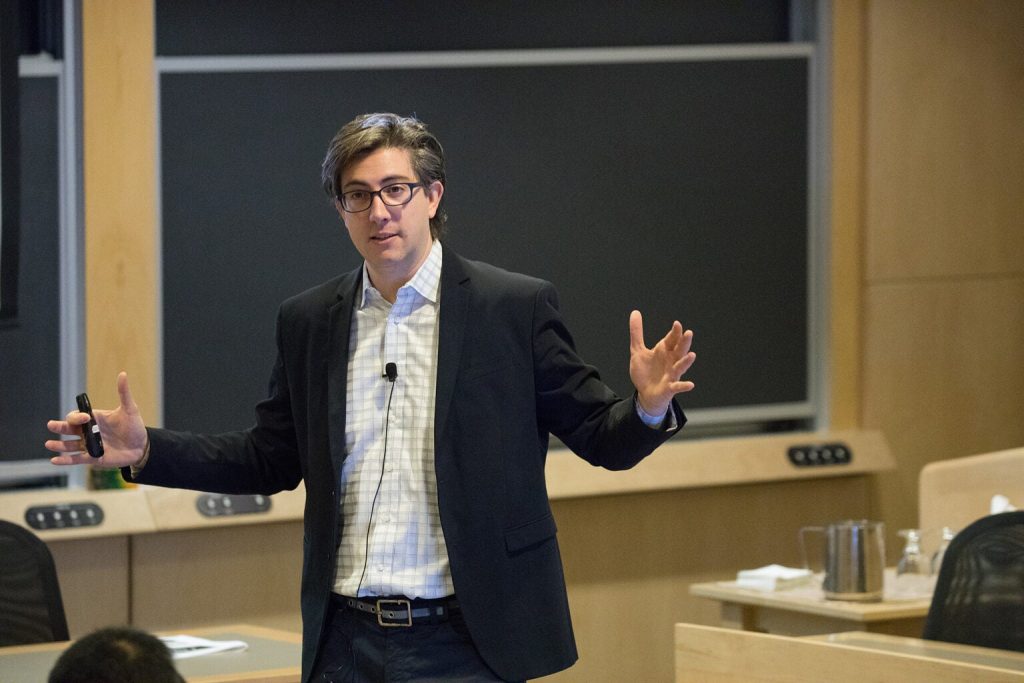
Edward Cunningham teaching. Photo courtesy of the Ash Center

For Tony Saich, Daewoo Professor of International Affairs and director of the Ash Center, the quest to build a firmer understanding of Chinese public opinion has taken the better part of 15 years. It began with an attempt to develop a suite of curricular materials to inform a course on local government in China. 

 “We thought it would be helpful to know how satisfied citizens were with different levels of government, and in particular how satisfied they were with different kinds of government services,” said Saich. 

The work began in 2003, and together with a leading private research and polling company in China, the team developed a series of questionnaires for in-person interviews. The surveys were conducted in eight waves from 2003 through 2016, and captured opinion data from 32,000 individual respondents.

“There’s nothing comparable done on this scale, over such a long period of time, and over a large geographic area,” said Jesse Turiel, a China public policy postdoctoral fellow and co-author who worked closely with Saich and Cunningham on the project’s analysis and subsequent publications.  

The survey team set out to assess overall satisfaction levels with government among respondents from across the socioeconomic and geographic strata of China. “It is always a challenge to obtain a representative sample of the Chinese population, particularly from interior provinces,” said Turiel. “Our survey does not include migrant laborers, for example. But given the fact that the survey conducted in-person interviews with over 3,000 respondents per year in a purposive stratified sample, we are happy that the results include not just the coastal elites or large urban areas, but also poorer and less developed inland provinces.”

Levels of government and public opinion 

The survey team found that compared to public opinion patterns in the U.S., in China there was very high satisfaction with the central government. In 2016, the last year the survey was conducted, 95.5 percent of respondents were either “relatively satisfied” or “highly satisfied” with Beijing.

In contrast to these findings, Gallup reported in January of this year that their latest polling on U.S. citizen satisfaction with the American federal government revealed only 38 percent of respondents were satisfied with the federal government.  

For the survey team, there are a number of possible explanations for why Chinese respondents view the central government in Beijing so favorably. According to Saich, a few factors include the proximity of central government from rural citizens, as well as highly positive news proliferated throughout the country.

This result supports the findings of more recent shorter-term surveys in China, and reinforces long-held patterns of citizens reporting local grievances to Beijing in hopes of central government action. “I think citizens often hear that the central government has introduced a raft of new policies, then get frustrated when they don’t always see the results of such policy proclamations, but they think it must be because of malfeasance or foot-dragging by the local government,” said Saich.

Tony Saich, Daewoo Professor of International Affairs and director of the Ash Center. Photo courtesy of the Ash Center

Compared to the relatively high satisfaction rates with Beijing, respondents held considerably less favorable views toward local government. At the township level, the lowest level of government surveyed, only 11.3 percent of respondents reported that they were “very satisfied.”

Again, the U.S. reveals quite a different story. “American trust surveys over time show a clear distinction between low levels of trust towards the federal government, but a strong belief and faith in the power of local government — at the most local level, those positions may be filled by part-time volunteers who are a part of your everyday life,” said Cunningham. This dichotomy is highlighted by a 2017 Gallup poll, where 70 percent of U.S. respondents had a “great” or “fair” amount of trust in local government.

Saich contends that the lack of trust in local governments in China is due to the fact that they provide the vast majority of services to the Chinese people. This trust deficit was compounded by the 1994 tax reforms, which garnered a substantially larger share of total national tax revenues for the central government. Local governments, despite being faced with declining revenues, were still on the hook for providing the bulk of public services throughout China.

“Local governments were caught between dropping tax revenue and rising expenditures,” Cunningham said. “Many local governments then had to turn to ad-hoc extra budgetary fees to close the budget gap. I think that has consistently undermined trust at the local level.”

Regional disparities

The research team was also keen to examine disparities in the responses of wealthy, predominantly urban and coastal areas of China and those of less developed interior provinces. “It didn’t surprise us that the wealthy coastal citizens who were the winners of globalization in many ways, and the winners of China’s domestic reform program, had a very high favorability rate of government overall, regardless of level of government examined,” said Cunningham.

The responses from survey participants in rural areas, however, surprised the researchers, particularly over time. “We did not anticipate how quickly both low-income citizens and people from less-developed regions in China closed the satisfaction gap with high-income citizens and people from the coastal areas,” Cunningham added.

The surveys found that rural residents, generally poorer than those in cities, had more optimistic attitudes about inequality than their wealthier urban counterparts. The team’s analysis ties the closing of this satisfaction gap between rich and poor, as well as coastal and hinterland populations, to several policies including local budget spent on healthcare, welfare and education, and paved roads per capita.

“We tend to forget that for many in China, and in their lived experience of the past four decades, each day was better than the last.”— Tony Saich, Daewoo Professor of International Affairs and director of the Ash Center

Saich added that the findings “run counter to the general idea that these people are marginalized and disfavored by policies,” and therefore undermine the persistent notion that rising inequality, and dissatisfaction with corruption and local government, have created the potential for widespread unrest in China.

Observers have long predicted that China’s slowing economic growth coupled with a complacent, ineffective government bureaucracy could ultimately lead to the crumbling of Beijing’s political authority. While frustration with corruption and the quality of public services at the local level clearly exists, the Ash research team’s work has shown that the current political system in China appears remarkably resilient.

Inequality remains a key concern for policymakers and citizens alike in China, but the survey project found little to support the argument that those concerns among ordinary Chinese are translating into broader dissatisfaction with government.

The final round of the survey in 2016 revealed that about one-third of respondents were much more likely to lodge complaints with the government or protest if they felt that air pollution had negatively impacted their own health or the health of their immediate family members.

Although state censorship and propaganda are widespread in China, these findings highlight that citizen perceptions of governmental performance respond most to real, measurable changes in individuals’ material well-being. Satisfaction and support must be consistently reinforced. As a result, the data point to specific areas in which citizen satisfaction could decline in today’s era of slowing economic growth and continued environmental degradation.

For Cunningham, it’s important not to forget that many in China are only a generation removed from an era of chronic food shortages and significant social and economic instability. “Relative perspective is always important, as China is still a developing country,” he said.

“We tend to forget that for many in China, and in their lived experience of the past four decades, each day was better than the next,” Saich added. “Our surveys show that many in China therefore seem to be much more satisfied with government performance over time, despite rising inequality, corruption, and a range of other pressures that are the result of the reform era.”

Originally published at The Harvard Gazette

Please help TFF remain truly independent by contributing if you benefited from this article

[paypal-donation]

Share

Leave a Reply

Your email address will not be published. Required fields are marked *

Related Posts

Launched on November 17, 2024Updated with new materials regularly TFF Board members Thore Vest. Everywhere, the delegation was met with a sincere wish to develop knowledge, dialogue, cooperative projects, and initiatives based on citizens’ diplomacy – in general, but with the West in particular. For more, see “Report from the Nordic delegation to China’s Xinjiang Province, September 7-15, 2024.” While the delegation was in Xinjiang, various ideas were already being discussed from the local to the top level, i.e., with the governor and party leaders of Xinjiang. The two TFF Associates suggested that TFF set up a special section – in addition to its “China and Silk” – where various quality materials about Xinjiang would regularly be published to promote public education about Xinjiang, particularly its contemporary development – worldwide but in the West in particular. This is now a reality – as can be seen below – but it...
Photo Jan Oberg China has recently garnered significant attention due to its advancements in various technological fields, such as quantum physics and artificial intelligence. In media discussions and my lectures on China, it is common to encounter objections asserting that the West, particularly the United States, is certainly ahead of China. These assertions appear to be more emotional than factual. However, a more fundamental consideration is whether this question holds any significance. Cultural Perspective One aspect that Westerners often overlook is the cultural variation in understanding the relationship between abstract academic insights and practical applications of those insights. To comprehend the origin and significance of discussions on technological superiority, it is essential to acknowledge cultural and social differences between China and the West. I have explored this topic before in some of my previous articles published on the TFF website. Particularism On the cultural dimension universalist – particularist, China exhibits...
Foreword The Board of The Transnational Foundation in Sweden has decided to publish an easy-to-read, scholarly anthology that addresses one of the most important – and potentially dangerous – issues of our time: Why are the political, economic, and medialised Western images of China so consistently negative – and what can you do to understand China better? These images may be expressions of a political will to present only various shades of grey and black with the aim of building a consciousness about China as an enemy and not a partner. They may also be seen as a sort of world-dominating ethos of ignorance based upon the assumption that “we’ve-got-nothing-to-learn-from-others,’ we are the teacher. Another possibility is that the West, deep down, feels that it is getting relatively weaker from a macro-historical perspective and comforts itself with denial and accusations against “the other” of being the reason for its manifest...

Recent Articles

Jan Oberg May 15, 2026 Go to this Fox News page and scroll the whole way down: President Donald Trump tells the world that his meeting with President Xi Jinping yielded a lot of very concrete political and economic results – of course, only where the Chinese side, according to him, agreed with him. He does not mention the Taiwan issue, but Secretary of State, Marco Rubio, says that it did not feature prominently in their talks and that the US policy on Taiwan has not changed. Then go to China Daily – or Global Times – and you will see that for the Chinese it is framework, principles, structure of cooperation etc. that matters – all embedded in the overall idea of “constructive bilateral relationship of strategic stability.” Nowhere is any concrete agreement or deal – all that Trump refers to – mentioned. At the general level, this gives you insights into the very different social...
Lena Petrova of “World Affairs In Context” with more than half a million subscribers on YouTube wanted to explore what a peace researcher like me has to say about, among other things, the First and the Second Cold War and why eethics has disappeared from politics. I am particularly happy about this conversation that also yielded an amazing number of very appreciative comments on YouTube. No doubt, people are longing for alternatives, including peace perspectives.
The MIMAC – Military-Industrial-Media-Academic Complex – drives the world’s rampant militarism and wars without end. Here is a short reflection of how it works against all interests of humanity. #5 deals with why there is no real enemy or threat images/analysis. It’s all ex-post constructions. And, btw, theTFF Peace Pulse is now on Rumble.

TFF on Substack

Discover more from TFF Transnational Foundation & Jan Oberg.

Most Popular

Jan Oberg May 15, 2026 Go to this Fox News page and scroll the whole way down: President Donald Trump tells the world that his meeting with President Xi Jinping yielded a lot of very concrete political and economic results – of course, only where the Chinese side, according to him, agreed with him. He does not mention the Taiwan issue, but Secretary of State, Marco Rubio, says that it did not feature prominently in their talks and that the US policy on Taiwan has not changed. Then go to China Daily – or Global Times – and you will see that for the Chinese it is framework, principles, structure of cooperation etc. that matters – all embedded in the overall idea of “constructive bilateral relationship of strategic stability.” Nowhere is any concrete agreement or deal – all that Trump refers to – mentioned. At the general level, this gives you insights into the very different social...
Lena Petrova of “World Affairs In Context” with more than half a million subscribers on YouTube wanted to explore what a peace researcher like me has to say about, among other things, the First and the Second Cold War and why eethics has disappeared from politics. I am particularly happy about this conversation that also yielded an amazing number of very appreciative comments on YouTube. No doubt, people are longing for alternatives, including peace perspectives.
The MIMAC – Military-Industrial-Media-Academic Complex – drives the world’s rampant militarism and wars without end. Here is a short reflection of how it works against all interests of humanity. #5 deals with why there is no real enemy or threat images/analysis. It’s all ex-post constructions. And, btw, theTFF Peace Pulse is now on Rumble.
Read More
Screenshot-2026-05-15-103534
Jan Oberg May 15, 2026 Go to this Fox News page and scroll the whole way down: President Donald Trump tells the world that his meeting with President Xi Jinping yielded a lot of very concrete political and economic results – of course, only where the Chinese side, according to him, agreed with him. He does not mention the Taiwan issue, but Secretary of State, Marco Rubio, says that it did not feature prominently in their talks and that the US policy on Taiwan has not changed. Then go to China Daily – or Global Times – and you will see that for the Chinese it is framework, principles, structure of cooperation etc. that matters – all embedded in the overall idea of “constructive bilateral relationship of strategic stability.” Nowhere is any concrete agreement or deal – all that Trump refers to – mentioned. At the general level, this gives you insights into the very different social...
Screenshot-2026-05-12-104023
Lena Petrova of “World Affairs In Context” with more than half a million subscribers on YouTube wanted to explore what a peace researcher like me has to say about, among other things, the First and the Second Cold War and why eethics has disappeared from politics. I am particularly happy about this conversation that also yielded an amazing number of very appreciative comments on YouTube. No doubt, people are longing for alternatives, including peace perspectives.
Screenshot-2026-04-13-154551 (2)
The MIMAC – Military-Industrial-Media-Academic Complex – drives the world’s rampant militarism and wars without end. Here is a short reflection of how it works against all interests of humanity. #5 deals with why there is no real enemy or threat images/analysis. It’s all ex-post constructions. And, btw, theTFF Peace Pulse is now on Rumble.
Screenshot-2026-04-13-154551 (1)
Jan Oberg, TFF director April 28, 2026 In this third TFF Peace Pulse, I make the important distinction between the violence and the conflict that violence is a symptom of. If you want peace, focus on the underlying conflict because that is the key to resolution, peacemaking, and a better future for the parties. The West is obsessed with violence, just look around you – and 90+ per cent of the public debate is about military issues and other violence – totally wasted for peace. These Peace Pulses will only be published here a few times. You will also not find them on YouTube and Vimeo because both platforms have blocked TFF and me; you know, peace is dangerous these days. Most TFF’s videos since 2007 are now on Rumble.
Screenshot-2026-04-13-154551
In contrast to most, we’ll bring alternatives, solutions, hope and strategies for a better future. Times are dangerous, yes, but that only intensifies the need for constructive thinking and action! Jan Oberg, TFF director April 13, 2026 The new TFF Peace Pulse uses video messages in a new way: Max 3-5-minute-long comments, ideas or perhaps mini-lectures, all about peace – positive peace. We launch them today on April 13, 2026 with a carefully crafted visual aesthetic fitting the content. We hope to publish them regularly from now on. We launch Peace Pulse (PP) – for a number of reasons. The world is in chaos, and there are countless reasons to feel concerned, frustrated, even angry. The atmosphere is saturated with doom and gloom, with negative energy and rear‑mirror thinking, while vision, imagination, alternatives, strategies and genuine future‑mindedness remain in short supply. And without them, we simply can’t save the world. Looking at problems from a hundred angles will...
IMG_5165 (1)
PART II — Publishing Peace in a System That Prioritises Militarism Jan Oberg, TFF director April 10, 2026 How TFF Maintains a Daily Voice in a Digital World Built for Noise This article is part of the series “TFF at 40″ and it invites you to learn about Four Decades of Publishing Peace. It takes a look at how a small, people‑financed peace foundation has communicated across four generations of technology — from wax stencils and fax machines to mass email and Substack — and why TFF continues to publish every single day in a system that rewards noise, conflict, and militarism. ◆ What it means to publish peace every single day in a digital system built for 24/7 news and other noise, confrontation, and militarism. How TFF’s independence, continuity, and global readership defy algorithms, donor cycles, and Western media censorhip — and why the Majority World keeps listening. When the...

