
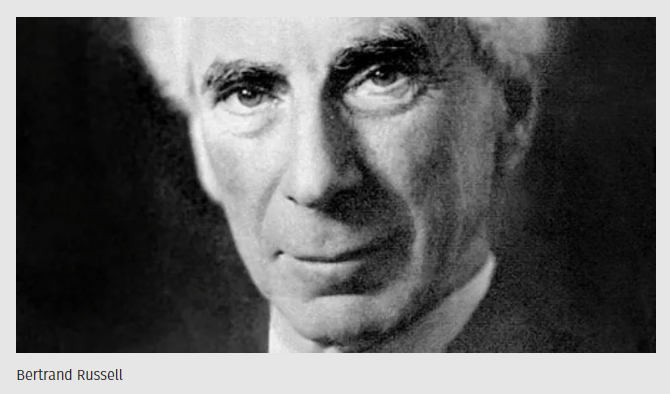
Bertrand Russell on the Salve for Our Modern Helplessness and Overwhelm

October 19, 2023

“To be a good human being is to have a kind of openness to the world, an ability to trust uncertain things beyond your own control,” philosopher Martha Nussbaum concluded in considering how to live with our human fragility. And yet in the face of overwhelming uncertainty, when the world seems to splinter and crumble in the palm of our civilization’s hand, something deeper and more robust than blind trust is needed to keep us anchored to our own goodness — something pulsating with rational faith in the human spirit and a profound commitment to goodness.

Originally published at The Marginalian

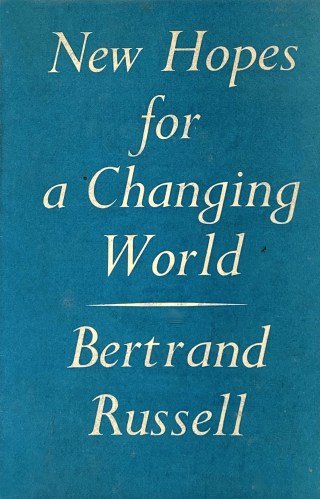
That is what Bertrand Russell (May 18, 1872–February 2, 1970) explores in the out-of-print treasure New Hopes for a Changing World (public library), composed a year after he received the Nobel Prize, while humanity was still shaking off the dust and dread of its Second World War and already shuddering with the catastrophic nuclear threat of the Cold War.

Observing that his time, like ours, is marked by “a feeling of impotent perplexity” and “a deep division in our souls between the sane and the insane parts,” Russell considers the consequence such total world-overwhelm has on the human spirit:
“One of the painful things about our time is that those who feel certainty are stupid, and those with any imagination and understanding are filled with doubt and indecision.”

And yet, with his unfaltering reasoned optimism, he insists that there is an alternate view of our human destiny — one that vitalizes rather than paralyzes, based on “the completest understanding of the moods, the despairs, and the maddening doubts” that beset us; one that helps mitigate the worst of Western culture — “our restlessness, our militarism, our fanaticism, and our ruthless belief in mechanism” — and amplifies the best in it: “the spirit of free inquiry, the understanding of the conditions of general prosperity, and emancipation from superstition.” He examines the root of our modern perplexity, perhaps even more pronounced in our time than it was in his:

“Traditional systems of dogma and traditional codes of conduct have not the hold that they formerly had. Men and women are often in genuine doubt as to what is right and what is wrong, and even as to whether right and wrong are anything more than ancient superstitions. When they try to decide such questions for themselves they find them too difficult. They cannot discover any clear purpose that they ought to pursue or any clear principle by which they should be guided. Stable societies may have principles that, to the outsider, seem absurd. But so long as the societies remain stable their principles are subjectively adequate. That is to say they are accepted by almost everybody unquestioningly, and they make the rules of conduct as clear and precise as those of the minuet or the heroic couplet. Modern life, in the West, is not at all like a minuet or a heroic couplet. It is like free verse which only the poet can distinguish from prose.”

This torment, Russell argues, is simply the growing pains of our civilization. When we reach maturity, we would attain a life “full of joy and vigour and mental health.” Building on his lifelong reckoning with the meaning of the good life and the nature of happiness, he writes:

The good life, as I conceive it, is a happy life. I do not mean that if you are good you will be happy; I mean that if you are happy you will be good. Unhappiness is deeply implanted in the souls of most of us.

[…]

A way of life cannot be successful so long as it is a mere intellectual conviction. It must be deeply felt, deeply believed, dominant even in dreams.

He offers a lucid and luminous prescription for attaining the good life, individually and as a society:

What I should put in the place of an ethic in the old sense is encouragement and opportunity for all the impulses that are creative and expansive. I should do everything possible to liberate men from fear, not only conscious fears, but the old imprisoned primeval terrors that we brought with us out of the jungle. I should make it clear, not merely as an intellectual proposition, but as something that the heart spontaneously believes, that it is not by making others suffer that we shall achieve our own happiness, but that happiness and the means to happiness depend upon harmony with other men. When all this is not only understood but deeply felt, it will be easy to live in a way that brings happiness equally to ourselves and to others. If men could think and feel in this way, not only their personal problems, but all the problems of world politics, even the most abstruse and difficult, would melt away. Suddenly, as when the mist dissolves from a mountain top, the landscape would be visible and the way would be clear. It is only necessary to open the doors of our hearts and minds to let the imprisoned demons escape and the beauty of the world take possession.

Complement New Hopes for a Changing World with the poetic scientist Lewis Thomas on how to live with ourselves and each other and Virginia Woolf on finding beauty in the uncertainty of time, space, and being, then revisit Russell on the four desires driving all human behavior and how to grow old.

Originally published at The Marginalian

Go here, it is safe, fast and easy. Many thanks!

Maria Popova

Says the author: “Each month, I spend hundreds of hours and thousands of dollars keeping The Marginalian going. For seventeen years, it has remained free and ad-free and alive thanks to patronage from readers. I have no staff, no interns, not even an assistant — a thoroughly one-woman labor of love that is also my life and my livelihood.

If this labor has made your own life more livable in the past year (or the past decade), please consider aiding its sustenance with a one-time or loyal donation. Your support makes all the difference.”

We suggest that you support Maria Popova’s unique and very beautiful life work. Go here.

Share

Leave a Reply

Your email address will not be published. Required fields are marked *

Related Posts

Jan Oberg, TFF director April 28, 2026 In this third TFF Peace Pulse, I make the important distinction between the violence and the conflict that violence is a symptom of. If you want peace, focus on the underlying conflict because that is the key to resolution, peacemaking, and a better future for the parties. The West is obsessed with violence, just look around you – and 90+ per cent of the public debate is about military issues and other violence – totally wasted for peace. These Peace Pulses will only be published here a few times. You will also not find them on YouTube and Vimeo because both platforms have blocked TFF and me; you know, peace is dangerous these days. Most TFF’s videos since 2007 are now on Rumble.
In contrast to most, we’ll bring alternatives, solutions, hope and strategies for a better future. Times are dangerous, yes, but that only intensifies the need for constructive thinking and action! Jan Oberg, TFF director April 13, 2026 The new TFF Peace Pulse uses video messages in a new way: Max 3-5-minute-long comments, ideas or perhaps mini-lectures, all about peace – positive peace. We launch them today on April 13, 2026 with a carefully crafted visual aesthetic fitting the content. We hope to publish them regularly from now on. We launch Peace Pulse (PP) – for a number of reasons. The world is in chaos, and there are countless reasons to feel concerned, frustrated, even angry. The atmosphere is saturated with doom and gloom, with negative energy and rear‑mirror thinking, while vision, imagination, alternatives, strategies and genuine future‑mindedness remain in short supply. And without them, we simply can’t save the world. Looking at problems from a hundred angles will...
PART II — Publishing Peace in a System That Prioritises Militarism Jan Oberg, TFF director April 10, 2026 How TFF Maintains a Daily Voice in a Digital World Built for Noise This article is part of the series “TFF at 40″ and it invites you to learn about Four Decades of Publishing Peace. It takes a look at how a small, people‑financed peace foundation has communicated across four generations of technology — from wax stencils and fax machines to mass email and Substack — and why TFF continues to publish every single day in a system that rewards noise, conflict, and militarism. ◆ What it means to publish peace every single day in a digital system built for 24/7 news and other noise, confrontation, and militarism. How TFF’s independence, continuity, and global readership defy algorithms, donor cycles, and Western media censorhip — and why the Majority World keeps listening. When the...

Recent Articles

Jan Oberg May 15, 2026 Go to this Fox News page and scroll the whole way down: President Donald Trump tells the world that his meeting with President Xi Jinping yielded a lot of very concrete political and economic results – of course, only where the Chinese side, according to him, agreed with him. He does not mention the Taiwan issue, but Secretary of State, Marco Rubio, says that it did not feature prominently in their talks and that the US policy on Taiwan has not changed. Then go to China Daily – or Global Times – and you will see that for the Chinese it is framework, principles, structure of cooperation etc. that matters – all embedded in the overall idea of “constructive bilateral relationship of strategic stability.” Nowhere is any concrete agreement or deal – all that Trump refers to – mentioned. At the general level, this gives you insights into the very different social...
Lena Petrova of “World Affairs In Context” with more than half a million subscribers on YouTube wanted to explore what a peace researcher like me has to say about, among other things, the First and the Second Cold War and why eethics has disappeared from politics. I am particularly happy about this conversation that also yielded an amazing number of very appreciative comments on YouTube. No doubt, people are longing for alternatives, including peace perspectives.
The MIMAC – Military-Industrial-Media-Academic Complex – drives the world’s rampant militarism and wars without end. Here is a short reflection of how it works against all interests of humanity. #5 deals with why there is no real enemy or threat images/analysis. It’s all ex-post constructions. And, btw, theTFF Peace Pulse is now on Rumble.

TFF on Substack

Discover more from TFF Transnational Foundation & Jan Oberg.

Most Popular

Jan Oberg May 15, 2026 Go to this Fox News page and scroll the whole way down: President Donald Trump tells the world that his meeting with President Xi Jinping yielded a lot of very concrete political and economic results – of course, only where the Chinese side, according to him, agreed with him. He does not mention the Taiwan issue, but Secretary of State, Marco Rubio, says that it did not feature prominently in their talks and that the US policy on Taiwan has not changed. Then go to China Daily – or Global Times – and you will see that for the Chinese it is framework, principles, structure of cooperation etc. that matters – all embedded in the overall idea of “constructive bilateral relationship of strategic stability.” Nowhere is any concrete agreement or deal – all that Trump refers to – mentioned. At the general level, this gives you insights into the very different social...
Lena Petrova of “World Affairs In Context” with more than half a million subscribers on YouTube wanted to explore what a peace researcher like me has to say about, among other things, the First and the Second Cold War and why eethics has disappeared from politics. I am particularly happy about this conversation that also yielded an amazing number of very appreciative comments on YouTube. No doubt, people are longing for alternatives, including peace perspectives.
The MIMAC – Military-Industrial-Media-Academic Complex – drives the world’s rampant militarism and wars without end. Here is a short reflection of how it works against all interests of humanity. #5 deals with why there is no real enemy or threat images/analysis. It’s all ex-post constructions. And, btw, theTFF Peace Pulse is now on Rumble.
Read More
Screenshot-2026-05-15-103534
Jan Oberg May 15, 2026 Go to this Fox News page and scroll the whole way down: President Donald Trump tells the world that his meeting with President Xi Jinping yielded a lot of very concrete political and economic results – of course, only where the Chinese side, according to him, agreed with him. He does not mention the Taiwan issue, but Secretary of State, Marco Rubio, says that it did not feature prominently in their talks and that the US policy on Taiwan has not changed. Then go to China Daily – or Global Times – and you will see that for the Chinese it is framework, principles, structure of cooperation etc. that matters – all embedded in the overall idea of “constructive bilateral relationship of strategic stability.” Nowhere is any concrete agreement or deal – all that Trump refers to – mentioned. At the general level, this gives you insights into the very different social...
Screenshot-2026-05-12-104023
Lena Petrova of “World Affairs In Context” with more than half a million subscribers on YouTube wanted to explore what a peace researcher like me has to say about, among other things, the First and the Second Cold War and why eethics has disappeared from politics. I am particularly happy about this conversation that also yielded an amazing number of very appreciative comments on YouTube. No doubt, people are longing for alternatives, including peace perspectives.
Screenshot-2026-04-13-154551 (2)
The MIMAC – Military-Industrial-Media-Academic Complex – drives the world’s rampant militarism and wars without end. Here is a short reflection of how it works against all interests of humanity. #5 deals with why there is no real enemy or threat images/analysis. It’s all ex-post constructions. And, btw, theTFF Peace Pulse is now on Rumble.
Screenshot-2026-04-13-154551 (1)
Jan Oberg, TFF director April 28, 2026 In this third TFF Peace Pulse, I make the important distinction between the violence and the conflict that violence is a symptom of. If you want peace, focus on the underlying conflict because that is the key to resolution, peacemaking, and a better future for the parties. The West is obsessed with violence, just look around you – and 90+ per cent of the public debate is about military issues and other violence – totally wasted for peace. These Peace Pulses will only be published here a few times. You will also not find them on YouTube and Vimeo because both platforms have blocked TFF and me; you know, peace is dangerous these days. Most TFF’s videos since 2007 are now on Rumble.
Screenshot-2026-04-13-154551
In contrast to most, we’ll bring alternatives, solutions, hope and strategies for a better future. Times are dangerous, yes, but that only intensifies the need for constructive thinking and action! Jan Oberg, TFF director April 13, 2026 The new TFF Peace Pulse uses video messages in a new way: Max 3-5-minute-long comments, ideas or perhaps mini-lectures, all about peace – positive peace. We launch them today on April 13, 2026 with a carefully crafted visual aesthetic fitting the content. We hope to publish them regularly from now on. We launch Peace Pulse (PP) – for a number of reasons. The world is in chaos, and there are countless reasons to feel concerned, frustrated, even angry. The atmosphere is saturated with doom and gloom, with negative energy and rear‑mirror thinking, while vision, imagination, alternatives, strategies and genuine future‑mindedness remain in short supply. And without them, we simply can’t save the world. Looking at problems from a hundred angles will...
IMG_5165 (1)
PART II — Publishing Peace in a System That Prioritises Militarism Jan Oberg, TFF director April 10, 2026 How TFF Maintains a Daily Voice in a Digital World Built for Noise This article is part of the series “TFF at 40″ and it invites you to learn about Four Decades of Publishing Peace. It takes a look at how a small, people‑financed peace foundation has communicated across four generations of technology — from wax stencils and fax machines to mass email and Substack — and why TFF continues to publish every single day in a system that rewards noise, conflict, and militarism. ◆ What it means to publish peace every single day in a digital system built for 24/7 news and other noise, confrontation, and militarism. How TFF’s independence, continuity, and global readership defy algorithms, donor cycles, and Western media censorhip — and why the Majority World keeps listening. When the...

