
Ben Norton: The West is out of touch with the rest of world politically, EU-funded study admits

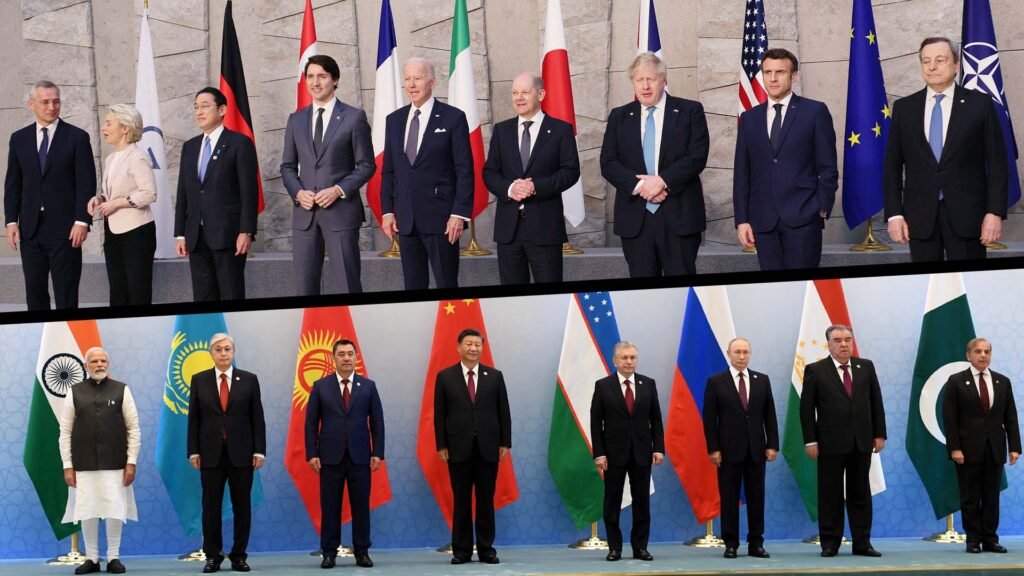
Meetings of the G7 and NATO (top) and Shanghai Cooperation Organization (bottom)

Ben Norton

March 29, 2023

A study by the elite EU-funded European Council on Foreign Relations found the West is out of touch politically with the rest of the world. Most people in China, India, and Türkiye see Russia as an important ally, and they want multipolarity, not continued “American global supremacy”.

Originally published at Geopolitical Economy on February 25, 2023

A study by an elite European government-funded think tank found that, while the United States and Europe are growing closer together, the West is increasingly out of touch politically with the rest of the world.

The report, from the EU member state-financed European Council on Foreign Relations, conceded that the system of “American global supremacy” is in rapid decline, and many people in the Global South want a new “multipolar world”.

The series of polls concluded that NATO’s proxy war in “Ukraine confirmed the renewed centrality of American power to Europe”, uniting the West under Washington’s leadership. Today, Europeans and North Americans “hold many views in common about major global questions”.

But this “consolidation of the West is taking place in an increasingly divided post-Western world”, the study acknowledged. The Global South is moving in the opposite direction.

It described “a wide gap between the West and the ‘rest’ when it comes to their desired outcomes for the war and differing understandings of why the US and Europe support Ukraine”.

The report admitted that, even if Ukraine somehow managed to win the NATO proxy war with Russia, “it is highly unlikely to restore a US-led global liberal order”, and, instead, “the West will have to live, as one pole of a multipolar world”.

The 13% of the global population in the West is out of touch with the ‘rest’ of the world

This study was conducted by the European Council on Foreign Relations (ECFR), a notoriously hawkish think tank that expresses overt anti-Russia and anti-China bias.

The ECFR is funded by the European Parliament and numerous European governments, including Germany, France, Italy, Spain, Belgium, Ireland, Norway, Denmark, Finland, and the Czech Republic, as well as key Western ally Japan.

For the report, the ECFR commissioned polling in:

  • China
  • India
  • Türkiye
  • Russia
  • United States
  • Britain

It also surveyed people in nine major European Union member states, which it referred to collectively as the EU9:

  • Denmark
  • Estonia
  • France
  • Germany
  • Italy
  • Poland
  • Portugal
  • Romania
  • Spain

The pollsters interviewed a total of 19,765 adults in late December 2022 and early January 2023.

The sample of participants in the West was representative of the general population. But the study disclosed that, in China, India, and Russia, the people surveyed in the polling only came from large cities, meaning the results may not reflect the views of those living in rural areas.

The study suffered from bias. This slant was clear when the report misleadingly referred to the NATO-Russia proxy war in Ukraine facilely as “Putin’s war” and “Russian aggression”, as if the West did not play a fundamental role in starting the conflict in the first place by sponsoring a violent coup d’etat in Kiev in 2014, repeatedly violating promises not to expand NATO east after the 1990 reunification of Germany, sabotaging the Minsk accords and peace talks, and ignoring Moscow’s 2021 request for security guarantees.

But despite the ECFR study’s many flaws, its results convey an unmistakable message: The West is out of touch with the rest of the world.

The report acknowledged this, choosing as its title: “United West, divided from the rest“.

The Western nations surveyed in the study have a combined population of nearly 1 billion – approximately 13% of the global population of 8 billion.

This is a mere fraction of the populations of China (1.41 billion), India (1.39 billion), Russia (142 million), and Türkiye (83 million).

Together, these countries have a population of just over 3 billion – making up around 38% of the total global population.

The ECFR polling shows how significantly the public opinion of the 13% in the West differs from that of the Eurasian powers.

The West’s view of the Ukraine war is not shared by the rest of the world

In its report, the European Council on Foreign Relations stated that the proxy war in “Ukraine marks both the consolidation of the West and the emergence of the long-heralded post-Western international order”.

“Many in China state that American and European support for Ukraine is driven by the desire to protect Western dominance”, the study acknowledged.

“And for the vast majority of Chinese and Turks, Western support for Ukraine is motivated by reasons other than a defence of Ukraine’s territorial integrity or of its democracy”, it added.

45% of people surveyed in China, 38% in Russia, 30% in Türkiye, and 23% in India said the US is supporting Ukraine simply in order “to defend Western dominance”.
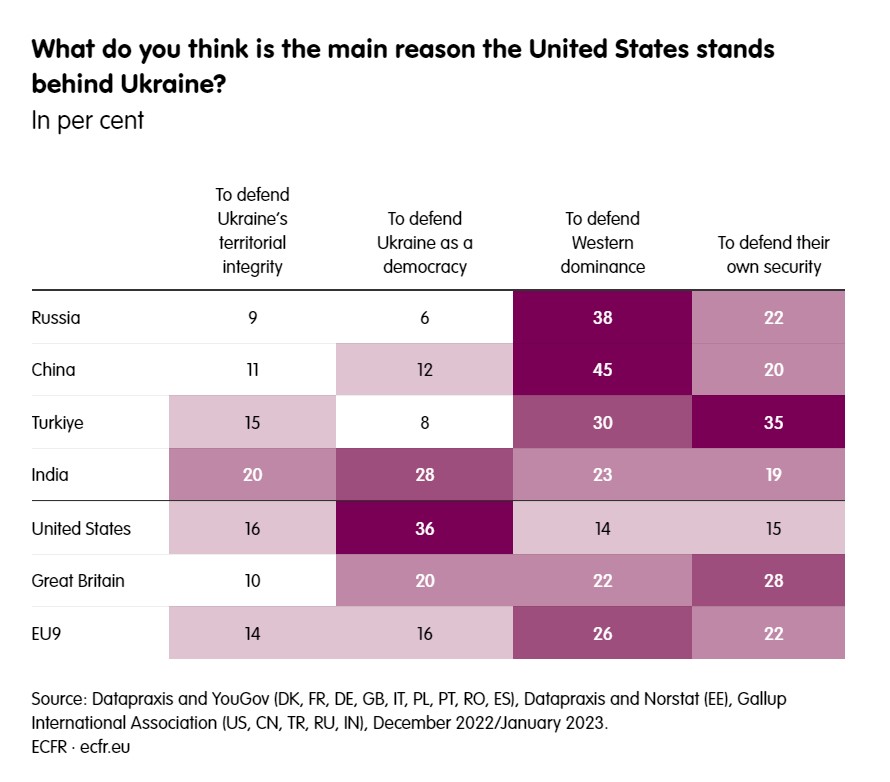
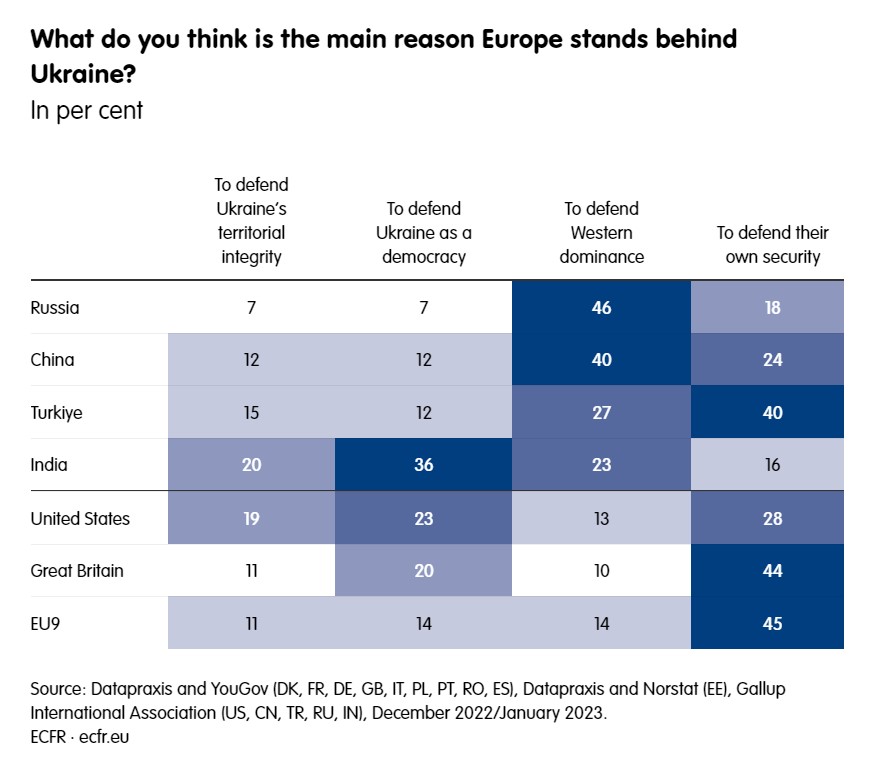
A plurality in these Eurasian nations thinks the same about Brussels.

40% of people surveyed in China, 46% in Russia, 27% in Türkiye, and 23% in India said Europe is supporting Ukraine in order “to defend Western dominance”.
The report admitted that “people in non-Western countries possess a clear preference for the war to end now – even if it means Ukraine having to give up territory”.

54% of people surveyed in India, 48% in Türkiye, 44% in Russia, and 42% in China think “the conflict between Russia and Ukraine needs to stop as soon as possible, even if it means Ukraine giving control of areas to Russia”.

Despite biased wording from the pollsters, an additional 12% of people in India, 8% in Türkiye, 29% in Russia, and 12% in China said “Western dominance of the world needs to be pushed back, even if it means accepting Russian territorial aggression against Ukraine”.

While a majority of people in the United States, Britain, and EU consider Russia to be an “adversary with which we are in conflict”, the situation is the opposite in India, China, and Türkiye.

In India, 80% of people surveyed see Russia as an ally or partner (51% as an “ally that shares our interests and values” and 29% as a “necessary partner with which we must strategically cooperate”).

In China, 79% of people surveyed see Russia as an ally or partner (35% as an ally and 44% as a necessary partner).

In Türkiye, 69% of people surveyed see Russia as an ally or partner (14% as an ally and 55% as a necessary partner).

Another question in the poll showed how Western media propaganda has manipulated public opinion.

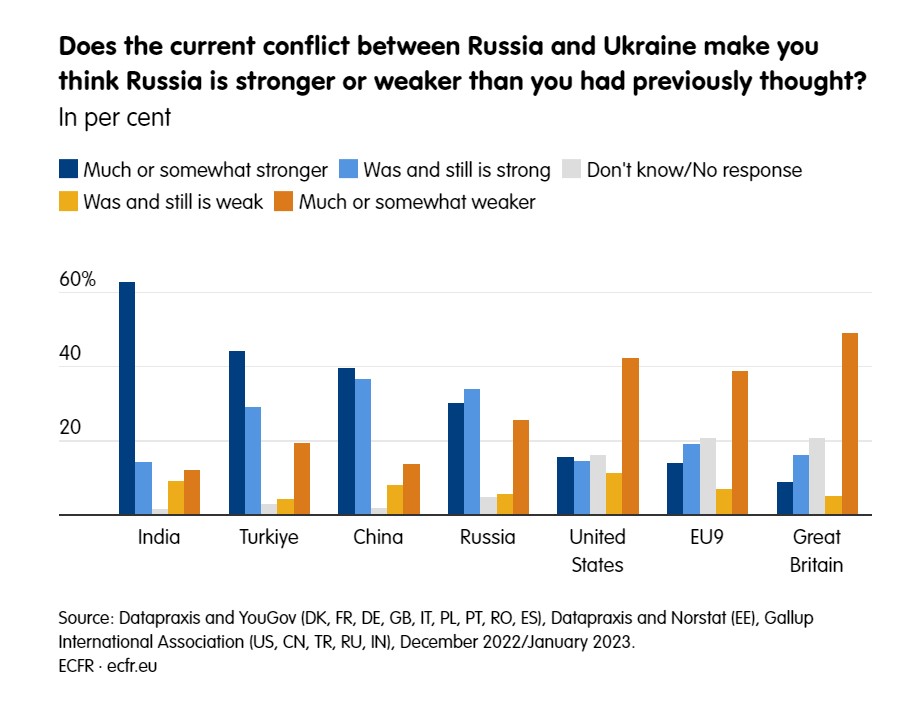
The proxy war in Ukraine has made Russia seem stronger in India, Türkiye, China, and the country itself, whereas people across the West now see Moscow as weaker.

This was another example of where Western views were the exact opposite of those in the Global South.
The ECFR report admitted that, while US “President Joe Biden has framed the war [in Ukraine] as a struggle between democracy and authoritarianism”, this is not how people in the Global South see it.

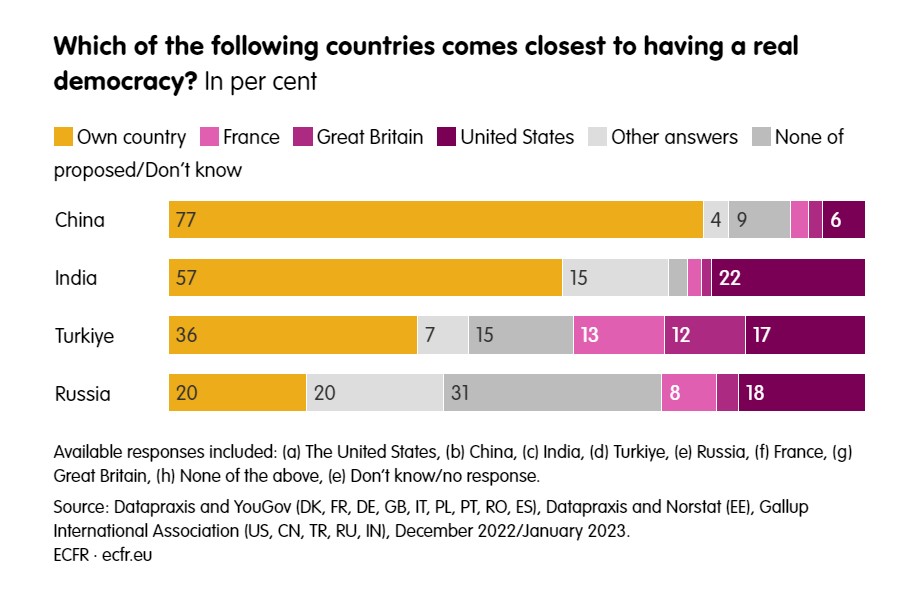
The pollsters asked participants which country they consider “comes closest to having a real democracy”. This question, again, reflected the bias of the study, turning the survey into a contest to see which country is supposedly the most democratic of all.

Yet despite these limitations, more than three-quarters of people surveyed in China (77%) considered their country to “come closest to having a real democracy”.

A separate study conducted in 2022 by another Western government-backed organization, the NATO-linked Alliance of Democracies Foundation, found that 83% of people in China consider their government a democracy, and 91% said they value democracy as important. (In the United States, on the other hand, just 49% of people said their government is a democracy.)
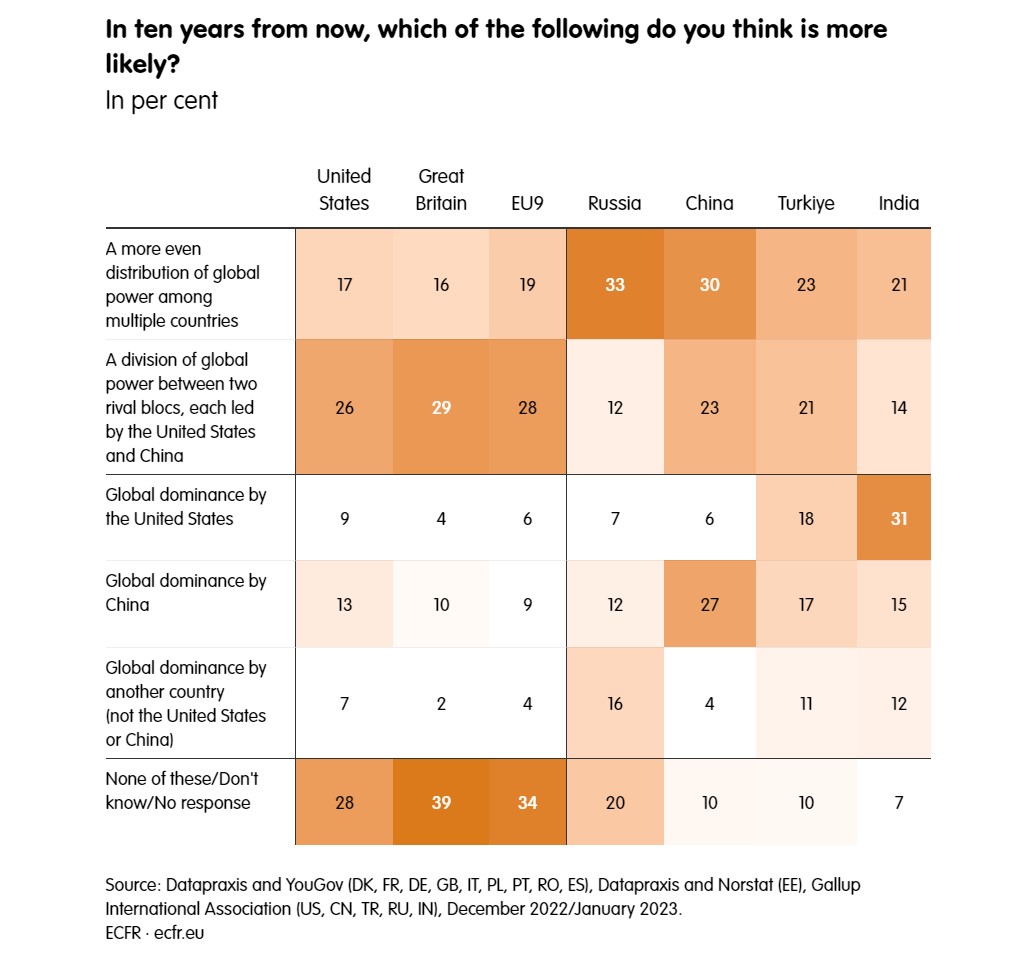
The ECFR study also acknowledged, “Most people in major non-Western countries such as China, India, Turkiye, and Russia predict the West will soon be just one global pole among several. The West may still be the strongest party but it will not be hegemonic”.

A plurality of people surveyed in China (30%) and Russia (33%) think the world will become increasingly multipolar.

This is in stark contrast to the plurality of those surveyed in Britain (29%), the EU (28%), and the US (26%), who see the world returning to a bipolar system of cold war competition between a US-led bloc and a China-led bloc.
Originally published at Geopolitical Economy on February 25, 2023

About the author

Ben Norton is an investigative journalist and analyst. He is the founder and editor of Geopolitical Economy Report and is based in Latin America. (Publicaciones en español aquí.)

Please help TFF remain truly independent by contributing if you benefited from this article

[paypal-donation]

Share

Leave a Reply

Your email address will not be published. Required fields are marked *

Related Posts

Jan Oberg May 15, 2026 Go to this Fox News page and scroll the whole way down: President Donald Trump tells the world that his meeting with President Xi Jinping yielded a lot of very concrete political and economic results – of course, only where the Chinese side, according to him, agreed with him. He does not mention the Taiwan issue, but Secretary of State, Marco Rubio, says that it did not feature prominently in their talks and that the US policy on Taiwan has not changed. Then go to China Daily – or Global Times – and you will see that for the Chinese it is framework, principles, structure of cooperation etc. that matters – all embedded in the overall idea of “constructive bilateral relationship of strategic stability.” Nowhere is any concrete agreement or deal – all that Trump refers to – mentioned. At the general level, this gives you insights into the very different social...
Jan Oberg, TFF director April 9, 2026 I was recently invited to have a good, long talk about the world – and, of course, about peace too – with Boris Malagurski on his Weight of Chains Channel on YouTube. It was a real joy and seems to have been greatly appreciated by the viewers too. Mr Malagurski and I shall of course be grateful if you share this conversation in your circles – of course, only if you like what you see and hear  And remember that this one – like hundreds of others with TFF Associates – can be enjoyed at our TFF Video Collection.
Jan Oberg February 19, 2026 What a thrill to be interviewed by former British diplomat Ian Proud! Don’t waste a minute: acquaint yourself with him here on his homepage, which he elegantly calls “Proud Diplomat.” Notice also his book, A Misfit In Moscow. Ian is, of course, also on Substack, where he calls himself The Peace Monger, and recently he set up his own PeaceMonger Channel on YouTube. For once, I was not interviewed as if I were a military geopolitical expert, where I normally have to twist the whole thing in the direction of peace. No, we both had a focus on peace – why it has been disappeared by research, politics and the media, but also what can be done to shape a more peaceful future for us all. One idea we came up with was that of connecting people through citizens diplomacy – in an era where more or less authoritarian leaders meet frequently and confirm each other as members...

Recent Articles

Jan Oberg May 15, 2026 Go to this Fox News page and scroll the whole way down: President Donald Trump tells the world that his meeting with President Xi Jinping yielded a lot of very concrete political and economic results – of course, only where the Chinese side, according to him, agreed with him. He does not mention the Taiwan issue, but Secretary of State, Marco Rubio, says that it did not feature prominently in their talks and that the US policy on Taiwan has not changed. Then go to China Daily – or Global Times – and you will see that for the Chinese it is framework, principles, structure of cooperation etc. that matters – all embedded in the overall idea of “constructive bilateral relationship of strategic stability.” Nowhere is any concrete agreement or deal – all that Trump refers to – mentioned. At the general level, this gives you insights into the very different social...
Lena Petrova of “World Affairs In Context” with more than half a million subscribers on YouTube wanted to explore what a peace researcher like me has to say about, among other things, the First and the Second Cold War and why eethics has disappeared from politics. I am particularly happy about this conversation that also yielded an amazing number of very appreciative comments on YouTube. No doubt, people are longing for alternatives, including peace perspectives.
The MIMAC – Military-Industrial-Media-Academic Complex – drives the world’s rampant militarism and wars without end. Here is a short reflection of how it works against all interests of humanity. #5 deals with why there is no real enemy or threat images/analysis. It’s all ex-post constructions. And, btw, theTFF Peace Pulse is now on Rumble.

TFF on Substack

Discover more from TFF Transnational Foundation & Jan Oberg.

Most Popular

Jan Oberg May 15, 2026 Go to this Fox News page and scroll the whole way down: President Donald Trump tells the world that his meeting with President Xi Jinping yielded a lot of very concrete political and economic results – of course, only where the Chinese side, according to him, agreed with him. He does not mention the Taiwan issue, but Secretary of State, Marco Rubio, says that it did not feature prominently in their talks and that the US policy on Taiwan has not changed. Then go to China Daily – or Global Times – and you will see that for the Chinese it is framework, principles, structure of cooperation etc. that matters – all embedded in the overall idea of “constructive bilateral relationship of strategic stability.” Nowhere is any concrete agreement or deal – all that Trump refers to – mentioned. At the general level, this gives you insights into the very different social...
Lena Petrova of “World Affairs In Context” with more than half a million subscribers on YouTube wanted to explore what a peace researcher like me has to say about, among other things, the First and the Second Cold War and why eethics has disappeared from politics. I am particularly happy about this conversation that also yielded an amazing number of very appreciative comments on YouTube. No doubt, people are longing for alternatives, including peace perspectives.
The MIMAC – Military-Industrial-Media-Academic Complex – drives the world’s rampant militarism and wars without end. Here is a short reflection of how it works against all interests of humanity. #5 deals with why there is no real enemy or threat images/analysis. It’s all ex-post constructions. And, btw, theTFF Peace Pulse is now on Rumble.
Read More
Screenshot-2026-05-15-103534
Jan Oberg May 15, 2026 Go to this Fox News page and scroll the whole way down: President Donald Trump tells the world that his meeting with President Xi Jinping yielded a lot of very concrete political and economic results – of course, only where the Chinese side, according to him, agreed with him. He does not mention the Taiwan issue, but Secretary of State, Marco Rubio, says that it did not feature prominently in their talks and that the US policy on Taiwan has not changed. Then go to China Daily – or Global Times – and you will see that for the Chinese it is framework, principles, structure of cooperation etc. that matters – all embedded in the overall idea of “constructive bilateral relationship of strategic stability.” Nowhere is any concrete agreement or deal – all that Trump refers to – mentioned. At the general level, this gives you insights into the very different social...
Screenshot-2026-05-12-104023
Lena Petrova of “World Affairs In Context” with more than half a million subscribers on YouTube wanted to explore what a peace researcher like me has to say about, among other things, the First and the Second Cold War and why eethics has disappeared from politics. I am particularly happy about this conversation that also yielded an amazing number of very appreciative comments on YouTube. No doubt, people are longing for alternatives, including peace perspectives.
Screenshot-2026-04-13-154551 (2)
The MIMAC – Military-Industrial-Media-Academic Complex – drives the world’s rampant militarism and wars without end. Here is a short reflection of how it works against all interests of humanity. #5 deals with why there is no real enemy or threat images/analysis. It’s all ex-post constructions. And, btw, theTFF Peace Pulse is now on Rumble.
Screenshot-2026-04-13-154551 (1)
Jan Oberg, TFF director April 28, 2026 In this third TFF Peace Pulse, I make the important distinction between the violence and the conflict that violence is a symptom of. If you want peace, focus on the underlying conflict because that is the key to resolution, peacemaking, and a better future for the parties. The West is obsessed with violence, just look around you – and 90+ per cent of the public debate is about military issues and other violence – totally wasted for peace. These Peace Pulses will only be published here a few times. You will also not find them on YouTube and Vimeo because both platforms have blocked TFF and me; you know, peace is dangerous these days. Most TFF’s videos since 2007 are now on Rumble.
Screenshot-2026-04-13-154551
In contrast to most, we’ll bring alternatives, solutions, hope and strategies for a better future. Times are dangerous, yes, but that only intensifies the need for constructive thinking and action! Jan Oberg, TFF director April 13, 2026 The new TFF Peace Pulse uses video messages in a new way: Max 3-5-minute-long comments, ideas or perhaps mini-lectures, all about peace – positive peace. We launch them today on April 13, 2026 with a carefully crafted visual aesthetic fitting the content. We hope to publish them regularly from now on. We launch Peace Pulse (PP) – for a number of reasons. The world is in chaos, and there are countless reasons to feel concerned, frustrated, even angry. The atmosphere is saturated with doom and gloom, with negative energy and rear‑mirror thinking, while vision, imagination, alternatives, strategies and genuine future‑mindedness remain in short supply. And without them, we simply can’t save the world. Looking at problems from a hundred angles will...
IMG_5165 (1)
PART II — Publishing Peace in a System That Prioritises Militarism Jan Oberg, TFF director April 10, 2026 How TFF Maintains a Daily Voice in a Digital World Built for Noise This article is part of the series “TFF at 40″ and it invites you to learn about Four Decades of Publishing Peace. It takes a look at how a small, people‑financed peace foundation has communicated across four generations of technology — from wax stencils and fax machines to mass email and Substack — and why TFF continues to publish every single day in a system that rewards noise, conflict, and militarism. ◆ What it means to publish peace every single day in a digital system built for 24/7 news and other noise, confrontation, and militarism. How TFF’s independence, continuity, and global readership defy algorithms, donor cycles, and Western media censorhip — and why the Majority World keeps listening. When the...

