At 70: A few problems with the human rights concept

Today the Universal Declaration of Human Rights turns 70. All reason to celebrate. Without the norms embedded in this extremely important document, humankind would be much worse off.

Because normativity is important even though it is only words. It enables us to make those who violate human rights accountable. And that is, in general terms, an extremely important aspect of the UN and its Charter.

So too the norm expressed in its Article 1 – that peace shall be established by peaceful means and only when all such means have been tried an found in vain, can the UN member states take to violent means. As a last resort.

That said, the only two problems I have with the human rights philosophy and concept are:

  1. The word “human” – the implicit idea that only humans have right, not all the other creatures on earth. That is, it is a very anthropocentric concept. We need something much more inclusive and holistic today.
  2. The word “rights” – people constantly claiming their rights is good but it’s not enough. Gandhi said it a very long time ago: “There are no rights without duties.”

One could also formulate it this way: Human beings have duties vis-a-vis those whose rights are not embedded in any declaration, i.e. other living creatures, be it trees, rivers or microorganisms, in short: Mother Earth. And these creatures cannot speak up and claim their rights – for which reason we shall have to show empathy and use our imagination to “hear” them.

We need to see it as our duty to care – care both for the non-human beings and, most importantly, caring for the yet unborn, that is for future generations.

This means giving up the contractual thinking so fundamental in the Western worldview or social cosmology.

When it comes to the yet unborn, we have to do something to make their lives possible and even good even though they cannot claim these rights and even though we do not have a ‘contract’ – a quid pro quo – with them.

The question “what did future generations ever do for us/me” is of course meaningless. But we need anyhow to think beyond ourselves in time and space, all of us: Care for the rights of the non-human beings and for the not yet born human beings.

Other serious problems

It goes without saying that there are many more problems with the human rights concept and policies today. To mention a few:

  1. How universal can they be, given the world has so many and different cultures, ways of thinking and historical experiences? Is it at all realistic to argue that they can be universal?
  2. To which extent can one argue that the Declaration came out as basically Western product and with too much focus on the individual?
  3. How destructive has it been for the whole idea that, since about the intervention in Yugoslavia, human rights have been (mis)used as an argument, or justification, for the concept and policy of humanitarian intervention and the Responsibility To Protect (R2P) – advocating the legitimate use of military force in the name of human rights protection – even though these interventions have, more often than not, caused gross human rights violation and been conducted without a UN Security Council mandate?
  4. The whole intimacy between government and human rights NGO – where the N stands more for Near- than Non-Governmental, e.g. the rotation of government officials into human rights organisations and vice versa – in other words, the fundamental politicization of human rights to such an extent that the commitment to human rights become purely political and selective, a weapon in the (propaganda) for oneself and against designated enemies. 

So what about implementation?

That said – admittedly in the more philosophical realm – it is good to also discuss how we can, much more fully, implement the present human rights norms.

You just need to let your eyes run down over the Declaration’s 30 points in summary above to see how far the world still is from the ideals – and how the West that has been championing this Declaration has itself become increasingly authoritarian over time, excusing itself predominantly by referring to its global war on terror.

For the Western world, human rights have always been predominantly about freedoms to speak, assemble and travel etc. – whereas the rights in the economic sphere – such as the right to a job and the right to have enough to survive on, even the right to life –  have always been secondary. 

This of course has to do with global, Western-driven capitalism which is not exactly a human rights promoting system, just look at the ongoing marginalisation, suffering, poverty and misery of millions of people. And when China has championed these rights the last 40 years, the West points out that it systematically violates human right, the rights of course as the West sees them.

Or look at the wars and human- and system-caused environmental problems that cause the number of IDPs (Internally Displaces Persons), refugees, asylum seekers and migrants (different concepts!) increase, now so tragically approaching 70 million fellow human beings.

A new ethics of global care

We, therefore, need a new ethics of global care – norm systems like Christianity talking about what you as an individual should and should not do to your neighbour are way too narrow in time and space in our globalising world and in the future.

Fortunately, there are some good attempts at re-thinking rights and duties such as The Earth Charter Initiative and The People’s Charter to Create A Nonviolent World – but they have not been integrated enough in the general discourse and neither have they been institutionalised nor made legally binding by governments.

While humanity can see progress here and there in terms of civilisation – which means respecting the equal human rights of everybody – there is certainly a very long way to go to improve both the way we think and speak about these things and the way the right, all of them, are realised in daily lives on the ground around our troubled Earth.

Note
1. I have written about these matters some 25 years ago in “Alternatives To World Disorder In the 1990s. Sustainability, Nonviolence, Global Ethics And Democracy,” General Education Series, Institute of Asian Cultural Studies, International Christian University, ICU, Tokyo, 1991.

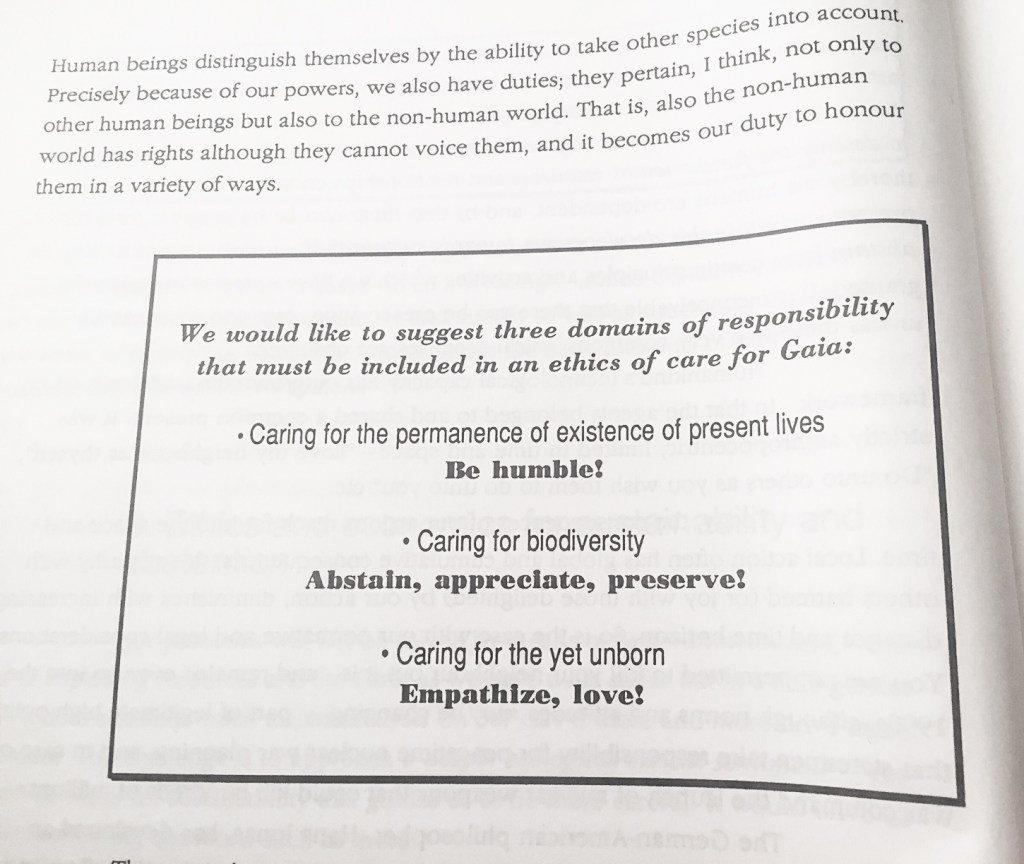
Here’s a photo of one of the summaries about global ethics:


Peace & future researcher + ‌Art Photographer

Share

Leave a Reply

Your email address will not be published. Required fields are marked *

Related Posts

Lena Petrova of “World Affairs In Context” with more than half a million subscribers on YouTube wanted to explore what a peace researcher like me has to say about, among other things, the First and the Second Cold War and why eethics has disappeared from politics. I am particularly happy about this conversation that also yielded an amazing number of very appreciative comments on YouTube. No doubt, people are longing for alternatives, including peace perspectives.
The MIMAC – Military-Industrial-Media-Academic Complex – drives the world’s rampant militarism and wars without end. Here is a short reflection of how it works against all interests of humanity. #5 deals with why there is no real enemy or threat images/analysis. It’s all ex-post constructions. And, btw, theTFF Peace Pulse is now on Rumble.
Jan Oberg, TFF director April 28, 2026 In this third TFF Peace Pulse, I make the important distinction between the violence and the conflict that violence is a symptom of. If you want peace, focus on the underlying conflict because that is the key to resolution, peacemaking, and a better future for the parties. The West is obsessed with violence, just look around you – and 90+ per cent of the public debate is about military issues and other violence – totally wasted for peace. These Peace Pulses will only be published here a few times. You will also not find them on YouTube and Vimeo because both platforms have blocked TFF and me; you know, peace is dangerous these days. Most TFF’s videos since 2007 are now on Rumble.

Recent Articles

Jan Oberg May 15, 2026 Go to this Fox News page and scroll the whole way down: President Donald Trump tells the world that his meeting with President Xi Jinping yielded a lot of very concrete political and economic results – of course, only where the Chinese side, according to him, agreed with him. He does not mention the Taiwan issue, but Secretary of State, Marco Rubio, says that it did not feature prominently in their talks and that the US policy on Taiwan has not changed. Then go to China Daily – or Global Times – and you will see that for the Chinese it is framework, principles, structure of cooperation etc. that matters – all embedded in the overall idea of “constructive bilateral relationship of strategic stability.” Nowhere is any concrete agreement or deal – all that Trump refers to – mentioned. At the general level, this gives you insights into the very different social...
Lena Petrova of “World Affairs In Context” with more than half a million subscribers on YouTube wanted to explore what a peace researcher like me has to say about, among other things, the First and the Second Cold War and why eethics has disappeared from politics. I am particularly happy about this conversation that also yielded an amazing number of very appreciative comments on YouTube. No doubt, people are longing for alternatives, including peace perspectives.
The MIMAC – Military-Industrial-Media-Academic Complex – drives the world’s rampant militarism and wars without end. Here is a short reflection of how it works against all interests of humanity. #5 deals with why there is no real enemy or threat images/analysis. It’s all ex-post constructions. And, btw, theTFF Peace Pulse is now on Rumble.

TFF on Substack

Discover more from TFF Transnational Foundation & Jan Oberg.

Most Popular

Jan Oberg May 15, 2026 Go to this Fox News page and scroll the whole way down: President Donald Trump tells the world that his meeting with President Xi Jinping yielded a lot of very concrete political and economic results – of course, only where the Chinese side, according to him, agreed with him. He does not mention the Taiwan issue, but Secretary of State, Marco Rubio, says that it did not feature prominently in their talks and that the US policy on Taiwan has not changed. Then go to China Daily – or Global Times – and you will see that for the Chinese it is framework, principles, structure of cooperation etc. that matters – all embedded in the overall idea of “constructive bilateral relationship of strategic stability.” Nowhere is any concrete agreement or deal – all that Trump refers to – mentioned. At the general level, this gives you insights into the very different social...
Lena Petrova of “World Affairs In Context” with more than half a million subscribers on YouTube wanted to explore what a peace researcher like me has to say about, among other things, the First and the Second Cold War and why eethics has disappeared from politics. I am particularly happy about this conversation that also yielded an amazing number of very appreciative comments on YouTube. No doubt, people are longing for alternatives, including peace perspectives.
The MIMAC – Military-Industrial-Media-Academic Complex – drives the world’s rampant militarism and wars without end. Here is a short reflection of how it works against all interests of humanity. #5 deals with why there is no real enemy or threat images/analysis. It’s all ex-post constructions. And, btw, theTFF Peace Pulse is now on Rumble.
Read More
Screenshot-2026-05-15-103534
Jan Oberg May 15, 2026 Go to this Fox News page and scroll the whole way down: President Donald Trump tells the world that his meeting with President Xi Jinping yielded a lot of very concrete political and economic results – of course, only where the Chinese side, according to him, agreed with him. He does not mention the Taiwan issue, but Secretary of State, Marco Rubio, says that it did not feature prominently in their talks and that the US policy on Taiwan has not changed. Then go to China Daily – or Global Times – and you will see that for the Chinese it is framework, principles, structure of cooperation etc. that matters – all embedded in the overall idea of “constructive bilateral relationship of strategic stability.” Nowhere is any concrete agreement or deal – all that Trump refers to – mentioned. At the general level, this gives you insights into the very different social...
Screenshot-2026-05-12-104023
Lena Petrova of “World Affairs In Context” with more than half a million subscribers on YouTube wanted to explore what a peace researcher like me has to say about, among other things, the First and the Second Cold War and why eethics has disappeared from politics. I am particularly happy about this conversation that also yielded an amazing number of very appreciative comments on YouTube. No doubt, people are longing for alternatives, including peace perspectives.
Screenshot-2026-04-13-154551 (2)
The MIMAC – Military-Industrial-Media-Academic Complex – drives the world’s rampant militarism and wars without end. Here is a short reflection of how it works against all interests of humanity. #5 deals with why there is no real enemy or threat images/analysis. It’s all ex-post constructions. And, btw, theTFF Peace Pulse is now on Rumble.
Screenshot-2026-04-13-154551 (1)
Jan Oberg, TFF director April 28, 2026 In this third TFF Peace Pulse, I make the important distinction between the violence and the conflict that violence is a symptom of. If you want peace, focus on the underlying conflict because that is the key to resolution, peacemaking, and a better future for the parties. The West is obsessed with violence, just look around you – and 90+ per cent of the public debate is about military issues and other violence – totally wasted for peace. These Peace Pulses will only be published here a few times. You will also not find them on YouTube and Vimeo because both platforms have blocked TFF and me; you know, peace is dangerous these days. Most TFF’s videos since 2007 are now on Rumble.
Screenshot-2026-04-13-154551
In contrast to most, we’ll bring alternatives, solutions, hope and strategies for a better future. Times are dangerous, yes, but that only intensifies the need for constructive thinking and action! Jan Oberg, TFF director April 13, 2026 The new TFF Peace Pulse uses video messages in a new way: Max 3-5-minute-long comments, ideas or perhaps mini-lectures, all about peace – positive peace. We launch them today on April 13, 2026 with a carefully crafted visual aesthetic fitting the content. We hope to publish them regularly from now on. We launch Peace Pulse (PP) – for a number of reasons. The world is in chaos, and there are countless reasons to feel concerned, frustrated, even angry. The atmosphere is saturated with doom and gloom, with negative energy and rear‑mirror thinking, while vision, imagination, alternatives, strategies and genuine future‑mindedness remain in short supply. And without them, we simply can’t save the world. Looking at problems from a hundred angles will...
IMG_5165 (1)
PART II — Publishing Peace in a System That Prioritises Militarism Jan Oberg, TFF director April 10, 2026 How TFF Maintains a Daily Voice in a Digital World Built for Noise This article is part of the series “TFF at 40″ and it invites you to learn about Four Decades of Publishing Peace. It takes a look at how a small, people‑financed peace foundation has communicated across four generations of technology — from wax stencils and fax machines to mass email and Substack — and why TFF continues to publish every single day in a system that rewards noise, conflict, and militarism. ◆ What it means to publish peace every single day in a digital system built for 24/7 news and other noise, confrontation, and militarism. How TFF’s independence, continuity, and global readership defy algorithms, donor cycles, and Western media censorhip — and why the Majority World keeps listening. When the...