
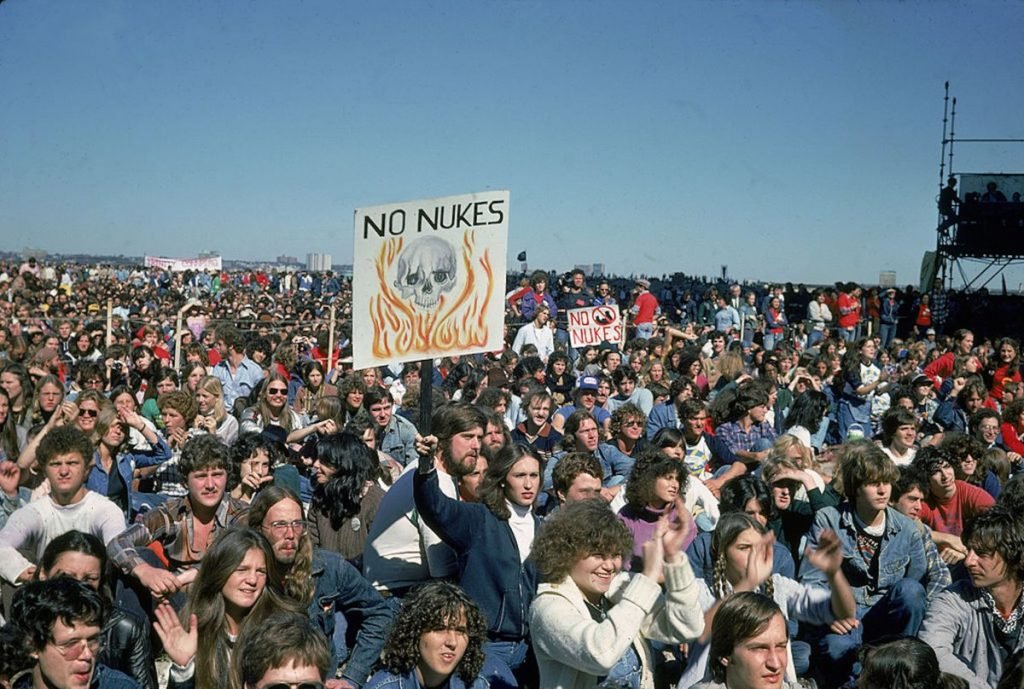
Americans are ready for a different approach to nuclear weapons

By Dr. Lawrence Wittner

January 17, 2020

Although today’s public protests against nuclear weapons can’t compare to the major antinuclear upheavals of past decades, there are clear indications that most Americans reject the Trump administration’s nuclear weapons policies.

Originally posted on History News Network on December 22, 2019 here

Since entering office in 2017, the Trump administration has withdrawn the United States from the nuclear agreement with Iranscrapped the Intermediate-Range Nuclear Forces (INF) Treaty with Russia, and apparently abandoned plans to renew the New START Treaty with Russia. After an overwhelming majority of the world’s nations agreed on a landmark UN Treaty on the Prohibitions of Nuclear Weapons in July 2017, the Trump administration quickly announced that it would never sign the treaty.  The only nuclear arms control measure that the Trump administration has pursued―an agreement by North Korea to abandon its nuclear weapons program―appears to have collapsed, at least in part because the Trump administration badly mishandled the negotiations.

Moreover, the Trump administration has not only failed to follow the nuclear arms control and disarmament policies of its Democratic and Republican predecessors, but has plunged into a renewed nuclear arms race with other nations by championing a $1.7 trillion program to refurbish the entire U.S. nuclear weapons complex.  Perhaps most alarming, it has again and again publicly threatened to initiate a nuclear war.

These policies are quite out of line with U.S. public opinion.

Polling Americans in July 2018 about Trump’s withdrawal of the United States from the Iran nuclear agreement, the Chicago Council on Global Affairs found that 66 percent of respondents preferred remaining within it.  In February 2019, when the Chicago Council surveyed Americans about U.S. withdrawal from the INF Treaty, 54 percent opposed the action.  Moreover, when Americans were presented with arguments for and against withdrawal, opposition to withdrawal rose to 66 percent. 

The Center for International & Security Studies at the University of Maryland also reported overwhelming public support for nuclear arms control and disarmament agreements.  Polling Americans in early 2019, the Center found that two-thirds of respondents (including a majority of Republicans) favored remaining within the INF Treaty, while eight out of ten respondents wanted the U.S. government to extend the New START Treaty. Indeed, more than eight out of ten U.S. respondents backed new nuclear arms control treaties with Russia―findings similar to those of the Chicago Council, which reported that 87 percent of American respondents to a poll in early 2019 wanted the United States and Russia to secure a further nuclear arms limitation agreement.

But just how much arms control and disarmament do Americans want?  It might come as a shock to the many pundits in the mass media who have never mentioned the 2017 UN Treaty on the Prohibition of Nuclear Weapons, but roughly half the U.S. population supports nuclear abolition along the lines of the treaty.  According to a YouGov opinion survey done in late September 2019, 49 percent of American respondents thought the United States should work with other nations to eliminate all nuclear weapons in the world. Only 32 percent disagreed, while 19 percent said they didn’t know.

When it comes to actual use of nuclear weapons, Americans are even clearer in their preferences.  A YouGov/Huffington Post poll in August 2016 found that 67 percent of American respondents thought the U.S. government should never initiate a nuclear attack.  In mid-2019, Zogby Analytics surveys of American respondents in key primary states also discovered very high levels of opposition to first use of nuclear weapons.

Not surprisingly, Donald Trump’s angry, impulsive behavior, coupled with his threats to launch nuclear attacks upon other nations, has left many Americans uneasy.  This might help to explain why 68 percent of Americans surveyed in early 2019 by the Center for International & Security Studies backed congressional legislation requiring that a president, before ordering a nuclear attack upon another nation, consult with congress and secure a congressional declaration of war upon that nation.  As the U.S. congress has not passed a declaration of war since 1941, this opinion, too, provides a substantial challenge to current U.S. nuclear policy.

There are other indications, as well, that the American public wants a new approach.  In July 2019, the U.S. Conference of Mayors, at its 87th annual meeting, unanimously passed a resolution calling on all U.S. presidential candidates “to pledge U.S. global leadership in preventing nuclear war, returning to diplomacy, and negotiating the elimination of nuclear weapons.”  Calling for negotiations to replace the INF Treaty and to extend or replace the New START Treaty, the resolution demanded that candidates support the Treaty on the Prohibition of Nuclear Weapons and renounce the option of first use of nuclear weapons.

Yet another sign of public discontent is the emerging Back from the Brink campaign, supported by numerous peace, environmental, religious, health, and other organizations.  Endorsed by dozens of cities and towns across the country, it has also received the official backing of the state legislatures of California and Oregon, as well as of the New Jersey State Assembly and the Maine State Senate.  The campaign calls on the U.S. government to “lead a global effort to prevent nuclear war” by: “renouncing the option of using nuclear weapons first”; “ending the sole, unchecked authority of any U.S. president to launch a nuclear attack”; “taking U.S. nuclear weapons off hair-trigger alert”; “cancelling the plan to replace its entire nuclear arsenal with enhanced weapons”; and “actively pursuing a verifiable agreement among nuclear-armed states to eliminate their nuclear arsenals.”

Looked at from the standpoint of most Americans and, indeed, survival in the nuclear age, this departure from the dangerous direction of U.S. nuclear policy makes a lot of sense.  Looked at from the standpoint of candidates seeking election to national office, it would also make good politics.

If you appreciated this…

[paypal-donation]


Dr. Lawrence Wittner is a prominent American historian who has combined intellectual life with activism for peace and social justice. He is a professor of History Emeritus at SUNY/Albany and the author of Confronting the Bomb (Stanford University Press).

Share

Leave a Reply

Your email address will not be published. Required fields are marked *

Related Posts

Jan Oberg May 15, 2026 Go to this Fox News page and scroll the whole way down: President Donald Trump tells the world that his meeting with President Xi Jinping yielded a lot of very concrete political and economic results – of course, only where the Chinese side, according to him, agreed with him. He does not mention the Taiwan issue, but Secretary of State, Marco Rubio, says that it did not feature prominently in their talks and that the US policy on Taiwan has not changed. Then go to China Daily – or Global Times – and you will see that for the Chinese it is framework, principles, structure of cooperation etc. that matters – all embedded in the overall idea of “constructive bilateral relationship of strategic stability.” Nowhere is any concrete agreement or deal – all that Trump refers to – mentioned. At the general level, this gives you insights into the very different social...
Lena Petrova of “World Affairs In Context” with more than half a million subscribers on YouTube wanted to explore what a peace researcher like me has to say about, among other things, the First and the Second Cold War and why eethics has disappeared from politics. I am particularly happy about this conversation that also yielded an amazing number of very appreciative comments on YouTube. No doubt, people are longing for alternatives, including peace perspectives.
Jan Oberg, TFF director April 28, 2026 In this third TFF Peace Pulse, I make the important distinction between the violence and the conflict that violence is a symptom of. If you want peace, focus on the underlying conflict because that is the key to resolution, peacemaking, and a better future for the parties. The West is obsessed with violence, just look around you – and 90+ per cent of the public debate is about military issues and other violence – totally wasted for peace. These Peace Pulses will only be published here a few times. You will also not find them on YouTube and Vimeo because both platforms have blocked TFF and me; you know, peace is dangerous these days. Most TFF’s videos since 2007 are now on Rumble.

Recent Articles

Jan Oberg May 15, 2026 Go to this Fox News page and scroll the whole way down: President Donald Trump tells the world that his meeting with President Xi Jinping yielded a lot of very concrete political and economic results – of course, only where the Chinese side, according to him, agreed with him. He does not mention the Taiwan issue, but Secretary of State, Marco Rubio, says that it did not feature prominently in their talks and that the US policy on Taiwan has not changed. Then go to China Daily – or Global Times – and you will see that for the Chinese it is framework, principles, structure of cooperation etc. that matters – all embedded in the overall idea of “constructive bilateral relationship of strategic stability.” Nowhere is any concrete agreement or deal – all that Trump refers to – mentioned. At the general level, this gives you insights into the very different social...
Lena Petrova of “World Affairs In Context” with more than half a million subscribers on YouTube wanted to explore what a peace researcher like me has to say about, among other things, the First and the Second Cold War and why eethics has disappeared from politics. I am particularly happy about this conversation that also yielded an amazing number of very appreciative comments on YouTube. No doubt, people are longing for alternatives, including peace perspectives.
The MIMAC – Military-Industrial-Media-Academic Complex – drives the world’s rampant militarism and wars without end. Here is a short reflection of how it works against all interests of humanity. #5 deals with why there is no real enemy or threat images/analysis. It’s all ex-post constructions. And, btw, theTFF Peace Pulse is now on Rumble.

TFF on Substack

Discover more from TFF Transnational Foundation & Jan Oberg.

Most Popular

Jan Oberg May 15, 2026 Go to this Fox News page and scroll the whole way down: President Donald Trump tells the world that his meeting with President Xi Jinping yielded a lot of very concrete political and economic results – of course, only where the Chinese side, according to him, agreed with him. He does not mention the Taiwan issue, but Secretary of State, Marco Rubio, says that it did not feature prominently in their talks and that the US policy on Taiwan has not changed. Then go to China Daily – or Global Times – and you will see that for the Chinese it is framework, principles, structure of cooperation etc. that matters – all embedded in the overall idea of “constructive bilateral relationship of strategic stability.” Nowhere is any concrete agreement or deal – all that Trump refers to – mentioned. At the general level, this gives you insights into the very different social...
Lena Petrova of “World Affairs In Context” with more than half a million subscribers on YouTube wanted to explore what a peace researcher like me has to say about, among other things, the First and the Second Cold War and why eethics has disappeared from politics. I am particularly happy about this conversation that also yielded an amazing number of very appreciative comments on YouTube. No doubt, people are longing for alternatives, including peace perspectives.
The MIMAC – Military-Industrial-Media-Academic Complex – drives the world’s rampant militarism and wars without end. Here is a short reflection of how it works against all interests of humanity. #5 deals with why there is no real enemy or threat images/analysis. It’s all ex-post constructions. And, btw, theTFF Peace Pulse is now on Rumble.
Read More
Screenshot-2026-05-15-103534
Jan Oberg May 15, 2026 Go to this Fox News page and scroll the whole way down: President Donald Trump tells the world that his meeting with President Xi Jinping yielded a lot of very concrete political and economic results – of course, only where the Chinese side, according to him, agreed with him. He does not mention the Taiwan issue, but Secretary of State, Marco Rubio, says that it did not feature prominently in their talks and that the US policy on Taiwan has not changed. Then go to China Daily – or Global Times – and you will see that for the Chinese it is framework, principles, structure of cooperation etc. that matters – all embedded in the overall idea of “constructive bilateral relationship of strategic stability.” Nowhere is any concrete agreement or deal – all that Trump refers to – mentioned. At the general level, this gives you insights into the very different social...
Screenshot-2026-05-12-104023
Lena Petrova of “World Affairs In Context” with more than half a million subscribers on YouTube wanted to explore what a peace researcher like me has to say about, among other things, the First and the Second Cold War and why eethics has disappeared from politics. I am particularly happy about this conversation that also yielded an amazing number of very appreciative comments on YouTube. No doubt, people are longing for alternatives, including peace perspectives.
Screenshot-2026-04-13-154551 (2)
The MIMAC – Military-Industrial-Media-Academic Complex – drives the world’s rampant militarism and wars without end. Here is a short reflection of how it works against all interests of humanity. #5 deals with why there is no real enemy or threat images/analysis. It’s all ex-post constructions. And, btw, theTFF Peace Pulse is now on Rumble.
Screenshot-2026-04-13-154551 (1)
Jan Oberg, TFF director April 28, 2026 In this third TFF Peace Pulse, I make the important distinction between the violence and the conflict that violence is a symptom of. If you want peace, focus on the underlying conflict because that is the key to resolution, peacemaking, and a better future for the parties. The West is obsessed with violence, just look around you – and 90+ per cent of the public debate is about military issues and other violence – totally wasted for peace. These Peace Pulses will only be published here a few times. You will also not find them on YouTube and Vimeo because both platforms have blocked TFF and me; you know, peace is dangerous these days. Most TFF’s videos since 2007 are now on Rumble.
Screenshot-2026-04-13-154551
In contrast to most, we’ll bring alternatives, solutions, hope and strategies for a better future. Times are dangerous, yes, but that only intensifies the need for constructive thinking and action! Jan Oberg, TFF director April 13, 2026 The new TFF Peace Pulse uses video messages in a new way: Max 3-5-minute-long comments, ideas or perhaps mini-lectures, all about peace – positive peace. We launch them today on April 13, 2026 with a carefully crafted visual aesthetic fitting the content. We hope to publish them regularly from now on. We launch Peace Pulse (PP) – for a number of reasons. The world is in chaos, and there are countless reasons to feel concerned, frustrated, even angry. The atmosphere is saturated with doom and gloom, with negative energy and rear‑mirror thinking, while vision, imagination, alternatives, strategies and genuine future‑mindedness remain in short supply. And without them, we simply can’t save the world. Looking at problems from a hundred angles will...
IMG_5165 (1)
PART II — Publishing Peace in a System That Prioritises Militarism Jan Oberg, TFF director April 10, 2026 How TFF Maintains a Daily Voice in a Digital World Built for Noise This article is part of the series “TFF at 40″ and it invites you to learn about Four Decades of Publishing Peace. It takes a look at how a small, people‑financed peace foundation has communicated across four generations of technology — from wax stencils and fax machines to mass email and Substack — and why TFF continues to publish every single day in a system that rewards noise, conflict, and militarism. ◆ What it means to publish peace every single day in a digital system built for 24/7 news and other noise, confrontation, and militarism. How TFF’s independence, continuity, and global readership defy algorithms, donor cycles, and Western media censorhip — and why the Majority World keeps listening. When the...

