
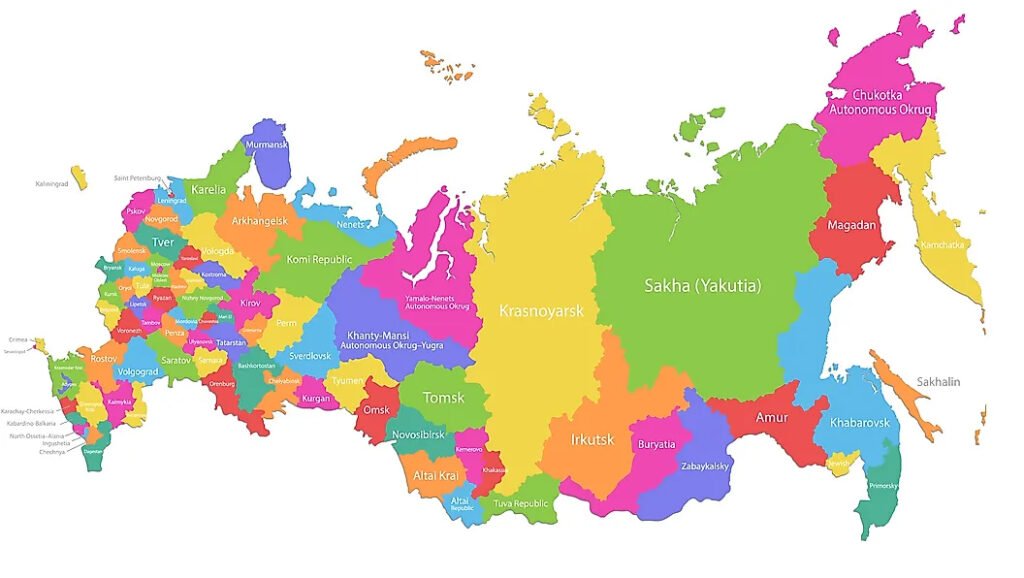
A Russian Voice: Can Russia really break away from The West?

Source: World Atlas. Maps of Russia

Ivan Timofeev

May 9, 2023

Long before relations between Russia and the West spiralled into a comprehensive political crisis, officials and experts here were enthusiastically voicing ideas about developing ties with the rest of the world. At the administrative level, such a course began to take shape as early as the 1990s, starting from the views of former Foreign Minister Evgeny Primakov. Subsequently, it also received practical development within the framework of a multi-vector foreign policy.

Originally published by RT on May 4, 2023

The gradual growth of contradictions with the West accelerated the formation of ‘pivot to the East’ ideas, although their implementation was slow. It was limited by objective infrastructural and economic conditions, as well as the absence of a direct and painful incentive for such a ‘turn’.

However, the current crisis in relations between Russia and the West, for all its appearances, is irreversible and has driven an increase in the number and quality of ties with countries which are outside the control of the US. The ‘sanctions tsunami’ and the impasse in relations with the West have become a very sharp stimulus for long overdue changes.

At the same time, a number of difficulties and obstacles await us on our way to the ‘world majority’. Moscow must assess them realistically and objectively, and we must avoid the illusion that the pivot itself will solve all our problems. We have hard and painstaking work ahead, for decades to come.

The development of Russia’s relations with the non-Western world is likely to take into account several interrelated tasks.

The first is the formation of centres of power which are relatively independent from the United States and its allies, with a high degree of political agency. These do not have to be consolidated into a single political project. There may be some contradictions between them. However, their independence in making fundamental decisions in the areas of security and development is the essential feature that unites them.

Russia itself is unlikely to be able to cement and consolidate them alone. However, it exemplifies the very possibility of challenging the political West on fundamental issues. Not everyone is ready to follow the same path, but the very fact of its presence is an event which has a global dimension.

While avoiding imposing ideological conditions, Russia has nevertheless managed to create a significant precedent. That is why the suppression of the ‘Russian rebellion’ is a matter of principle for the West. The victory of Moscow – in any form – will mean the consolidation of the precedent, which means that the fight against the West will become uncompromising. The stakes are extremely high.

The second task is to create reliable opportunities for modernisation through interaction with the non-Western world. Here, success is far from guaranteed. The ‘world majority’ is closely embedded in Western-centric globalisation, although the existing system has its own problems.

One of the most obvious is the West’s growing use of its central position in global networks as a political tool. Politicisation is taking place on a broad front, from global finance and supply chains, to the media and universities. So far, the system is outwardly stable, but the number of dissatisfied voices is growing. If Russia manages to build a workable economic model that is not fundamentally connected to Western financial institutions or supply chains, the precedent will be very serious.

Previously, such precedents have been associated with countries that are called ‘rogue states’. Despite the costs for them and their citizens, countries such as North Korea and Iran have managed to maintain their agency and build functional economic models. These are distorted by sanctions and restrictions. However, they still exist and develop. The emergence of such an alternative in a large and well-resourced power will significantly change the current state of affairs.

In addition, China, as a major player, is very cautiously following the same path. While maintaining beneficial global ties and not forcing a confrontation with the US, Beijing is gradually building an economic system that is resistant to the external contour. Russia’s course is beneficial there because the Chinese get a partner in building their own economic system, protected from the influence of competitors and rivals. At the same time, Beijing is hardly interested in revolutionary breakthroughs that would make it lose control of the situation.

The third task is to ensure security vis-à-vis the West.

The conflict has drastically undermined Russia’s security. On our Western borders, we are dealing with a powerful, technologically advanced and consolidated bloc. Its military strength will grow and it will be positioned to oppose Moscow. The military situation in Ukraine will determine the further dynamics of threats.

The prospect of an open military clash between Russia and NATO is becoming quite real. Preventing such a scenario has already become a key military-political priority, in which the military rather than the diplomatic factors play the leading role. The prerequisites for a peaceful solution to the conflict are not yet visible. If we assume a peace agreement or a ceasefire will eventually happen, then the problem of the stability of such a deal will arise.

Our disastrous experience with Minsk-2 has shown that it can become a cover for the next phase of the conflict, as some Western European leaders have directly confirmed. The countries of the Euro-Atlantic region will remain a direct military-political threat.

Does this situation mean the severing of all ties with the West and a painless restructuring? No. Russia’s links with its Western neighbours have been accumulating for centuries. Even such a powerful crisis like today’s cannot cut them overnight. Within the West itself, there is both an ideological and a purely material stratification.

Behind the facade of general political slogans lies an extremely heterogeneous political and mental space. It bizarrely combines postmodernism and ultra-liberalism with conservatism and traditionalism. Moreover, the latter does not determine the proximity of positions to Russia. For example, Poland is one of the most conservative countries in Europe. However, conservatism in itself does not create the political prerequisites for rapprochement with Russia.

It is impossible to count on the proximity of cultures, values, and mentality as a prerequisite for political rapprochement. On the other hand, the very existence of such connections will continue to provide Russia and various Western countries with similar coordinates and human ties, no matter how distant political relations may be. To remain human even in the face of confrontation, to maintain cultural, humanitarian, and, ultimately, family ties amid hostility, hatred, and political confrontation, is a much more difficult, but nonetheless very important task.

In our relations with the ‘world majority’, there is no similar cultural commonality. However, this does not prevent the establishment of pragmatic relations. Does it mean that the cultural distance will remain significant forever? No. It will be necessary to build up our cultural competencies in working with a wide variety of non-Western countries.

The civilisational diversity is amazing here. Russia has unique schools of Sinology, Arabic studies, Indology, and many other areas. Unfortunately, though, these institutional advantages are extremely limited when it comes to meeting the tasks of a full-fledged turn to the East. It is normal for us to speak European languages, we have absorbed European literature, and we more or less understand a person of European culture, with all the diversity of the West. At the same time, we know very little about the literature, culture, and mentalities of countries which remain friendly.

For a complete turnaround, we will need dozens of schools like the Institute of Asian and African Countries at Lomonosov Moscow State University, not to mention language teachers. Without such competencies, working in the depths of Chinese, Indian, and many other societies will be extremely difficult, if not impossible.

At the same time, we will have to take into account the fact that the countries of the world majority which are friendly to us have their own national interests. They are unlikely to sacrifice them simply for the sake of friendship with Russia. Every time, we will face a set of requirements and requests that will, ultimately, not be beneficial to Moscow.

Many non-Western countries maintain close relations with the West. A considerable number of them still benefit from Western-centric globalisation, even if this gain is inertial in some cases. Moreover, many use a modernising process according to the Western model, preserving their cultural identity, and if possible, political sovereignty, but do not hesitate to use Western standards in the fields of economics, production, management, education, science, technology, etc.

When establishing and maintaining ties with friendly countries, Russia may well find itself in a situation in which certain Western models will again come to Russia through the East, just as the ideas of Aristotle came to medieval Europe through Arab intellectuals.

It will be difficult for Russia to make a choice between the West and the non-West, simply because such a choice is impossible in practice. Rather, Russia will have to engage with a variety of cultures and ways of life.        

We may have to listen more than we talk and learn more than teach.

What lies ahead is a time of patience, endurance, and sometimes humility, in the face of hardship, without which it will be difficult to survive a new historical epoch.

About the author

Ivan Timofeev
One of Russia’s leading foreign policy experts. Since 2015, Programme Director of the Valdai Discussion Club; since 2023, Director General of the Russian International Affairs Council (RIAC); Associate Professor at MGIMO MFA of Russia.

Previously, he held the position of Director of Programmes of the Russian International Affairs Council (RIAC), responsible for substantive work: research, educational and publishing projects, relations with government agencies and the media.

Before joining RIAC, Dr Timofeev was Head of the Analytical Monitoring Centre at MGIMO University (2009–2011). He has been Associate Professor at MGIMO University since 2006.

Dr Timofeev is the author and co-author of more than 80 publications issued in Russian and foreign academic press. He is a member of the editorial board at Comparative Politics Journal.


Share

Leave a Reply

Your email address will not be published. Required fields are marked *

Related Posts

By Jan ObergTFF co-founder and director February 11, 2026 PART 3 — ECONOMICS, TRADE & FINANCIAL SOVEREIGNTY A. Trade Measures & Market Signaling Economic pressure can be applied instantly and scaled without violence. Immediate Measures (within a week) Government boycott US goods and services  A very powerful signal which over time will be felt. Targeted tariffs on selected U.S. goods Symbolic but high-visibility sectors send a clear message. Suspend trade facilitation talks A peaceful pause that signals deep concern. Freeze U.S. participation in public procurement – military procurement in particular A nonviolent way to reduce influence. Competition law review of U.S. corporations A legal tool to scrutinise market dominance. Longer-Term Measures EU–Asia–Africa trade corridors Reducing reliance on U.S. markets. European supply chains for critical minerals Strategic autonomy in resource access. European Strategic Trade Authority Monitoring coercive practices globally. Euro-denominated commodity markets Weakening the dollar’s pricing monopoly. The EU must resume contacts and negotiations with Russia, focusing on energy cooperation To...
PART 2 — Diplomacy, Law and Nonviolent Power By Jan ObergTFF co-founder and director January 26, 2026 This is the second of four TFF-created idea portfolios designed to curb the global reach of the United States and, in both the short and long term, help catalyse a worldwide nonviolent resistance to what many observers describe as the Trump administration’s uniquely confrontational, destructive and world-threatening policies. These portfolios outline what governments and citizens across the world can do through dynamic diplomacy, creative initiatives, and strictly nonviolent means. They are typical TFF works in that we do not only tell what the problem is and how bad it will go – as 90+% of all commentators, experts and scholars do – we tell what we think can be done, inviting you to think of what you think you can do. It seems painfully clear to me that the current political dynamics in Washington increasingly resemble the most dangerous...
TFF’s comprehensive proposal for dialogue about true peace in Ukraine is due in a day or two Jan Oberg November 20, 2025 What is being whispered through diplomatic corridors today is not peace, but quackery. The alleged 28‑point plan drafted in Washington and Moscow is mentioned as a solution to the Ukraine war. It is being negotiated by US businessman, real estate developer and Trump ally, Steve Witkoff, and by Kirill Dmitriev, who is CEO of the Russian Direct Investment Fund and a close ally of Putin, according to India’s Economic Times. For presumably good reasons, their education, qualifications and experience in international conflict analysis and peace-making remain untold. They look like surgeons who have never opened a medical textbook. It is nothing more than a mirage: a framework of concessions imposed on Ukraine’s citizens, negotiated without Kyiv, and excluding Europe. Like Gaza, it promises “peace” while institutionalising injustice. If half of what is available about...

Recent Articles

Jan Oberg May 15, 2026 Go to this Fox News page and scroll the whole way down: President Donald Trump tells the world that his meeting with President Xi Jinping yielded a lot of very concrete political and economic results – of course, only where the Chinese side, according to him, agreed with him. He does not mention the Taiwan issue, but Secretary of State, Marco Rubio, says that it did not feature prominently in their talks and that the US policy on Taiwan has not changed. Then go to China Daily – or Global Times – and you will see that for the Chinese it is framework, principles, structure of cooperation etc. that matters – all embedded in the overall idea of “constructive bilateral relationship of strategic stability.” Nowhere is any concrete agreement or deal – all that Trump refers to – mentioned. At the general level, this gives you insights into the very different social...
Lena Petrova of “World Affairs In Context” with more than half a million subscribers on YouTube wanted to explore what a peace researcher like me has to say about, among other things, the First and the Second Cold War and why eethics has disappeared from politics. I am particularly happy about this conversation that also yielded an amazing number of very appreciative comments on YouTube. No doubt, people are longing for alternatives, including peace perspectives.
The MIMAC – Military-Industrial-Media-Academic Complex – drives the world’s rampant militarism and wars without end. Here is a short reflection of how it works against all interests of humanity. #5 deals with why there is no real enemy or threat images/analysis. It’s all ex-post constructions. And, btw, theTFF Peace Pulse is now on Rumble.

TFF on Substack

Discover more from TFF Transnational Foundation & Jan Oberg.

Most Popular

Jan Oberg May 15, 2026 Go to this Fox News page and scroll the whole way down: President Donald Trump tells the world that his meeting with President Xi Jinping yielded a lot of very concrete political and economic results – of course, only where the Chinese side, according to him, agreed with him. He does not mention the Taiwan issue, but Secretary of State, Marco Rubio, says that it did not feature prominently in their talks and that the US policy on Taiwan has not changed. Then go to China Daily – or Global Times – and you will see that for the Chinese it is framework, principles, structure of cooperation etc. that matters – all embedded in the overall idea of “constructive bilateral relationship of strategic stability.” Nowhere is any concrete agreement or deal – all that Trump refers to – mentioned. At the general level, this gives you insights into the very different social...
Lena Petrova of “World Affairs In Context” with more than half a million subscribers on YouTube wanted to explore what a peace researcher like me has to say about, among other things, the First and the Second Cold War and why eethics has disappeared from politics. I am particularly happy about this conversation that also yielded an amazing number of very appreciative comments on YouTube. No doubt, people are longing for alternatives, including peace perspectives.
The MIMAC – Military-Industrial-Media-Academic Complex – drives the world’s rampant militarism and wars without end. Here is a short reflection of how it works against all interests of humanity. #5 deals with why there is no real enemy or threat images/analysis. It’s all ex-post constructions. And, btw, theTFF Peace Pulse is now on Rumble.
Read More
Screenshot-2026-05-15-103534
Jan Oberg May 15, 2026 Go to this Fox News page and scroll the whole way down: President Donald Trump tells the world that his meeting with President Xi Jinping yielded a lot of very concrete political and economic results – of course, only where the Chinese side, according to him, agreed with him. He does not mention the Taiwan issue, but Secretary of State, Marco Rubio, says that it did not feature prominently in their talks and that the US policy on Taiwan has not changed. Then go to China Daily – or Global Times – and you will see that for the Chinese it is framework, principles, structure of cooperation etc. that matters – all embedded in the overall idea of “constructive bilateral relationship of strategic stability.” Nowhere is any concrete agreement or deal – all that Trump refers to – mentioned. At the general level, this gives you insights into the very different social...
Screenshot-2026-05-12-104023
Lena Petrova of “World Affairs In Context” with more than half a million subscribers on YouTube wanted to explore what a peace researcher like me has to say about, among other things, the First and the Second Cold War and why eethics has disappeared from politics. I am particularly happy about this conversation that also yielded an amazing number of very appreciative comments on YouTube. No doubt, people are longing for alternatives, including peace perspectives.
Screenshot-2026-04-13-154551 (2)
The MIMAC – Military-Industrial-Media-Academic Complex – drives the world’s rampant militarism and wars without end. Here is a short reflection of how it works against all interests of humanity. #5 deals with why there is no real enemy or threat images/analysis. It’s all ex-post constructions. And, btw, theTFF Peace Pulse is now on Rumble.
Screenshot-2026-04-13-154551 (1)
Jan Oberg, TFF director April 28, 2026 In this third TFF Peace Pulse, I make the important distinction between the violence and the conflict that violence is a symptom of. If you want peace, focus on the underlying conflict because that is the key to resolution, peacemaking, and a better future for the parties. The West is obsessed with violence, just look around you – and 90+ per cent of the public debate is about military issues and other violence – totally wasted for peace. These Peace Pulses will only be published here a few times. You will also not find them on YouTube and Vimeo because both platforms have blocked TFF and me; you know, peace is dangerous these days. Most TFF’s videos since 2007 are now on Rumble.
Screenshot-2026-04-13-154551
In contrast to most, we’ll bring alternatives, solutions, hope and strategies for a better future. Times are dangerous, yes, but that only intensifies the need for constructive thinking and action! Jan Oberg, TFF director April 13, 2026 The new TFF Peace Pulse uses video messages in a new way: Max 3-5-minute-long comments, ideas or perhaps mini-lectures, all about peace – positive peace. We launch them today on April 13, 2026 with a carefully crafted visual aesthetic fitting the content. We hope to publish them regularly from now on. We launch Peace Pulse (PP) – for a number of reasons. The world is in chaos, and there are countless reasons to feel concerned, frustrated, even angry. The atmosphere is saturated with doom and gloom, with negative energy and rear‑mirror thinking, while vision, imagination, alternatives, strategies and genuine future‑mindedness remain in short supply. And without them, we simply can’t save the world. Looking at problems from a hundred angles will...
IMG_5165 (1)
PART II — Publishing Peace in a System That Prioritises Militarism Jan Oberg, TFF director April 10, 2026 How TFF Maintains a Daily Voice in a Digital World Built for Noise This article is part of the series “TFF at 40″ and it invites you to learn about Four Decades of Publishing Peace. It takes a look at how a small, people‑financed peace foundation has communicated across four generations of technology — from wax stencils and fax machines to mass email and Substack — and why TFF continues to publish every single day in a system that rewards noise, conflict, and militarism. ◆ What it means to publish peace every single day in a digital system built for 24/7 news and other noise, confrontation, and militarism. How TFF’s independence, continuity, and global readership defy algorithms, donor cycles, and Western media censorhip — and why the Majority World keeps listening. When the...
