
The forgotten camp:In the West Bank with Operations Support

Generic thumbnail

March 4, 2008

Vicky Samantha Rossi

One sunny morning last December I joined John Torday, an Operations Support Officer (OSO) (1), on a visit from the United Nations Relief and Works Agency’s (UNRWA)(2) HQ in Jerusalem to New Fahme, a village in the vicinity of Nablus in the West Bank. The aim of the trip was to confirm whether or not the residents of New Fahme were registered refugees who had somehow been overlooked by UNRWA and were in need of assistance.

On the road heading out from Jerusalem, John explained that the OSO mandate is to try to maintain the neutrality of United Nations (UN) property from abuse by Israelis or Palestinians; this includes the movement of UN food and medical convoys through Israeli checkpoints. OSOs also have a protection mandate; they might, for example, be asked to evaluate the local population’s level of food security, or to assess the damage caused to Palestinian homes following an incursion by the Israeli Defence Forces (IDF) and then liaise with a social worker to evaluate the needs of families whose houses have been destroyed, including whether they can file for compensation.

An intrinsic part of OSO work is the simple task of driving through Israeli military checkpoints inside the occupied Palestinian territory (oPt). At the first checkpoint on the way to New Fahme, we predictably found a queue of vehicles. UN cars are permitted to slowly overtake other vehicles in such instances. The procedure has been arranged with the Israeli Defence Forces (IDF) to ensure UN staff don’t get held up for hours. Despite this, as we reached the head of the queue, we were pulled over by an angry soldier. John kept his calm and explained to the soldier that the agreement between the UN and Israel existed and was necessary for the OSO work to be done. The soldier was neither convinced nor happy with what John was saying and seemed intent on getting him to promise he wouldn’t make the manoeuvre again. After repeated exchanges, the soldier eventually allowed us to drive on. I have to admit the experience made me feel tense, yet as the day progressed and we passed military checkpoint after military checkpoint, I realised that this was something OSOs had to get used to.

On the way to New Fahme the road took us near the abandoned Jewish settlement of Homesh, which I had heard about frequently in the local newspapers. Often Jewish settlers try to make their way back there in a sign of protest at their eviction. “The view from up on the hill where Homesh used to be is beautiful,” said John, “On a clear day you can see as far as the Mediterranean Sea.” We decided to take a few minutes to drive up there. It was incredible – nothing was left of Homesh settlement apart from the old water tank. We stepped out of the car to take in the view.

Despite the apparent desertedness of the place, within a few minutes four youngsters showed up and started walking towards us. John signalled to me and Haitham – a fellow OSO who was John’s interpreter – to return to the car. The first youngster was shouting angrily in Hebrew. John tried to explain he didn’t speak Hebrew. The youngster – aged around 15 – continued to shout at us aggressively. Then one of his friends took the courage to speak to us in English. His English was patchy, but certainly better than any Hebrew we spoke. The boy asked us if we believed in the Bible. He said that the Bible held that all the land of historic Palestine belonged to Israel. He felt the world had abandoned the Jews because they weren’t being supported in their moves to settle in “Judea and Samaria”.(3) We discovered that the teenagers had been camping on this hill for a number of months.

After Homesh, our drive took us passed Silat ad Daher and on to New Fahme. There, with Haitham as translator, John began his enquiry. “How many refugees live in the village?”
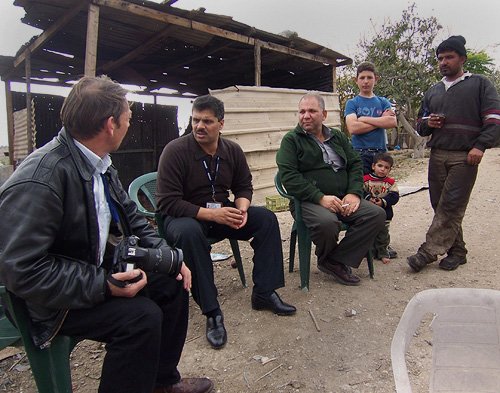


John, Haitam, head of village, and villagers • Photo The author © 2008

“Around 500,” said Mr Samir abu Sha the head of the village council, “We are the Forgotten Camp.”

Given the number of refugees involved, John went through a thorough series of questions to find out what UNRWA might or might not be able to do. Many of the refugees were originally from Haifa and Acca and had fled in 1948, whilst the others were from Gaza. Samir said they’d been brought from Gaza in trucks in 1970, under the orders of Ariel Sharon, and had been forbidden to return. John asked if they had been brought to New Fahme because they’d collaborated with the Israelis – there was a rumour to that effect. “None of the people here now are collaborators,” said Samir, “It was their predecessors.” Samir said that in 1994 – in the wake of the Oslo Accords – Israel had given these collaborators Israeli IDs and they’d moved out of New Fahme.

Samir took us to visit two Special Hardship Cases (SHCs). It turned out that 25 families in New Fahme probably come under this category of people in severe need of assistance:

Najwa was sitting in her wheel chair baking bread in an outside oven. Next to her was one of her daughters and her son, who is mentally disabled. Najwa’s leg was injured by an explosive device in January 2002. It wasn’t clear whether this device belonged to the IDF or to local militia and whether or not it was a deliberate act intended to inflict a civilian casualty. After a number of months in the hospital, the doctors decided to amputate Najwa’s leg.
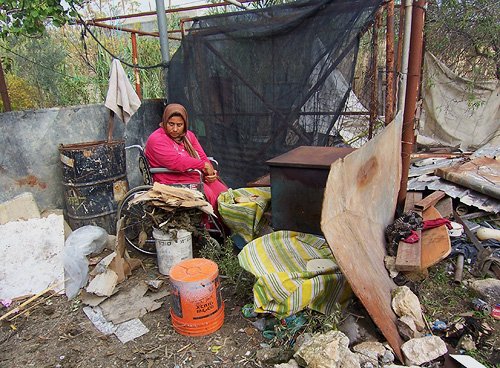
Najwa • Photo The author © 2008

Now she spends all her time at home. As I looked around it was clear that somebody had carried her outside as it wasn’t possible for Najwa to wheel herself around the rough, littered terrain; moreover, there were steps going into her home. She said the YMCA had put some ramps in her house so at least once she was inside she had some degree of mobility. The wheel chair was a second-hand one found by her husband, who makes a living collecting and selling on empty plastic bottles and aluminium cans.

The second SHC we visited was facing similarly dire challenges. Ibrahim, the head of the household, has become addicted to heroin, most likely – in my opinion – as an escape from the difficulties he faces on a daily basis. Like many of the other inhabitants of New Fahme, he is unemployed and sinking further into debt. Many of his family members are unwell: one of his sons is mentally disabled, his wife needs an operation but can’t get a permit from the Israelis to travel out of the West Bank to the hospital in Jerusalem, and his one-year-old granddaughter is suffering from a serious heart condition.
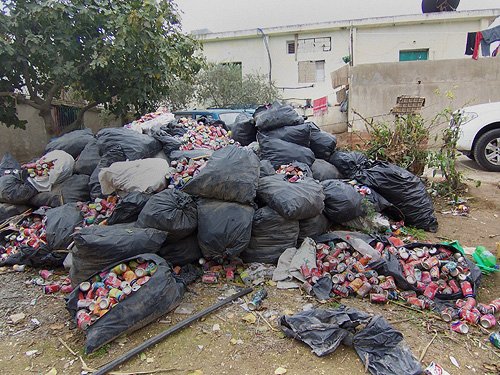
Rubbish • Photo The author © 2008

Leaving Ibrahim’s home, we returned to Samir abu Sha’s office. Samir said he hoped UNRWA might help rebuild some of the houses in the village that were at risk of collapse. John was candid and explained that the Agency (4) was experiencing an austerity period and that at best there was the hope that a social worker could visit the SHCs to make a proper assessment of their situation, after which they could apply to UNRWA for specific needs-related assistance. A mobile clinic was another option that John was considering recommending to UNRWA given the number of refugees in the village.


Would you be reading this now,
if it wasn’t useful to you?
Then please support TFF and this homepage

Despite John’s initial hesitation, an idea for salvaging the collapsing houses by applying to UNRWA’s Job Creation Programme (JCP) was broached. It seemed there was a chance that through JCP the villagers might be able to receive cement and other materials from UNRWA to enable them to restore their homes. Samir was enthusiastic about this idea not only because it would make the houses safe for villagers, but also because it would provide the men with work and an income. As with Najwa’s husband, the main source of employment at the moment in New Fahme is the sale of scrap iron, aluminium and plastic. The men used to sell this waste to Israel, but this trade has all but stopped because of the Israeli-imposed restrictions on the movement of people and goods in the oPt.
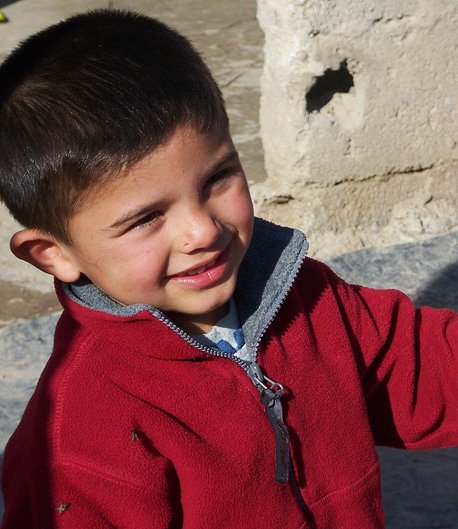
Young boy • Photo The author © 2008

Driving away from New Fahme, I admired the beauty of the undulating hills that stretched into the distance. As we approached Jerusalem, however, the view became scarred by the Barrier, a concrete wall that serpentines for kilometres between Israel and the Palestinian territory as well as around Palestinian towns themselves. This despite a July 2004 ruling by the International Court of Justice that Israel’s West Bank barrier is illegal.

Footnotes

1. “Since 2001, the Operations Support Officer (OSO) programme has supported the delivery of UNRWA’s emergency services in the occupied Palestinian territory (oPt) in conditions of heightened restrictions on access and movement within Palestinian areas. OSOs have facilitated delivery of essential aid to refugees in isolated communities, including those under military siege or curfew, and coordinated UNRWA and inter-agency responses to conflict- and non-conflict related crises.” UNRWA Emergency Appeal 2008, p.24, http://www.un.org/unrwa/emergency/appeals/2008-appeal.pdf

2. United Nations Relief and Works Agency for Palestine Refugees in the Near East

3.Judea and Samaria is how many Jews refer to the West Bank.

4.The Agency is a term used to refer to UNRWA (United Nations Relief and Works Agency for Palestine Refugees in the Near East)


Share

Leave a Reply

Your email address will not be published. Required fields are marked *

Related Posts

Peace is promoted by constructive proposals and dialogue Four preceding PressInfos have expressed concern over — and criticised — the ongoing, militarisation of the EU. Some will say: but there are no alternatives. We believe that there are always alternatives, that democracies are characterised by alternatives and choice, and that openly discussed alternatives will improve the quality and legitimacy of society’s decision–making. In addition, it is an intellectual and moral challenge to not only criticise but also be constructive. If we only tell people that we think they are wrong, they are not likely to listen. However, if we say: what are your views on this set of ideas and steps? — we may sometimes engage them in dialogue and sow a seed. Most people in power circles live their daily lives in in a time frame and a social space where certain ideas, viewpoints and concepts are just not...
Photos © TFF 2000 Read PressInfo 90 “Lift the Sanctions and Bring More Aid to Yugoslavia” See Pictures from Belgrade © TFF 2000 Please reprint, copy, archive, quote or re-post this item, but please retain the source.
Av FRANK SØHOLM GREVIL 16 augusti 2004  Vi er nu nået til tredje akt i det absurde teaterstykke, der i analogi med de store skueprocesser i Moskva 1936-38 er blevet døbt ‘Grevil-sagen’. Første akt bestod i min anonyme fremlæggelse af egenhændigt nedklassificerede rapporter i Berlingske Tidende i februar og marts. Andet akt udgjordes af min fremtræden med navn og billede i Information i april samt den efterfølgende mediestorm, som uden min direkte medvirken kostede en forsvarsminister taburetten samt en sigtelse for brud på tavshedspligten. Tredje akt bliver en retssag, hvor jeg står tiltalt for at have overtrådt straffelovens bestemmelser om uberettiget videregivelse eller udnyttelse af fortrolige oplysninger. Statsanklageren har ovenikøbet valgt at påberåbe sig særligt skærpende omstændigheder. Da jeg aldrig har modtaget betaling for at stille rapporterne til rådighed eller lade mig interviewe, må det skærpende bestå i, at “videregivelsen eller udnyttelsen er sket under sådanne omstændigheder, at det påfører...

Recent Articles

Jan Oberg May 15, 2026 Go to this Fox News page and scroll the whole way down: President Donald Trump tells the world that his meeting with President Xi Jinping yielded a lot of very concrete political and economic results – of course, only where the Chinese side, according to him, agreed with him. He does not mention the Taiwan issue, but Secretary of State, Marco Rubio, says that it did not feature prominently in their talks and that the US policy on Taiwan has not changed. Then go to China Daily – or Global Times – and you will see that for the Chinese it is framework, principles, structure of cooperation etc. that matters – all embedded in the overall idea of “constructive bilateral relationship of strategic stability.” Nowhere is any concrete agreement or deal – all that Trump refers to – mentioned. At the general level, this gives you insights into the very different social...
Lena Petrova of “World Affairs In Context” with more than half a million subscribers on YouTube wanted to explore what a peace researcher like me has to say about, among other things, the First and the Second Cold War and why eethics has disappeared from politics. I am particularly happy about this conversation that also yielded an amazing number of very appreciative comments on YouTube. No doubt, people are longing for alternatives, including peace perspectives.
The MIMAC – Military-Industrial-Media-Academic Complex – drives the world’s rampant militarism and wars without end. Here is a short reflection of how it works against all interests of humanity. #5 deals with why there is no real enemy or threat images/analysis. It’s all ex-post constructions. And, btw, theTFF Peace Pulse is now on Rumble.

TFF on Substack

Discover more from TFF Transnational Foundation & Jan Oberg.

Most Popular

Jan Oberg May 15, 2026 Go to this Fox News page and scroll the whole way down: President Donald Trump tells the world that his meeting with President Xi Jinping yielded a lot of very concrete political and economic results – of course, only where the Chinese side, according to him, agreed with him. He does not mention the Taiwan issue, but Secretary of State, Marco Rubio, says that it did not feature prominently in their talks and that the US policy on Taiwan has not changed. Then go to China Daily – or Global Times – and you will see that for the Chinese it is framework, principles, structure of cooperation etc. that matters – all embedded in the overall idea of “constructive bilateral relationship of strategic stability.” Nowhere is any concrete agreement or deal – all that Trump refers to – mentioned. At the general level, this gives you insights into the very different social...
Lena Petrova of “World Affairs In Context” with more than half a million subscribers on YouTube wanted to explore what a peace researcher like me has to say about, among other things, the First and the Second Cold War and why eethics has disappeared from politics. I am particularly happy about this conversation that also yielded an amazing number of very appreciative comments on YouTube. No doubt, people are longing for alternatives, including peace perspectives.
The MIMAC – Military-Industrial-Media-Academic Complex – drives the world’s rampant militarism and wars without end. Here is a short reflection of how it works against all interests of humanity. #5 deals with why there is no real enemy or threat images/analysis. It’s all ex-post constructions. And, btw, theTFF Peace Pulse is now on Rumble.
Read More
Screenshot-2026-05-15-103534
Jan Oberg May 15, 2026 Go to this Fox News page and scroll the whole way down: President Donald Trump tells the world that his meeting with President Xi Jinping yielded a lot of very concrete political and economic results – of course, only where the Chinese side, according to him, agreed with him. He does not mention the Taiwan issue, but Secretary of State, Marco Rubio, says that it did not feature prominently in their talks and that the US policy on Taiwan has not changed. Then go to China Daily – or Global Times – and you will see that for the Chinese it is framework, principles, structure of cooperation etc. that matters – all embedded in the overall idea of “constructive bilateral relationship of strategic stability.” Nowhere is any concrete agreement or deal – all that Trump refers to – mentioned. At the general level, this gives you insights into the very different social...
Screenshot-2026-05-12-104023
Lena Petrova of “World Affairs In Context” with more than half a million subscribers on YouTube wanted to explore what a peace researcher like me has to say about, among other things, the First and the Second Cold War and why eethics has disappeared from politics. I am particularly happy about this conversation that also yielded an amazing number of very appreciative comments on YouTube. No doubt, people are longing for alternatives, including peace perspectives.
Screenshot-2026-04-13-154551 (2)
The MIMAC – Military-Industrial-Media-Academic Complex – drives the world’s rampant militarism and wars without end. Here is a short reflection of how it works against all interests of humanity. #5 deals with why there is no real enemy or threat images/analysis. It’s all ex-post constructions. And, btw, theTFF Peace Pulse is now on Rumble.
Screenshot-2026-04-13-154551 (1)
Jan Oberg, TFF director April 28, 2026 In this third TFF Peace Pulse, I make the important distinction between the violence and the conflict that violence is a symptom of. If you want peace, focus on the underlying conflict because that is the key to resolution, peacemaking, and a better future for the parties. The West is obsessed with violence, just look around you – and 90+ per cent of the public debate is about military issues and other violence – totally wasted for peace. These Peace Pulses will only be published here a few times. You will also not find them on YouTube and Vimeo because both platforms have blocked TFF and me; you know, peace is dangerous these days. Most TFF’s videos since 2007 are now on Rumble.
Screenshot-2026-04-13-154551
In contrast to most, we’ll bring alternatives, solutions, hope and strategies for a better future. Times are dangerous, yes, but that only intensifies the need for constructive thinking and action! Jan Oberg, TFF director April 13, 2026 The new TFF Peace Pulse uses video messages in a new way: Max 3-5-minute-long comments, ideas or perhaps mini-lectures, all about peace – positive peace. We launch them today on April 13, 2026 with a carefully crafted visual aesthetic fitting the content. We hope to publish them regularly from now on. We launch Peace Pulse (PP) – for a number of reasons. The world is in chaos, and there are countless reasons to feel concerned, frustrated, even angry. The atmosphere is saturated with doom and gloom, with negative energy and rear‑mirror thinking, while vision, imagination, alternatives, strategies and genuine future‑mindedness remain in short supply. And without them, we simply can’t save the world. Looking at problems from a hundred angles will...
IMG_5165 (1)
PART II — Publishing Peace in a System That Prioritises Militarism Jan Oberg, TFF director April 10, 2026 How TFF Maintains a Daily Voice in a Digital World Built for Noise This article is part of the series “TFF at 40″ and it invites you to learn about Four Decades of Publishing Peace. It takes a look at how a small, people‑financed peace foundation has communicated across four generations of technology — from wax stencils and fax machines to mass email and Substack — and why TFF continues to publish every single day in a system that rewards noise, conflict, and militarism. ◆ What it means to publish peace every single day in a digital system built for 24/7 news and other noise, confrontation, and militarism. How TFF’s independence, continuity, and global readership defy algorithms, donor cycles, and Western media censorhip — and why the Majority World keeps listening. When the...
