
Scott Ritter: The Ukraine Crisis - US ‘Toolboxes’ Are Empty

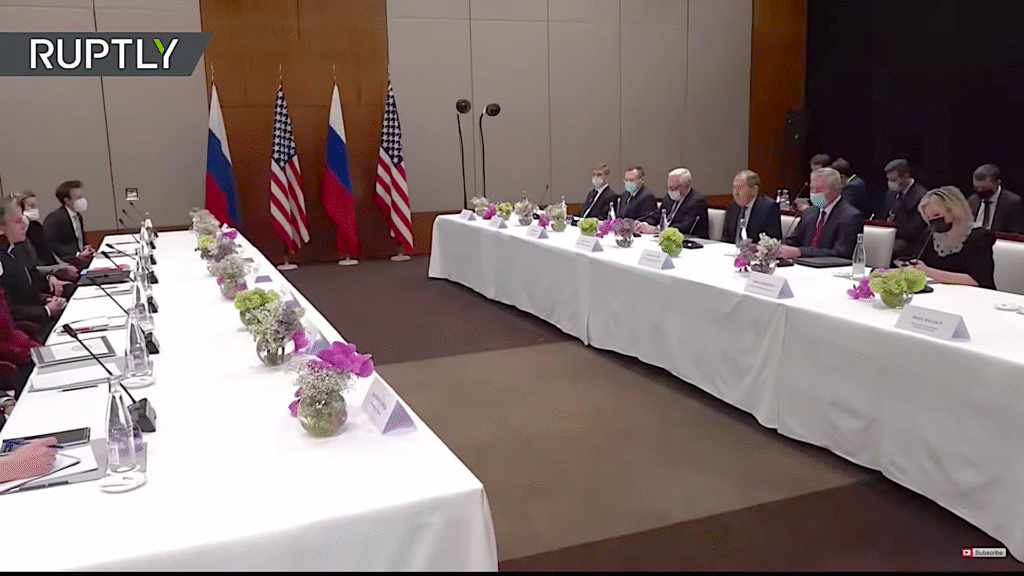
Public opening session between Lavrov and Blinken on Friday. (Ruptly screenshot.)

The toolbox is empty. Russia knows this. Biden knows this. Blinken knows this. CNN knows this. The only ones who aren’t aware of this are the American people, says Scott Ritter.

https://youtu.be/uIcXryB9Ml4

Scott Ritter

January 26, 2022

Originally published by Consortiumnews on January 22, 2022

U.S. Secretary of State Antony Blinken met with his Russian counterpart, Sergei Lavrov, in a hastily scheduled, 90-minute summit in Geneva yesterday, after which both sides lauded the meeting as worthwhile because it kept the door open for a diplomatic resolution to the ongoing crisis in Ukraine. What “keeping the door open” entails, however, represents two completely different realities.

For Blinken, the important thing appears to be process, continuing a dialogue which, by its very essence, creates the impression of progress, with progress being measured in increments of time, as opposed to results.

A results-oriented outcome was not in the books for Blinken and his entourage; the U.S. was supposed to submit a written response to Russia’s demands for security guarantees as spelled out in a pair of draft treaties presented to the U.S. and NATO in December. Instead, Blinken told Lavrov the written submission would be provided next week.

In the meantime, Blinken primed the pump of expected outcomes by highlighting the possibility of future negotiations that addressed Russian concerns (on a reciprocal basis) regarding intermediate-range missiles and NATO military exercises.

But under no circumstances, Blinken said, would the U.S. be responding to Russian demands against NATO expanding to Ukraine and Georgia, and for the redeployment of NATO forces inside the territory of NATO as it existed in 1997.

Blinken also spent a considerable amount of time harping on the danger of a imminent military invasion of Ukraine by Russian forces said to be massing along the Ukraine-Russian border. He pointed out that any military incursion by Russia, not matter what size, that violated the territorial integrity of Ukraine, would be viewed as a continuation of the Russian “aggression” of 2014 and, as such, trigger “massive consequences” which would be damaging to Russia.

Blinken’s restatement of a position he has pontificated on incessantly for more than a month now was not done for the benefit of Lavrov and the Russian government, but rather for an American and European audience which had been left scratching their collective heads over comments made the day before by President Joe Biden which suggested that the U.S. had a range of options it would consider depending on the size of a Russian incursion.

“My guess is he [Russian President Vladimir Putin] will move in, he has to do something,” Biden said during a press briefing on Wednesday. While presenting a Russian invasion as inevitable, Biden went on to note that Putin “will be held accountable” and has “never have seen sanctions like the ones I promised will be imposed” if Russia were, in fact, to move against Ukraine. Biden spoke of deploying additional U.S. military forces to eastern Europe, as well as unspecified economic sanctions.

Biden then, however, hedged his remarks, noting that the scope and scale of any U.S. response would depend on what Russia did. “It’s one thing,” Biden said, “if it’s a minor incursion and we end up having to fight about what to do and not do.”

Almost immediately the Washington establishment went into overdrive to correct what everyone said was a “misstatement” by Biden, with Biden himself making a new statement the next day, declaring that he had been “absolutely clear with President Putin. He has no misunderstanding, any, any assembled Russian units move across the Ukrainian border, that is an invasion,” and that there should be “no doubt at all that if Putin makes this choice, Russia will pay a heavy price.”

And just in case the President was not clear enough, Blinken reiterated that point following his Friday meeting with Lavrov.

Immutable

The U.S. narrative about Russia and Ukraine was immutable; Russia was hell bent on invading, and there would be massive consequences if Russia acted out on its intent. This was no idle threat, Blinken said, but rather represented the unified position of the United States and its allies and partners.

Or was it? In a telling admission, CNN’s White House correspondent, John Harwood, stated that the “minor incursions” statement by Biden was harmless, because (Harwood said) Putin already knew through sources that this was, in fact, the U.S. position. As for Europe and Ukraine, their collective confusion and outrage was merely an act, a posture they had to take for public consumption, since the optics of Biden’s statement “sounds bad.”

In short, the lack of an agreed-upon strategy on how to deal with a Russian incursion/invasion of Ukraine was an open secret for everyone except the U.S. and European publics, who being fed a line of horse manure to assuage domestic political concerns over being seen as surrendering to Russian demands.

Biden and his administration are old hands at lying to the American public when it comes to matters of national security. One only need look to Biden’s July 23, 2021, phone call with Afghan President Ashraf Ghani for a clear precedent into this inability to speak openly and honestly about reality on the ground. “I need not tell you,” Biden told Ghani, “the perception around the world and in parts of Afghanistan, I believe, is that things are not going well in terms of the fight against the Taliban. And there is a need,” Biden added, “whether it is true or not, there is a need to project a different picture.”

This, in a nutshell, is the essence of the posture taken by the Biden administration on Ukraine. Blinken has indicated that the U.S. has a toolbox filled with options that will deliver “massive consequences” to Russia should Russia invade Ukraine.

These “tools” include military options, such as the reinforcement of NATO’s eastern flank with additional U.S. troops, and economic options, such as shutting down the NordStream 2 pipeline and cutting Russia off from the SWIFT banking system. All these options, Blinken notes, have the undivided support of U.S. European allies and partners.

The toolbox is everywhere, it seems—Biden has referred to it, as has White House Press Secretary Jen Psaki. Blinken has alluded to it on numerous occasions.

There’s only one problem—the toolbox, it turns out, is empty.

While the Pentagon is reportedly working on a series of military options to reinforce the existing U.S. military presence in eastern Europe, the actual implementation of these options would neither be timely nor even possible.

One option is to move forces already in Europe; the U.S. Army maintains one heavy armored brigade in Europe on a rotational basis and has a light armored vehicle brigade and an artillery brigade stationed in Germany. Along with some helicopter and logistics support, that’s it.

Flooding these units into Poland would be for display purposes only—they represent an unsustainable combat force that would be destroyed within hours, if not days, in any large-scale ground combat against a Russian threat.

The U.S. can deploy a second heavy armored brigade to Poland which would fall in on prepositioned equipment already warehoused on Polish soil. This brigade would suffer a similar fate if matched up against the Russian army. The U.S. can also deploy an airborne brigade. They, too, would die.

There are no other options available to deploy additional U.S. heavy forces to Europe on a scale and in a timeframe that would be meaningful. The problem isn’t just the deployment of forces from their bases in the U.S. (something that would takes months to prepare for), but the sustainability of these forces once they arrived on the ground in Europe. Food, ammunition, water, fuel—the logistics of war is complicated, and not resolved overnight.

In short, there is no viable military option, and Biden knows this.

Empty Sanctions Too

The U.S. has no sanctions plan that can survive initial contact with the enemy, which in this case is the collective weakness of the post-pandemic economies of both Europe and the U.S.; the over-reliance of Europe on Russian-sourced energy, and the vulnerability of democratically elected leaders to the whim of a consumer-based constituency.

Russia can survive the impact of any sanctions regime the U.S. is able to scrape together—even those targeting the Russian banking system—far longer than Europe can survive without access to Russian energy.

This is a reality that Europe lives with, and while U.S. policy makers might think hard-hitting sanctions look good on paper, the reality is that whatever passes for U.S.-European unity today would collapse in rapid order when the Russian pipelines were shut down.

The pain would not just be limited to Europe, either—the U.S. economy would suffer as well, with sky-high fuel prices and a stock market collapse that would put the U.S. into an economic recession, if not outright depression.

The political cost that would be incurred by Biden and, by extension, the Democrats, would be fatal to any hope that might remain for holding onto either house of Congress in 2022, or the White House in 2024.

It would be one thing if Biden and his national security team were honest and forthright about the real consequences of declaring the equivalent of economic war on Russia.

It is another thing altogether to speak only of the pain sanctions would cause Russia, with little thought, if any, to the real consequences that will be paid on the home front.

Americans should never forget that Russia has been laboring under severe U.S. sanctions since 2014, with zero effect. Russia knows what could be coming and has prepared. The American people wallow in their ignorance, believing at face value what they are told by the Biden administration, and echoed by a compliant mainstream media.

Propaganda About ‘Propaganda’

One of the great ironies of the current crisis is that, on the eve of the Blinken-Lavrov meeting in Geneva, the U.S. State Department published a report on Russian propaganda, decrying the role played by state-funded outlets such as RT and Sputnik in shaping public opinion in the United States and the West (in the interest of full disclosure, RT is one of the outlets that I write for.)

The fact that the State Department would publish such a report on the eve of a meeting which is all about propagating the big lie—that the U.S. has a plan for deterring “irresponsible Russian aggression”—while ignoring the hard truth: this is a crisis derived solely from the irresponsible policies of the U.S. and NATO over the past 30 years.

While a compliant mainstream American media unthinkingly repeated every warning and threat issued by Biden and Blinken to Russia over the course of the past few days, the Russian position has been largely ignored. Here’s a reminder of where Russia stands on its demands for security guarantees: “We are talking about the withdrawal of foreign forces, equipment, and weapons, as well as taking other steps to return to the set-up we had in 1997 in non-NATO countries,” the Russian Foreign Ministry declared in a bulletin published after the Lavrov-Blinken meeting. “This includes Bulgaria and Romania.”

Blinken has already said the U.S. will reject this.

The toolbox is empty. Russia knows this. Biden knows this. Blinken knows this. CNN knows this. The only ones who aren’t aware of this are the American people.

The consequences of a U.S. rejection of Russia’s demands will more than likely be war.

If you think the American people are ready to bear the burden of a war with Russia, think again.

Originally published by Consortiumnews on January 22, 2022

About the author

Scott Ritter is a former U.S. Marine Corps intelligence officer who served in the former Soviet Union implementing arms control treaties, in the Persian Gulf during Operation Desert Storm, and in Iraq overseeing the disarmament of WMD.

Please help TFF remain truly independent and exclusively people-financed by contributing if you benefited from this article. Many thanks.

[paypal-donation]

Share

Leave a Reply

Your email address will not be published. Required fields are marked *

Related Posts

Jan Oberg May 15, 2026 Go to this Fox News page and scroll the whole way down: President Donald Trump tells the world that his meeting with President Xi Jinping yielded a lot of very concrete political and economic results – of course, only where the Chinese side, according to him, agreed with him. He does not mention the Taiwan issue, but Secretary of State, Marco Rubio, says that it did not feature prominently in their talks and that the US policy on Taiwan has not changed. Then go to China Daily – or Global Times – and you will see that for the Chinese it is framework, principles, structure of cooperation etc. that matters – all embedded in the overall idea of “constructive bilateral relationship of strategic stability.” Nowhere is any concrete agreement or deal – all that Trump refers to – mentioned. At the general level, this gives you insights into the very different social...
Jan Oberg, TFF director April 9, 2026 I was recently invited to have a good, long talk about the world – and, of course, about peace too – with Boris Malagurski on his Weight of Chains Channel on YouTube. It was a real joy and seems to have been greatly appreciated by the viewers too. Mr Malagurski and I shall of course be grateful if you share this conversation in your circles – of course, only if you like what you see and hear  And remember that this one – like hundreds of others with TFF Associates – can be enjoyed at our TFF Video Collection.
The MSC’s closed groupthink militarism offers only one prescription — more weapons — even as record military expenditures, squeezed from taxpayers in economic crisis, destroy diplomacy and drive escalation to the highest war risks in decades. Jan Oberg TFF director February 13, 2026 From Dialogue Forum to Militarised Ritual For decades, the Munich Security Conference (MSC) – which opened today and runs till Sunday – was one of the few places where adversaries could meet without theatrics. Founded in 1963 as the Wehrkundetagung, it served as a discreet Cold War dialogue forum between NATO and the Warsaw Pact. Even at moments of high tension, Soviet and later Russian representatives were present, and Munich allowed uncomfortable messages to be delivered directly rather than through press releases or military manoeuvres. That era has vanished. The MSC has become something entirely different: a €13–20 million annual gathering of a closed Western security elite, a polished meeting...

Recent Articles

“En dag som berättigar till fest”, utropade den London-baserade al-Quds al-Arabi efter FN:s eldupphörresolution, “eftersom detta är första gången som Israel accepterar ett FN-beslut från en position som besegrad och inte som segrare”. Att ett arabisk-israeliskt krig för en gångs skull slutat med arabisk seger, är en helt dominerade åsikt i arabiska medier. Al-Quds al-Arabi tillåter sig att drömma om att det israeliska nederlaget skall leda till massflykt från Israel. Men i nästa andetag påminner tidningen om att Israel aldrig brukar genomföra sina internationella åtaganden och varnar för att förlorarna, liksom tidigare, kan hämnas genom att provocera fram inbördeskrig i Libanon. Med tanke på de otaliga massmediala vittnesmålen om det libanesiska folkets eniga motståndskraft förefaller risken för inre stridigheter i det sargade landet just nu liten. Men visst kan man urskilja nyansskillnader i libanesiska tidningar. Vänsterorganet al-Safir uppfattar FN-resolutionen som en komplott i syfte att rädda Israel från ännu större...
Greenland – the world’s largest island, a continent of its own with only 57.000 inhabitants. I visited it for the first time in May 2005. I flew across the inland ice to Nuuk, the tiny capital with some 14.000 inhabitants. I was overwhelmed by the pride and kindness of everyone I met as well as by the unique natural beauty. Unfortunately, due to weather conditions during my ten-day stay I could get nowhere else but Nuuk. Fortunately, however, among those I met was Gitte Arvegaard, a Danish lawyer and negotiator employed by the local government, Greenland Home Rule. She turned out to be an enthusiastic photographer with a lot of pictures taken during various trips around Greenland. So this Greeland series is the result of our cooperative effort. We both hope you enjoy it and are stimulated to visit Greenland – about which you may read more here. Finally, if you want to...
 Jan Oberg’s storyof how he met Sir Paul Liverpool – where else to meet Paul McCartney? Paul’s old class mate and TFF Associate, Jonathan Power introduced me to Paul McCartney in Liverpool at an informal reception. It was held at what used to be their school, now the Liverpool Institute for Performing Arts and we were there to celebrate that Jonathan had written Amnesty International’s 40th Anniversary book. This happy event for “righting wrongs and writing songs” gave me an opportunity to meet Paul and tell him about TFF and get straight to the matter: would he consider making a donation in support of our work for peace? While I was probably the only one with such a wish that day, I was certainly not the only one who wanted to shake hands and talk with him. In the last minutes before Paul was to leave, Jonathan brought us together and we got about three...

TFF on Substack

Discover more from TFF Transnational Foundation & Jan Oberg.

Most Popular

“En dag som berättigar till fest”, utropade den London-baserade al-Quds al-Arabi efter FN:s eldupphörresolution, “eftersom detta är första gången som Israel accepterar ett FN-beslut från en position som besegrad och inte som segrare”. Att ett arabisk-israeliskt krig för en gångs skull slutat med arabisk seger, är en helt dominerade åsikt i arabiska medier. Al-Quds al-Arabi tillåter sig att drömma om att det israeliska nederlaget skall leda till massflykt från Israel. Men i nästa andetag påminner tidningen om att Israel aldrig brukar genomföra sina internationella åtaganden och varnar för att förlorarna, liksom tidigare, kan hämnas genom att provocera fram inbördeskrig i Libanon. Med tanke på de otaliga massmediala vittnesmålen om det libanesiska folkets eniga motståndskraft förefaller risken för inre stridigheter i det sargade landet just nu liten. Men visst kan man urskilja nyansskillnader i libanesiska tidningar. Vänsterorganet al-Safir uppfattar FN-resolutionen som en komplott i syfte att rädda Israel från ännu större...
Greenland – the world’s largest island, a continent of its own with only 57.000 inhabitants. I visited it for the first time in May 2005. I flew across the inland ice to Nuuk, the tiny capital with some 14.000 inhabitants. I was overwhelmed by the pride and kindness of everyone I met as well as by the unique natural beauty. Unfortunately, due to weather conditions during my ten-day stay I could get nowhere else but Nuuk. Fortunately, however, among those I met was Gitte Arvegaard, a Danish lawyer and negotiator employed by the local government, Greenland Home Rule. She turned out to be an enthusiastic photographer with a lot of pictures taken during various trips around Greenland. So this Greeland series is the result of our cooperative effort. We both hope you enjoy it and are stimulated to visit Greenland – about which you may read more here. Finally, if you want to...
 Jan Oberg’s storyof how he met Sir Paul Liverpool – where else to meet Paul McCartney? Paul’s old class mate and TFF Associate, Jonathan Power introduced me to Paul McCartney in Liverpool at an informal reception. It was held at what used to be their school, now the Liverpool Institute for Performing Arts and we were there to celebrate that Jonathan had written Amnesty International’s 40th Anniversary book. This happy event for “righting wrongs and writing songs” gave me an opportunity to meet Paul and tell him about TFF and get straight to the matter: would he consider making a donation in support of our work for peace? While I was probably the only one with such a wish that day, I was certainly not the only one who wanted to shake hands and talk with him. In the last minutes before Paul was to leave, Jonathan brought us together and we got about three...
Read More
Imagen-thumbnail-The-Transnational-1
“En dag som berättigar till fest”, utropade den London-baserade al-Quds al-Arabi efter FN:s eldupphörresolution, “eftersom detta är första gången som Israel accepterar ett FN-beslut från en position som besegrad och inte som segrare”. Att ett arabisk-israeliskt krig för en gångs skull slutat med arabisk seger, är en helt dominerade åsikt i arabiska medier. Al-Quds al-Arabi tillåter sig att drömma om att det israeliska nederlaget skall leda till massflykt från Israel. Men i nästa andetag påminner tidningen om att Israel aldrig brukar genomföra sina internationella åtaganden och varnar för att förlorarna, liksom tidigare, kan hämnas genom att provocera fram inbördeskrig i Libanon. Med tanke på de otaliga massmediala vittnesmålen om det libanesiska folkets eniga motståndskraft förefaller risken för inre stridigheter i det sargade landet just nu liten. Men visst kan man urskilja nyansskillnader i libanesiska tidningar. Vänsterorganet al-Safir uppfattar FN-resolutionen som en komplott i syfte att rädda Israel från ännu större...
Greenland – the world’s largest island, a continent of its own with only 57.000 inhabitants. I visited it for the first time in May 2005. I flew across the inland ice to Nuuk, the tiny capital with some 14.000 inhabitants. I was overwhelmed by the pride and kindness of everyone I met as well as by the unique natural beauty. Unfortunately, due to weather conditions during my ten-day stay I could get nowhere else but Nuuk. Fortunately, however, among those I met was Gitte Arvegaard, a Danish lawyer and negotiator employed by the local government, Greenland Home Rule. She turned out to be an enthusiastic photographer with a lot of pictures taken during various trips around Greenland. So this Greeland series is the result of our cooperative effort. We both hope you enjoy it and are stimulated to visit Greenland – about which you may read more here. Finally, if you want to...
p_mccartney_poem
 Jan Oberg’s storyof how he met Sir Paul Liverpool – where else to meet Paul McCartney? Paul’s old class mate and TFF Associate, Jonathan Power introduced me to Paul McCartney in Liverpool at an informal reception. It was held at what used to be their school, now the Liverpool Institute for Performing Arts and we were there to celebrate that Jonathan had written Amnesty International’s 40th Anniversary book. This happy event for “righting wrongs and writing songs” gave me an opportunity to meet Paul and tell him about TFF and get straight to the matter: would he consider making a donation in support of our work for peace? While I was probably the only one with such a wish that day, I was certainly not the only one who wanted to shake hands and talk with him. In the last minutes before Paul was to leave, Jonathan brought us together and we got about three...
Logo-Transnational
1942James Paul McCartney is born in Liverpool on June 18th. 1956Paul writes his first song, I Lost My Little Girl. 1957Paul meets John Lennon at St. Peter’s Church Fete, Woolton, Liverpool. He joins his first group, The Quarrymen and performs in his first gig at The New Clubmoor Hall, Liverpool, on October 18th. 1960Formation of The Beatles, who play residencies in Hamburg and at The Cavern in Liverpool. 1961First Beatles recordings issued in Germany, as the backing group for Tony Sheridan. 1962The first Beatles Parlophone recording, Love Me Do, reaches number 17 in the British charts. 1963The birth of Beatlemania. Please Please Me gives the group their first British Number 1. She Loves You cements their success. Please Please Me and With The Beatles albums released. 1964First triumphant American tour. The Beatles perform at the Royal Command Performance and release their first film, A Hard Day’s Night. Their single I...
Logo-Transnational
  Back to the series “Bujumbura, Burundi”
By JONATHAN POWER August 16, 2000 LONDON – Remember the summer of ’98? In the sweltering, torpid heat of a Roman august, charged with exhaust fumes, the international community gave its overwhelming approval to the establishment of an International Criminal Court that will enable those accused of “crimes against humanity” to be tried and, if convicted, sentenced. Only seven nations opposed or abstained from the motion, including Israel, China, India and the U.S.A. where the Pentagon had successfully waged bureaucratic guerrilla war to undermine the initially sympathetic stance of President Bill Clinton. Two years on we can now see what an epochal event that was. In a the stroke of 120 pens it changed the climate on political thuggery. After numerous half-starts and false starts ever since the Nuremberg and Tokyo trials that convicted the war criminals of the Second World War, the world at last had agreed en masse a common...

