
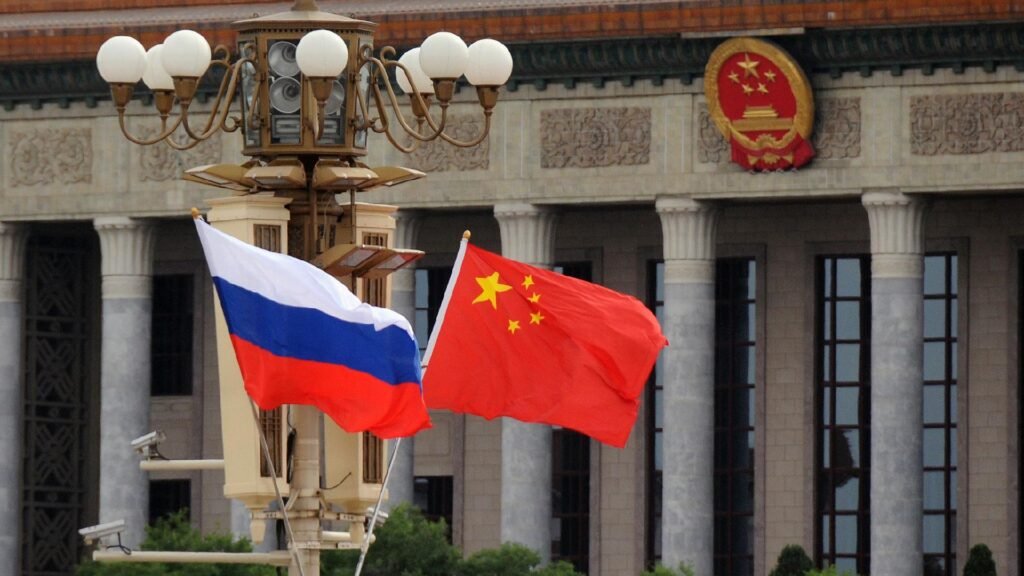
Joint Article by Chinese and Russian Ambassadors: Respecting People’s Democratic Rights

The embassy of the People’s Republic of China in the United States of America

10 December 2021

This Joint Article was published on ”The National Interest”. Qin Gang is the Chinese Ambassador to the United States. Anatoly Antonov is the Russian Ambassador to the United States.

We publish it here on The Transnational because we believe it is a historic document both because of China-Russia cooperation which is increasing rapidly and because it makes the important point that the US no longer has any legitimate – or exceptionalist – right to tell others how to operate.

The upcoming American-led online Summit for Democracy will stoke ideological confrontation. Faced with an array of global challenges, countries urgently need to strengthen coordination and cooperation for common progress.

The United States will be hosting the online Summit for Democracy on December 9-10, 2021, empowering itself to define who is to attend the event and who is not, who is a “democratic country” and who is not eligible for such status. An evident product of its Cold-War mentality, this will stoke up ideological confrontation and a rift in the world, creating new “dividing lines.”

This trend contradicts the development of the modern world. It is impossible to prevent the shaping of a global polycentric architecture but could strain the objective process. China and Russia firmly reject this move.

Originally published at China-embassy.org

Peace, development, fairness, justice, democracy, and freedom are common values of humanity. Democracy is not a prerogative of a certain country or a group of countries, but a universal right of all peoples. It can be realized in multiple ways, and no model can fit all countries.

Whether a country’s path works depends on whether it meets the country’s realities, follows the trend of the times, and brings about economic development, social stability and progress, and better lives for the people. Ultimately, it relies on the support of the people and will be proven by its contribution to human progress.

Therefore, a basic criterion of democracy should be about the people, i.e. whether the people have the right to govern their country, whether their needs are met, and whether they have a sense of fulfilment and happiness.

If the people are only awakened when casting their votes and sent back to hibernation when the voting is over, if they are served with sweet-sounding slogans in campaigns but have no say after the election, if they are wooed during canvassing but left out in the cold after that, this is not a genuine democracy.

What China has is an extensive, whole-process socialist democracy. It reflects the people’s will, suits the country’s realities, and enjoys strong support from the people.

In China, the people have the right to elections, and they can get deeply involved in national governance, exercising their power through the People’s Congresses at the national and other levels. China has eight non-Communist parties participating in governance, as well as a unique system and corresponding institutions of political consultation.

On matters concerning people’s keen interests, there are broad-based and sufficient consultations and discussions before any decision is made. Policies and measures can only be introduced when there is a consensus that they are what the people want and will serve the people’s needs.

It has been proved that the whole-process democracy works in China, and works very well. China calls for building a community with a shared future for mankind. As residents of the same global village, we should handle international affairs through consultation.

Russia is a democratic federative law-governed state with a republican form of government. Democracy is the fundamental principle of its political system. The democratic institutions were further strengthened by the amendments to the Constitution adopted through a referendum in 2020.

In Russia, the development of democracy is closely connected to culture and traditions. Traditions of its parliamentarianism go back over a hundred years. Russia’s political system is evolving steadily and needs a stable and calm environment that guarantees the rights and interests of its people.

Democracy is not just about domestic governance; it should also be reflected in international relations. A truly democratic government will support democracy in international relations. It will not foster hegemony and division abroad while building democracy and unity at home. The path to prosperity of nations goes through respectful cooperation with each other, despite some differences in views on particular issues.

The sovereignty, security, and development interests of a country should not be violated. Interfering in other countries’ internal affairs—under the pretext of fighting corruption, promoting democratic values, or protecting human rights—hindering their development, wielding the big stick of sanctions, and even infringing on their sovereignty, unity and territorial integrity go against the UN Charter and other basic norms of international law and are obviously anti-democratic.

No country has the right to judge the world’s vast and varied political landscape by a single yardstick, and having other countries copy one’s political system through color revolution, regime change and even use of force go against international law, and are obviously anti-democratic.

International affairs should be handled in accordance with the principles of extensive consultation, joint contribution, and shared benefits, and decided in the spirit of true multilateralism.

There should be a more inclusive global governance, not something like “might makes right.” Seeking supremacy and putting oneself always first are acts of hegemonism and unilateralism, and are obviously anti-democratic.

Common security and development are a prevailing aspiration of the international community. Using ideology to bring down other countries, and promote a geo-strategy for absolute security will lead to division and confrontation, and are obviously anti-democratic.

There is only one international system in the world, i.e. the international system with the United Nations at its core. There is only one international order, i.e. the one underpinned by international law. And there is only one set of rules, i.e. the basic norms governing international relations based on the purposes and principles of the UN Charter.

Flaunting the “rules-based international order” without referencing the UN and international law and attempting to replace international rules with the dictums of certain blocs falls into the category of revisionism and is obviously anti-democratic.

There has seen no shortage of wars and turmoil worldwide to prove that spreading “democracy,” its political system, and values against other countries’ will severely undermine regional and international peace, security, and stability.

Bombings of Yugoslavia, military intervention in Iraq, Afghanistan, and Libya, and “democratic transformation” do nothing but harm. Countries should focus on running their own affairs well, not condescendingly criticizing others.

There is no need to worry about democracy in Russia and China. Certain foreign governments better think about themselves and what is going on in their homes. Is it freedom when various rallies in their countries are dispersed with rubber bullets and tear gas? It does not look very much like freedom.

Faced with an array of global challenges, countries urgently need to strengthen coordination and cooperation for common progress. Especially today when the international community needs to improve cooperation between all countries to counter the pandemic of COVID-19, foster economic development, and neutralize cross-border threats.

China and Russia call on countries: to stop using “value-based diplomacy” to provoke division and confrontation; to practice mutual respect and win-win cooperation in international relations, and to work for harmonious coexistence between countries with different social systems, ideologies, histories, cultures, and development levels.

Originally published at China-embassy.org

Please help TFF remain truly independent by contributing if you benefited from this article

[paypal-donation]

Share

Leave a Reply

Your email address will not be published. Required fields are marked *

Related Posts

Jan Oberg May 15, 2026 Go to this Fox News page and scroll the whole way down: President Donald Trump tells the world that his meeting with President Xi Jinping yielded a lot of very concrete political and economic results – of course, only where the Chinese side, according to him, agreed with him. He does not mention the Taiwan issue, but Secretary of State, Marco Rubio, says that it did not feature prominently in their talks and that the US policy on Taiwan has not changed. Then go to China Daily – or Global Times – and you will see that for the Chinese it is framework, principles, structure of cooperation etc. that matters – all embedded in the overall idea of “constructive bilateral relationship of strategic stability.” Nowhere is any concrete agreement or deal – all that Trump refers to – mentioned. At the general level, this gives you insights into the very different social...
Jan Oberg, TFF director April 9, 2026 I was recently invited to have a good, long talk about the world – and, of course, about peace too – with Boris Malagurski on his Weight of Chains Channel on YouTube. It was a real joy and seems to have been greatly appreciated by the viewers too. Mr Malagurski and I shall of course be grateful if you share this conversation in your circles – of course, only if you like what you see and hear  And remember that this one – like hundreds of others with TFF Associates – can be enjoyed at our TFF Video Collection.
This is not another geopolitical commentary on the Arctic. It is a visionary peace proposal that can save the region from militarised rivalry and ecological ruin. A blueprint for shared security, sustainable development, and human dignity — benefitting Greenland, the Arctic, and the rest of us. Jan Oberg TFF director Lund, Sweden, February 17, 2026 I. Four Principles for a New Arctic Vision The Arctic is often framed as a cold arena of rivalry — a place where great powers test each other’s resolve. But this worldview is outdated, unimaginative, and ultimately self‑defeating. The Arctic is not a vacuum waiting to be militarised; it is a living region, a climate stabiliser, and a cultural homeland whose future will shape the future of humanity. If we begin from that understanding, a far more rational Arctic order becomes possible — one that is peaceful, cooperative, and centred on the people who actually live there. This vision rests...

Recent Articles

Jan Oberg May 15, 2026 Go to this Fox News page and scroll the whole way down: President Donald Trump tells the world that his meeting with President Xi Jinping yielded a lot of very concrete political and economic results – of course, only where the Chinese side, according to him, agreed with him. He does not mention the Taiwan issue, but Secretary of State, Marco Rubio, says that it did not feature prominently in their talks and that the US policy on Taiwan has not changed. Then go to China Daily – or Global Times – and you will see that for the Chinese it is framework, principles, structure of cooperation etc. that matters – all embedded in the overall idea of “constructive bilateral relationship of strategic stability.” Nowhere is any concrete agreement or deal – all that Trump refers to – mentioned. At the general level, this gives you insights into the very different social...
Lena Petrova of “World Affairs In Context” with more than half a million subscribers on YouTube wanted to explore what a peace researcher like me has to say about, among other things, the First and the Second Cold War and why eethics has disappeared from politics. I am particularly happy about this conversation that also yielded an amazing number of very appreciative comments on YouTube. No doubt, people are longing for alternatives, including peace perspectives.
The MIMAC – Military-Industrial-Media-Academic Complex – drives the world’s rampant militarism and wars without end. Here is a short reflection of how it works against all interests of humanity. #5 deals with why there is no real enemy or threat images/analysis. It’s all ex-post constructions. And, btw, theTFF Peace Pulse is now on Rumble.

TFF on Substack

Discover more from TFF Transnational Foundation & Jan Oberg.

Most Popular

Jan Oberg May 15, 2026 Go to this Fox News page and scroll the whole way down: President Donald Trump tells the world that his meeting with President Xi Jinping yielded a lot of very concrete political and economic results – of course, only where the Chinese side, according to him, agreed with him. He does not mention the Taiwan issue, but Secretary of State, Marco Rubio, says that it did not feature prominently in their talks and that the US policy on Taiwan has not changed. Then go to China Daily – or Global Times – and you will see that for the Chinese it is framework, principles, structure of cooperation etc. that matters – all embedded in the overall idea of “constructive bilateral relationship of strategic stability.” Nowhere is any concrete agreement or deal – all that Trump refers to – mentioned. At the general level, this gives you insights into the very different social...
Lena Petrova of “World Affairs In Context” with more than half a million subscribers on YouTube wanted to explore what a peace researcher like me has to say about, among other things, the First and the Second Cold War and why eethics has disappeared from politics. I am particularly happy about this conversation that also yielded an amazing number of very appreciative comments on YouTube. No doubt, people are longing for alternatives, including peace perspectives.
The MIMAC – Military-Industrial-Media-Academic Complex – drives the world’s rampant militarism and wars without end. Here is a short reflection of how it works against all interests of humanity. #5 deals with why there is no real enemy or threat images/analysis. It’s all ex-post constructions. And, btw, theTFF Peace Pulse is now on Rumble.
Read More
Screenshot-2026-05-15-103534
Jan Oberg May 15, 2026 Go to this Fox News page and scroll the whole way down: President Donald Trump tells the world that his meeting with President Xi Jinping yielded a lot of very concrete political and economic results – of course, only where the Chinese side, according to him, agreed with him. He does not mention the Taiwan issue, but Secretary of State, Marco Rubio, says that it did not feature prominently in their talks and that the US policy on Taiwan has not changed. Then go to China Daily – or Global Times – and you will see that for the Chinese it is framework, principles, structure of cooperation etc. that matters – all embedded in the overall idea of “constructive bilateral relationship of strategic stability.” Nowhere is any concrete agreement or deal – all that Trump refers to – mentioned. At the general level, this gives you insights into the very different social...
Screenshot-2026-05-12-104023
Lena Petrova of “World Affairs In Context” with more than half a million subscribers on YouTube wanted to explore what a peace researcher like me has to say about, among other things, the First and the Second Cold War and why eethics has disappeared from politics. I am particularly happy about this conversation that also yielded an amazing number of very appreciative comments on YouTube. No doubt, people are longing for alternatives, including peace perspectives.
Screenshot-2026-04-13-154551 (2)
The MIMAC – Military-Industrial-Media-Academic Complex – drives the world’s rampant militarism and wars without end. Here is a short reflection of how it works against all interests of humanity. #5 deals with why there is no real enemy or threat images/analysis. It’s all ex-post constructions. And, btw, theTFF Peace Pulse is now on Rumble.
Screenshot-2026-04-13-154551 (1)
Jan Oberg, TFF director April 28, 2026 In this third TFF Peace Pulse, I make the important distinction between the violence and the conflict that violence is a symptom of. If you want peace, focus on the underlying conflict because that is the key to resolution, peacemaking, and a better future for the parties. The West is obsessed with violence, just look around you – and 90+ per cent of the public debate is about military issues and other violence – totally wasted for peace. These Peace Pulses will only be published here a few times. You will also not find them on YouTube and Vimeo because both platforms have blocked TFF and me; you know, peace is dangerous these days. Most TFF’s videos since 2007 are now on Rumble.
Screenshot-2026-04-13-154551
In contrast to most, we’ll bring alternatives, solutions, hope and strategies for a better future. Times are dangerous, yes, but that only intensifies the need for constructive thinking and action! Jan Oberg, TFF director April 13, 2026 The new TFF Peace Pulse uses video messages in a new way: Max 3-5-minute-long comments, ideas or perhaps mini-lectures, all about peace – positive peace. We launch them today on April 13, 2026 with a carefully crafted visual aesthetic fitting the content. We hope to publish them regularly from now on. We launch Peace Pulse (PP) – for a number of reasons. The world is in chaos, and there are countless reasons to feel concerned, frustrated, even angry. The atmosphere is saturated with doom and gloom, with negative energy and rear‑mirror thinking, while vision, imagination, alternatives, strategies and genuine future‑mindedness remain in short supply. And without them, we simply can’t save the world. Looking at problems from a hundred angles will...
IMG_5165 (1)
PART II — Publishing Peace in a System That Prioritises Militarism Jan Oberg, TFF director April 10, 2026 How TFF Maintains a Daily Voice in a Digital World Built for Noise This article is part of the series “TFF at 40″ and it invites you to learn about Four Decades of Publishing Peace. It takes a look at how a small, people‑financed peace foundation has communicated across four generations of technology — from wax stencils and fax machines to mass email and Substack — and why TFF continues to publish every single day in a system that rewards noise, conflict, and militarism. ◆ What it means to publish peace every single day in a digital system built for 24/7 news and other noise, confrontation, and militarism. How TFF’s independence, continuity, and global readership defy algorithms, donor cycles, and Western media censorhip — and why the Majority World keeps listening. When the...

