The banality of evil redux

Daryl Guppy

April 11, 2024

This article, first published by Pearls & Irritations on April 4, 2024, focuses on Australia but there is no reason that you could not insert any Western country in its place.

Hannah Arendt’s BANALITY OF EVIL report on the Eichmann trial failed to adequately address a key question. How could the German people not have known and how could they have let the holocaust happen?

Arendt’s observation that the administrative industrialisation of evil led to its banality is most relevant today, but it is enhanced and magnified by the pervasive distribution of horrendous images by ubiquitous social media. What the mainstream Western media chooses not to show, or report, is readily available on Facebook, X and Instagram.

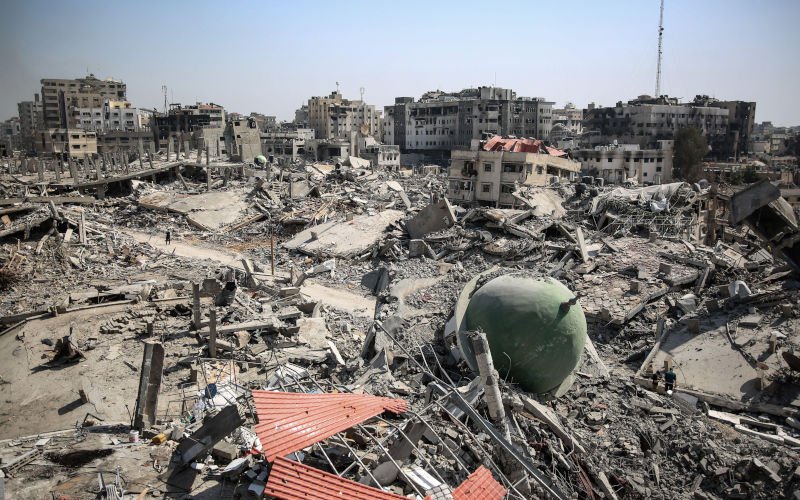
Israel’s disproportionate response in Gaza to the Hamas’ attack, the al-Shifa hospital massacre, images of children crushed beneath tanks, joyous Israeli troops looting houses and the outright lie that only a few innocent civilians were harmed in this destruction, are a farrago of evil from which we cannot escape, but which we choose to ignore.

The film, THE ZONE OF INTEREST explores Arendt’s observations at a more personal level. The film follows the ordinary lives of those living beside a concentration camp in 1943. Apart from the occasional distraction of unpleasant odours when the wind changed direction, life was, if not cultured, at least comfortable and proceeded largely unperturbed.

Likewise, today we scroll down our small screens, perhaps pausing for a moment in delicious horror, before moving onto the next comedy sketch or advertisement for luxury goods.

At this early stage of the 21st century there ought to be a difference in our response to evil, but there is not. The Gaza war crimes unfold simultaneously on millions of small screens and give a new meaning to the banality of evil.

Is this banality to be our fate? The questions for us are will we allow these war crimes to go un-noticed and, if not, what can we do about it?

Recognising the reality of the emergence of a rogue state that rivals North Korea in its contempt for international law is a first step. Individually we can refuse to buy products from Israel, we can protest, and in my case, write. But it’s barely enough.

If we are to breakout out of the walled garden zone of interest then it requires a strength of political willpower to unshackle Australia from its cowardly acquiescence to the policy directions set by the United States.

It is good that Australia supports the calls for a ceasefire made in the United Nations. True leadership would see Australia leading these calls for a ceasefire. That is how Australia could establish its credibility in Asia Pacific and the broader international community.

As a matter of priority, Australia should suspend all arms exports to Israel until it complies with the UN ceasefire resolutions. Australia policy aspires to be a leading weapons supplier. We must be careful what we wish for because the supply of weapons that enable war crimes to a military action that has all the characteristics of a genocide make Australia complicit in those actions. Failure to prevent, or suspend these sales, shows contempt for the United Nations and contempt for the international rules based order upon which Australia endlessly pontificates.

Australia could emulate South Africa, and refuse landing rights for flights coming from Israel or transiting Israel. This sends a message that Australia will not enable the commission of war crimes on a grand scale.

Australia is quick to follow the United States and place travel sanctions on selected Chinese and Russian individuals, but has not yet considered placing similar travel bans on those who are committing war crimes in Gaza. It’s an administrative action that could be initiated by Foreign Minister Wong, but she is missing in action.

Prime Minister Albanese wants full accountability for the killing of Australian aid worker “Zomi” Frankcom, but there is little evidence we want to hold anybody actually accountable. We meekly accept Netanyahu’s “unintentional strike” fig-leaf as an explanation for what was a targeted assassination of an aid convoy where its movements had been coordinated with the Israeli army. Albanese’s expression of outrage is a substitute for action.

Foreign Minister Wong acted quickly, without evidence, to suspend UNWRA funding, but she is conspicuously absent when it comes to taking real action to enforce UN resolutions involving Gaza.

I cannot speak for Hannah Arendt, but her understanding of the enabling factors underpinning fascism and the holocaust are today, suddenly, on all our phone screens. We cannot tell our children and grandchildren that we did not know. Hopefully we can tell them that we did something to stop it.

The author
Daryl Guppy is an international financial technical analysis expert. He has provided weekly Shanghai Index analysis for mainland Chinese media for more than a decade. Guppy appears regularly on CNBC Asia and is known as “The Chart Man”. He is a former national board member of the Australia-China Business Council. The views expressed here are his own.
Share

Leave a Reply

Your email address will not be published. Required fields are marked *

Related Posts

Jan Oberg, TFF director April 28, 2026 In this third TFF Peace Pulse, I make the important distinction between the violence and the conflict that violence is a symptom of. If you want peace, focus on the underlying conflict because that is the key to resolution, peacemaking, and a better future for the parties. The West is obsessed with violence, just look around you – and 90+ per cent of the public debate is about military issues and other violence – totally wasted for peace. These Peace Pulses will only be published here a few times. You will also not find them on YouTube and Vimeo because both platforms have blocked TFF and me; you know, peace is dangerous these days. Most TFF’s videos since 2007 are now on Rumble.
In contrast to most, we’ll bring alternatives, solutions, hope and strategies for a better future. Times are dangerous, yes, but that only intensifies the need for constructive thinking and action! Jan Oberg, TFF director April 13, 2026 The new TFF Peace Pulse uses video messages in a new way: Max 3-5-minute-long comments, ideas or perhaps mini-lectures, all about peace – positive peace. We launch them today on April 13, 2026 with a carefully crafted visual aesthetic fitting the content. We hope to publish them regularly from now on. We launch Peace Pulse (PP) – for a number of reasons. The world is in chaos, and there are countless reasons to feel concerned, frustrated, even angry. The atmosphere is saturated with doom and gloom, with negative energy and rear‑mirror thinking, while vision, imagination, alternatives, strategies and genuine future‑mindedness remain in short supply. And without them, we simply can’t save the world. Looking at problems from a hundred angles will...
Jan Oberg, TFF director April 9, 2026 I was recently invited to have a good, long talk about the world – and, of course, about peace too – with Boris Malagurski on his Weight of Chains Channel on YouTube. It was a real joy and seems to have been greatly appreciated by the viewers too. Mr Malagurski and I shall of course be grateful if you share this conversation in your circles – of course, only if you like what you see and hear  And remember that this one – like hundreds of others with TFF Associates – can be enjoyed at our TFF Video Collection.

Recent Articles

Jan ObergTFF director ☮️ When this morning – August 19, 2026 – I saw the above new US Trump map, I came to think of Frank Zappa, The Mothers of Invention, who said that politics is the entertainment division of the Military-Industrial Complex. That formulation beats many academic analyses – as you will have understood […]
A Civilizational Interpretation of the West’s Body Politic Pascal Lottaz Associate professor at Ritsumeikan University in Kyoto and TFF Board member August 25, 2026 “How do we explain the self-defeating and self-harming policies of Western states? Europe seems to be happily deindustrializing, the US proxy war in Ukraine is killing hundreds of thousands (if not millions) […]
LONDON – Many of the great and the good have dismissed the utility of nuclear weapons as well as finding the idea of their use morally indefensible but still they exist in enormous numbers in the arsenals of the great powers. Secretary of Defence Robert McNamara and Secretary of State Dean Rusk both came to be convinced during their tenure in the Kennedy administration that their use was “unthinkable”. President George H.W. Bush has written that in private he ruled out a nuclear response during the 1991 Gulf War although in public his Administration did not. General Colin Powell, then the chairman of the Joint Chiefs of Staff, in his autobiography recalls chiding his boss, Dick Cheney, for even considering it. Paul Nitze, one of the principal architects of containing the Soviet Union by nuclear deterrence, went even further. He argued in a Washington Post article in 1994 that it...

TFF on Substack

Discover more from TFF Transnational Foundation & Jan Oberg.

Most Popular

Jan ObergTFF director ☮️ When this morning – August 19, 2026 – I saw the above new US Trump map, I came to think of Frank Zappa, The Mothers of Invention, who said that politics is the entertainment division of the Military-Industrial Complex. That formulation beats many academic analyses – as you will have understood […]
A Civilizational Interpretation of the West’s Body Politic Pascal Lottaz Associate professor at Ritsumeikan University in Kyoto and TFF Board member August 25, 2026 “How do we explain the self-defeating and self-harming policies of Western states? Europe seems to be happily deindustrializing, the US proxy war in Ukraine is killing hundreds of thousands (if not millions) […]
LONDON – Many of the great and the good have dismissed the utility of nuclear weapons as well as finding the idea of their use morally indefensible but still they exist in enormous numbers in the arsenals of the great powers. Secretary of Defence Robert McNamara and Secretary of State Dean Rusk both came to be convinced during their tenure in the Kennedy administration that their use was “unthinkable”. President George H.W. Bush has written that in private he ruled out a nuclear response during the 1991 Gulf War although in public his Administration did not. General Colin Powell, then the chairman of the Joint Chiefs of Staff, in his autobiography recalls chiding his boss, Dick Cheney, for even considering it. Paul Nitze, one of the principal architects of containing the Soviet Union by nuclear deterrence, went even further. He argued in a Washington Post article in 1994 that it...
Read More
HQAB7NMWUAA1gSk
Jan ObergTFF director ☮️ When this morning – August 19, 2026 – I saw the above new US Trump map, I came to think of Frank Zappa, The Mothers of Invention, who said that politics is the entertainment division of the Military-Industrial Complex. That formulation beats many academic analyses – as you will have understood […]
21b7244b-c83e-46c1-ba23-556b21b9a0a8_1536x1024
A Civilizational Interpretation of the West’s Body Politic Pascal Lottaz Associate professor at Ritsumeikan University in Kyoto and TFF Board member August 25, 2026 “How do we explain the self-defeating and self-harming policies of Western states? Europe seems to be happily deindustrializing, the US proxy war in Ukraine is killing hundreds of thousands (if not millions) […]
Imagen-thumbnail-The-Transnational-1
LONDON – Many of the great and the good have dismissed the utility of nuclear weapons as well as finding the idea of their use morally indefensible but still they exist in enormous numbers in the arsenals of the great powers. Secretary of Defence Robert McNamara and Secretary of State Dean Rusk both came to be convinced during their tenure in the Kennedy administration that their use was “unthinkable”. President George H.W. Bush has written that in private he ruled out a nuclear response during the 1991 Gulf War although in public his Administration did not. General Colin Powell, then the chairman of the Joint Chiefs of Staff, in his autobiography recalls chiding his boss, Dick Cheney, for even considering it. Paul Nitze, one of the principal architects of containing the Soviet Union by nuclear deterrence, went even further. He argued in a Washington Post article in 1994 that it...
Screenshot-2026-08-22-011310
August 24, 2026 Lena Petrova & Jan Oberg I am truly happy and honoured to have been invited by Lena to her unique channel, World Affairs In Context where she has over 600,000 subscribers. She covers a very wide range of global themes, based not least on her own deep and broad knowledge of economics. I want […]
Logo-Transnational
Greenland – the world’s largest island, a continent of its own with only 57.000 inhabitants. I visited it for the first time in May 2005. I flew across the inland ice to Nuuk, the tiny capital with some 14.000 inhabitants. I was overwhelmed by the pride and kindness of everyone I met as well as by the unique natural beauty. Unfortunately, due to weather conditions during my ten-day stay I could get nowhere else but Nuuk. Fortunately, however, among those I met was Gitte Arvegaard, a Danish lawyer and negotiator employed by the local government, Greenland Home Rule. She turned out to be an enthusiastic photographer with a lot of pictures taken during various trips around Greenland. So this Greeland series is the result of our cooperative effort. We both hope you enjoy it and are stimulated to visit Greenland – about which you may read more here. Finally, if you want to...
p_mccartney_poem
 Jan Oberg’s storyof how he met Sir Paul Liverpool – where else to meet Paul McCartney? Paul’s old class mate and TFF Associate, Jonathan Power introduced me to Paul McCartney in Liverpool at an informal reception. It was held at what used to be their school, now the Liverpool Institute for Performing Arts and we were there to celebrate that Jonathan had written Amnesty International’s 40th Anniversary book. This happy event for “righting wrongs and writing songs” gave me an opportunity to meet Paul and tell him about TFF and get straight to the matter: would he consider making a donation in support of our work for peace? While I was probably the only one with such a wish that day, I was certainly not the only one who wanted to shake hands and talk with him. In the last minutes before Paul was to leave, Jonathan brought us together and we got about three...