
April 4, 2022
Russia launched its massive invasion of Ukraine on February 24 flagrantly violating the most fundamental norm of international law—the prohibition of recourse to international force encroaching upon the territory of a sovereign state except in exercising the right of self-defense against a prior armed attack.
Yes, there were a series of irresponsible provocations by NATO that aroused understandable security concerns in Moscow, including the relentless expansion of the Cold War NATO alliance after the Cold War was over, the threat from the Soviet Union had disappeared, and promises were made by Western leaders to Gorbachev of no further NATO expansion.
Such geopolitical behaviour amounted to imprudent statecraft by the West, especially given Russian historical anxieties about being surrounded and attacked by hostile forces. Such eminent public figures as George Kennan, Jack Matlock (respected former U.S. ambassador to Russia), and even Henry Kissinger issued warnings to this effect, but they went unheeded in Washington.
The Ukraine War is best understood and interpreted as a two-level war. In the active combat zones of Ukraine, it is a devastating traditional war between Russia and Ukraine producing an increasingly severe humanitarian crisis that includes massive civilian displacement taking the dual form of refugee flows over Ukraine’s borders and internal movements away from embattled cities and throughout the country.
This primary war phenomenon interacts with, and in some respects contradicts, an ongoing secondary proxy war pitting Russia against the United States, with Russia trying to impose its will on Ukraine and the U.S. pursuing several geopolitical objectives additional to the support of Ukrainian territorial sovereignty. These include revitalizing and strengthening NATO and mobilizing unity in Europe by inflaming anti-Russian sentiments, which as during the Cold War rested on fear and loathing of Russia, then the Soviet Union.
There is no military engagement at this point in the proxy war, although its ideological confrontations, while avoiding direct violence at present, run the risk of escalating dangerously in various directions, including putting inhibitions on nuclear threats and risks to their greatest test since the Cuban Missile Crisis of 1962.
It should be appreciated that the fog of war is denser in the secret sessions of proxy war advisors and leaders than even what is hovering over the Ukrainian battlefields. Strategic objectives in this two-level war are confusing, being neither coherent nor consistent, and because there are no current images of death and destruction, the very real negative effects of the proxy war tend to be ignored, such as prolonging the killing, delaying a ceasefire.
In this proxy war, Russia is seeking to re-establish its traditional sphere of influence over the Russian ‘near abroad’ in Ukraine and the U.S. is determined to frustrate this Russian mission, although at a high cost to Ukrainians. The U.S., along with other NATO members, is doing this by sending weapons and other forms of assistance to help the Ukrainians resist more effectively.
In addition, strong sanctions are being imposed on Russia with the announced intention of exerting enough economic and political pain on Moscow and Putin to make Russia reverse course. To augment coercive policies Biden, in particular, has used the language of incitement to attack Putin, climaxing with this outburst a few days ago while in Poland: “For God’s sake, this man cannot stay in power.”
Previously, he had called Putin a war criminal, supportive of an indictment of the Russian leader by the International Criminal Court, surely viewed by most of the world as hypocritical given the denunciation of the ICC for daring to investigate charges of war crimes against the U.S. in Afghanistan, reinforced by retaliatory personal sanctions imposed on the Prosecutor in the Hague and other officials of the Tribunal.
I find both of these war strategies dysfunctional and dangerous. For Russia to impose its will on Ukraine by military force is both unlawful and unlikely to succeed, while inflicting great harm on Ukraine and Ukrainians, as well as on itself as a result of the sanctions and diplomatic pushback. One symbolic result has been the activation of the International Criminal Court in pursuit of an indictment of Putin. Some critics are urging the UN to establish the type of tribunal used to prosecute surviving Nazi leaders at Nuremberg after World War II. Although these gestures towards accountability for international crimes are plausibly associated with the Russian leader’s behaviour, their wider credibility is gravely compromised as mentioned above by moral, legal, and political hypocrisy given past U.S. comparable behaviour that was carefully spared similar scrutiny.
•
Looked at differently, for the U.S. to pursue a militarist strategy toward Russia in this manner is to choose a path leading toward frustration and danger, drawn-out humanitarian suffering in Ukraine, disastrous economic spillover effects already leading to food insecurity throughout the Middle East and North Africa by way of spikes in prices and shortages, renewed pressures to turn to nuclear power and fossil fuels in the vain search for energy independence, and the likelihood of inducing a severe global recession coupled with an escalation of geopolitical tensions of the West with Russia and possibly China.
In other words, these antagonists on the geopolitical level of conflict are on a treacherous collision course, with only China so far acting prudently throughout the crisis, remaining on the sidelines, unwilling to give either Russia assistance or to endorse its flagrant violations of Ukrainian sovereignty while opposing sanctions and punitive action directed at Russia.
There is another, better way to proceed to resolve the Ukraine crisis. Russia should have learned from its earlier Afghanistan invasion that military superiority cannot overcome determined national resistance, particularly if externally supported. This is the unlearned lesson for the U.S. of the Vietnam War and all subsequent regime-changing wars of the Ukraine variant. The political outcomes of the Iraq War of 2003 and the costly failure of the prolonged effort to keep the Taliban from power in Afghanistan were reminders that military superiority had lost its historical agency in the post-colonial world. Such a recognition by Washington while long overdue, yet not forthcoming, increases the likelihood of future failures of a similar kind.
At the same time, the U.S. has been losing out globally, overplaying its geopolitical hand ever since the end of the Cold War. Instead of dissolving NATO when Moscow ended the Warsaw Pact, it sponsored anti-Russian political forces all along the Russian border as well as taking the lead in converting NATO into an expanding offensive alliance to be used anywhere in the world, defying its European founding mission as specified in the underlying treaty arrangement.
Since the Soviet collapse, the alliance was being illegitimately used by Washington as a global policy tool to provide a collective cover somewhat obscuring the unilateral lawlessness of controversial U.S. foreign policy undertakings that involve various uses of military force.
•
The U.S. would have much to gain by shifting the emphasis from a pro-active level 2 strategy to a level 1 diplomatic approach. By this is meant that instead of inflicting pain on Russia and demonizing Putin and Russia, the U.S. should be seeking to solve the humanitarian crisis in Ukraine by opting for diplomacy and political compromise, stopping the killing as the highest policy priority, and also moving to ease the nuclear dangers associated with escalation and prolonging the Ukrainian ordeal of this Level 1 war. Such a behavioral abandonment by the U.S. of its Level 2 irresponsible geopolitical tactics of confrontation and incitement would also have the great national advantage of minimizing the adverse spillover effects outside of Ukraine on food, energy, trade, and political stability.
This seems an opportune moment to renounce the triumphalist unipolar pretensions that took over in Washington at the end of the Cold War.
It is time to take account of the self-inflicted wounds of a disastrous record of U.S. over-investment in the military (currently more than the combined expenditures of the next eleven countries) and under-investment in humane state-building at home. Those who seek peace, justice, and economic stability in the political sphere should explore further the restorative potentialities of a UN/international law-centred geopolitics of multipolarity.
Regrettably, at present, neither side seems ready to move in such constructive directions.
Biden articulates the Level 2 strategy of the U.S. as based on bolstering Ukraine’s military capabilities to carry on a successful war of resistance while seeking to pressure Russia to the point of acknowledging that their leader should be replaced and Moscow renounce all security claims justifying action beyond its borders. Backing Putin into such a corner is a recipe for geopolitical retaliation, likely giving rise to an escalation spiral that comes ever closer to the nuclear threshold, which as it unfolds would lead to a Western response that was more prone to engage in the active defense of Ukraine.
Escalation along these lines would heighten the nuclear danger, amounts to starting a menacing second cold war, and seems oblivious to the risks of World War III. In the interim, climate change challenges, despite their urgency are placed once more on the back burner of international attention where they were temporarily relocated during the COVID pandemic since 2020.
Put simply the opposed geopolitical postures draw on competing visions of world order: the U.S. seeks to police a unipolar world without opposition, while Russia and China in different ways are insisting on establishing geopolitical norms of multipolarity, which include the restoration of geographically proximate spheres of influence for geopolitical actors.
I find it extremely disturbing that the venerable Economist articulates support for Biden’s geopolitical approach, framed as Western support for a Ukrainian victory in a form that inflicts a humiliating defeat upon Russia: “Unfortunately, Ukraine’s Western backers are dragging their feet–reluctant, it seems, to provoke Russia or bear the cost of sanctions. That is reprehensibly short-sighted. A decisive Ukrainian victory is more likely to lead to a stable peace. And by dealing what may be a terminal blow to three centuries of Russian imperialism, it could also transform the security of Europe.” [March 31, 2022]
Such a logic is oblivious to Ukrainian suffering arising from a prolonged war, the severity of severe spillover costs to Central Asia, the Middle East, North Africa and the world economy, as well as dangerously stressing geopolitics with high probabilities of escalation in the short-run including heightened risks of breaching nuclear red lines and in the longer run of stimulating a resurgent militarism experienced as a new cold war that diverts the world from climate change and other global challenges. Never has it seemed more beneficial ‘to give peace a chance’ not by such militarist thinking, but by a turn to imaginatively flexible diplomacy. If The Economist editorial is a reflection of a consensus prevailing in Western political elite circles, we are all in for a dismal future.
These concerns are aggravated by other factors in the broader international context.
The UN has been sidelined, international law is flaunted, and the killing goes on. Only the transnational civil society in the form of public pressure from within the main geopolitical antagonists can bring these two governments to their senses and end this terrible two-level struggle. A few countries, among them Turkey, could offer to mediate peace negotiations to end the Level 1 Ukrainian War but the Level 2 antagonists seem stubbornly entrapped in their lose/lose war paradigm.
As long as this is so, Ukrainians will continue to die and the peoples of the world suffer from the immediate and more deferred consequence of dysfunctional geopolitics.
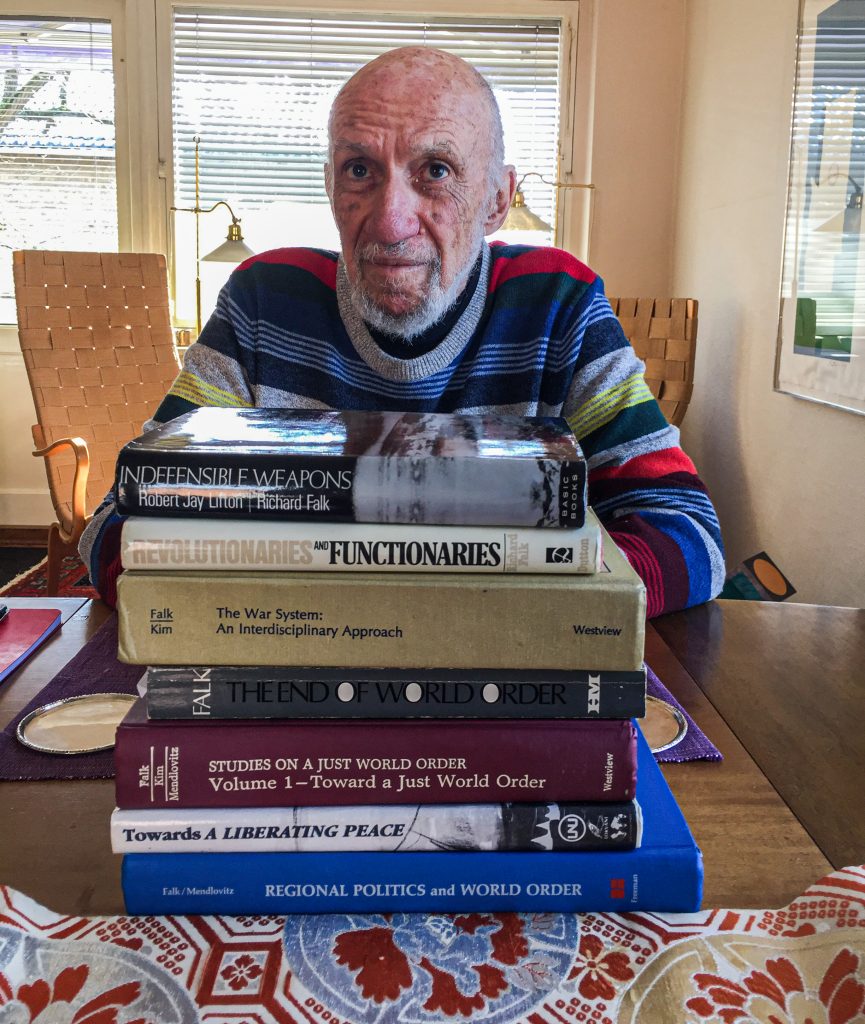
Professor emeritus, Richard Falk, has been a dear TFF Associate since 1986. We have published hundreds of articles by him at The Transnational. Learn more about his life-long academic and political work for a better, more peaceful and lawful, global community at his blog here.
Photo Jan Oberg
Please support TFF’s work for peace through research and public education. We are all-volunteer, people-financed and do not accept money from governments or corporations. In other words, one of the very last free research think tanks in this world – and for a noble purpose stated by the UN Charter: Peace by peaceful – intelligent – means. Thanks!


