October 9, 2019
There is currently a good deal of hysteria here in Washington about something called “authoritarianism” allegedly taking the offensive against democratic systems of government. A century ago, imperialists, colonialists, fascists and communists did indeed articulate theories about their superiority to democracy and seek to impose autocratic systems of government on others. In World War II and the Cold War, ideology played almost as large a role as geopolitics.
Originally posted on Consortium News on October 4, 2019 here
Today there are plenty of countries in the grips of autocratic regimes, but there are none propagandizing on behalf of autocracy or “authoritarianism.” The international appeal of authoritarian systems of government, if any, derives from the extent to which they deliver prosperity and domestic tranquility to their citizens. In the case of China, this is considerable – vastly superior so far to democratic India, for example. In the case of Russia, not so much.
Present-day systems of government in countries with authoritarian governments are specific to their birthplaces. They are not exportable. They have little in common with each other and, despite the way Americans lump them together, they don’t seem to feel a bond.
What is happening is not the advance of some sort of united front of the world’s many incompatible varieties of authoritarianism, but the retreat of representative democracy, constitutionalism, secularism, the rule of law, and the rule-bound international order. We are witnessing the erosion of systems built on the values of the European Enlightenment and implemented most radically here in the United States. The West disseminated these values and imposed them on the world over the past two centuries. They have been the foundation of global peace and development and remain the most widely accepted standards of good government.
As the Cold Peace that followed the Cold War ends in renewed hostility between great powers, it is not clear what values will shape a new world order, when and if one emerges. This is deeply disquieting – especially when one acknowledges the active role of the present U.S. administration in unraveling the world order American hegemony invented, sustained and managed throughout the last half of the last century.

Citizens’ Diminished Confidence
Democracy is contracting, not because it is under pressure from foreign foes, but because citizens in democratic countries have diminished confidence in it. They increasingly regard their elected leaders as incompetent, indecisive, self-serving, corrupt, contemptuous of them, and ineffectual or indifferent to their interests and needs. Dissatisfaction with what democratic governments now actually deliver to their citizens fuels “populism” and empowers demagoguery.
Resistance to ethnic and cultural change takes the form of phenomena like “white nationalism” and fury at “political correctness” that appears to privilege previously despised minorities over those previously favored. We are being reminded that populism has historically found its highest expression in various forms of ethno-cultural “fascism.” Disillusionment with democracy creates fissures that geopolitical adversaries inevitably exploit.
Given citizen disenchantment with democratic dysfunction, democracy advocates are at a clear disadvantage in making the case against non-democratic systems. It does not help that many democratic governments have deviated from their own constitutional traditions and entered various stages of constitutional crisis.
Three years ago, in the United Kingdom, direct democracy by referendum displaced parliamentary sovereignty in deciding which way to go on Brexit. Today, Prime Minister Boris Johnson’s effort to preempt further parliamentary involvement in determining Britain’s relationship with Europe or its place in a world of shifting power balances has thrown British politics into a dispiriting muddle.
U.S. Presidency Authorizing War
Meanwhile, in the United States, the checks and balances of the separation of powers and bill of rights no longer effectively constrain government. Despite the clear language of the U.S. constitution, the presidency has wrested the power to authorize wars of choice from the Congress. The current president has gone further than any before in arrogating congressional power to himself. Donald Trump has even managed in some respects to override the Congress’s power of the purse – its exclusive right to impose taxes, including tariffs, and to authorize or withhold the release of public funds for specific purposes, like building a wall on the Mexican border. These constitutional changes are no trivial matter. Consider their impact on war.
War is legalized murder. Its currency is men’s souls. No authoritarian leader abroad now has as much power to kill as many men and women in as many places or does so as the American president. A self-sustaining professional military relieves ordinary Americans of any connection to America’s wars other than that of spectators in a televised sport or employment by the military-industrial complex. This assures a high level of apathy that discourages public debate and frees the president to order and conduct wars as he wills for as long as he wants. As a result, America has become by far the most opposed of all the industrial democracies to rule-bound resolution of disputes. Washington habitually uses coercive measures, including warfare, to conduct its relations with foreign countries.
Similar trends toward the removal of longstanding checks and balances on the arbitrary exercise of state power are evident in non-democratic systems, including in regions of West Asia and North Africa. Impatience with the pace of change is removing the traditional constraints on government decision-making that both parliamentary democracies and shura-governed societies have relied upon to avoid erroneous policies. Authority is becoming concentrated in the hands of a very few, sometimes a single person. And it is increasingly intolerant of heterodox beliefs.

Secularism & Multilateralism Both Sinking
Secularism is the foundation of religious tolerance in Western society. Rejected by Pakistan and Israel after World War II and then by the Islamic revolution in Iran, it is now under overt attack in India, with Muslims the greatest losers from this. Demonstrative religiosity is gnawing away at tolerance in the United States. The conflation of Islam with terrorism has entrenched Islamophobia in much of the West. Judaism, Christianity, Islam and Hinduism alike all seem to be in the process of sponsoring violent prejudices against those of other faiths.
Due process is the conviction that it is not the outcome but the fairness of the way it is determined that legitimizes a decision and demands its acceptance. This has been the essential theory of justice in the West for at least three centuries. Due process fails when those making decisions exhibit conflicts of interest, corruption, amorality or prejudice. Voters now attribute government neglect of their needs and aspirations to these very moral failings on the part of their leaders.
With people increasingly doubting the integrity of democratic governance and the rule of law, conspiracy theories spread with the speed of dark. In this atmosphere, allegations of foreign influence in elections, as in the United States in 2016, produce hysteria that threatens to discredit the results of any and all electoral processes. This further erodes confidence in democracy.
Meanwhile, impatience with international dispute resolution mechanisms that cannot guarantee desired outcomes reinforces disdain for multilateralism, promotes unilateralism, and rationalizes actions based on the idea that might can make right. The growing lack of confidence in due process in the United States undermines the rule of law at home. It also facilitates the rejection of international law and the institutions that implement it abroad – the United Nations, the World Trade Organization, the multilateral development banks. These pillars of the world order represent signal American diplomatic achievements facilitated by U.S. global primacy. We are now learning that America’s maintenance of a liberal constitutional order at home is the prerequisite for its preservation of an open and cooperative order abroad.
Historic Trade Wars
In this context, the Trump trade wars mark an historic break with the past. The single world order formerly secured by the (mostly) benevolent hegemony of the United States is fracturing into multiple functional and regional architectures. It is becoming an open question whether, in the absence of a hegemon, a unified order of any kind can exist at either the global or regional levels.
In recent decades, the norm has been ever freer trade regulated by the market within parameters set by multilateral compacts and collegial dispute resolution mechanisms. The United States now seeks to replace this system and its rules with neo-mercantilism in the form of government-managed bilateral trade balances and dispute resolution through economic attacks on opponents. Supply chains have been the sinews of global economic growth based on comparative advantage. American politicians have now decided to treat them as leverage with which to punish or coerce trading partners. As Japan and south Korea are currently demonstrating, America’s deviation from past deference to rules and international comity is proving contagious.
Interdependence was once seen as a highly desirable way of stabilizing bilateral and coalition relationships and assuring market access. It is now viewed as a vulnerability. Countries are hedging against reliance on long-established trading and investment partners by diversifying and indigenizing their sources of imported commodities, technology, and services. As the unpredictability of U.S. and other nations’ policies increases, so do perceived risk and the volatility of capital and commodity markets. Expanding uncertainty causes businesses to defer investment decisions and consumers to delay purchases. This phenomenon is now visibly reducing economic efficiency and depressing growth across the globe.
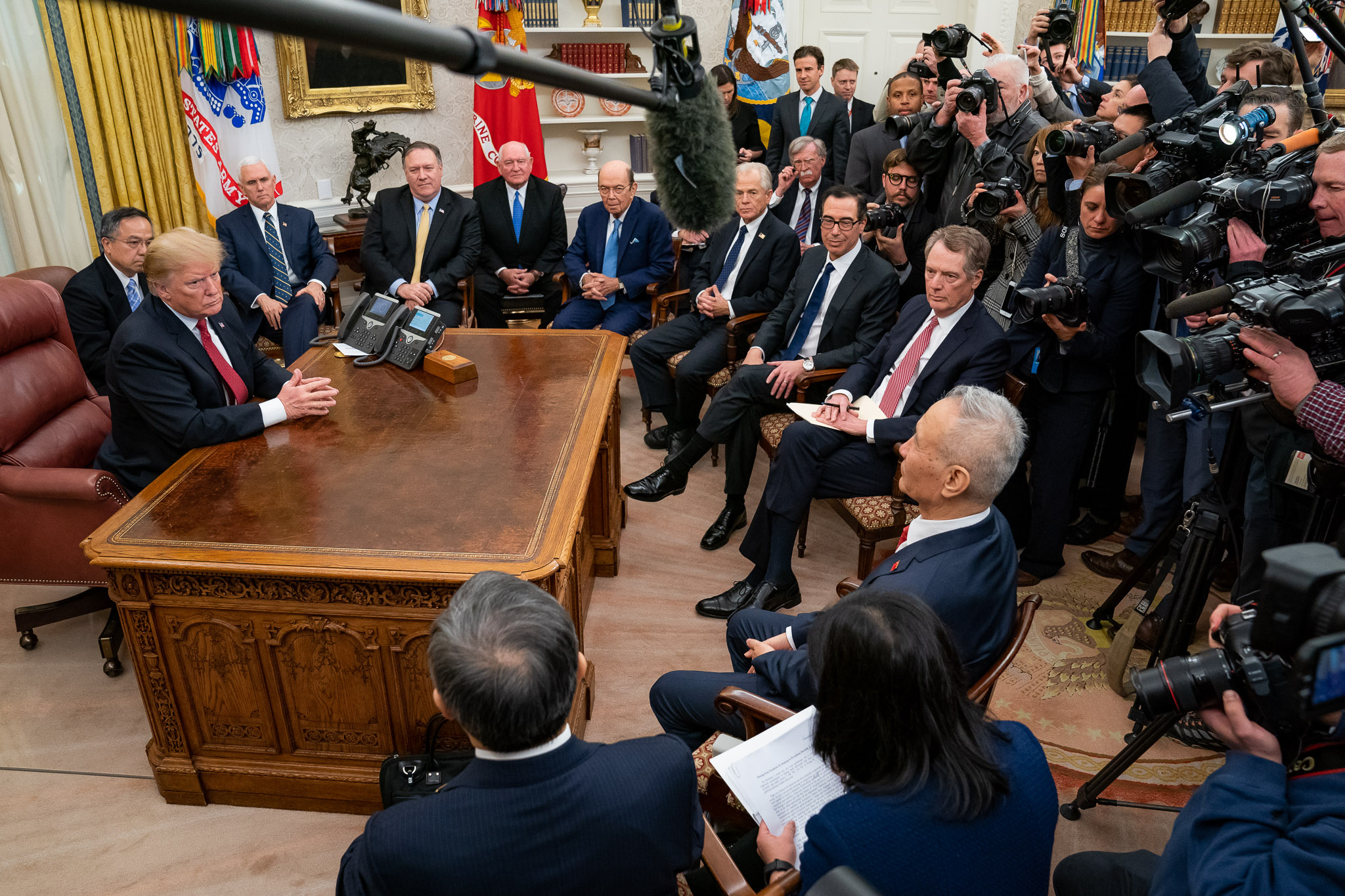
In addition to its sudden embrace of coercive protectionism, Washington has weaponized its currency to project American extraterritorial power. The United States now routinely uses its grip on the dollar – the de facto universal currency – to override the sovereignty of other governments by compelling them to comply with regime change projects or other policies they and their domestic publics oppose. This places politics instead of markets in command of economic transactions, devalues supplier reliability, and discourages continued reliance on imports of goods and services from the United States.
Declining Faith in Dollar
The dollar has long been the most convenient and secure currency in which to do business internationally. It gained this status as a result of the global dominance of the United States after World War II. The dollar retains its global supremacy in no small measure because oil and other commodities are still priced in it. But it is a fiat currency in which there is declining faith. Governments are coming to see transactions in dollars as risky. Quite aside from concerns about U.S. fiscal policy, transactions in the U.S. currency can be curtailed or punished by arbitrary and capricious decisions in Washington against which there is no recourse. Practices that all but their perpetrator find intolerable cannot last. Sooner or later they will be challenged and put to an end.
A search for ways to end dollar dominance of international transactions is now underway in a lengthening list of countries. Some look for the Chinese yuan to replace the dollar. But no nation – not even one as economically powerful as China – can hope to match the global dominance of the United States after World War II. Whatever replaces the dollar-based international monetary system will not be a national currency, but a patchwork of currency swaps or a global reference currency created by multilateral agreement.
In a world in which alliances are loosening or disintegrating and bilateral antagonisms are multiplying and deepening, government regulation of trade and investment increasingly reflects national security judgments rather than efforts to promote prosperity or efficiency. Some of these judgments verge on the paranoid. Controls on scientific exchange and technology transfers are tightening. Countries are banning or limiting foreign participation in ever more sectors of their economies. The United States is demanding that others align with it against Russia and, especially, China. The academy is being penetrated by gumshoes. There is more than a whiff of McCarthyism in the air.
For the most part, both individuals and countries want to do business with whomever can produce the best goods and services at the lowest cost and deliver them on the fastest and most reliable schedule. They do not want to subject their commercial choices to control by their security partners. But the American effort to rollback China’s global influence and confine the use of Chinese technology is dividing the world into at least two distinct technological ecosystems. The implications of this are potentially far-reaching.
Choosing Techno Realms
No country wants to be forced to choose between the United States and its actual or potential international rivals. The goal of most countries is to keep the bidding open. But as technology and standards diverge in a world divided by contention between great powers, it will become progressively harder for smaller economies to avoid deciding with which techno-realm they should align themselves. Each will embody its own set of interdependent economies, a dominant scientific educational system and language, and evolving standards that differentiate it from others.
If, as may be expected, countries opt for the zone in which their access to technology is least impeded by political posturing and export and travel controls, the realm in which China is preeminent could end up significantly larger than the American one. It is entirely possible that, within such “techno-realms,” Chinese and other tongues will increasingly compete effectively with English as the dominant language of science. That, in itself, would have a significant impact on world affairs.
Great and middle-ranking powers alike are substituting military confrontation and contention for the negotiation of differences with other countries. Rising tensions and concerns about national security are walling up science and technology in sub-global “techno-realms.” Again, the United States has led the trend. It has largely abandoned diplomacy in favor of the adoption of maximalist positions that ignore the interests of other parties, reject dialogue, lack negotiating strategies, threaten the use of force, and demand unconditional surrender. The result is escalating confrontation between America and a growing list of other countries. So far, this approach has produced no agreed adjustments in relations. America’s wars and those of its major security partners like Israel and Saudi Arabia no longer have fixed or feasible objectives or terms for their termination, so they never end.
Explosive Arms Growth
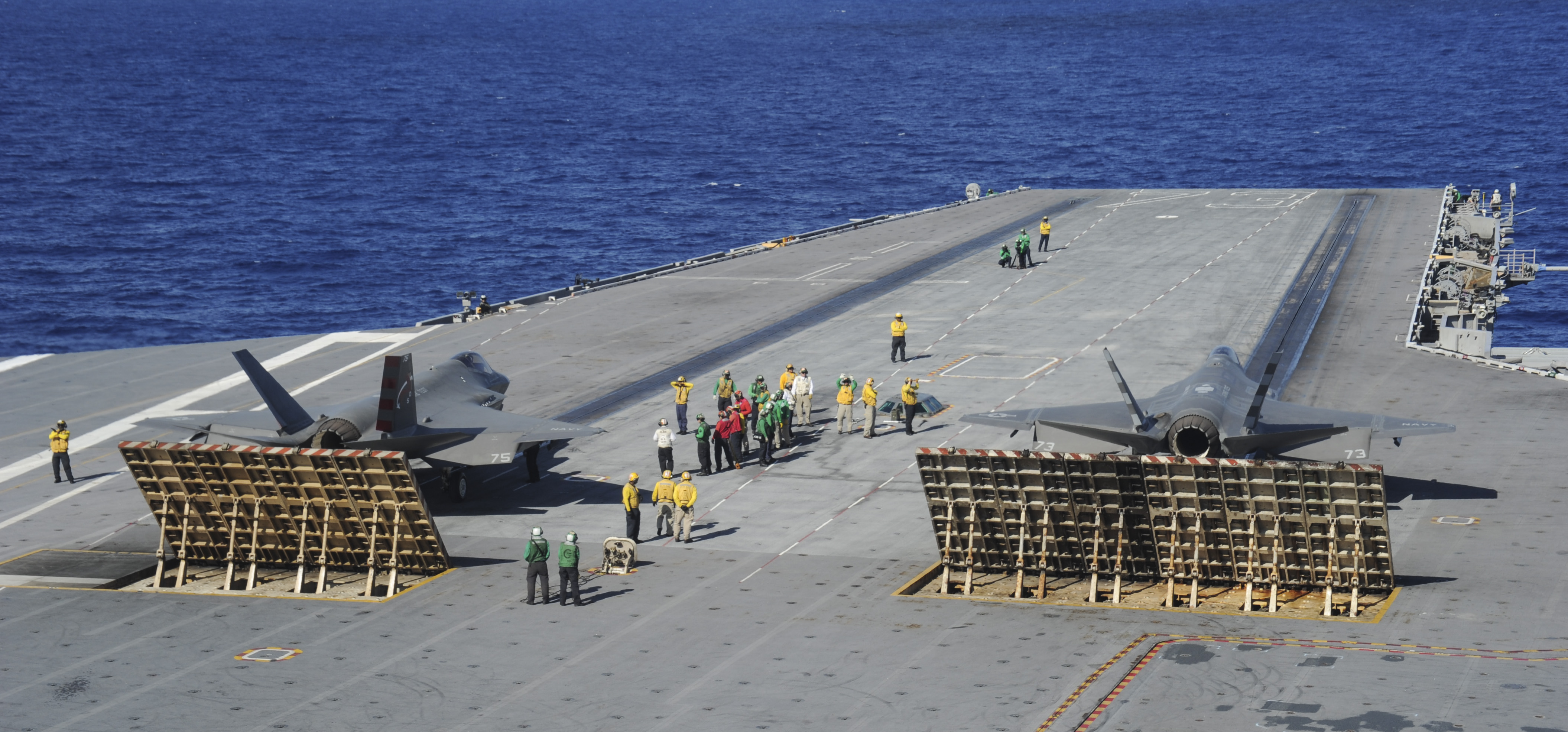
In military terms, the United States retains unchallenged offensive power. Other great powers may be improving their ability to defend themselves against attack by the United States, but they lack the capacity to take the offensive against it. Russia retains a nuclear deterrent sized to extinguish all life on this planet. China has a credible ability to conduct a devastating nuclear counterattack on the continental U.S. as well as to destroy U.S. bases in Asia. In the age of regime change wars, some smaller countries, like north Korea, have concluded that the only effective guarantee of their security is acquisition of a nuclear deterrent. Many suspect that Iran has come or will come to the same conclusion. If so, others in the region will also seek to acquire nuclear deterrents. India and Pakistan are already at nuclear daggers drawn. The risk that nuclear weapons could be used to decide the outcome of a desperate conflict is growing.
The unique ability of the United States to project power throughout the globe has led many countries to seek American protection against more powerful or bellicose neighbors. It has caused others to arm themselves against possible American attack. As American reliability has come into question, those countries reliant on U.S. protection have stepped up their efforts to bolster their own defense capabilities, while those who feel threatened have done the same. The result is the rebirth of arms races and explosive growth in the international trade in arms.
Meanwhile, many abroad see American statecraft as increasingly erratic, self-centered, and rash. This is provoking reconsideration by U.S. allies of the costs and benefits of military dependence on the United States. Alliances are broad commitments to mutual aid. Those contracted by the United States during the Cold War are evolving toward the narrow and conditional partnerships characteristic of entente (diplomatic jargon for a limited commitment for limited purposes, perhaps for a limited time). In these circumstances, even a substantial military presence in any given region or country no longer assures the United States decisive political or economic influence there.
Washington’s disparagement of the European Union and European NATO members has strained Euro-American solidarity. Brexit, when and if it takes place, will add to the strain. U.S. schizophrenia about Russia, with the president enamored of its leader and Congress determined to confront and isolate it, is a less visible but real threat to transatlantic politico-military unity and cooperation. Differences over how to deal with Iran’s nuclear program continue to fester. Europeans do not share the American obsession with the rise of China and do not agree with Washington’s something-for-nothing appeasement of Israel.
U.S. bilateral defense cooperation with key allies is deteriorating. Turkey is disengaging from America, looking away from Europe, and redefining itself as a mainly Middle Eastern power with independent ties to Russia. Japan remains committed to the framework of its post-occupation alliance with the United States but is beginning to act outside it, courting Russia and exploring accommodation with China. Japan’s US-brokered defense cooperation with south Korea is breaking down. Meanwhile, the abiding U.S. preference for military rather than political approaches to defanging north Korea has strained relations between Washington and Seoul. The Philippines has substituted appeasement of China for a role in American confrontation with it. Australia is struggling to find a secure place for itself in an increasingly Sino-centric Asia.
In the Middle East, Israel, Saudi Arabia, the U.A.E., and Egypt no longer follow American guidance but act on their own independent judgments of their national interests and are working to diversify their international relationships. India remains determinedly non-aligned even as it seeks to exploit American interest in recruiting it as an ally. The United States has officially decided that China and Russia are enemies.
In short, politically, economically, and militarily a great deal is in motion. Broken at the top, a new world order is being invented from the bottom up by people who are immersed in the artificial universes that the information-entertainment industry, social media, and political spin-doctors create. Knowledge of current events now arrives via media that reinforce rather than challenge prejudices. It is hard to think clearly about what’s happening and what it means when news of it arrives accompanied by “politically correct” interpretations designed to appeal to established narratives and exclude uncongenial interpretations. “Alternative facts” trump real ones.
Summing It Up
If current trends continue, the world of the future seems likely to be one in which:
- Both governments and surveillance capitalist corporations will enhance their ability to monitor and manipulate the societies in which they operate and those with which they compete. International cyber-attacks will grow in both frequency and severity.
- The domestic and international eclipse of Western values will lead to a reduction in transnational advocacy of human rights, as Europe pursues the benefits of expanded economic relations with China, India, Indonesia, and other rising non-Western powers and joins the Trump administration in downgrading the importance it assigns to the promotion of democratic constitutionalism.
- There will be little, if any, recovery of markets lost in the current trade wars. Apparently temporary shifts in trade patterns will persist. Nations will strive to diversify markets and suppliers to minimize vulnerability to politically dictated interruptions of supply and demand.
- Some regional blocs will lose members or break up entirely. The GCC and EU are currently endangered by internal disagreements. NAFTA has been weakened. NATO may be in the process of being flanked by European defense initiatives that could divide it. Differences over how to deal with Sino-American rivalry threaten the unity of ASEAN.
- Competing “techno-realms” have begun to divide the world between them. Incompatible technological standards and systems will take root in the countries affiliated with these realms. Huawei and 5G are just the beginning of this partitioning process. Scientific collaboration will be increasingly deglobalized and limited to interaction within compatible transnational communities. Competition between “techno-realms” will speed the development of technology but slow its global diffusion.
- Functional and regional institutions created by sub-global national communities will increasingly displace 20thcentury global institutions like the United Nations, the World Trade Organization, the IMF, the World Bank, and so forth. We see this already in the growing role of regional groupings like the Organization for Islamic Cooperation, the Comprehensive and Progressive Agreement for Trans-Pacific Partnership, the New Development Bank, and the Asian Infrastructure Investment Bank, to cite just a few examples.
- The devolution of collective decision-making and capabilities to the sub-global level will reduce capacity to coordinate or muster worldwide responses to issues like global warming, sea level rise, nuclear proliferation, the need to enforce existing precepts of international law or for standard setting.
- Shifting patterns of competition and cooperation between the political economies of nations and trading blocs will replace long-term bilateral commitments. Spot markets and multinational intra-company transfers will increasingly supplant both supply chains and long-term contracts for trade in commodities like oil. (Saudi Aramco is wise to be securing markets by acquiring refineries abroad.)
- As the global role of the dollar declines, currency risk will rise. New capital markets will be established to enable financial transactions to take place without the involvement of traditional financial centers like New York.
- Longstanding bilateral alliance relationships will decay. Some will disappear, to be succeeded by a mixture of rivalry on some issues and cooperation on others. So-called “special relationships” – whether in Europe, the Middle East, or East Asia – will attenuate and be replaced by a much heavier reliance on transactionalism. No U.S. relationships will be exempt from change, including those with the United Kin