Measuring humanity's undoubted progress

“Lies, damn lies and statistics”. “You can bend any fact with statistics”. There is some truth in that. Nevertheless, some statistics are necessary, revealing and surprising.

Many of us when asked about the position of the poor in America would say that over the last two centuries they have made little progress. But look at the statistics, look at the data.

True, many are living in slums and ghettos but today they have indoor plumbing, heating, electricity, smallpox and tuberculosis-free lives, adequate nutrition, much lower child and maternal mortality, doubled life expectancy, increasingly sophisticated medical attention, the availability of contraception, secondary level schooling for their children, buses, trains, cars and bicycles, much less racial prejudice, longer retirement, a rising quality of the goods they buy, better working conditions and the vote.

Once these were luxuries that only the richer could experience.

For Europe, Canada and Japan it is the same, even if poverty is not so deep-rooted. In recent years this is the experience of most of Latin America although 20% still live in real poverty.

In the Middle East too (including Iraq and Syria before their wars). In China, India, Pakistan, Sri Lanka, South East Asia and North Africa there has been good progress.

In Africa, less so, but a number of countries are getting there – South Africa, Nigeria, Ivory Coast, Ghana, Senegal, Rwanda, Gabon, Ethiopia, Tanzania, Uganda and Kenya.

The author of “Bourgeois Equality”, Deirdre McCloskey, has called this “The Great Enrichment”.

The very poorest, living on incomes of less than $2 a day, have experienced some of this but not that much, but they are a fast decreasing breed. Over the 20 years from 1993 the number of very poor people fell by over 1 billion.

Between 1990 and 2010 the percentage of children who died before their fifth birthday dropped by almost one half. The biggest declines were in India and China during the time of Prime Minister Manmohan Singh and President Hu Jintao.

According to The Economist the average person among the very poorest lives on $1.33 a day. It would take only $.0.57 per person to abolish extreme poverty. This would cost only $78 billion a year, less than 0.1% of Global GDP.

Indeed, there is an argument for giving the abolition of the worst poverty priority over funding the combating of global warming. It’s a much, much cheaper cause than what is being estimated as necessary for stalling global warming.

Present projections estimate that the world should spend 2.5 trillion US dollars each year on the energy issue, overwhelmingly targeted on renewables. It is also a more urgent cause because people are suffering right now whereas global warming’s severe impact will not come about for another ten to twenty years.

Of course we should do both.

The resources are there- locked up in arms’ budgets. If the justification of military expenditure is “defence” then isn’t the priority of “defence” the defence of the very lives of the poorest and the defence of our planet?

Despite popular belief, the world has become a more equal place since the global financial crisis that began eleven years ago. The growth of Brazil, India and China has led to the biggest decrease in inequality since the Industrial Revolution began in Britain.

The world has also become a less violent place. There have never been so few wars as since the end of the Cold War. According to Stephen Pinker’s magisterial study of 2011, “The Better Angels of Our Nature”, the worldwide rate of death from war has fallen from 300 per 100,000 people during World War 2 to single digits in the 1970s and 80s to less than 1 in this century.

Sixty per cent of the world is now democratic (in 1940 you could count the number on both hands). The democracies almost never go to war with each other. UN peacekeeping operations have exploded in number, bringing much success.

Under both Presidents Barack Obama and Donald Trump, as Syria has shown, the US, the world’s superpower, is becoming skittish about getting into wars and the tendency is when in to pull out.

Murder and crime rates have fallen precipitously. Poor people are the ones disproportionately hurt by crime. The European murder rate has fallen 35 fold since the Middle Ages.

Though between the 1970s and 80s homicide rates climbed back up from their historic lows, reversing the progress made since the late 19th century, they have fallen sharply in the 21st century in 75 countries. Violent crime has dropped particularly sharply in the developed world.

This is not because of increased incarceration. Police tactics have markedly improved. DNA testing has enabled criminals to be tracked down more easily. Abortion is more widely available and thus the number of children born to drug addicts, drunks and single mothers who cannot cope, and thus are more likely to turn to crime, has shrunk significantly.

Not least a factor is the abolition of lead in petrol (gasoline) in 175 countries. Lead exposure damages people’s brains. The parts of the brain damaged by lead are the same ones that check people’s aggressive impulses. Crime shot up in the mid to late 20th century as cars and lorries spread around the world.

Surrounded still by poverty, environmental degradation, injustice, the talk of war and the fear of crime we tend to believe the worst.

The media with its focus on disaster does not help. But the statistics and the facts reveal another story.

That should gives us the strength and the hope to fight on.

We can make the world an even better place.

Foreign affairs columnist, film-maker and author

Share

Leave a Reply

Your email address will not be published. Required fields are marked *

Related Posts

The MIMAC – Military-Industrial-Media-Academic Complex – drives the world’s rampant militarism and wars without end. Here is a short reflection of how it works against all interests of humanity. #5 deals with why there is no real enemy or threat images/analysis. It’s all ex-post constructions. And, btw, theTFF Peace Pulse is now on Rumble.
Jan Oberg, TFF director April 28, 2026 In this third TFF Peace Pulse, I make the important distinction between the violence and the conflict that violence is a symptom of. If you want peace, focus on the underlying conflict because that is the key to resolution, peacemaking, and a better future for the parties. The West is obsessed with violence, just look around you – and 90+ per cent of the public debate is about military issues and other violence – totally wasted for peace. These Peace Pulses will only be published here a few times. You will also not find them on YouTube and Vimeo because both platforms have blocked TFF and me; you know, peace is dangerous these days. Most TFF’s videos since 2007 are now on Rumble.
In contrast to most, we’ll bring alternatives, solutions, hope and strategies for a better future. Times are dangerous, yes, but that only intensifies the need for constructive thinking and action! Jan Oberg, TFF director April 13, 2026 The new TFF Peace Pulse uses video messages in a new way: Max 3-5-minute-long comments, ideas or perhaps mini-lectures, all about peace – positive peace. We launch them today on April 13, 2026 with a carefully crafted visual aesthetic fitting the content. We hope to publish them regularly from now on. We launch Peace Pulse (PP) – for a number of reasons. The world is in chaos, and there are countless reasons to feel concerned, frustrated, even angry. The atmosphere is saturated with doom and gloom, with negative energy and rear‑mirror thinking, while vision, imagination, alternatives, strategies and genuine future‑mindedness remain in short supply. And without them, we simply can’t save the world. Looking at problems from a hundred angles will...

Recent Articles

Jan Oberg May 15, 2026 Go to this Fox News page and scroll the whole way down: President Donald Trump tells the world that his meeting with President Xi Jinping yielded a lot of very concrete political and economic results – of course, only where the Chinese side, according to him, agreed with him. He does not mention the Taiwan issue, but Secretary of State, Marco Rubio, says that it did not feature prominently in their talks and that the US policy on Taiwan has not changed. Then go to China Daily – or Global Times – and you will see that for the Chinese it is framework, principles, structure of cooperation etc. that matters – all embedded in the overall idea of “constructive bilateral relationship of strategic stability.” Nowhere is any concrete agreement or deal – all that Trump refers to – mentioned. At the general level, this gives you insights into the very different social...
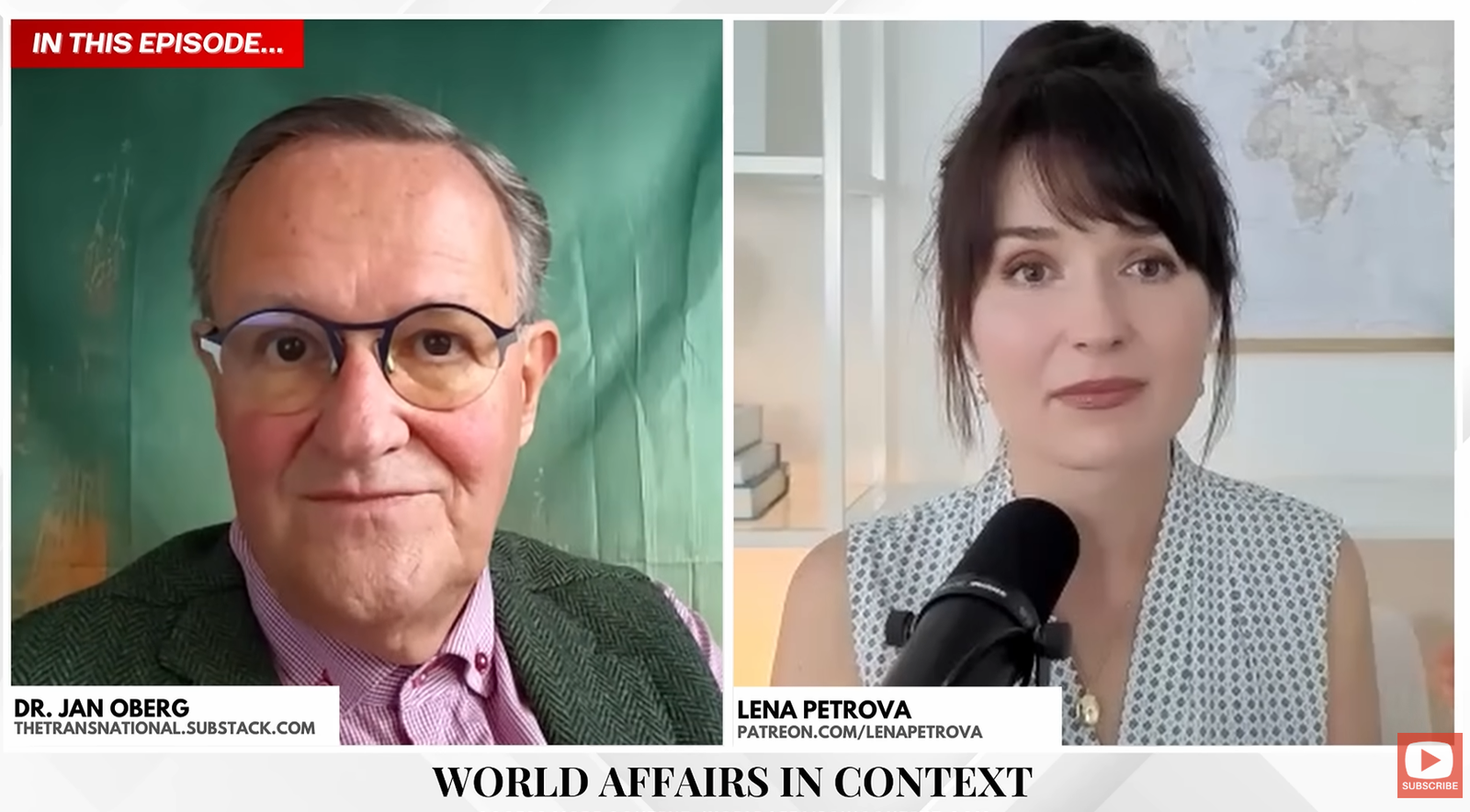
Lena Petrova of “World Affairs In Context” with more than half a million subscribers on YouTube wanted to explore what a peace researcher like me has to say about, among other things, the First and the Second Cold War and why eethics has disappeared from politics. I am particularly happy about this conversation that also yielded an amazing number of very appreciative comments on YouTube. No doubt, people are longing for alternatives, including peace perspectives.
The MIMAC – Military-Industrial-Media-Academic Complex – drives the world’s rampant militarism and wars without end. Here is a short reflection of how it works against all interests of humanity. #5 deals with why there is no real enemy or threat images/analysis. It’s all ex-post constructions. And, btw, theTFF Peace Pulse is now on Rumble.

TFF on Substack

Discover more from TFF Transnational Foundation & Jan Oberg.

Most Popular

Jan Oberg May 15, 2026 Go to this Fox News page and scroll the whole way down: President Donald Trump tells the world that his meeting with President Xi Jinping yielded a lot of very concrete political and economic results – of course, only where the Chinese side, according to him, agreed with him. He does not mention the Taiwan issue, but Secretary of State, Marco Rubio, says that it did not feature prominently in their talks and that the US policy on Taiwan has not changed. Then go to China Daily – or Global Times – and you will see that for the Chinese it is framework, principles, structure of cooperation etc. that matters – all embedded in the overall idea of “constructive bilateral relationship of strategic stability.” Nowhere is any concrete agreement or deal – all that Trump refers to – mentioned. At the general level, this gives you insights into the very different social...
Lena Petrova of “World Affairs In Context” with more than half a million subscribers on YouTube wanted to explore what a peace researcher like me has to say about, among other things, the First and the Second Cold War and why eethics has disappeared from politics. I am particularly happy about this conversation that also yielded an amazing number of very appreciative comments on YouTube. No doubt, people are longing for alternatives, including peace perspectives.
The MIMAC – Military-Industrial-Media-Academic Complex – drives the world’s rampant militarism and wars without end. Here is a short reflection of how it works against all interests of humanity. #5 deals with why there is no real enemy or threat images/analysis. It’s all ex-post constructions. And, btw, theTFF Peace Pulse is now on Rumble.
Read More
Screenshot-2026-05-15-103534
Jan Oberg May 15, 2026 Go to this Fox News page and scroll the whole way down: President Donald Trump tells the world that his meeting with President Xi Jinping yielded a lot of very concrete political and economic results – of course, only where the Chinese side, according to him, agreed with him. He does not mention the Taiwan issue, but Secretary of State, Marco Rubio, says that it did not feature prominently in their talks and that the US policy on Taiwan has not changed. Then go to China Daily – or Global Times – and you will see that for the Chinese it is framework, principles, structure of cooperation etc. that matters – all embedded in the overall idea of “constructive bilateral relationship of strategic stability.” Nowhere is any concrete agreement or deal – all that Trump refers to – mentioned. At the general level, this gives you insights into the very different social...
Screenshot-2026-05-12-104023
Lena Petrova of “World Affairs In Context” with more than half a million subscribers on YouTube wanted to explore what a peace researcher like me has to say about, among other things, the First and the Second Cold War and why eethics has disappeared from politics. I am particularly happy about this conversation that also yielded an amazing number of very appreciative comments on YouTube. No doubt, people are longing for alternatives, including peace perspectives.
Screenshot-2026-04-13-154551 (2)
The MIMAC – Military-Industrial-Media-Academic Complex – drives the world’s rampant militarism and wars without end. Here is a short reflection of how it works against all interests of humanity. #5 deals with why there is no real enemy or threat images/analysis. It’s all ex-post constructions. And, btw, theTFF Peace Pulse is now on Rumble.
Screenshot-2026-04-13-154551 (1)
Jan Oberg, TFF director April 28, 2026 In this third TFF Peace Pulse, I make the important distinction between the violence and the conflict that violence is a symptom of. If you want peace, focus on the underlying conflict because that is the key to resolution, peacemaking, and a better future for the parties. The West is obsessed with violence, just look around you – and 90+ per cent of the public debate is about military issues and other violence – totally wasted for peace. These Peace Pulses will only be published here a few times. You will also not find them on YouTube and Vimeo because both platforms have blocked TFF and me; you know, peace is dangerous these days. Most TFF’s videos since 2007 are now on Rumble.
Screenshot-2026-04-13-154551
In contrast to most, we’ll bring alternatives, solutions, hope and strategies for a better future. Times are dangerous, yes, but that only intensifies the need for constructive thinking and action! Jan Oberg, TFF director April 13, 2026 The new TFF Peace Pulse uses video messages in a new way: Max 3-5-minute-long comments, ideas or perhaps mini-lectures, all about peace – positive peace. We launch them today on April 13, 2026 with a carefully crafted visual aesthetic fitting the content. We hope to publish them regularly from now on. We launch Peace Pulse (PP) – for a number of reasons. The world is in chaos, and there are countless reasons to feel concerned, frustrated, even angry. The atmosphere is saturated with doom and gloom, with negative energy and rear‑mirror thinking, while vision, imagination, alternatives, strategies and genuine future‑mindedness remain in short supply. And without them, we simply can’t save the world. Looking at problems from a hundred angles will...
IMG_5165 (1)
PART II — Publishing Peace in a System That Prioritises Militarism Jan Oberg, TFF director April 10, 2026 How TFF Maintains a Daily Voice in a Digital World Built for Noise This article is part of the series “TFF at 40″ and it invites you to learn about Four Decades of Publishing Peace. It takes a look at how a small, people‑financed peace foundation has communicated across four generations of technology — from wax stencils and fax machines to mass email and Substack — and why TFF continues to publish every single day in a system that rewards noise, conflict, and militarism. ◆ What it means to publish peace every single day in a digital system built for 24/7 news and other noise, confrontation, and militarism. How TFF’s independence, continuity, and global readership defy algorithms, donor cycles, and Western media censorhip — and why the Majority World keeps listening. When the...