Making the world more equal

Maybe, after all, there is an argument for saying that the world needs more violence not less if we are to make its societies more equal. This is one conclusion one can derive from Walter Scheidel’s new book, The Great Leveler.

He starts from what we all know by now: the richest 62 persons in the world own as much net wealth as the poorer half of humanity. This is the number that could fit inside a London double-decker bus.

This inequality appears to get worse by the year, although if we go back to 1929 it was then about the same. Two thousand years ago in Roman times the richest had fortunes about 1.5 million times that of the average citizen, roughly the same ratio as Bill Gates and the average American.

Plato, writing in the fourth century BC, was vexed by the fact “there were not one but two states, the one of the poor, and the other of rich men”. Later Jesus, took up similar themes, as the pope does today. There can be no justification in Christianity, Islam, Buddhism or Judaism for concentrated personnel wealth and the continuous ill-being of the poor.

Any member of these faiths who justifies their wealth is de facto an apostate.

Scheidel’s case is that nothing changes without a great shock. The Black Death was one. It wiped out so many laborers that landlords in order to attract workers had to raise wages quite substantially.

Surprisingly, wars are no great levelers except in specific circumstances. Until the time of the First World War fighting was geographically localized. It didn’t penetrate deep into society.

On the other hand, World War 2, which involved much of British society, forced the hand of the wealthier classes and they had to go along with the social reforms, including universal health care, that a Labor government introduced as a “pay back” to the rank and file soldiers who had born the brunt of the fighting.

Going back over the centuries, peasant revolts and civil wars contributed little to leveling. Neither did the French Revolution.

The Communist-led land reform in China was an exception. But Mao Zedong’s revolution was overturned by Deng Xiaoping and a great leveling process ended. It had only come into being because of the deep-rooted revolution. It worked best when it was associated with violence or the threat of violence.

So what about non-violent movements? The only sure evidence of achieving leveling without violence is the path most of Latin America took in the early 2000s. But this has been fairly modest in scope. Will it be sustained?

In Brazil the legacy of President Lula da Silva of the Workers’ Party is now threatened by the right wing new president, Jair Bolsonaro. In Mexico, however, the new socialist president is likely to push reform forward.

Today in the post Cold War world we see that unions have been tamed in the US and UK, top tax rates have been raised in some countries and globalization is hurting ill-trained workers. Inequality is worsening. The Cold War wasn’t a war that penetrated deep into our social institutions.

With the end of communism, Russia, China and Eastern Europe have all become much more unequal societies; in Russia and China, grossly so.

One hopeful myth should be queried: By and large the introduction of democracy on its own hasn’t produced more equal societies, although because it has encouraged economic growth it has helped improve the wages, education, health and welfare of the poorer classes.

Does it matter if the world has inequality? It does. Study after study, including those published by the International Monetary Fund and the World Bank, have demonstrated that inequality holds back economic growth.  

But what can be done? The era of mass mobilization is over. Very few of us want to see bloody revolutions and the likes of Robespierre, Mao or Guevara. As Thomas Piketty and Steven Pinker have proved in recent books the world is becoming a less violent place.

The probability of death from violent causes has been declining for centuries. Ageing societies- Europe, Russia, Japan and China- are likely to become less violent as older people are less tolerant of it or less drawn to it as a political solution.

The answer to this question, writes Scheidel, is not much. In the future “It will be a challenge for the social democracies of continental Europe to maintain and adjust elaborate systems of high taxation and extensive redistribution or for the richest democracies of Asia to preserve their unusually equitable allocation of pretax incomes to stem the rising tide of inequality, which can only grow stronger as globalization and unprecedented demographic transitions add to the pressure”.

Throughout history most attempts to improve income equality have only brought forth sorrow. We should be careful what we wish for.

Foreign affairs columnist, film-maker and author

Share

Leave a Reply

Your email address will not be published. Required fields are marked *

Related Posts

The MIMAC – Military-Industrial-Media-Academic Complex – drives the world’s rampant militarism and wars without end. Here is a short reflection of how it works against all interests of humanity. #5 deals with why there is no real enemy or threat images/analysis. It’s all ex-post constructions. And, btw, theTFF Peace Pulse is now on Rumble.
Jan Oberg, TFF director April 28, 2026 In this third TFF Peace Pulse, I make the important distinction between the violence and the conflict that violence is a symptom of. If you want peace, focus on the underlying conflict because that is the key to resolution, peacemaking, and a better future for the parties. The West is obsessed with violence, just look around you – and 90+ per cent of the public debate is about military issues and other violence – totally wasted for peace. These Peace Pulses will only be published here a few times. You will also not find them on YouTube and Vimeo because both platforms have blocked TFF and me; you know, peace is dangerous these days. Most TFF’s videos since 2007 are now on Rumble.
In contrast to most, we’ll bring alternatives, solutions, hope and strategies for a better future. Times are dangerous, yes, but that only intensifies the need for constructive thinking and action! Jan Oberg, TFF director April 13, 2026 The new TFF Peace Pulse uses video messages in a new way: Max 3-5-minute-long comments, ideas or perhaps mini-lectures, all about peace – positive peace. We launch them today on April 13, 2026 with a carefully crafted visual aesthetic fitting the content. We hope to publish them regularly from now on. We launch Peace Pulse (PP) – for a number of reasons. The world is in chaos, and there are countless reasons to feel concerned, frustrated, even angry. The atmosphere is saturated with doom and gloom, with negative energy and rear‑mirror thinking, while vision, imagination, alternatives, strategies and genuine future‑mindedness remain in short supply. And without them, we simply can’t save the world. Looking at problems from a hundred angles will...

Recent Articles

Jan Oberg May 15, 2026 Go to this Fox News page and scroll the whole way down: President Donald Trump tells the world that his meeting with President Xi Jinping yielded a lot of very concrete political and economic results – of course, only where the Chinese side, according to him, agreed with him. He does not mention the Taiwan issue, but Secretary of State, Marco Rubio, says that it did not feature prominently in their talks and that the US policy on Taiwan has not changed. Then go to China Daily – or Global Times – and you will see that for the Chinese it is framework, principles, structure of cooperation etc. that matters – all embedded in the overall idea of “constructive bilateral relationship of strategic stability.” Nowhere is any concrete agreement or deal – all that Trump refers to – mentioned. At the general level, this gives you insights into the very different social...
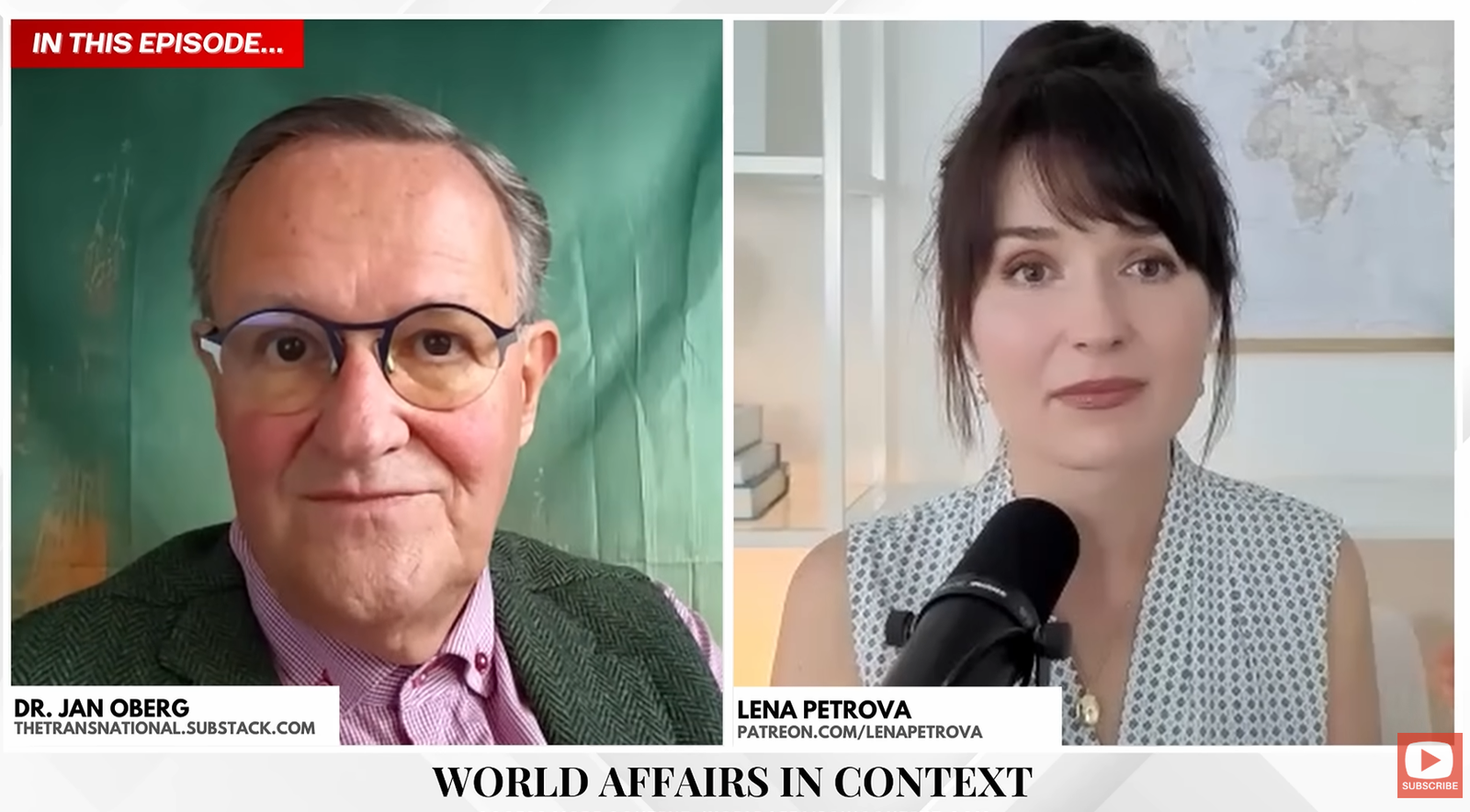
Lena Petrova of “World Affairs In Context” with more than half a million subscribers on YouTube wanted to explore what a peace researcher like me has to say about, among other things, the First and the Second Cold War and why eethics has disappeared from politics. I am particularly happy about this conversation that also yielded an amazing number of very appreciative comments on YouTube. No doubt, people are longing for alternatives, including peace perspectives.
The MIMAC – Military-Industrial-Media-Academic Complex – drives the world’s rampant militarism and wars without end. Here is a short reflection of how it works against all interests of humanity. #5 deals with why there is no real enemy or threat images/analysis. It’s all ex-post constructions. And, btw, theTFF Peace Pulse is now on Rumble.

TFF on Substack

Discover more from TFF Transnational Foundation & Jan Oberg.

Most Popular

Jan Oberg May 15, 2026 Go to this Fox News page and scroll the whole way down: President Donald Trump tells the world that his meeting with President Xi Jinping yielded a lot of very concrete political and economic results – of course, only where the Chinese side, according to him, agreed with him. He does not mention the Taiwan issue, but Secretary of State, Marco Rubio, says that it did not feature prominently in their talks and that the US policy on Taiwan has not changed. Then go to China Daily – or Global Times – and you will see that for the Chinese it is framework, principles, structure of cooperation etc. that matters – all embedded in the overall idea of “constructive bilateral relationship of strategic stability.” Nowhere is any concrete agreement or deal – all that Trump refers to – mentioned. At the general level, this gives you insights into the very different social...
Lena Petrova of “World Affairs In Context” with more than half a million subscribers on YouTube wanted to explore what a peace researcher like me has to say about, among other things, the First and the Second Cold War and why eethics has disappeared from politics. I am particularly happy about this conversation that also yielded an amazing number of very appreciative comments on YouTube. No doubt, people are longing for alternatives, including peace perspectives.
The MIMAC – Military-Industrial-Media-Academic Complex – drives the world’s rampant militarism and wars without end. Here is a short reflection of how it works against all interests of humanity. #5 deals with why there is no real enemy or threat images/analysis. It’s all ex-post constructions. And, btw, theTFF Peace Pulse is now on Rumble.
Read More
Screenshot-2026-05-15-103534
Jan Oberg May 15, 2026 Go to this Fox News page and scroll the whole way down: President Donald Trump tells the world that his meeting with President Xi Jinping yielded a lot of very concrete political and economic results – of course, only where the Chinese side, according to him, agreed with him. He does not mention the Taiwan issue, but Secretary of State, Marco Rubio, says that it did not feature prominently in their talks and that the US policy on Taiwan has not changed. Then go to China Daily – or Global Times – and you will see that for the Chinese it is framework, principles, structure of cooperation etc. that matters – all embedded in the overall idea of “constructive bilateral relationship of strategic stability.” Nowhere is any concrete agreement or deal – all that Trump refers to – mentioned. At the general level, this gives you insights into the very different social...
Screenshot-2026-05-12-104023
Lena Petrova of “World Affairs In Context” with more than half a million subscribers on YouTube wanted to explore what a peace researcher like me has to say about, among other things, the First and the Second Cold War and why eethics has disappeared from politics. I am particularly happy about this conversation that also yielded an amazing number of very appreciative comments on YouTube. No doubt, people are longing for alternatives, including peace perspectives.
Screenshot-2026-04-13-154551 (2)
The MIMAC – Military-Industrial-Media-Academic Complex – drives the world’s rampant militarism and wars without end. Here is a short reflection of how it works against all interests of humanity. #5 deals with why there is no real enemy or threat images/analysis. It’s all ex-post constructions. And, btw, theTFF Peace Pulse is now on Rumble.
Screenshot-2026-04-13-154551 (1)
Jan Oberg, TFF director April 28, 2026 In this third TFF Peace Pulse, I make the important distinction between the violence and the conflict that violence is a symptom of. If you want peace, focus on the underlying conflict because that is the key to resolution, peacemaking, and a better future for the parties. The West is obsessed with violence, just look around you – and 90+ per cent of the public debate is about military issues and other violence – totally wasted for peace. These Peace Pulses will only be published here a few times. You will also not find them on YouTube and Vimeo because both platforms have blocked TFF and me; you know, peace is dangerous these days. Most TFF’s videos since 2007 are now on Rumble.
Screenshot-2026-04-13-154551
In contrast to most, we’ll bring alternatives, solutions, hope and strategies for a better future. Times are dangerous, yes, but that only intensifies the need for constructive thinking and action! Jan Oberg, TFF director April 13, 2026 The new TFF Peace Pulse uses video messages in a new way: Max 3-5-minute-long comments, ideas or perhaps mini-lectures, all about peace – positive peace. We launch them today on April 13, 2026 with a carefully crafted visual aesthetic fitting the content. We hope to publish them regularly from now on. We launch Peace Pulse (PP) – for a number of reasons. The world is in chaos, and there are countless reasons to feel concerned, frustrated, even angry. The atmosphere is saturated with doom and gloom, with negative energy and rear‑mirror thinking, while vision, imagination, alternatives, strategies and genuine future‑mindedness remain in short supply. And without them, we simply can’t save the world. Looking at problems from a hundred angles will...
IMG_5165 (1)
PART II — Publishing Peace in a System That Prioritises Militarism Jan Oberg, TFF director April 10, 2026 How TFF Maintains a Daily Voice in a Digital World Built for Noise This article is part of the series “TFF at 40″ and it invites you to learn about Four Decades of Publishing Peace. It takes a look at how a small, people‑financed peace foundation has communicated across four generations of technology — from wax stencils and fax machines to mass email and Substack — and why TFF continues to publish every single day in a system that rewards noise, conflict, and militarism. ◆ What it means to publish peace every single day in a digital system built for 24/7 news and other noise, confrontation, and militarism. How TFF’s independence, continuity, and global readership defy algorithms, donor cycles, and Western media censorhip — and why the Majority World keeps listening. When the...