
Kenny Stancil: Military madness - US deploys nuclear-capable B-52s to Australia

Kenny Stancil

November 28th, 2022

This escalation of U.S. hostility comes just days after the Biden administration released a Nuclear Posture Review that nonproliferation advocates said makes catastrophe more, rather than less, likely.

Originally posted on Consortium News on October 31st 2022 here

In what critics are calling a “dangerous escalation,” the United States is reportedly preparing to deploy up to six nuclear-capable B-52 bombers to northern Australia, where they would be close enough to strike China.

“The ability to deploy U.S. Air Force bombers to Australia sends a strong message to adversaries about our ability to project lethal air power,” the U.S. Air Force told “Four Corners,” a television program of the Australian Broadcasting Corporation (ABC), on Sunday.

Becca Wasser, a senior fellow at the Center for a New American Security, a Washington D.C.-based think tank, told ABC that “having bombers that could range and potentially attack mainland China could be very important in sending a signal to China that any of its actions over Taiwan could also expand further.”

Investigative journalist and former ABC correspondent Peter Cronau, however, described the plan, which came with “no debate [or] discussion,” as “military madness [that] is fanning tensions with China.”
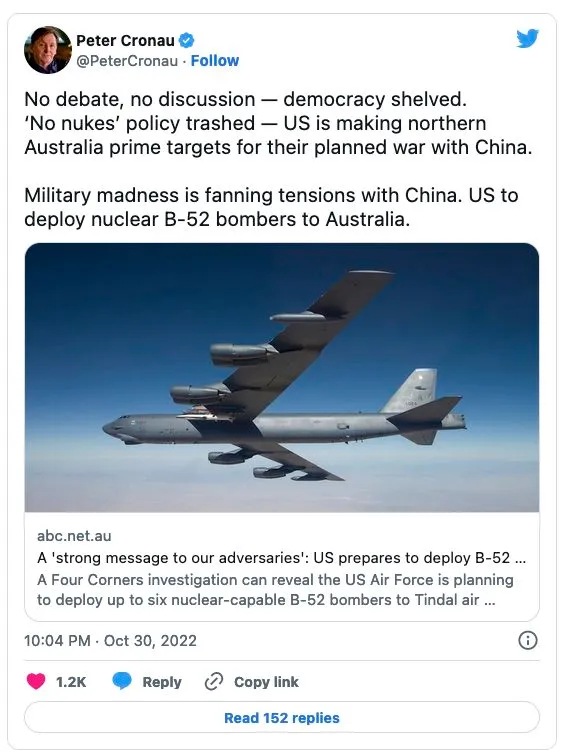
Cronau’s message was echoed by David Shoebridge, an Australian Greens senator for New South Wales.

“This is a dangerous escalation,” Shoebridge wrote on Twitter. “It makes Australia an even bigger part of the global nuclear weapons threat to humanity’s very existence — and by rising military tensions it further destabilizes our region.”

According to the ABC, “Washington is planning to build dedicated facilities” for the nuclear-capable B-52 bombers at Royal Australian Air Force Base Tindal, less than 200 miles south of Darwin, the capital of the country’s Northern Territory.
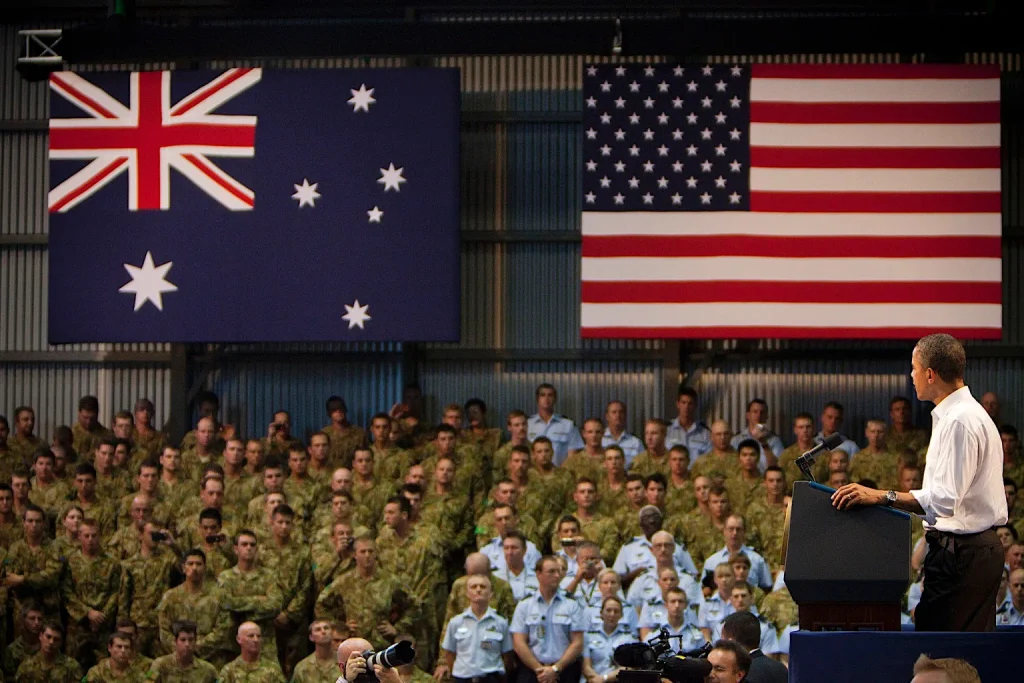
The Pentagon’s plan represents the latest U.S. act of hostility toward China.

Relations between the two countries have only worsened since August, when U.S. House Speaker Nancy Pelosi (D-CA) and other members of Congress visited Taiwan (the Republic of China, or ROC) despite opposition from Beijing, which — along with most of the international community, including Washington since the 1970s — considers the breakaway province to be part of the People’s Republic of China (PRC).

In a departure from more than four decades of “One China” policy — in which the U.S. recognizes the PRC as the sole legal government of China and maintains informal relations with the ROC while adopting a position of “strategic ambiguity” to obscure how far it would go to protect Taiwan — U.S. President Joe Biden has repeatedly threatened to use military force in response to a Chinese invasion of the island.

Although Biden warned earlier this month that Russia’s assault on Ukraine has brought the world closer to “Armageddon” than at any point since the Cuban Missile Crisis, his move to station B-52 bombers in Australia further increases the global risk of nuclear war.

Biden’s Nuclear Posture Review

News of the impending deployment comes just days after the Biden administration released a Nuclear Posture Review (NPR) that nonproliferation advocates said makes catastrophe more, rather than less, likely.

“The formal statement of U.S. nuclear strategy pays lip service to the need to limit the spread and prevent the use of atomic weaponry and cancels an egregious Trump-era missile program,” Common Dreams reported last week, but “the document makes clear that the country will move ahead with dangerous and costly modernization plans — and leaves intact the option of a nuclear first strike.”

According to Stephen Young, senior Washington representative at the Union of Concerned Scientists, “The world is becoming a more dangerous place, but the only military threat to the survival of the United States is a nuclear war with Russia or China.”

“Rather than recognizing that threat and seeking to find ways to end it,” said Young, “the Biden NPR doubles down on nuclear deterrence and the status quo approach to security that says we all must be prepared to die in less than an hour.”

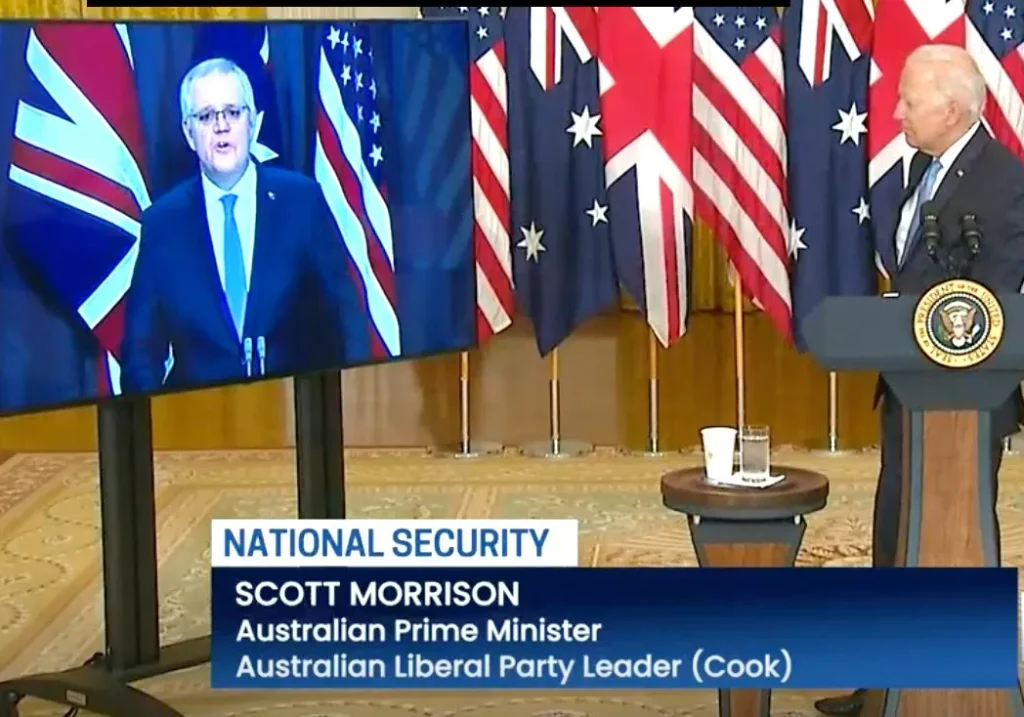
The move to park B-52 bombers at the Tindal air base also comes just over a year after the establishment of the so-called AUKUS alliance, a trilateral military partnership through which the U.S. and the United Kingdom plan to help Australia build a fleet of nuclear-powered submarines — a long-term initiative widely seen as a challenge to China by Western powers determined to exert control over the Pacific region.
Some Australian critics expressed concerns that the planned deployment of U.S. military aircraft to the Northern Territory locks the country into joining Washington in the event an armed conflict with China erupts.

“It’s a great expansion of Australian commitment to the United States’ war plan with China,” said Richard Tanter, a senior research associate at the Nautilus Institute and longstanding anti-nuclear activist.

“It’s a sign to the Chinese that we are willing to be the tip of the spear,” said Tanter. “It’s very hard to think of a more open commitment that we could make. A more open signal to the Chinese that we are going along with American planning for a war with China.”

Beijing, for its part, accused Washington of destabilizing the entire Pacific region with its planned deployment of B-52s to the Tindal air base.

Asked about the U.S. positioning nuclear-capable bombers in Australia, Chinese Foreign Ministry spokesperson Zhao Lijian said that military cooperation pacts between countries should “not target any third parties or harm the interests of third parties.”

“The relevant U.S. behaviours have increased regional tensions, seriously undermined regional peace and stability, and may trigger an arms race in the region,” Zhao told reporters at a regular briefing in Beijing.

“China urges the parties concerned to abandon the outdated Cold War and zero-sum mentality and narrow-minded geopolitical thinking, and to do something conducive to regional peace and stability and enhancing mutual trust between the countries,” he added.

Support TFF
Please support TFF’s work for peace through research and public education. We are all-volunteer, people-financed and do not accept money from governments or corporations. In other words, one of the very last free research think tanks in this world – and for a noble purpose: Peace by peaceful – intelligent – means. It is fast, easy and secure. Click here. Thanks!

[paypal-donation]

Kenny Stancil is a staff writer for Common Dreams.

Share

Leave a Reply

Your email address will not be published. Required fields are marked *

Related Posts

In contrast to most, we’ll bring alternatives, solutions, hope and strategies for a better future. Times are dangerous, yes, but that only intensifies the need for constructive thinking and action! Jan Oberg, TFF director April 13, 2026 The new TFF Peace Pulse uses video messages in a new way: Max 3-5-minute-long comments, ideas or perhaps mini-lectures, all about peace – positive peace. We launch them today on April 13, 2026 with a carefully crafted visual aesthetic fitting the content. We hope to publish them regularly from now on. We launch Peace Pulse (PP) – for a number of reasons. The world is in chaos, and there are countless reasons to feel concerned, frustrated, even angry. The atmosphere is saturated with doom and gloom, with negative energy and rear‑mirror thinking, while vision, imagination, alternatives, strategies and genuine future‑mindedness remain in short supply. And without them, we simply can’t save the world. Looking at problems from a hundred angles will...
This is not another geopolitical commentary on the Arctic. It is a visionary peace proposal that can save the region from militarised rivalry and ecological ruin. A blueprint for shared security, sustainable development, and human dignity — benefitting Greenland, the Arctic, and the rest of us. Jan Oberg TFF director Lund, Sweden, February 17, 2026 I. Four Principles for a New Arctic Vision The Arctic is often framed as a cold arena of rivalry — a place where great powers test each other’s resolve. But this worldview is outdated, unimaginative, and ultimately self‑defeating. The Arctic is not a vacuum waiting to be militarised; it is a living region, a climate stabiliser, and a cultural homeland whose future will shape the future of humanity. If we begin from that understanding, a far more rational Arctic order becomes possible — one that is peaceful, cooperative, and centred on the people who actually live there. This vision rests...
PART 2 — Diplomacy, Law and Nonviolent Power By Jan ObergTFF co-founder and director January 26, 2026 This is the second of four TFF-created idea portfolios designed to curb the global reach of the United States and, in both the short and long term, help catalyse a worldwide nonviolent resistance to what many observers describe as the Trump administration’s uniquely confrontational, destructive and world-threatening policies. These portfolios outline what governments and citizens across the world can do through dynamic diplomacy, creative initiatives, and strictly nonviolent means. They are typical TFF works in that we do not only tell what the problem is and how bad it will go – as 90+% of all commentators, experts and scholars do – we tell what we think can be done, inviting you to think of what you think you can do. It seems painfully clear to me that the current political dynamics in Washington increasingly resemble the most dangerous...

Recent Articles

2003 The capital Bujumbura 2006 The capital Bujumbura 2006 Gitega, the second largest town& its surroundings 2007 Muramvia Back to Oberg’s Photography main page
By JONATHAN POWER August 16, 2000 LONDON – Remember the summer of ’98? In the sweltering, torpid heat of a Roman august, charged with exhaust fumes, the international community gave its overwhelming approval to the establishment of an International Criminal Court that will enable those accused of “crimes against humanity” to be tried and, if convicted, sentenced. Only seven nations opposed or abstained from the motion, including Israel, China, India and the U.S.A. where the Pentagon had successfully waged bureaucratic guerrilla war to undermine the initially sympathetic stance of President Bill Clinton. Two years on we can now see what an epochal event that was. In a the stroke of 120 pens it changed the climate on political thuggery. After numerous half-starts and false starts ever since the Nuremberg and Tokyo trials that convicted the war criminals of the Second World War, the world at last had agreed en masse a common...
By Jonathan Power April 8th 2004 LONDON – There is a widely held opinion abroad that Brazil never had the chance of profoundly changing for the better- shedding its widespread poverty and dire income distribution- until Lula (President Luiz Inácio da Silva) came along last year. This is not entirely false, but neither is it entirely true. Brazil has long made a kind of progress- in the last century it was second only to Taiwan as the fastest growing economy in the world- but it has been appallingly uneven. Part of the story of contemporary Brazil is clear to the eye in this small village of 7,000 people in the arid north east, along with the Amazon the poorest part of this vast country. Twenty five years or so ago I used to come to Pilõezinhos regularly when I had a close friend living here, Valéria Rezende, a radical, grass roots-stirring...

TFF on Substack

Discover more from TFF Transnational Foundation & Jan Oberg.

Most Popular

2003 The capital Bujumbura 2006 The capital Bujumbura 2006 Gitega, the second largest town& its surroundings 2007 Muramvia Back to Oberg’s Photography main page
By JONATHAN POWER August 16, 2000 LONDON – Remember the summer of ’98? In the sweltering, torpid heat of a Roman august, charged with exhaust fumes, the international community gave its overwhelming approval to the establishment of an International Criminal Court that will enable those accused of “crimes against humanity” to be tried and, if convicted, sentenced. Only seven nations opposed or abstained from the motion, including Israel, China, India and the U.S.A. where the Pentagon had successfully waged bureaucratic guerrilla war to undermine the initially sympathetic stance of President Bill Clinton. Two years on we can now see what an epochal event that was. In a the stroke of 120 pens it changed the climate on political thuggery. After numerous half-starts and false starts ever since the Nuremberg and Tokyo trials that convicted the war criminals of the Second World War, the world at last had agreed en masse a common...
By Jonathan Power April 8th 2004 LONDON – There is a widely held opinion abroad that Brazil never had the chance of profoundly changing for the better- shedding its widespread poverty and dire income distribution- until Lula (President Luiz Inácio da Silva) came along last year. This is not entirely false, but neither is it entirely true. Brazil has long made a kind of progress- in the last century it was second only to Taiwan as the fastest growing economy in the world- but it has been appallingly uneven. Part of the story of contemporary Brazil is clear to the eye in this small village of 7,000 people in the arid north east, along with the Amazon the poorest part of this vast country. Twenty five years or so ago I used to come to Pilõezinhos regularly when I had a close friend living here, Valéria Rezende, a radical, grass roots-stirring...
Read More
Generic thumbnail
2003 The capital Bujumbura 2006 The capital Bujumbura 2006 Gitega, the second largest town& its surroundings 2007 Muramvia Back to Oberg’s Photography main page
By JONATHAN POWER August 16, 2000 LONDON – Remember the summer of ’98? In the sweltering, torpid heat of a Roman august, charged with exhaust fumes, the international community gave its overwhelming approval to the establishment of an International Criminal Court that will enable those accused of “crimes against humanity” to be tried and, if convicted, sentenced. Only seven nations opposed or abstained from the motion, including Israel, China, India and the U.S.A. where the Pentagon had successfully waged bureaucratic guerrilla war to undermine the initially sympathetic stance of President Bill Clinton. Two years on we can now see what an epochal event that was. In a the stroke of 120 pens it changed the climate on political thuggery. After numerous half-starts and false starts ever since the Nuremberg and Tokyo trials that convicted the war criminals of the Second World War, the world at last had agreed en masse a common...
By Jonathan Power April 8th 2004 LONDON – There is a widely held opinion abroad that Brazil never had the chance of profoundly changing for the better- shedding its widespread poverty and dire income distribution- until Lula (President Luiz Inácio da Silva) came along last year. This is not entirely false, but neither is it entirely true. Brazil has long made a kind of progress- in the last century it was second only to Taiwan as the fastest growing economy in the world- but it has been appallingly uneven. Part of the story of contemporary Brazil is clear to the eye in this small village of 7,000 people in the arid north east, along with the Amazon the poorest part of this vast country. Twenty five years or so ago I used to come to Pilõezinhos regularly when I had a close friend living here, Valéria Rezende, a radical, grass roots-stirring...
Mearsheimer-800x418-1
A friendly quarrel while we agree that the US sanctions are a weapon of mass destruction and kill more people than wars do. And that we must talk much more about sanctions than we have so far. Jan Oberg, TFF director March 16, 2026 John Mearsheimer recently stated that U.S. sanctions murdered around 38 million people between 1971 and 2021 – see the video below. It is a dramatic figure, and it has spread quickly because it captures, in one sentence, the enormous human cost of modern sanctions. I share his concern about the destructive effects of economic coercion. But the specific number he cites — and the way he attributes it — deserves a friendly academic clarification. The figure comes from a 2023 Lancet Global Health article estimating the mortality effects of unilateral U.S. and EU sanctions over the past half‑century. This is the first point where Mearsheimer’s shorthand diverges from the text: the study...
Screenshot-2026-05-15-103534
Jan Oberg May 15, 2026 Go to this Fox News page and scroll the whole way down: President Donald Trump tells the world that his meeting with President Xi Jinping yielded a lot of very concrete political and economic results – of course, only where the Chinese side, according to him, agreed with him. He does not mention the Taiwan issue, but Secretary of State, Marco Rubio, says that it did not feature prominently in their talks and that the US policy on Taiwan has not changed. Then go to China Daily – or Global Times – and you will see that for the Chinese it is framework, principles, structure of cooperation etc. that matters – all embedded in the overall idea of “constructive bilateral relationship of strategic stability.” Nowhere is any concrete agreement or deal – all that Trump refers to – mentioned. At the general level, this gives you insights into the very different social...
Screenshot-2026-05-12-104023
Lena Petrova of “World Affairs In Context” with more than half a million subscribers on YouTube wanted to explore what a peace researcher like me has to say about, among other things, the First and the Second Cold War and why eethics has disappeared from politics. I am particularly happy about this conversation that also yielded an amazing number of very appreciative comments on YouTube. No doubt, people are longing for alternatives, including peace perspectives.