
John Scales Avery: NATO’s Aggressive Militarism

The Illegality of NATO: Violation of the UN Charter and the Nuremberg Principles

In recent years, participation in NATO has made European countries accomplices in US efforts to achieve global hegemony by means of military force, in violation of international law, and especially in violation of the UN Charter, the Nuremberg Principles.

Former UN Assistant Secretary-General Hans Christof von Sponeck – also a TFF Associate – used the following words to express his opinion that NATO now violates the UN Charter and international law: “In the 1949 North Atlantic Treaty, the Charter of the United Nations was declared to be NATO’s legally binding framework.”

However, the United Nations’ monopoly of the use of force, especially as specified in Article 51 of the Charter, was no longer accepted according to the 1999 NATO doctrine. NATO’s territorial scope, until then limited to the Euro-Atlantic region, was expanded by its members to include the whole world.”

Article 2 of the UN Charter requires that “All members shall refrain in their international relations from the threat or use of force against the territorial integrity or political independence of any state.”

This requirement is somewhat qualified by Article 51, which says that “Nothing in the present Charter shall impair the inherent right of individual or collective self-defense if an armed attack occurs against a Member of the United Nations, until the Security Council has taken measures necessary to maintain international peace and security.”

Thus, in general, war is illegal under the UN Charter. Self-defense against an armed attack is permitted, but only for a limited time until the Security Council has had time to act.

The United Nations Charter does not permit the threat or use of force in preemptive wars, or to produce regime changes, or for so-called “democratization”, or for the domination of regions that are rich in oil. NATO must not be a party to the threat or use of force for such illegal purposes.

In 1946, the United Nations General Assembly unanimously affirmed “the principles of international law recognized by the Charter of the Nuremberg Tribunal and the judgment of the Tribunal”.

The General Assembly also established an International Law Commission to formalize the Nuremberg Principles. The result was a list that included Principles VI and VII, which are particularly important in the context of the illegality of NATO:

Principle VI: The crimes hereinafter set out are punishable as crimes under international law:

Crimes against peace: (i) Planning, preparation, initiation or waging of a war of aggression or a war in violation of international treaties, agreements or assurances; (ii) Participation in a common plan or conspiracy for accomplishment of any of the acts mentioned under (i).

  1. War crimes: Violations of the laws and customs of war which include, but are not limited to, murder, ill treatment of prisoners of war or persons on the seas, killing of hostages, plunder of public or private property, wanton destructions of cities, towns or villages, or devastation not justified by military necessity
  2. Crimes against humanity: Atrocities and offenses, including but not limited to murder, extermination, deportation, imprisonment, torture, rape or other inhumane acts committed against any civilian population, or persecutions on political, racial or religious grounds, whether or not in violation of the laws of the country where perpetrated

Principle VII: Complicity in the commission of a crime against the peace, a war crime or a crime against humanity as set forth in Principle VI as a crime against international law.

Robert H. Jackson, who was the chief United States prosecutor at the Nuremberg trials, said that:

“To initiate a war of aggression is therefore not only an international crime, it is the supreme international crime, differing from other war crimes in that it contains within itself the accumulated evil of the whole.”

Violation of the Nuclear Non-Proliferation Treaty (NPT)

At present, NATO’s nuclear weapons policies violate both the spirit and the text of the NPT in several respects: Today there are an estimated 200 US nuclear weapons still in Europe. The air forces of the nations in which they are based are regularly trained to deliver the US weapons.

This “nuclear sharing,” as it is called, violates Articles I and II of the NPT, which forbid the transfer of nuclear weapons to non-nuclear-weapon states. It has been argued that the NPT would no longer be in force if a crisis arose, but there is nothing in the NPT saying that the treaty would not hold under all circumstances.

Article VI of the NPT requires states possessing nuclear weapon to get rid of them within a reasonable period of time. This article is violated by fact that NATO policy is guided by a Strategic Concept, which visualizes the continued use of nuclear weapons in the foreseeable future.

The principle of no-first-use of nuclear weapons has been an extremely important safeguard over the years, but it is violated by present NATO policy, which permits the first-use of nuclear weapons in a wide variety of circumstances.

The Ukraine War and Nuclear Weapons

After his illegal and brutal invasion of Ukraine, Vladimir Putin put Russia’s nuclear forces on high alert, thus threatening the world with an all-destroying nuclear war. The threat brought back memories of the Cuban Missile Crisis, when the world was balanced on the edge of a suicidal and genocidal nuclear war. We are once again reminded of the urgent need for the world to rid itself of nuclear weapons.

War was always madness, always immoral, always the cause of unspeakable suffering, economic waste and widespread destruction, and always a source of poverty, hate, barbarism and endless cycles of revenge and counter-revenge. It has always been a crime for soldiers to kill people, just as it is a crime for murderers in civil society to kill people. No flag has ever been wide enough to cover up the atrocities of war.

But today, the development of all-destroying thermonuclear weapons has put war completely beyond the bounds of sanity and elementary humanity.

Today, the existing nuclear weapons have half a million times the power of the bombs that devastated Hiroshima and Nagasaki. A thermonuclear war would destroy human civilization, together with most of the plants and animals with which we share the gift of life.

Research has shown that fire-storms produced by a nuclear war would send vast quantities of smoke into the atmosphere, blocking sunlight, and blocking the hydrological cycle. The climate would become very cold for a period of about ten years. Human agriculture would fail. Plants and animals would also be killed by the nuclear winter.

Can we not rid ourselves of both nuclear weapons and the institution of war itself?

We must act quickly and resolutely before our beautiful world is reduced to radioactive ashes, together with everything that we love.

The Invasion of Ukraine Cannot Be Called Unprovoked

To understand how Russians feel about having western weapons and troops poured into a position on their nation’s borders, we should imagine how the United States would react if large numbers of Russian weapons and troops were stationed in Mexico or Canada.

In 1991, after the breakup of the Soviet Union, George H.W. Bush and his Secretary of State, James Baker, promised Mikhail Gorbachev that if he agreed to the unification of Germany, NATO would not expand eastward, toward Russia, “not one inch”.

The promise was broken almost immediately by Bill Clinton, who helped to bring the Czech Republic, Hungary and Poland into NATO. Russians saw this not only as a betrayal, but also as an act of aggression.

The Monroe Doctrine

There is no document more fundamental to the foreign policy of the United States than the Monroe Doctrine. It states that interference in the Western Hemisphere by European powers would be interpreted as an attack on the United States, and would be opposed by the United States.

The Monroe Doctrine has been used to justify U.S. interventions in Central America and in the Caribbean. Understandably, the United States wishes to have its backyard secure. Why should Russia not have the same wish?

The U.S. Should Stop Threatening Russia

Russia’s fears are legitimate and based on historical suffering, the U.S and its allies should stop threatening Russia. Nuclear missiles should be removed from positions near the Russian border, and the eastward expansion of NATO should be halted

A Diplomatic Solution to the Conflict Is the Only Way to End It

UN Secretary-General Antonio Guterres has urged Russia and Ukraine to negotiate an immediate cease-fire and a mutually agreeable settlement to end the conflict.

However, this rational solution is opposed by politicians in the United States and elsewhere, who are influenced by money from giant arms corporations. Thus, more and more heavy weapons are sent to Ukraine, pouring oil onto the flames, and enriching the merchants of death. This must stop, and a diplomatic solution must be found under Secretary General Guterres’ wise leadership.

Jens Stoltenberg Urges Production of More and More Munitions

NATO’s Secretary General Jens Stoltenberg recently urged member states to greatly increase their production of modern weapons and munitions, both for their own use, and to increase the armaments sent to Ukraine. Those of us who are on the side of peace are  dismayed by this escalation of the conflict. It is the vast profits made by the armaments industry that perpetuate the institution of war.

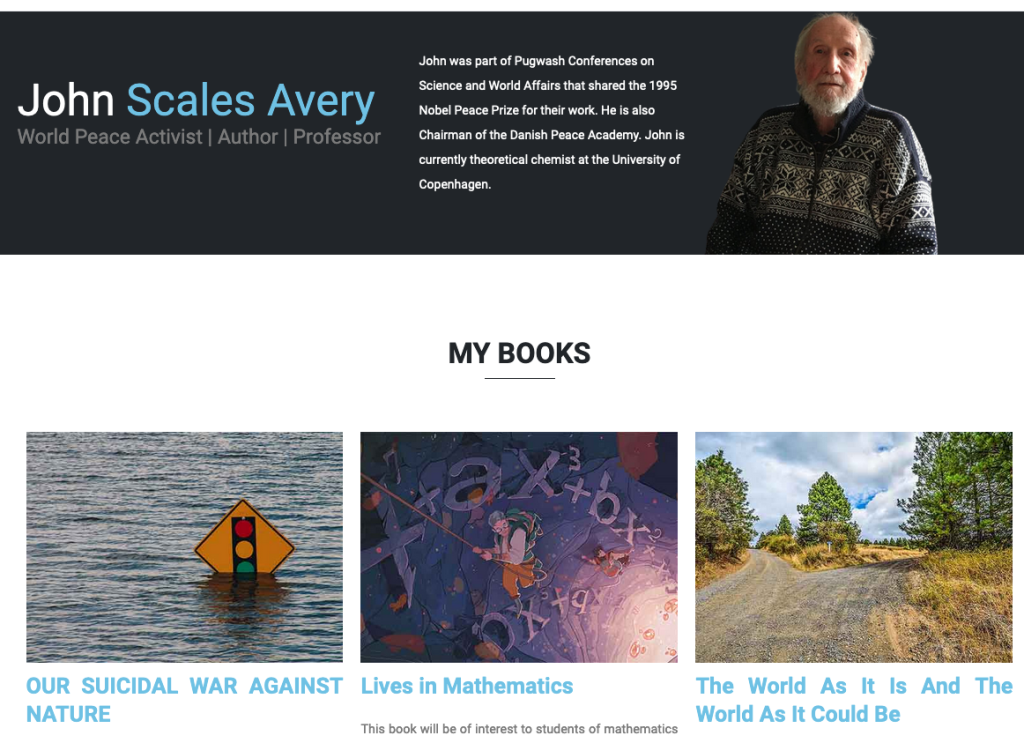
Read about Avery’s amazing life and work for peace here. In addition, he is a prolific writer, so we recommend that you visit – and browse extensively – his rich homepage here.

Finally, we at TFF are honoured to have John as a TFF Associate and friend over decades.
Share

Leave a Reply

Your email address will not be published. Required fields are marked *

Related Posts

Lena Petrova of “World Affairs In Context” with more than half a million subscribers on YouTube wanted to explore what a peace researcher like me has to say about, among other things, the First and the Second Cold War and why eethics has disappeared from politics. I am particularly happy about this conversation that also yielded an amazing number of very appreciative comments on YouTube. No doubt, people are longing for alternatives, including peace perspectives.
The MIMAC – Military-Industrial-Media-Academic Complex – drives the world’s rampant militarism and wars without end. Here is a short reflection of how it works against all interests of humanity. #5 deals with why there is no real enemy or threat images/analysis. It’s all ex-post constructions. And, btw, theTFF Peace Pulse is now on Rumble.
Jan Oberg, TFF director April 28, 2026 In this third TFF Peace Pulse, I make the important distinction between the violence and the conflict that violence is a symptom of. If you want peace, focus on the underlying conflict because that is the key to resolution, peacemaking, and a better future for the parties. The West is obsessed with violence, just look around you – and 90+ per cent of the public debate is about military issues and other violence – totally wasted for peace. These Peace Pulses will only be published here a few times. You will also not find them on YouTube and Vimeo because both platforms have blocked TFF and me; you know, peace is dangerous these days. Most TFF’s videos since 2007 are now on Rumble.

Recent Articles

The most recent on top Farhang Jahanpour, January 7, 2012 As US and Iran confront each other, where is the diplomacy? Farhang Jahanpour, August 3, 2011 Iran can’t reform itself – the power struggle bewtween Ahmadinejad and Khamenei Farhang Jahanpour, May 17, 2011 Is Iran next? The Supreme Leader versus Ahmadinejad Farhang Jahanpour, March 4, 2011 The revolutions in the Arab world: The need for long-term thinking and humility Farhang Jahanpour, December 15, 2010 The Wikileak files: The banality of politics Farhang Jahanpour, November 18, 2010 This is what ought to be the U.S.’s interests in the Middle East! Farhang Jahanpour – Video on Vimeo, October 6, 2010 Towards a solution in the Middle East Farhang Jahanpour and Susanne Sklar, July 28, 2010 Dialogue on nuclear weapons and culture of peace by TFF Associate and a TFF friend Farhang Jahanpour, July 28, 2010 Iran, Turkey and Israel – New Global...
Lidt om bogen Bogens indhold Bestil bogen her Anmeldelser Siden den kolde krigs afslutning har dansk udenrigs- og sikkerhedspolitik bevæget sig langt ind i en politisk og moralsk blindgyde. Men det tjener hverken os eller verden at Danmark er blevet en krigs- og besættelsesmagt, viser den internationalt respekterede danske freds- og fremtidsforsker, Jan Øberg i denne bog. Tværtimod mindsker det vores og andres sikkerhed og bidrager til at øge, snarere end at mindske, terrortruslen. Forudsigelig fiasko – der udkommer 4. juni 2004 – sætter fokus på det irakiske samfund og Vestens måde at betragte og behandle Irak på. Jan Øberg kombinerer konkret konfliktanalyse med et personligt engagement, og underbygger overbevisende og konsekvent det synspunkt, at Vestens mangelfulde konfliktforståelse og ukyndige konflikthåndtering måtte ende med den ulykkelige krig. Det er en krig, som efter forfatterens opfattelse hverken kan fremme ædle motiver – etablere et demokratisk Irak – eller økonomisk-kulturelle interesser, men...
Burundi – hopp om fred Burundi, var är det nu det ligger? Det är nånting med Hutsier och Tutuer – eller vad de nu heter – som mördar varandra med machete-knivar, nånting med fattigdom, korruption, militärdiktatur, nöd och elände? Det hopplösa, mörka Afrika i ett bananskal, eller hur? Tja. Jag har precis varit där. Det ligger naturligtvis någonting i det. Och det finns en del orsaker till att vi inte ser mycket om landet i massmedia. En av dem är att det inte försiggår något folkmord just nu, ingen naturkatastrofer, ingen kupp. Det finns ingen misslyckad FN-mission, USA och EU har få intressen, Madeleine Halfbright har inte sagt något om det nyss, NATO:s Solana ser inte bombningar i Burundi som viktiga för firandet av alliansens 50-årsdag i april. För en tid sedan då 50 människor mördades strömmade hundratals journalister med CNN i spetsen till Burundi…men för att snabbt försvinna till Kongo...

TFF on Substack

Discover more from TFF Transnational Foundation & Jan Oberg.

Most Popular

The most recent on top Farhang Jahanpour, January 7, 2012 As US and Iran confront each other, where is the diplomacy? Farhang Jahanpour, August 3, 2011 Iran can’t reform itself – the power struggle bewtween Ahmadinejad and Khamenei Farhang Jahanpour, May 17, 2011 Is Iran next? The Supreme Leader versus Ahmadinejad Farhang Jahanpour, March 4, 2011 The revolutions in the Arab world: The need for long-term thinking and humility Farhang Jahanpour, December 15, 2010 The Wikileak files: The banality of politics Farhang Jahanpour, November 18, 2010 This is what ought to be the U.S.’s interests in the Middle East! Farhang Jahanpour – Video on Vimeo, October 6, 2010 Towards a solution in the Middle East Farhang Jahanpour and Susanne Sklar, July 28, 2010 Dialogue on nuclear weapons and culture of peace by TFF Associate and a TFF friend Farhang Jahanpour, July 28, 2010 Iran, Turkey and Israel – New Global...
Lidt om bogen Bogens indhold Bestil bogen her Anmeldelser Siden den kolde krigs afslutning har dansk udenrigs- og sikkerhedspolitik bevæget sig langt ind i en politisk og moralsk blindgyde. Men det tjener hverken os eller verden at Danmark er blevet en krigs- og besættelsesmagt, viser den internationalt respekterede danske freds- og fremtidsforsker, Jan Øberg i denne bog. Tværtimod mindsker det vores og andres sikkerhed og bidrager til at øge, snarere end at mindske, terrortruslen. Forudsigelig fiasko – der udkommer 4. juni 2004 – sætter fokus på det irakiske samfund og Vestens måde at betragte og behandle Irak på. Jan Øberg kombinerer konkret konfliktanalyse med et personligt engagement, og underbygger overbevisende og konsekvent det synspunkt, at Vestens mangelfulde konfliktforståelse og ukyndige konflikthåndtering måtte ende med den ulykkelige krig. Det er en krig, som efter forfatterens opfattelse hverken kan fremme ædle motiver – etablere et demokratisk Irak – eller økonomisk-kulturelle interesser, men...
Burundi – hopp om fred Burundi, var är det nu det ligger? Det är nånting med Hutsier och Tutuer – eller vad de nu heter – som mördar varandra med machete-knivar, nånting med fattigdom, korruption, militärdiktatur, nöd och elände? Det hopplösa, mörka Afrika i ett bananskal, eller hur? Tja. Jag har precis varit där. Det ligger naturligtvis någonting i det. Och det finns en del orsaker till att vi inte ser mycket om landet i massmedia. En av dem är att det inte försiggår något folkmord just nu, ingen naturkatastrofer, ingen kupp. Det finns ingen misslyckad FN-mission, USA och EU har få intressen, Madeleine Halfbright har inte sagt något om det nyss, NATO:s Solana ser inte bombningar i Burundi som viktiga för firandet av alliansens 50-årsdag i april. För en tid sedan då 50 människor mördades strömmade hundratals journalister med CNN i spetsen till Burundi…men för att snabbt försvinna till Kongo...
Read More
The most recent on top Farhang Jahanpour, January 7, 2012 As US and Iran confront each other, where is the diplomacy? Farhang Jahanpour, August 3, 2011 Iran can’t reform itself – the power struggle bewtween Ahmadinejad and Khamenei Farhang Jahanpour, May 17, 2011 Is Iran next? The Supreme Leader versus Ahmadinejad Farhang Jahanpour, March 4, 2011 The revolutions in the Arab world: The need for long-term thinking and humility Farhang Jahanpour, December 15, 2010 The Wikileak files: The banality of politics Farhang Jahanpour, November 18, 2010 This is what ought to be the U.S.’s interests in the Middle East! Farhang Jahanpour – Video on Vimeo, October 6, 2010 Towards a solution in the Middle East Farhang Jahanpour and Susanne Sklar, July 28, 2010 Dialogue on nuclear weapons and culture of peace by TFF Associate and a TFF friend Farhang Jahanpour, July 28, 2010 Iran, Turkey and Israel – New Global...
Lidt om bogen Bogens indhold Bestil bogen her Anmeldelser Siden den kolde krigs afslutning har dansk udenrigs- og sikkerhedspolitik bevæget sig langt ind i en politisk og moralsk blindgyde. Men det tjener hverken os eller verden at Danmark er blevet en krigs- og besættelsesmagt, viser den internationalt respekterede danske freds- og fremtidsforsker, Jan Øberg i denne bog. Tværtimod mindsker det vores og andres sikkerhed og bidrager til at øge, snarere end at mindske, terrortruslen. Forudsigelig fiasko – der udkommer 4. juni 2004 – sætter fokus på det irakiske samfund og Vestens måde at betragte og behandle Irak på. Jan Øberg kombinerer konkret konfliktanalyse med et personligt engagement, og underbygger overbevisende og konsekvent det synspunkt, at Vestens mangelfulde konfliktforståelse og ukyndige konflikthåndtering måtte ende med den ulykkelige krig. Det er en krig, som efter forfatterens opfattelse hverken kan fremme ædle motiver – etablere et demokratisk Irak – eller økonomisk-kulturelle interesser, men...
Burundi – hopp om fred Burundi, var är det nu det ligger? Det är nånting med Hutsier och Tutuer – eller vad de nu heter – som mördar varandra med machete-knivar, nånting med fattigdom, korruption, militärdiktatur, nöd och elände? Det hopplösa, mörka Afrika i ett bananskal, eller hur? Tja. Jag har precis varit där. Det ligger naturligtvis någonting i det. Och det finns en del orsaker till att vi inte ser mycket om landet i massmedia. En av dem är att det inte försiggår något folkmord just nu, ingen naturkatastrofer, ingen kupp. Det finns ingen misslyckad FN-mission, USA och EU har få intressen, Madeleine Halfbright har inte sagt något om det nyss, NATO:s Solana ser inte bombningar i Burundi som viktiga för firandet av alliansens 50-årsdag i april. För en tid sedan då 50 människor mördades strömmade hundratals journalister med CNN i spetsen till Burundi…men för att snabbt försvinna till Kongo...
Mr President ! President Bill Clinton gjorde i tisdags en blixtvisit i Kosovo. I ett tal manade han albanerna att sluta hämnas på den krympande serbiska minoriteten. Han besökte också de amerikanska soldaterna på den nya Bondsteelbasen. Det finns viktiga frågor som borde ha ställts still honom om Balkan och Kosovo och om USA:s ledande roll i bombningarna av Jugoslavien. Det borde vara en självklarhet att oberoende medier i demokratiska länder låter politiska ledare svara på viktiga frågor. Men ställdes verkligen de viktiga frågorna? Här är några frågor som jag skulle ha ställt ˆ om jag vore journalist och hade fått tillfälle att göra en intervju i tisdags. (1) Mr President! Amerikanska plan bombade i våras Jugoslavien och Kosovo med er som överbefälhavare. Aktionen rättfärdigades av uppgifter om ett folkmord planerat av Belgrad. Dessa uppgifter har nu visat sig vara grovt missvisande eller falska. Hur ställer Ni er till detta?...
Burundi – håb forude Burundi, hvor er det nu det ligger? Det er noget med Hutsier og Tutuer – eller hvad de nu hedder – der laver folkemord med machete-knive på hinanden, noget med fattigdom, korruption, militærdiktatur, nød og elendighed? Det håbløse, mørke Afrika i en bananskal, ikke? Tjah. Jeg har lige været der. Der er selvfølgelig noget om snakken. Der er en del årsager til at man ikke hører særligt meget om livet i dette lille land. En af dem er at der ikke foregår noget folkemord for tiden, ingen naturkatastrofer, intet kup. Der er ingen mislykket FN-mission, USA og EU har ingen interesser, Madeleine Halfbright har ikke sagt noget om det, NATO’s Solana ser ikke bombinger i Burundi som afgørende forud for alliancens 50årsdag. For nogen tid siden da et halvt hundrede mennesker var blevet dræbt valfartede hundreder af journalister med CNN i spidsen dertil . . . men...
Rambouillet (Rambo-Yeah) og Rashid Vi skriver fredag den 19. januar. For få dage siden kom jeg hjem fra små tre uger i Skopje, Beograd og Kosovo. Min analyse og min intuition siger mig dét, jeg ikke vil høre: bombningerne nærmer sig. Det var 34. besøg siden 1991. Jeg er delvist uddannet i Dubrovnik, fra 1974. Jeg kan ikke slippe det. Det er altså også mit land, der atter trues af den kulturkreds, jeg tilhører. Radmila og Peca i Beograd, venner siden 1974, intellektuelle der har valgt ikke at forlade landet og netop har sagt nej til et ophold i udlandet. Datteren Anja på 9 skal vokse op hér. "Jeg rejste ned nu," siger jeg, "fordi der enten ville falde bomber eller blive en eller anden slags ‘forhandling’ og jeg vil være hér hvis I blir bombet, for jeg skammer mig over hvad Danmark og andre lande gør." Hun får tårer...