By 1914 Europeans ruled 84% of the globe. How did they do it? Eleven hundred years ago Europe was a backwater. There were no grand cities, apart from Muslim Cordoba in Spain, and the remnants of Rome and Athens.

The Middle East, India and China were further ahead. It was the Arabs who kept alive the teachings of the Ancient Greeks’ knowledge of science, medicine, architecture and philosophy.

We now have two schools of thought. Two years ago came Professor Philip Hoffman of Caltech University with his book “Why Did Europe Conquer The World?” He argued that Europe’s pace of innovation was driven by a peculiar form of military competition which he called a “tournament” – the sort of competition that under the right conditions can drive contestants to exert enormous efforts in the hope of earning a prize.

Europe, unlike the Ottoman Empire and China, was a very un-unified kind of place. Since the fall of Charlemagne in 814 there was no one strong enough to hold Europe together. Dozens of small states and principalities, often vying to be top dog, were stimulated to nurse their competitive instincts, and in doing so and fighting they refined their military capabilities more than any of other world’s peoples.

European rulers raised taxes and lavished resources on armies, navies and gunpowder technology. Moreover, unlike in Asia, private entrepreneurs faced few legal, financial or political obstacles to launching expeditions of conquest and exploration.

This is why the British East India Company could conquer much of India.

In contrast, China was a massive hegemon; Japan and the Ottoman empires sizeable ones; India partly one. A hegemon inevitably comes to believe that since it’s political dominant it doesn’t have to work so hard at maintaining superior arms.

So when it came to gunpowder technology and its adaption to warships the European powers, each seeking to outscore the other, could often call the shots against Asia’s hegemons.

The wars that led to Europe’s and particularly Britain’s domination of the world made possible the Industrial Revolution, not vice versa as is commonly thought.

Now comes along a book with a different take on all this – “Empires of the Weak” by J. C. Sharman, professor of International Relations at Cambridge University. He doesn’t appear to have read Hoffman’s book, but it reads as if he was refuting it.

In Latin America the Conquistadores, who did set out to conquer, won because of alliances with smallish local kingdoms and the spreading of European diseases. They did not win because of superior military technology. Pizaro who conquered the Incas had an army of only 170. Pizaro did indeed have guns which the Incas didn’t but they were just a few canons and basic muskets. Fighting was mainly hand to hand.

In Africa, the imperialists limited themselves to border posts where they bought slaves from local chiefs. Incursions into the interior when they happened later were pioneered with small groups of soldiers, also fighting hand to hand.

Sharman argues that, apart from the Americas, Europeans did not gain military superiority during the period of European expansion from the fifteenth century to the late eighteenth century.

He posits that European success in this era is explained by deference, and even subordination, to strong Asian and African politics, the import of deadly European diseases in the Americas and maritime superiority earned by default because these local land-orientated polities were largely indifferent to war and trade at sea. A Chinese admiral once led a look-and-see trip to Africa but then ignored it.

What does he mean by “deference”? He points out that the Europeans were not sending overseas the big armies they used in Europe. Small bands of adventurers, expeditionary forces and private chartered companies who relied on the cultivation of local allies, led the expansion. They had to “go along to get along”.

What Europe did could not compare with the spreading of the Asian Empires – the Ottomans in the Near East, the Mughals in South Asia and the Ming and Manchu Qing in China.

At the time when Europe began its imperialism, the Chinese and Mughal empires were more economically developed than Europe.

“In the main”, writes Sharman, “Europeans were realistic that they stood little chance of mastering foes who could put far superior forces in the field against them, and so Europeans deferred to the authority of the Asian empires”.

Only with the advent of the Industrial Revolution did Europe begin around 1760 to outclass and defeat the Asian and Ottoman empires.

Competition with each other moved Europe to conquer Africa, apart from Christian Ethiopia.

Sharman’s book now puts a real debate on the academic mat. We spectators can enjoy this intellectual joust.

It’s not easy to tell who is right.

Foreign affairs columnist, film-maker and author

3 Responses

  1. It was maybe Arab linguistics keeping trail of classic grek philosophers, mainly in Bizantium but for sake of accuritesse one shld add that these compilers were not mohammadans!

  2. Interesting views with a great deal of food for thought. I think that another way of looking at the reasons for the rise and fall of civilisations is to look at the moral and spiritual (call it intellectual if you like) motivations for progress. At a time when Babylonian, Assyrian and Egyptian civilisations lacked any spiritual values, there came Zoroaster with his then new concept of monotheism and a universal battle between good and evil, represented by Ahura Mazda and Ahriman. That vision provided the motive for the rise of the Achaemenian Empire that conquered the earlier moribund empires. When Zoroastrianism became dominated by Zoroastrian clerics, the Magis, and was weakened as the result of constant wars between the Sasanians and the Byzantines, it paved the way for the rise of a new people, Muslim Arabs, with a new moral and ethical philosophy. In the West, the decline of the Roman Empire from democracy to dictatorship and relying on brute force paved the way for the new message of Jesus with its emphasis on “man does not live by bread alone” and emphasising spirituality. The early Islam was vibrant, egalitarian and mystical, but when the Shari’a and theological disputes dominated politics, the message of a revived Christianity and new ideas of individualism and democracy fired the Europeans to surpass and dominate Islamic countries. I am not suggesting that this is the main reason for the rise and fall of empires, but it seems to me that the two theories put forward by Hoffman and Sharman seem to ignore the mental and spiritual motives behind the rise and fall of empires.

  3. Dear Farhang – I could not agree more. With the Western science’s – and social science modelled upon it – emphasis on the empirical facts and their exact measurement – it lost a hugely important dimension: the one(s) you point out. American studies of international affairs are particularly poor on this and students who study these textbooks repeat the mistake. And you end up somehow believing that there is nothing else than geo-political, strategic and military dimensions of problems – the most intellectually poor approach to global affairs that I can think of. Perhaps this is one more reason the West is declining and militarising beyond any reason and analytical theory? – Jan Oberg

Related Posts

Johan Galtung 1930-2024October 2015 Published here on October 3, 2026 Let us focus on Civilization for conflict analysis and remedies. Major forms of disorder use violence; war is state organized violence. The most belligerent states are the United States of America and Israel, both with civilization roots. National Evangelism, the US Protestant Christian civilization– more national than evangelical–justifies US warfare as exceptionalism of a people chosen by God, with a manifest destiny to run the world. Orthodox Judaism justifies Israeli warfare to conquer and expand from Nile to Euphrates as a religious right and duty to the Eternal One. The third most belligerent country, the UK, no longer believes it is God-chosen but chosen by the USA; not quite the same but something. But the root cause of global disorder lies in the Occident–with Islam–seeing itself as the single, universal civilization valid for all at all times, all others being...
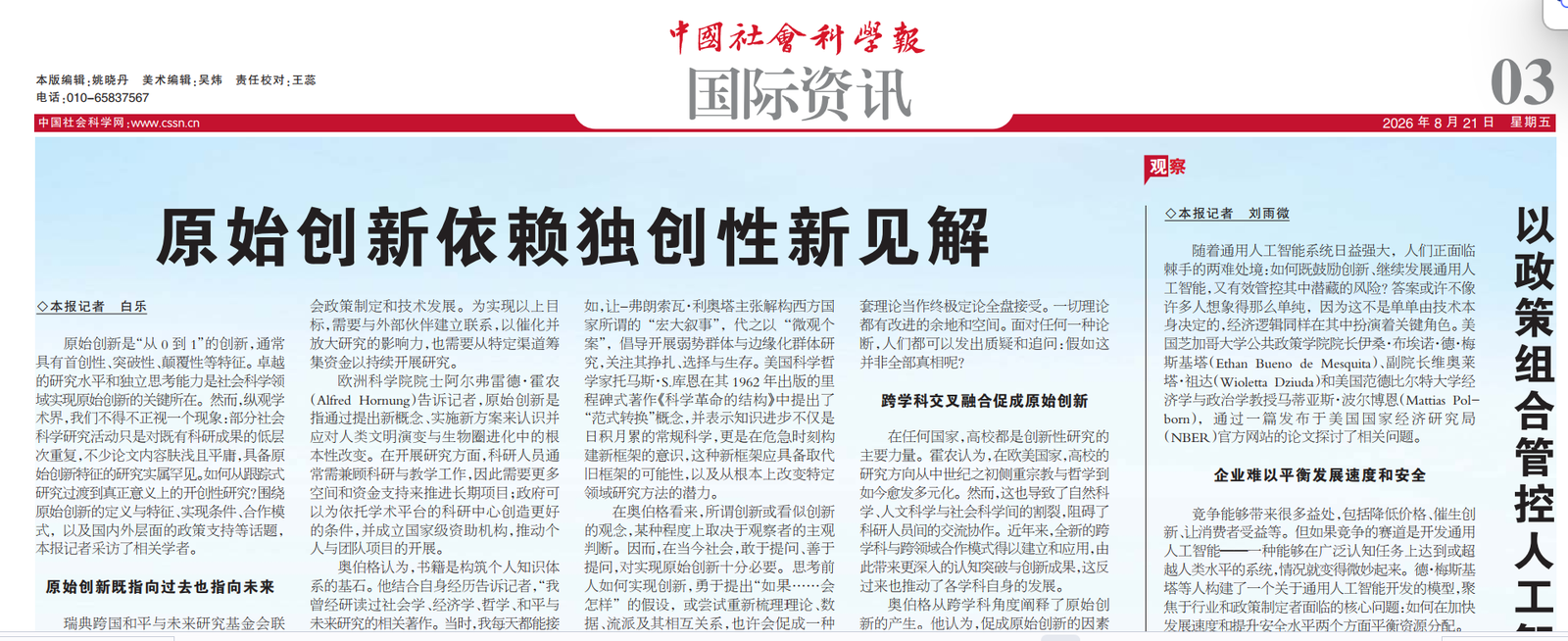
Jan ObergPhD, director, The Transnational Foundation for Peace and Future Research, TFFLund, Sweden October 2, 2026 This is my full original manuscript. The Chinese Academy of Social Science, CASS, makes two publications out if it. 1. China’s Five-year plan emphasized the capabilities of basic research and original innovation. It is regarded as the goal of the future social development, which, as required, should be significantly enhanced. Can you comment on the importance of original innovation in research and academic study? I believe it is easier to define “original innovation” in the natural sciences than in social sciences. The breaking points of what constitutes something new, or innovative, are not quite as sharp in the latter. But in both fields it is about opening up something that was closed, unseen, unexplored before – making manifest what was earlier latent. Innovations come in many forms and shapes – naming something that was not...
The agreement is catastrophic both because of what it says and what it doesn’t mention. It reduces further the major asset of security policies: Freedom of action. Jan Oberg TFF director September 25, 2026 A couple of hours before the agreement was signed on September 22, 2026, I published the following 13 hypotheses about what it would most likely contain on TFF Substack (in English). I was wrong on only the first point. Contrary to what Trump had written on his Truth Social platform, it does not appear to come into force immediately. In fact, it turned out to be worse than even I had anticipated. After these hypotheses now come a number of reflections in light of what the agreement actually contains, and does not contain, as well as the way in which it has generally been presented by major media outlets and by the public-service broadcaster DR. My...

Recent Articles

Tony Robinson October 4, 2026 Violence is easy to recognise when someone is being beaten, shot or killed. It becomes more difficult when nobody is holding a weapon. Poverty, discrimination, exploitation and repression can restrict a human life just as effectively, although they do so in very different ways and with very different consequences. Simply adding more categories to an ever-growing list of forms of violence does not really solve the problem. The more interesting question is what all these different situations have in common and why it makes sense to describe them using the same word. Human beings do not simply react to what happens around them. They remember the past, imagine things that do not yet exist, make plans and undertake projects. Workers organise because they imagine different working conditions; people migrate because they imagine another life somewhere else; social movements emerge because people refuse to accept the...
It’s a matter of principles, courage, vision and pulling together – while the militarist world is falling apart… Peter Langille October 3, 2026 “Here, then, is the problem which we present to you, stark and dreadful and inescapable: Shall we put an end to the human race; or shall mankind renounce war?”The Bertrand Russell—Albert Einstein Manifesto, July 9, 1955 ⁕ The forecast for what’s ahead is worrisome. The sharp rise in armed conflicts over the past three years is adding to what was already the highest level in over seventy years. Genocides, which should be prevented are supported. A shared climate emergency that jeopardises survival is ignored. Diverse polls now suggest that people are war-weary, worried and interested in a more effective United Nations. And, there are viable policy options for a more secure world! Yet governments are doubling-down, betting on more war and investing heavily. If current trends persist,...
Johan Galtung 1930-2024October 2015 Published here on October 3, 2026 Let us focus on Civilization for conflict analysis and remedies. Major forms of disorder use violence; war is state organized violence. The most belligerent states are the United States of America and Israel, both with civilization roots. National Evangelism, the US Protestant Christian civilization– more national than evangelical–justifies US warfare as exceptionalism of a people chosen by God, with a manifest destiny to run the world. Orthodox Judaism justifies Israeli warfare to conquer and expand from Nile to Euphrates as a religious right and duty to the Eternal One. The third most belligerent country, the UK, no longer believes it is God-chosen but chosen by the USA; not quite the same but something. But the root cause of global disorder lies in the Occident–with Islam–seeing itself as the single, universal civilization valid for all at all times, all others being...

TFF on Substack

Discover and subscribe to more peace materials on TFF Substack

Most Popular

Tony Robinson October 4, 2026 Violence is easy to recognise when someone is being beaten, shot or killed. It becomes more difficult when nobody is holding a weapon. Poverty, discrimination, exploitation and repression can restrict a human life just as effectively, although they do so in very different ways and with very different consequences. Simply adding more categories to an ever-growing list of forms of violence does not really solve the problem. The more interesting question is what all these different situations have in common and why it makes sense to describe them using the same word. Human beings do not simply react to what happens around them. They remember the past, imagine things that do not yet exist, make plans and undertake projects. Workers organise because they imagine different working conditions; people migrate because they imagine another life somewhere else; social movements emerge because people refuse to accept the...
It’s a matter of principles, courage, vision and pulling together – while the militarist world is falling apart… Peter Langille October 3, 2026 “Here, then, is the problem which we present to you, stark and dreadful and inescapable: Shall we put an end to the human race; or shall mankind renounce war?”The Bertrand Russell—Albert Einstein Manifesto, July 9, 1955 ⁕ The forecast for what’s ahead is worrisome. The sharp rise in armed conflicts over the past three years is adding to what was already the highest level in over seventy years. Genocides, which should be prevented are supported. A shared climate emergency that jeopardises survival is ignored. Diverse polls now suggest that people are war-weary, worried and interested in a more effective United Nations. And, there are viable policy options for a more secure world! Yet governments are doubling-down, betting on more war and investing heavily. If current trends persist,...
Johan Galtung 1930-2024October 2015 Published here on October 3, 2026 Let us focus on Civilization for conflict analysis and remedies. Major forms of disorder use violence; war is state organized violence. The most belligerent states are the United States of America and Israel, both with civilization roots. National Evangelism, the US Protestant Christian civilization– more national than evangelical–justifies US warfare as exceptionalism of a people chosen by God, with a manifest destiny to run the world. Orthodox Judaism justifies Israeli warfare to conquer and expand from Nile to Euphrates as a religious right and duty to the Eternal One. The third most belligerent country, the UK, no longer believes it is God-chosen but chosen by the USA; not quite the same but something. But the root cause of global disorder lies in the Occident–with Islam–seeing itself as the single, universal civilization valid for all at all times, all others being...
Read More
Living-Peace-Sign-Budapest-copy
Tony Robinson October 4, 2026 Violence is easy to recognise when someone is being beaten, shot or killed. It becomes more difficult when nobody is holding a weapon. Poverty, discrimination, exploitation and repression can restrict a human life just as effectively, although they do so in very different ways and with very different consequences. Simply adding more categories to an ever-growing list of forms of violence does not really solve the problem. The more interesting question is what all these different situations have in common and why it makes sense to describe them using the same word. Human beings do not simply react to what happens around them. They remember the past, imagine things that do not yet exist, make plans and undertake projects. Workers organise because they imagine different working conditions; people migrate because they imagine another life somewhere else; social movements emerge because people refuse to accept the...
b54a1f10-8c65-4f0b-9dd5-4abc0a7d04cc_2659x2659
It’s a matter of principles, courage, vision and pulling together – while the militarist world is falling apart… Peter Langille October 3, 2026 “Here, then, is the problem which we present to you, stark and dreadful and inescapable: Shall we put an end to the human race; or shall mankind renounce war?”The Bertrand Russell—Albert Einstein Manifesto, July 9, 1955 ⁕ The forecast for what’s ahead is worrisome. The sharp rise in armed conflicts over the past three years is adding to what was already the highest level in over seventy years. Genocides, which should be prevented are supported. A shared climate emergency that jeopardises survival is ignored. Diverse polls now suggest that people are war-weary, worried and interested in a more effective United Nations. And, there are viable policy options for a more secure world! Yet governments are doubling-down, betting on more war and investing heavily. If current trends persist,...
010
Johan Galtung 1930-2024October 2015 Published here on October 3, 2026 Let us focus on Civilization for conflict analysis and remedies. Major forms of disorder use violence; war is state organized violence. The most belligerent states are the United States of America and Israel, both with civilization roots. National Evangelism, the US Protestant Christian civilization– more national than evangelical–justifies US warfare as exceptionalism of a people chosen by God, with a manifest destiny to run the world. Orthodox Judaism justifies Israeli warfare to conquer and expand from Nile to Euphrates as a religious right and duty to the Eternal One. The third most belligerent country, the UK, no longer believes it is God-chosen but chosen by the USA; not quite the same but something. But the root cause of global disorder lies in the Occident–with Islam–seeing itself as the single, universal civilization valid for all at all times, all others being...
Screenshot 2026-10-02 011738
Jan ObergPhD, director, The Transnational Foundation for Peace and Future Research, TFFLund, Sweden October 2, 2026 This is my full original manuscript. The Chinese Academy of Social Science, CASS, makes two publications out if it. 1. China’s Five-year plan emphasized the capabilities of basic research and original innovation. It is regarded as the goal of the future social development, which, as required, should be significantly enhanced. Can you comment on the importance of original innovation in research and academic study? I believe it is easier to define “original innovation” in the natural sciences than in social sciences. The breaking points of what constitutes something new, or innovative, are not quite as sharp in the latter. But in both fields it is about opening up something that was closed, unseen, unexplored before – making manifest what was earlier latent. Innovations come in many forms and shapes – naming something that was not...
arctic-circle-map
The agreement is catastrophic both because of what it says and what it doesn’t mention. It reduces further the major asset of security policies: Freedom of action. Jan Oberg TFF director September 25, 2026 A couple of hours before the agreement was signed on September 22, 2026, I published the following 13 hypotheses about what it would most likely contain on TFF Substack (in English). I was wrong on only the first point. Contrary to what Trump had written on his Truth Social platform, it does not appear to come into force immediately. In fact, it turned out to be worse than even I had anticipated. After these hypotheses now come a number of reflections in light of what the agreement actually contains, and does not contain, as well as the way in which it has generally been presented by major media outlets and by the public-service broadcaster DR. My...
girl-5894831_1280
Below are TFF-related media mentions, comments, videos and social media posts published elsewhere but not on this homepage. We happen to catch and list only a fraction. Regarding video comments and debates, we recommend that you go to the TFF Video Channel on Substack where many of them are reproduced. Jan Oberg is a contributor to China Daily – 52 million daily clicks – and Global Times, CGTN and CCTV (the national television), China Investment, Xinhua News Agency and several others. Articles and videos on these media very often multiply into countless Chinese (and Western media) that re-post them from these main media. Thanks to The China Academy, his analyses, interviews and comments are frequently posted on YouTube channels such as Thinkers Forum and Wave Media. These videos are often re-posted on Bilibili (China’s YouTube), the China Content Center on TikTok, and on the Chinese edition of TikTok, Douyin.com. This means reaching hundreds of millions of viewers worldwide over a year. While there are too many to catch on all these...