Jan Oberg
PhD, director,
The Transnational Foundation for Peace and Future Research, TFF
Lund, Sweden
October 2, 2026
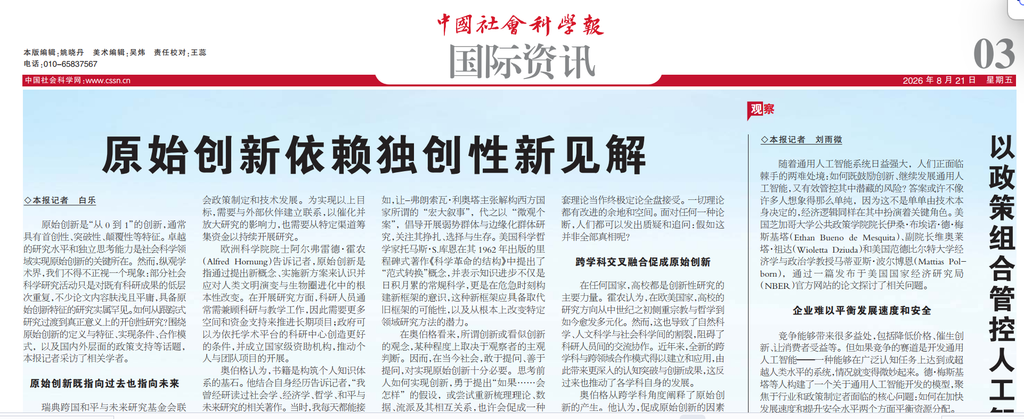
This is my full original manuscript. The Chinese Academy of Social Science, CASS, makes two publications out if it.
1. China’s Five-year plan emphasized the capabilities of basic research and original innovation. It is regarded as the goal of the future social development, which, as required, should be significantly enhanced. Can you comment on the importance of original innovation in research and academic study?
I believe it is easier to define “original innovation” in the natural sciences than in social sciences. The breaking points of what constitutes something new, or innovative, are not quite as sharp in the latter. But in both fields it is about opening up something that was closed, unseen, unexplored before – making manifest what was earlier latent. Innovations come in many forms and shapes – naming something that was not named before, developing a category or concept that re-organises what we thought before; it points both to the past and the future; it may also be an innovative interpretation of known facts, changing the level at which a concept or a theory seem to rest and finding that it works both on micro, meso and macro-levels. Important innovations may even give us a new worldview, seeing connections that were hidden before.
About twenty years ago, I wrote a chapter for an anthology about evil and how evil could explain violent behaviour. Almost all theories about evil had focused on individuals doing evil things, case studies of Adolf Hitler, etc. One of my – I believe innovative, at the time at least – ideas at the outset was to ask: What if evil does not exist only at the individual level? What if we could also talk about evil systems? Could only evil people create evil systems or could evil system create evil people – or make otherwise good people do evil things?
Related to that but on another level, I raised the question: Why do we have so much research on what is bad, evil or negative? People everywhere do a lot of good things – like helping each other, saving money for their children’s education, devote themselves to art instead of, say, plan the killing of others? How do they decide to forgive and reconciliation where other only want revenge? What makes these people happy?
Why is there no goodness research – research on what types of individuals and what types of social systems could be defined as good and tendentially free of violence – and how to promote factors of goodness as a way to reduce evil, aggression and violence – of which there is too much?
We surely need to study a disease to rid the world of it, but what if we also studied the (more) healthy living and healthy societies? Then we might get less of the diseases and the bad/negative things we want to get rid of, in the first place. Prevention rather than constant curing.
In today’s society is is almost revolutionary to say: What if? What if we did more research on where we want to go rather than spending so much time, energy and money on researching the things we want to eradicate.
Or, what if social sciences focused on peace, peace-making civil conflict-resolution methods and the factors of peaceful co-existence? On reconciliation and forgiveness rather than studying evil? While there is woefully little of it worldwide, research funds is increasingly allocated to warfare – or why we have violence and war – mostly based on the empirically unfounded hypothesis that the means of violence will eventually lead to a more peaceful world.
I do not know how much value what I just said has, but I am sure that the question: What if? – is absolutely necessary for original innovation, and that means and creative ability to look beyond the past and the present and focus imaginatively on possible futures – yes, future options in plural. Because: What if more futures are possible? Then we should develop scenarios for them, dialogue about them and then choose the one with the most merits for the largest number of citizens.
Regrettably, we have no research on what a fundamentally good, peaceful and less evil/violent society might look like.
2. For social sciences (which include many disciplines), how do you define “original innovation”? Original innovation is usually regarded as breakthrough research or research of originalities. But for most disciplines of social sciences, it is actually difficult to achieve “original innovation”in the real sense. Do you think so?
Let’s start out an answer by saying that innovation is both a personality thing and a milieu/culture thing. There are inviduals who sees potentials better than others, who have visions, more or less “wild” ideas, like to exercise their ability to ask What If? questions or see how theories, data and their relations could be re-organised and bring new insights. There are people who think in either linear or circular ways and those who do both – organic, mechanic and holistic.
On the other hand, there are milieus that stimulate the people in them to become more innovative – highly intensive, permissive of new ideas, with healthy competition, good listening, testing ideas in What If dialogues, encouraging each other to try a hypothesis and/or experiment with images of the future – and apply them back to a problem to be solved. There are multi-dimensional and -disciplinary milieus and, on the other hand, there are idea-killing uni-dimensional research “cultures” imbued with the bureaucratic-facory-like attitudes: Here we do what we are told to and paid for, we come at 9 AM and go home at 4 PM, and that’s it. However, truth is that creativity does not stop at 4PM.
And there are countries that cultivate and reward innovation – like China – and there are countries whose government support mainly repetitive, politically correct and non-innovative approaches – often countries that have peaked and are on their way down, comparatively speaking.
And I would like to add a fourth dimension – the Zeitgeist, the domain values of an epoch in time. There is no doubt in my mind that in the Western hemisphere, the 1960s to 1980s were times of creativity in many fields, of innovative thinking, an open-minded age of exploration and What If experiments.
Today’s West is, of course with notable exceptions, the wholesale negation of such an Zeitgeist. Debates about how things could – or should – be have vanished, or rather, been disappeared.
Where the constellation of the four – individual, milieu, national/governmental and the times – reinforce synergy, amasing things may indeed happen and churn out innovative social science.
3. In your opinion, what are the right ways and methods to achieve “original innovation”? In most cases, the social science research is about low-level repetition of the already existing papers/works, and about superficial, quick, and mediocre content. Research with“original innovation”is actually rare. Can you comment on this?
What is, or appears, innovative is very much in the mind of the beholder. When I was in my twenties and studied sociology, economics, some philosophy, peace and future research, I felt I came across innovative concepts, theories and data – even methodologies – every day. In hindsight, some of the authors whose works I studied back then were indeed innovative (fortunately, I had good teachers in most of these subjects who encouraged deep and broad reading and books were the bricks of one’s intellectual house, since there was no internet, no AI, no computers and rather little of today’s superficial secondary literature and summaries; one studied the original texts and, of essential importance, the long argument).
But the point I want to make is that what appears innovative depends a lot on how much you already know. Those who already know a lot, may find it more difficult to come by real original work and innovative new concepts and theories – because, one way or the other, they have seen a lot already. On the other hand, that is also precisely what permits the experienced scholar to spot a real innovation when it happens – or create on.
What is conducive to being innovative?
There are many factors, among which I would highlight: Borrow or be inspired by models from other sciences; cross-fertilisätion, multi-disciplinary dialogues, apply metaphors, find inspiration in non-scientific fields such as literature and other arts; and try to look at a problem through the lenses of the past – how were innovations done before? – and imagine a future in which the problem you grapple with has already been solved.
And, simply, look at the world and ask: Why does it have so many problem, why is it sub-optimnal for so many human beings? What more do we need to understand it better? How can it be changed?
C. Wright Mills invented the wonderful concept of the sociological imagination in his book with the same title, published in 1959. He argues that to understand any individual life, you must see how it is shaped by larger historical forces and social structures. Conversely, to understand society, you must see how it is created by many and different humans, lived and experienced by individuals. This “grasp” of the connection between personal biography and public history is the core of sociological imagination. Being aware of that connection and use it is, I believe, essential for social science innovation.
Social science is about life, life lived. It is not just something that takes place in rooms that has a research name on the doors.
If you are unhappy with a theory or concept – if it kind of does not really explain a social phenomenon, try to improve upon it, introduce a new variable, ask what it does not explain: Never buy a theory as if it were the last word – everything can be improved on, and to every truth, we can say What If: What if it is not the whole truth?
Very important in all this is to apply heuristic methods, brain storms, individual and team thinking, etc. If, for instance, we want to understand the impact of Artificial Intelligence (AI) on society at large, see its positive and negative, perhaps dangerous, potentials, we have to imagine the future society and cannot just focus on the past and the present. And we may also use the experience from the impact of earlier technological innovations on society; at the time when travelling at the speed of horses was normal, many seem to have believed that the first cars spelled the end of the world.
Further, a crisis or some unexpected event can/should stimulate innovation: How could that happen, and how do we prevent it from happening again, or predict it better? In other words, changes in the empirical reality can have positive effects on onnovation.
I would also like to touch upon the fact that, in certain, more mainstream, setting it may take intellectual courage to challenge the canonical thinkers and displinary norms, saying aloud that this or that correlation is not as strong as we liked to believe. If research can be seen as a permanent interplay between Data, Theories and Values (Johan Galtung’s D-P-T methodology theory), the implication is that a change in one reverberates through the others and that there are no permanent truths, only dynamic change, in social science.
Finally, I believe that time is important. Sometimes you can produce something of quality when under heavy time pressure; there is no necessary proportionality between time spent and results produced – as there is no such thing either in, say, photographic art or in finding that little musical theme that can carry itself through a whole piece of music. However, free thinking often does require free time, long reflection, intellectual/philosophical experimentation and letting things stay for a while in the incubator: Quick thinking + slow re-search = new thoughts. Innovations doesn’t come with search only, it comes with re-search.
Finally, one must be aware that ideas that help innovation may appear at the most strange moments, perhaps when you do exercise, brush your teeth, take a walk along a beautiful coast, sit and meditate, drink a coffee, do a watercolour or by doing something. You can sit an think for a long time but when you begin to put down your thoughts in a written article and look for the consistency of the argument you may actually stumble upon an innovation – a What if? I believe in thinking but also in taking action. Writing is a creative activity and in and of itself, it may stimulate new thinking.
Since ideas tend to slip away quickly again, it is wise to jot them down immediately in a small notebook or on one’s mobile we always carry with us. For some people, ideas may come when they have just woken up in the morning, so keep that notebook or mobile on your bedside table.
4. In your opinion, how to transit from follow-up studies to pioneering research? What are the prerequisites for original innovation? For instance, the enthusiasm of researchers; a favorable academic atmosphere; support from national policies; and outstanding academic research capabilities.Can you talk about this?
I think that here and there in the above, I have said something that could also serve as my answer to these questions. Obviously, the things you mention – enthusiasm, permissive and open-minded atmosphere, national support and knowledge about other outstanding academic achievements are urgently important.
Should I add one more cluster of factors, it would be discipline and hard work coupled with positive energy: Innovations grow out of joy and a positive attitude to work and life. Those who see research as a more or less boring duty and/or are not willing to do their best are not likely to produce innovations. And when you like to do social science, creativity come close to playing – playing borderlessly. Children can be very creative and imaginative because they do not think of rules; then they get an education and usually becomes less creative through their schooling experience and their being fit for employment in the market place.
5. Do you have anything else to say about this topic?
Oh, there are lots of things to discuss around the issue of innovation in society in general and in the social sciences in particular.
If you take an interest in macro-history a la Arnold Toynbee, societies rise and mature through innovation and vision while declining societies have not really understood that it was dangerous to be # 1 and that growth requires constant innovation; they begin to relax, lean back and be complacent and too satisfied with their own achievements and they keep teaching the world instead of learning from it. Curiosity disappeared on the way.
Being humble and always curious about learning increases the capacity for innovation – the innovation that becomes permanent but never self-satisfied. I hardly have to point out that the US-NATO-EU world belongs to that declining group. Knowing that change is the only constant, China has so far remained constantly innovative in many fields, also in term of fundamental societal development.
I am in no way a China expert, but I believe that if China keeps as a basic belief that everything can always become better tomorrow, it will continue to serve both itself, its people and the world. Social – and cultural – sciences are, in my view, at least as important as natural sciences to create the ever-better-for-everybody society.
Technological innovation is cherished and discussed all the time and globally. In closing, I would like to suggest that we upgrade social sciences and the humanities as well as societal innovation worldwide to secure a more balanced, stable and shared development for all humanity in the future. To put it crudely, there is too much fascination with technology and tools – and too little with dialoguing about the good society we hope these tools shall build.
Here is the link to the published article – should you read Chinese.
◩