
Déjà Vu-25 Years Later

Heyerdahl Burns “Tigris” Reed Ship to Protest War 

By Betty Blair
ai@artnet.net
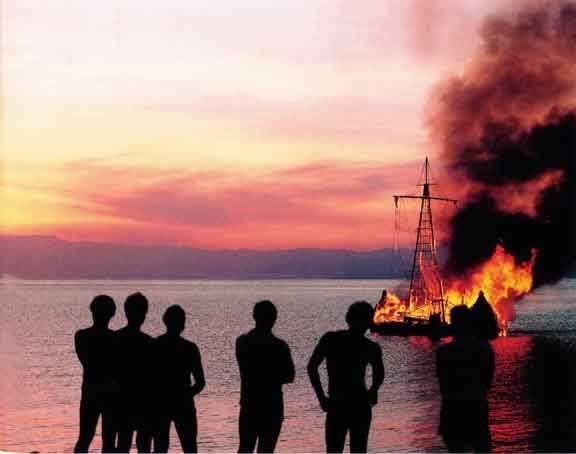
Thor Heyerdah with his international crew of 11 members had just completed a 5 month journey of 4,200 miles that began in the Tigris Valley. Here he sets his reed boat “Tigris” at Djibouti, Africa ablaze in protest of the numerous wars going on in the region which were fueled by Western and Soviet sales of military arms. Photo: April 3, 1978

© The Kon-Tiki Museum, Oslo, Norway. Used with Permission.

April 2, 2003

Twenty-five years ago, on April 3, 1978, Thor Heyerdahl (1914-2002) was just completing a 4,200-mile voyage on a 60-foot reed ship known as the Tigris. His journey had started at the place many consider to be the birth of civilization – the verdant valley between the Euphrates and Tigris rivers in Iraq. Setting sail from the banks of the Tigris, Thor and his crew navigated down the Persian Gulf to Oman and eastward to the Indus Delta of Pakistan. Then they reversed direction and headed back across the Indian Ocean in the direction of the Horn of Africa. It was the last of Thor’s four trans-oceanic voyages, the first being the well-known 1949 Kon-Tiki voyage made on a balsawood raft from the coast of Peru to the Polynesian Islands.

The Tigris’ crew comprised 11 multinational members: Thor Heyerdahl (Norway), navigator Norman Baker (USA), art student and interpreter Rashad Nazi Salim (Iraq), underwater cameraman Toru Suzuki (Japan), professional photographer Norris Brock (USA), young navy captain Detlef Zoltzek (Germany), physician Yuri Senkevitch (USSR), mountain climber and expert with ropes Carlo Mauri (Italy), amateur archeologist Ghermán Carrasco (Mexico) and students Hans Petter Bohn (Norway) and Asbjørn Damhus (Denmark).

After surviving the treacherous five-month journey at sea, Thor had wanted to end his voyage in the port of Mitsiwa (now Massawa) on the western (African) side of the Red Sea. It was through this port that Thor had originally brought the reeds from Lake Tana in Ethiopia for the building of two earlier experimental ships, Ra I and Ra II.

No Place to Land

But Ethiopia was involved with a breakaway war with the Eritreans. Nearby Somalia was at war, too. On the opposite side of the Gulf of Aden, civil war had erupted in Yemen. Thor and his crew decided to try to steer in the middle of the Gulf between Yemen and Somalia. However, when the winds died down, navigating the primitive reed craft became extremely difficult and they began drifting towards the island of Socotra, which belonged to South Yemen and on which the Soviets were installing military hardware at that time. Eventually, they had no choice but to land in the newly established African nation of Djibouti, a small neutral country squeezed in between Somalia and Ethiopia.

Heyerdahl’s experiment again proved that early man could have successfully navigated immense distances across seas and oceans thousands of years ago. The Tigris, constructed of buoyant river reeds, had been a fine sea-worthy vessel.

They had survived on sea, only to be denied a place to land because the entire region was engulfed in war. In the end, Heyerdahl decided to torch the Tigris, setting it ablaze as a bonfire for peace, protesting the wars that were raging, fueled by arms sales by the major Western powers, including the Soviet Union. The crew members stood on the coral reef in silent awe at the ironic fate of the Tigris, watching the hoisted sails flare up like a torch as the red sunset disappeared behind the dark African mountains.

Burning the Tigris was a difficult decision for Thor, but it was also his way of not letting the ship rot amidst the warships and man-made pollution found in the harbor off Djibouti. Also it meant that no one would be able to exploit the ship for their own commercial benefit. Saddam Hussein, too, had been eager to use the reed ship for his own public relations purposes, as it had originally been assembled in Iraq. Heyerdahl’s earlier vessels, the Kon Tiki (made of balsa logs) and Ra II (made of reed), are both on exhibition at the Kon Tiki Museum in Norway.

On April 3, 1978, Heyerdahl wrote the following Open Letter to Secretary-General Kurt Waldheim of the United Nations to explain why he had burned his ship as a desperate plea for world cooperation. His call for sanity is as relevant today as it was 25 years ago.

Open Letter to UN

Heyerdahl sent the following Open Letter to Secretary General Waldheim from the Republic of Djibouti, Africa on April 3, 1978.

As the multinational crew of the experimental reed-ship Tigris brings the test voyage to its conclusion today, we are grateful to the Secretary-General for the permission to have sailed under United Nations’ flag, and we are proud to report that the double objectives of the expedition [of succeeding on a transoceanic voyage with a primitive craft manned by an international crew] have been achieved to our complete satisfaction.

Ours has been a voyage into the past to study the qualities of a prehistoric type of vessel built upon ancient Sumerian principles. But it has also been a voyage into the future to demonstrate that no space is too restricted for peaceful coexistence of men who work for common survival. We are 11 men from countries governed by different political systems. We have sailed together on a small raft-ship of tender reeds and rope a distance of over 6,000km [4,200 miles] from the Republic of Iraq by way of the Emirates of Bahrain, the Sultanate of Oman and the Republic of Pakistan to the newly-born African nation of Djibouti.

We are able to report that in spite of different political views, we have lived and struggled together in perfect understanding and friendship, shoulder to shoulder in cramped quarters through calm and storms, always according to the ideals of the United Nations: cooperation for joint survival. When we embarked last November on our reed-ship Tigris, we knew we would sink or survive together, and this knowledge united us in friendship. When we now, in April, disperse to our respective homelands, we sincerely respect and feel sympathy for each other’s nations.

Our joint message is not directed to any one country but to modern man everywhere. We have shown that the ancient people in Mesopotamia, the Indus Valley and Egypt could have built man’s earliest civilizations through the benefit of mutual contact with the primitive vessels at their disposal 5,000 years ago. Culture arose through intelligent and profitable exchange of thoughts and products.

Today we burn our proud ship, though the sails and rigging are still up and the vessel is in perfect shape, to protest against inhuman elements in the world of 1978 to which we have come back as we reach land after sailing the open seas. Now we are forced to stop at the entrance to the Red Sea. Surrounded by military airplanes and warships from the world’s most civilized and developed nations, we have been denied permission by friendly governments, for reasons of security, to land anywhere, but in the tiny, and still neutral, republic of Djibouti. Elsewhere around us, brothers and neighbors are engaged in homicide with means made available to them by those who lead humanity on our joint road into the third millennium.

To the innocent masses in all industrialized countries, we direct our appeal. We must wake up to the insane reality of our time, which to all of us has been reduced to mere unpleasant headlines in the news. We are all irresponsible, unless we demand from the responsible decision makers that modern armaments must no longer be made available to people whose former battle axes and swords our ancestors condemned.

Our planet is bigger than the reed bundles that have carried us across the seas, and yet small enough to run the same risks unless those of us still alive open our eyes and minds to the desperate need of intelligent collaboration to save ourselves and our common civilization from what we are about to convert into a sinking ship.

_______

Please feel free to post and share this article about Thor Heyerdahl’s protest of war.

Further inquiries:
Betty Blair ai@artnet.net

Bjornar Storfjell, Director of Thor Heyerdahl Centre in English: jbs@thorheyerdahl.org

Share

Leave a Reply

Your email address will not be published. Required fields are marked *

Related Posts

LONDON – So far so good, at least on the wider level. While internally Iraq seems on the edge of chaos, the much heralded clash of civilizations between the Muslim and Judaeo-Christian worlds has yet to become apparent. We have anger and despair aplenty in the Arab and Muslim worlds. But very little rushing to the standard and there was no great pilgrimage of warriors to join the fight, as happened when the Soviet Union invaded Afghanistan twenty years ago, and then, having driven the Red Army out, were left to ferment in that mountainous redoubt. With the armaments supplied by the CIA the mujahidin were transformed into Al Qaeda that became, for a relatively brief moment as these things go, ‘the greatest threat to the homeland that America has ever known.’ Nevertheless a ‘Cold War’ between much of the Muslim world and the West is certainly in full swing. Winston...
The Challenge of Nuclear Weaponsin the Twenty-first CenturyA Path Forward The peoples and governments of the world face an urgent challenge relating to weaponry of mass destruction and particularly to nuclear weaponry.  At the crossroads of technology, terrorism, geopolitical ambition, and policies of preemption are new and potent dangers for humanity. Despite ending the nuclear standoff of the Cold War era, nuclear weaponry is again menacing the peoples of the world with catastrophic possibilities.  We recognize the need for any government to pursue its security interests in accordance with international law; and further, we recognize that distinctive threats to these interests now exist as a result of an active international terrorist network having declared war on the United States and its allies. Nonetheless, we reject the assessment of the current US administration that upgrading a reliance on nuclear weapons is in any sense justified as a response. We find it...
By Karin Wegestal MP, the Social Democratic Partyon behalf of the Swedish Committee for Solidarity with the Yugoslav People During the last decade, the Federal Republic of Yugoslavia has received more than 500,000 refugees from Croatia and Bosnia, and another 300,000 internally displaced persons, mainly from the province Kosovo and Metohia. For a country with about ten million inhabitants, such an influx of homeless people is obviously a very heavy burden – even under peaceful conditions. But in addition to that, the Federal Republic of Yugoslavia has been the subject to sanctions from the western powers for close to ten years and its infrastructure was badly hurt through Nato’s intense bombardment during 78 days in 1999. The result of all this is that Yugoslavia, once the most developed industrial country in Eastern Europe, is today the poorest country in Europe. In Serbia excluding Kosovo, with about ten million inhabitants and...

Recent Articles

The most recent on top Farhang Jahanpour, January 7, 2012 As US and Iran confront each other, where is the diplomacy? Farhang Jahanpour, August 3, 2011 Iran can’t reform itself – the power struggle bewtween Ahmadinejad and Khamenei Farhang Jahanpour, May 17, 2011 Is Iran next? The Supreme Leader versus Ahmadinejad Farhang Jahanpour, March 4, 2011 The revolutions in the Arab world: The need for long-term thinking and humility Farhang Jahanpour, December 15, 2010 The Wikileak files: The banality of politics Farhang Jahanpour, November 18, 2010 This is what ought to be the U.S.’s interests in the Middle East! Farhang Jahanpour – Video on Vimeo, October 6, 2010 Towards a solution in the Middle East Farhang Jahanpour and Susanne Sklar, July 28, 2010 Dialogue on nuclear weapons and culture of peace by TFF Associate and a TFF friend Farhang Jahanpour, July 28, 2010 Iran, Turkey and Israel – New Global...
Lidt om bogen Bogens indhold Bestil bogen her Anmeldelser Siden den kolde krigs afslutning har dansk udenrigs- og sikkerhedspolitik bevæget sig langt ind i en politisk og moralsk blindgyde. Men det tjener hverken os eller verden at Danmark er blevet en krigs- og besættelsesmagt, viser den internationalt respekterede danske freds- og fremtidsforsker, Jan Øberg i denne bog. Tværtimod mindsker det vores og andres sikkerhed og bidrager til at øge, snarere end at mindske, terrortruslen. Forudsigelig fiasko – der udkommer 4. juni 2004 – sætter fokus på det irakiske samfund og Vestens måde at betragte og behandle Irak på. Jan Øberg kombinerer konkret konfliktanalyse med et personligt engagement, og underbygger overbevisende og konsekvent det synspunkt, at Vestens mangelfulde konfliktforståelse og ukyndige konflikthåndtering måtte ende med den ulykkelige krig. Det er en krig, som efter forfatterens opfattelse hverken kan fremme ædle motiver – etablere et demokratisk Irak – eller økonomisk-kulturelle interesser, men...
Burundi – hopp om fred Burundi, var är det nu det ligger? Det är nånting med Hutsier och Tutuer – eller vad de nu heter – som mördar varandra med machete-knivar, nånting med fattigdom, korruption, militärdiktatur, nöd och elände? Det hopplösa, mörka Afrika i ett bananskal, eller hur? Tja. Jag har precis varit där. Det ligger naturligtvis någonting i det. Och det finns en del orsaker till att vi inte ser mycket om landet i massmedia. En av dem är att det inte försiggår något folkmord just nu, ingen naturkatastrofer, ingen kupp. Det finns ingen misslyckad FN-mission, USA och EU har få intressen, Madeleine Halfbright har inte sagt något om det nyss, NATO:s Solana ser inte bombningar i Burundi som viktiga för firandet av alliansens 50-årsdag i april. För en tid sedan då 50 människor mördades strömmade hundratals journalister med CNN i spetsen till Burundi…men för att snabbt försvinna till Kongo...

TFF on Substack

Discover more from TFF Transnational Foundation & Jan Oberg.

Most Popular

The most recent on top Farhang Jahanpour, January 7, 2012 As US and Iran confront each other, where is the diplomacy? Farhang Jahanpour, August 3, 2011 Iran can’t reform itself – the power struggle bewtween Ahmadinejad and Khamenei Farhang Jahanpour, May 17, 2011 Is Iran next? The Supreme Leader versus Ahmadinejad Farhang Jahanpour, March 4, 2011 The revolutions in the Arab world: The need for long-term thinking and humility Farhang Jahanpour, December 15, 2010 The Wikileak files: The banality of politics Farhang Jahanpour, November 18, 2010 This is what ought to be the U.S.’s interests in the Middle East! Farhang Jahanpour – Video on Vimeo, October 6, 2010 Towards a solution in the Middle East Farhang Jahanpour and Susanne Sklar, July 28, 2010 Dialogue on nuclear weapons and culture of peace by TFF Associate and a TFF friend Farhang Jahanpour, July 28, 2010 Iran, Turkey and Israel – New Global...
Lidt om bogen Bogens indhold Bestil bogen her Anmeldelser Siden den kolde krigs afslutning har dansk udenrigs- og sikkerhedspolitik bevæget sig langt ind i en politisk og moralsk blindgyde. Men det tjener hverken os eller verden at Danmark er blevet en krigs- og besættelsesmagt, viser den internationalt respekterede danske freds- og fremtidsforsker, Jan Øberg i denne bog. Tværtimod mindsker det vores og andres sikkerhed og bidrager til at øge, snarere end at mindske, terrortruslen. Forudsigelig fiasko – der udkommer 4. juni 2004 – sætter fokus på det irakiske samfund og Vestens måde at betragte og behandle Irak på. Jan Øberg kombinerer konkret konfliktanalyse med et personligt engagement, og underbygger overbevisende og konsekvent det synspunkt, at Vestens mangelfulde konfliktforståelse og ukyndige konflikthåndtering måtte ende med den ulykkelige krig. Det er en krig, som efter forfatterens opfattelse hverken kan fremme ædle motiver – etablere et demokratisk Irak – eller økonomisk-kulturelle interesser, men...
Burundi – hopp om fred Burundi, var är det nu det ligger? Det är nånting med Hutsier och Tutuer – eller vad de nu heter – som mördar varandra med machete-knivar, nånting med fattigdom, korruption, militärdiktatur, nöd och elände? Det hopplösa, mörka Afrika i ett bananskal, eller hur? Tja. Jag har precis varit där. Det ligger naturligtvis någonting i det. Och det finns en del orsaker till att vi inte ser mycket om landet i massmedia. En av dem är att det inte försiggår något folkmord just nu, ingen naturkatastrofer, ingen kupp. Det finns ingen misslyckad FN-mission, USA och EU har få intressen, Madeleine Halfbright har inte sagt något om det nyss, NATO:s Solana ser inte bombningar i Burundi som viktiga för firandet av alliansens 50-årsdag i april. För en tid sedan då 50 människor mördades strömmade hundratals journalister med CNN i spetsen till Burundi…men för att snabbt försvinna till Kongo...
Read More
The most recent on top Farhang Jahanpour, January 7, 2012 As US and Iran confront each other, where is the diplomacy? Farhang Jahanpour, August 3, 2011 Iran can’t reform itself – the power struggle bewtween Ahmadinejad and Khamenei Farhang Jahanpour, May 17, 2011 Is Iran next? The Supreme Leader versus Ahmadinejad Farhang Jahanpour, March 4, 2011 The revolutions in the Arab world: The need for long-term thinking and humility Farhang Jahanpour, December 15, 2010 The Wikileak files: The banality of politics Farhang Jahanpour, November 18, 2010 This is what ought to be the U.S.’s interests in the Middle East! Farhang Jahanpour – Video on Vimeo, October 6, 2010 Towards a solution in the Middle East Farhang Jahanpour and Susanne Sklar, July 28, 2010 Dialogue on nuclear weapons and culture of peace by TFF Associate and a TFF friend Farhang Jahanpour, July 28, 2010 Iran, Turkey and Israel – New Global...
Lidt om bogen Bogens indhold Bestil bogen her Anmeldelser Siden den kolde krigs afslutning har dansk udenrigs- og sikkerhedspolitik bevæget sig langt ind i en politisk og moralsk blindgyde. Men det tjener hverken os eller verden at Danmark er blevet en krigs- og besættelsesmagt, viser den internationalt respekterede danske freds- og fremtidsforsker, Jan Øberg i denne bog. Tværtimod mindsker det vores og andres sikkerhed og bidrager til at øge, snarere end at mindske, terrortruslen. Forudsigelig fiasko – der udkommer 4. juni 2004 – sætter fokus på det irakiske samfund og Vestens måde at betragte og behandle Irak på. Jan Øberg kombinerer konkret konfliktanalyse med et personligt engagement, og underbygger overbevisende og konsekvent det synspunkt, at Vestens mangelfulde konfliktforståelse og ukyndige konflikthåndtering måtte ende med den ulykkelige krig. Det er en krig, som efter forfatterens opfattelse hverken kan fremme ædle motiver – etablere et demokratisk Irak – eller økonomisk-kulturelle interesser, men...
Burundi – hopp om fred Burundi, var är det nu det ligger? Det är nånting med Hutsier och Tutuer – eller vad de nu heter – som mördar varandra med machete-knivar, nånting med fattigdom, korruption, militärdiktatur, nöd och elände? Det hopplösa, mörka Afrika i ett bananskal, eller hur? Tja. Jag har precis varit där. Det ligger naturligtvis någonting i det. Och det finns en del orsaker till att vi inte ser mycket om landet i massmedia. En av dem är att det inte försiggår något folkmord just nu, ingen naturkatastrofer, ingen kupp. Det finns ingen misslyckad FN-mission, USA och EU har få intressen, Madeleine Halfbright har inte sagt något om det nyss, NATO:s Solana ser inte bombningar i Burundi som viktiga för firandet av alliansens 50-årsdag i april. För en tid sedan då 50 människor mördades strömmade hundratals journalister med CNN i spetsen till Burundi…men för att snabbt försvinna till Kongo...
Mr President ! President Bill Clinton gjorde i tisdags en blixtvisit i Kosovo. I ett tal manade han albanerna att sluta hämnas på den krympande serbiska minoriteten. Han besökte också de amerikanska soldaterna på den nya Bondsteelbasen. Det finns viktiga frågor som borde ha ställts still honom om Balkan och Kosovo och om USA:s ledande roll i bombningarna av Jugoslavien. Det borde vara en självklarhet att oberoende medier i demokratiska länder låter politiska ledare svara på viktiga frågor. Men ställdes verkligen de viktiga frågorna? Här är några frågor som jag skulle ha ställt ˆ om jag vore journalist och hade fått tillfälle att göra en intervju i tisdags. (1) Mr President! Amerikanska plan bombade i våras Jugoslavien och Kosovo med er som överbefälhavare. Aktionen rättfärdigades av uppgifter om ett folkmord planerat av Belgrad. Dessa uppgifter har nu visat sig vara grovt missvisande eller falska. Hur ställer Ni er till detta?...
Burundi – håb forude Burundi, hvor er det nu det ligger? Det er noget med Hutsier og Tutuer – eller hvad de nu hedder – der laver folkemord med machete-knive på hinanden, noget med fattigdom, korruption, militærdiktatur, nød og elendighed? Det håbløse, mørke Afrika i en bananskal, ikke? Tjah. Jeg har lige været der. Der er selvfølgelig noget om snakken. Der er en del årsager til at man ikke hører særligt meget om livet i dette lille land. En af dem er at der ikke foregår noget folkemord for tiden, ingen naturkatastrofer, intet kup. Der er ingen mislykket FN-mission, USA og EU har ingen interesser, Madeleine Halfbright har ikke sagt noget om det, NATO’s Solana ser ikke bombinger i Burundi som afgørende forud for alliancens 50årsdag. For nogen tid siden da et halvt hundrede mennesker var blevet dræbt valfartede hundreder af journalister med CNN i spidsen dertil . . . men...
Rambouillet (Rambo-Yeah) og Rashid Vi skriver fredag den 19. januar. For få dage siden kom jeg hjem fra små tre uger i Skopje, Beograd og Kosovo. Min analyse og min intuition siger mig dét, jeg ikke vil høre: bombningerne nærmer sig. Det var 34. besøg siden 1991. Jeg er delvist uddannet i Dubrovnik, fra 1974. Jeg kan ikke slippe det. Det er altså også mit land, der atter trues af den kulturkreds, jeg tilhører. Radmila og Peca i Beograd, venner siden 1974, intellektuelle der har valgt ikke at forlade landet og netop har sagt nej til et ophold i udlandet. Datteren Anja på 9 skal vokse op hér. "Jeg rejste ned nu," siger jeg, "fordi der enten ville falde bomber eller blive en eller anden slags ‘forhandling’ og jeg vil være hér hvis I blir bombet, for jeg skammer mig over hvad Danmark og andre lande gør." Hun får tårer...