
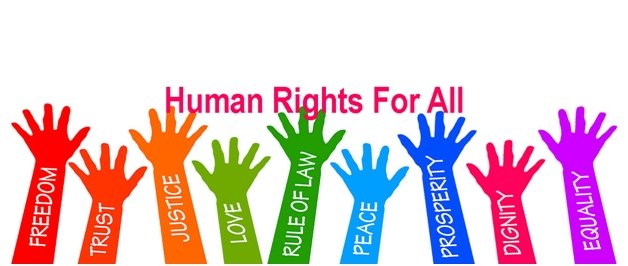
Baher Kamal: All Humans Are Born Equal in Rights? That’s Still Far from Being True

By Baher Kamal

December 25, 2021

MADRID, Dec 6 2021 (IPS) – ”All human beings are born free and equal in dignity and rights.” These words are a sound introduction to the transcendental issue of human rights and equalities, as stated by the 1948 Universal Declaration of Human Rights (UDHR).

The Declaration proclaims the “inalienable rights that everyone is entitled to as a human being – regardless of race, colour, religion, sex, language, political or other opinion, national or social origin, property, birth or other status.”

“All Human, All Equal” is the slogan for the 2021 Human Rights Day, marked 10 December. Its theme relates to equality: “The principles of equality and non-discrimination are at the heart of human rights.”According to the UN, “equality, inclusion and non-discrimination, in other words – a human rights-based approach to development  – is the best way to reduce inequalities and resume the path towards realising the 2030 Agenda”

“Equality includes addressing and finding solutions for deep-rooted forms of discrimination that have affected the most vulnerable people in societies, including women and girls, indigenous peoples, people of African descent, LGBTI people, migrants and people with disabilities, among others.”

According to the UN, “equality, inclusion and non-discrimination, in other words – a human rights-based approach to development – is the best way to reduce inequalities and resume the path towards realising the 2030 Agenda,” which principle is leaving no one behind.

Shamefully, this is not the case. In spite of all well-intentioned words, declarations, statements and appeals, the grave spread of inequalities all over the world remains prevailing and expanding.

The numerous and severe aspects of inequality are manifested in rampant poverty, pervasive inequalities and structural discrimination are human rights violations and among the greatest global challenges of the current time.

A new social contract urgent

Human rights, including economic, social and cultural rights as well as the right to development and the right to a safe, clean, healthy and sustainable environment, are central to building a new human rights-based economy that supports better, fairer and more sustainable societies for present and future generations. A human rights-based economy should be the foundation of a new social contract, according to World Day.

Here are just some examples of the prevailing violation of the most basic freedom, equality and human rights.

Racism

Racism is just one of the various severe forms of inequality.

In fact, racism, xenophobia and related discrimination and intolerance exist in all societies, everywhere. Racism harms not just the lives of those who endure it, but also society as a whole.

“We all lose in a society characterised by discrimination, division, distrust, intolerance, and hate. The fight against racism is everyone’s fight. We all have a part to play in building a world beyond racism,” the UN urges.

The COVID generation

Successive financial and health crises have had long-lasting and multidimensional impacts on millions of young people, according to this year’s World Day.

Unless their rights are protected, including through decent jobs and social protection, the “COVID generation” runs the risk of falling prey to the detrimental effects of mounting inequality and poverty.

Vaccine inequality

Vaccine injustice through unfair vaccine distribution and hoarding contravenes international legal and human rights norms and the spirit of global solidarity.

In fact, while rich societies have reached between 70 and 80 per cent of vaccination, only 1 per cent of the population of some countries in Africa has been vaccinated.

Climate injustice

Environmental degradation, including climate change, pollution and nature loss, disproportionately impacts persons, groups and peoples in vulnerable situations. These impacts exacerbate existing inequalities and negatively affect the human rights of present and future generations.

In a follow-up to the Human Rights Council’s recognition of the human right to a clean, healthy and sustainable environment, urgent action must be taken to respect, protect and fulfil this right.

“Such action should be the cornerstone of a new human rights-based economy that will produce a green recovery from COVID-19 and a just transition.”

According to recent estimates, the number of climate migrants and refugees could rise to up to one billion in the coming few years.

They would proceed from continents and countries that are the least polluting and the least responsible for the ongoing climate emergency.

For example, Africa has generated around four per cent of the causes of the climate crisis, while bearing the brunt of 80 per cent of its consequences.

Conflicts inequality

Human rights have the power to tackle the root causes of conflict and crisis, by addressing grievances, eliminating inequalities and exclusion and allowing people to participate in decision-making that affects their lives, says the UN.

“Equality and non-discrimination are key to prevention: all human rights for all ensure everyone has access to the preventive benefits of human rights but, when certain people or groups are excluded or face discrimination, the inequality will drive the cycle of conflict and crisis.”

Women, girls

Such an abhorrent abuse against women and girls is carried out all over the world. In fact, one-third of all women and girls have been subjected to physical or sexual violation in their lifetime.

And it is estimated that 800 million girls are being pushed into early marriage and forced to become child-mothers.

Child forced labour

Meanwhile, it has been reported that more than 160 million boys and girls are subjected to the abuse of forced child labour.

Many of them are recruited as child soldiers in armed conflicts. Others are being smuggled and trafficked for sexual exploitation, begging, and organs removals, among other forms of cruelty.

‘Modern’ slavery

It is estimated that one billion humans are victims of the so-called ‘modern’ slavery, including forced labour, migrants smuggling, sexual exploitation, youth sold and bought in public squares, migrants and refugees stranded in borders behind barbed walls, millions of displaced due to violence and armed conflicts they did not launch.

Smuggling, trafficking

“Human trafficking and migrant smuggling have evolved a lot since I first took over this job. They have become more severe, in the sense of what the criminals involved inflict on people. There is more violence, victims are younger and there are more child victims,” said Ilias Chatzis who heads up a global team of more than 60 experts at the UN Office on Drugs and Crime (UNODC), committed to countering Human Trafficking and Migrant Smuggling.

“It is a crime that can sometimes happen in front of our eyes, as we go to work, do our shopping, drive our children to school or meet friends for dinner. There are industries that we come into contact within our everyday lives, like hospitality, agriculture, construction, and others where trafficking victims are exploited.”

Traffickers in Europe take groups of children from country to country and force them to beg. Then they take all the money and often let them starve. For criminals, it is all about the money, and people are just a way to make a profit, the expert warned.

Poverty, hunger

The number of the poor and poorest and hungry is steadily rising. It is estimated that the figure is now approaching one billion, in a world that produces enough food for the global population. And that rich societies waste up to one-third of purchased food.

”All human beings are born free and equal in dignity and rights.” Nice words. But the dramatic reality shows all the opposite.

*Source: IPS. Go to the original.

2021 Human Wrongs Watch

Originally published at Human Wrongs Watch

About the author

Baher Kamal is Senior Advisor to IPS Director General on Africa & the Middle East. He is an Egyptian-born, Spanish-national, secular journalist, with over 43 years of experience. Since the late 70s, he specialised in all development related issues, as well as international politics. He also worked as Senior Information Expert for the Euro-Mediterranean Partnership at the European Commission in Brussels, and as the first-ever Information Officer and Spokesperson at UNEP’s Mediterranean Action Plan in Athens. Kamal speaks Spanish, Arabic, English and Italian. And he is the editor of the excellent Human Wrongs Watch.

Please help TFF remain truly independent by contributing if you benefited from this article

[paypal-donation]

Share

Leave a Reply

Your email address will not be published. Required fields are marked *

Related Posts

PART 2 — Diplomacy, Law and Nonviolent Power By Jan ObergTFF co-founder and director January 26, 2026 This is the second of four TFF-created idea portfolios designed to curb the global reach of the United States and, in both the short and long term, help catalyse a worldwide nonviolent resistance to what many observers describe as the Trump administration’s uniquely confrontational, destructive and world-threatening policies. These portfolios outline what governments and citizens across the world can do through dynamic diplomacy, creative initiatives, and strictly nonviolent means. They are typical TFF works in that we do not only tell what the problem is and how bad it will go – as 90+% of all commentators, experts and scholars do – we tell what we think can be done, inviting you to think of what you think you can do. It seems painfully clear to me that the current political dynamics in Washington increasingly resemble the most dangerous...
Peace will not result from any “peace” plan circulated to date. Neither will it emerge from warfare – as the elites of NATO, EU, Russia, and Ukraine seem to finally recognise after avoidable, unspeakable losses of people, trust and physical, socio-economic destruction. And horse-trading based on military ‘security’ guarantees reveals only peace and conflict illiteracy. TFF is critical of the widespread and severe misuse of the word peace – as if it did not require any knowledge. But we do not engage in geopolitical-military commentarism or dismissive criticism of present-day Realpolitik and its militarist mindset. Indeed, we do not believe that mainstream political and media elites are aware that they know woefully little about peace and peace-making or see it as a professional field. Thus, we do not expect they would acquaint themselves with a portfolio like this. TFF concentrates on constructive, visionary thinking grounded in the science and art of peace and in our 40 years...
TFF’s comprehensive proposal for dialogue about true peace in Ukraine is due in a day or two Jan Oberg November 20, 2025 What is being whispered through diplomatic corridors today is not peace, but quackery. The alleged 28‑point plan drafted in Washington and Moscow is mentioned as a solution to the Ukraine war. It is being negotiated by US businessman, real estate developer and Trump ally, Steve Witkoff, and by Kirill Dmitriev, who is CEO of the Russian Direct Investment Fund and a close ally of Putin, according to India’s Economic Times. For presumably good reasons, their education, qualifications and experience in international conflict analysis and peace-making remain untold. They look like surgeons who have never opened a medical textbook. It is nothing more than a mirage: a framework of concessions imposed on Ukraine’s citizens, negotiated without Kyiv, and excluding Europe. Like Gaza, it promises “peace” while institutionalising injustice. If half of what is available about...

Recent Articles

Jan Oberg May 15, 2026 Go to this Fox News page and scroll the whole way down: President Donald Trump tells the world that his meeting with President Xi Jinping yielded a lot of very concrete political and economic results – of course, only where the Chinese side, according to him, agreed with him. He does not mention the Taiwan issue, but Secretary of State, Marco Rubio, says that it did not feature prominently in their talks and that the US policy on Taiwan has not changed. Then go to China Daily – or Global Times – and you will see that for the Chinese it is framework, principles, structure of cooperation etc. that matters – all embedded in the overall idea of “constructive bilateral relationship of strategic stability.” Nowhere is any concrete agreement or deal – all that Trump refers to – mentioned. At the general level, this gives you insights into the very different social...
Lena Petrova of “World Affairs In Context” with more than half a million subscribers on YouTube wanted to explore what a peace researcher like me has to say about, among other things, the First and the Second Cold War and why eethics has disappeared from politics. I am particularly happy about this conversation that also yielded an amazing number of very appreciative comments on YouTube. No doubt, people are longing for alternatives, including peace perspectives.
The MIMAC – Military-Industrial-Media-Academic Complex – drives the world’s rampant militarism and wars without end. Here is a short reflection of how it works against all interests of humanity. #5 deals with why there is no real enemy or threat images/analysis. It’s all ex-post constructions. And, btw, theTFF Peace Pulse is now on Rumble.

TFF on Substack

Discover more from TFF Transnational Foundation & Jan Oberg.

Most Popular

Jan Oberg May 15, 2026 Go to this Fox News page and scroll the whole way down: President Donald Trump tells the world that his meeting with President Xi Jinping yielded a lot of very concrete political and economic results – of course, only where the Chinese side, according to him, agreed with him. He does not mention the Taiwan issue, but Secretary of State, Marco Rubio, says that it did not feature prominently in their talks and that the US policy on Taiwan has not changed. Then go to China Daily – or Global Times – and you will see that for the Chinese it is framework, principles, structure of cooperation etc. that matters – all embedded in the overall idea of “constructive bilateral relationship of strategic stability.” Nowhere is any concrete agreement or deal – all that Trump refers to – mentioned. At the general level, this gives you insights into the very different social...
Lena Petrova of “World Affairs In Context” with more than half a million subscribers on YouTube wanted to explore what a peace researcher like me has to say about, among other things, the First and the Second Cold War and why eethics has disappeared from politics. I am particularly happy about this conversation that also yielded an amazing number of very appreciative comments on YouTube. No doubt, people are longing for alternatives, including peace perspectives.
The MIMAC – Military-Industrial-Media-Academic Complex – drives the world’s rampant militarism and wars without end. Here is a short reflection of how it works against all interests of humanity. #5 deals with why there is no real enemy or threat images/analysis. It’s all ex-post constructions. And, btw, theTFF Peace Pulse is now on Rumble.
Read More
Screenshot-2026-05-15-103534
Jan Oberg May 15, 2026 Go to this Fox News page and scroll the whole way down: President Donald Trump tells the world that his meeting with President Xi Jinping yielded a lot of very concrete political and economic results – of course, only where the Chinese side, according to him, agreed with him. He does not mention the Taiwan issue, but Secretary of State, Marco Rubio, says that it did not feature prominently in their talks and that the US policy on Taiwan has not changed. Then go to China Daily – or Global Times – and you will see that for the Chinese it is framework, principles, structure of cooperation etc. that matters – all embedded in the overall idea of “constructive bilateral relationship of strategic stability.” Nowhere is any concrete agreement or deal – all that Trump refers to – mentioned. At the general level, this gives you insights into the very different social...
Screenshot-2026-05-12-104023
Lena Petrova of “World Affairs In Context” with more than half a million subscribers on YouTube wanted to explore what a peace researcher like me has to say about, among other things, the First and the Second Cold War and why eethics has disappeared from politics. I am particularly happy about this conversation that also yielded an amazing number of very appreciative comments on YouTube. No doubt, people are longing for alternatives, including peace perspectives.
Screenshot-2026-04-13-154551 (2)
The MIMAC – Military-Industrial-Media-Academic Complex – drives the world’s rampant militarism and wars without end. Here is a short reflection of how it works against all interests of humanity. #5 deals with why there is no real enemy or threat images/analysis. It’s all ex-post constructions. And, btw, theTFF Peace Pulse is now on Rumble.
Screenshot-2026-04-13-154551 (1)
Jan Oberg, TFF director April 28, 2026 In this third TFF Peace Pulse, I make the important distinction between the violence and the conflict that violence is a symptom of. If you want peace, focus on the underlying conflict because that is the key to resolution, peacemaking, and a better future for the parties. The West is obsessed with violence, just look around you – and 90+ per cent of the public debate is about military issues and other violence – totally wasted for peace. These Peace Pulses will only be published here a few times. You will also not find them on YouTube and Vimeo because both platforms have blocked TFF and me; you know, peace is dangerous these days. Most TFF’s videos since 2007 are now on Rumble.
Screenshot-2026-04-13-154551
In contrast to most, we’ll bring alternatives, solutions, hope and strategies for a better future. Times are dangerous, yes, but that only intensifies the need for constructive thinking and action! Jan Oberg, TFF director April 13, 2026 The new TFF Peace Pulse uses video messages in a new way: Max 3-5-minute-long comments, ideas or perhaps mini-lectures, all about peace – positive peace. We launch them today on April 13, 2026 with a carefully crafted visual aesthetic fitting the content. We hope to publish them regularly from now on. We launch Peace Pulse (PP) – for a number of reasons. The world is in chaos, and there are countless reasons to feel concerned, frustrated, even angry. The atmosphere is saturated with doom and gloom, with negative energy and rear‑mirror thinking, while vision, imagination, alternatives, strategies and genuine future‑mindedness remain in short supply. And without them, we simply can’t save the world. Looking at problems from a hundred angles will...
IMG_5165 (1)
PART II — Publishing Peace in a System That Prioritises Militarism Jan Oberg, TFF director April 10, 2026 How TFF Maintains a Daily Voice in a Digital World Built for Noise This article is part of the series “TFF at 40″ and it invites you to learn about Four Decades of Publishing Peace. It takes a look at how a small, people‑financed peace foundation has communicated across four generations of technology — from wax stencils and fax machines to mass email and Substack — and why TFF continues to publish every single day in a system that rewards noise, conflict, and militarism. ◆ What it means to publish peace every single day in a digital system built for 24/7 news and other noise, confrontation, and militarism. How TFF’s independence, continuity, and global readership defy algorithms, donor cycles, and Western media censorhip — and why the Majority World keeps listening. When the...

