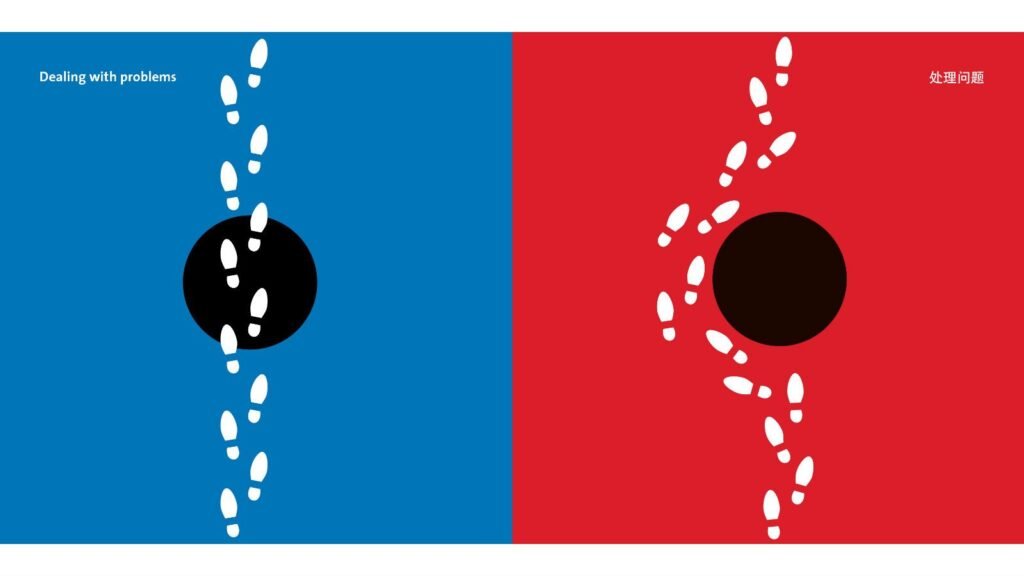
From: Une artiste confronte les différences entre l’Orient et l’Occident
Alex Lo
May 12, 2023
“Oh, East is East, and West is West, and never the twain shall meet,/ Till Earth and Sky stand presently at God’s great Judgment Seat;/ But there is neither East nor West, Border, nor Breed, nor Birth,/ When two strong men stand face to face though they come from the ends of the earth!”
– The Ballad of East and West,
Rudyard Kipling
When I was in university and the Asian tiger economies were just starting to roar in the 1980s, political leaders such as Lee Kuan Yew and Mahathir Mohamad started promoting what they called “Asian values”, that is beliefs, practices and norms that they claimed, underpinned the region’s success.
They were mercilessly hounded. Western critics said there were no such things as Asian values, and Lee and Mahathir were just trying to justify Asian authoritarianism. There were only “universal values”, many said and still say today, which of course were all of European origins. Western values were universal while Asian values were at best of limited value and at worst were of no value except for political propaganda.
How times have changed. Lately I notice the talk of values is back on the lips of Western politicians while commenting on foreign threats, but especially “the China threat”. However, their rhetoric has fundamentally changed. It is now our (Western) values vs theirs. I did a quick Google search and immediately came up with some juicy quotes, all from the past two months.
Originally published by the South China Morning Post, December 8, 2022
Speaking at the G20 summit in Bali, British Prime Minister Rishi Sunak said: “China unequivocally poses a systemic threat – well, a systemic challenge – to our values and our interests.”
An official document laying out Canada’s new Indo-Pacific strategy said: “China is looking to shape the international order into a more permissive environment for interests and values that increasingly depart from ours.”
Meanwhile, US Defence Secretary Lloyd Austin said global norms in the 21st century must be defined by “American values”.
So, they are not even Western or European values but American values.
Today, it’s back to “us vs them”, and that’s why it’s our values against theirs. And, given the often difficult transatlantic relationship between the European Union and the United States, their current professed brotherhood over Ukraine notwithstanding, it’s not surprising that Austin cited American values specifically.
How different it was back then. The late 1980s and 1990s were heady days for the West. The Cold War had been won. After centuries of war and genocide, Europe was becoming one big family. The US emerged as the most powerful nation ever in history, not only for its military might, but for what contemporary Chinese scholars have called its dominant “discourse power”.
The universal West then defined the purpose and goal of the rest of the world, which was to be more like it.
In his bestseller, The Lexus and the Olive Tree, the famous US journalist Thomas L. Friedman called it “the Golden Straitjacket”. You want to become rich and free like the West, you’d better put it on. He wrote: “Unfortunately, this Golden Straitjacket is pretty much ‘one-size fits all’ … It is not always pretty or gentle or comfortable. But it’s here and it’s the only model on the rack this historical season.”
That was why what the West believed and held sacred must be of universal value and applicability. After all, History with a capital H has already passed judgment; it’s “the end of history”.
Since then, though, the West, but especially the US, has been humbled, not least by “the rise of the rest”, but by their own internal conflicts, collapses and contradictions. The unipolar moment has passed, and a more chaotic period has followed as the world tries to establish a multipolar international order.
While collectively, it is still the richest and militarily the most powerful, the confidence of the West in its historical mission and destiny has evaporated. It has effectively declared: “If we can’t make them like us, then we will have to treat them as a threat.”
The universality of triumph has been replaced by the defensive particularity of insecurity. Instead of spreading the Gospels, the most you can do is to defend them. But when you feel insecure, having 1,000 military bases worldwide and all the nukes in the world won’t help.
Please support TFF in consistently bringing you urgently relevant quality materials. It’s easy, fast and totally secure. Do your good deed now. Here – Thanks!
About the author

Alex Lo has been a columnist at South China Morning Post, SCMP, since 2012, covering major issues affecting Hong Kong and the rest of China. A journalist for 25 years, he has worked for various publications in Hong Kong and Toronto as a news reporter and editor. He has also lectured in journalism at the University of Hong Kong. More of his excellent columns can be found here.