Introduction
Sinbad is in his mid-20s and he took up studies in Europe before his native Syria began falling apart in senseless violence. He used to live in Damascus, his father being an officer in the Syrian Army but retired well before hell broke loose.
Sinbad is one of his country’s many young intellectuals, extremely knowledgeable about international, regional and national politics and also a man who, from a distance, has done what he possibly could to maintain links with his society – which is not just Syria but civil society. Among other things he established a website on which everybody could dialogue freely under one condition: that they advocate political and other civil strategies and tools and no violence or expressions of hatred. It turned out to be very difficult to maintain such a website.
Today he is disillusioned. He did not have the slightest hunch that the Arab Spring would be turning into a violent winter in such a short time. His family has been forced to flee to a far-away village, he himself can not go home.
Sinbad is at least as much disappointed – if not angered – that so many of his fellow citizens have taken to the quick fix idea of violent struggle against the regime and have only managed that way to make everything worse – for all society, that is.

Eager as I am to understand better the civil society dimension of this conflict, I readily grasp the chance to sit down with him in a café in Amsterdam and start out asking him:
Q: Over the last few years Western media have covered basically the violence – both by the al-Assad regime and by the rebels. Do you feel that civil society has been under-covered, so to speak?
Sinbad: Absolutely! Western media has consistently ignored the millions who would not dream of touching a gun and even keep social functions and relations going on a daily basis, including help each other. What the media tell you is far from the whole truth. The silent – big – majority is silent, not given a voice and they are now hiding behind their doors.
I started the website with a view predominantly to help students express themselves – you know, they do have higher education and may be more able to see solutions than many other groups. But there has been repeated attacks on both students and universities – many people with guns in their hands are afraid of intellectuals – and with everything that has happened and the brutality we have seen, the frustration is now unbelievably widespread. Citizens can hardly even imagine that there may – or must! – once again be a peaceful Syria.
Q: But they once tried various actions?
Sinbad: Oh yes, there were many – demonstrations and symbolic actions, such a pouring red paint in a fountain on a square to protest the bloodshed. But you can hardly do anything before you are arrest or thrown out of the place, either by the government forces or by the rebels. Over time the courage to act has dissipated and you can say that civil society has gone hiding. I myself find it so sad but I also have to recognise that it is easier for me – being out of Syria – to see ways out than it is for people my age back home. The fear is much higher, the hopes much lover. War influences the mind to an incredible extent.
In the beginning there were lots of small, dispersed actions everywhere, but – well, it’s over. And it is the same – in the regime held areas you’ll be arrested by the regime police and the rebels will do the same in areas they control. No difference – and that is why civil society literally cannot exist in public. The escalation of violence – also thanks to all the violent means and ammunition that has flowed into the rebel side of Syria – long ago made civil society activity impossible. The hope has been crushed brutally by both sides. There is no space, simply. Even the word peace is impossible. You can’t use it. Propaganda has killed it and without hope there is no vision of peace.
Q: Could what is euphemistically called the international society have done it differently?
Sinbad: Yes, of course! The West and East and what have you could have gone in and supported that huge majority that has never committed any violence. But everybody rewarded those armed with the means to kill. You know when you have a civilisation of 20 000 years, you have something to build on. Outside forces should never have supported the radicals, the rebels, in this situation because they do not represent the people of Syria. Arming the government as well as the rebels is incompatible with a wish for peace and democracy in the future! Even the government and the rebels put together make up a small minority – maximum 10-20 % who use violence or advocate violent means.
The West – to live up to its stated ideals – should have helped create spaces for civil society and asked: What do the different groups want? What do people fear? What types of possible solutions do the Syrians themselves see? But nobody did!
You see, what we Syrians want is of course peace and democracy etc – but we do not want somebody else’s concepts; what we want grows naturally out of our society, culture and history – not just democracy or peace the way foreigners like it. That is the kind of thinking the West could help amplify but instead it amplified the violent minorities.
We don’t want those who may win militarily as new leaders – it should not qualify for national leadership that you’ve been able to kill out there and come home to the capital as victors. That type of people on top is not what the Syrian people, civil society, wants – under no circumstances. Such leaders would not do what civil society asks them to do, they’ll do their own authoritarian thing.
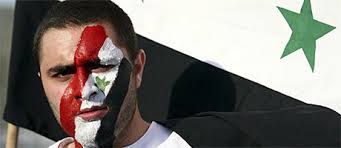
We started out as a civil society revolution and it was hijacked. Let it be again what it originally was – of, for and with civil society.
Both the East and the West are wrong in believing that there are only two groups – government and rebels. It is much much more complex. And as I would see it as a civil society person and peace activist the government and the rebels are one in at least one sense: they want to achieve their goals through killing and the are equally ignorant and authoritarian vis-a-vis the people, the majority of Syria. The result of they both do by definition cannot lead to any better, more democratic, free or trustful society – never!
Q – How do you look upon solutions? What desirable option are there? What do you still hope for?
Sinbad: All outsides should stop interfering. That’s Number One. Next a ceasefire – stop using all those weapons that have poured in, they only make it more difficult to reach a solution and a better Syria in the future. Third, let civil society come out and feel safe and begin to breathe again. After we have had a space and time to breathe, we can build a new post-war Syria. We are capable of dialoguing and we have brilliant people with ideas and visions.
Now is the time for Syrian interests to set themselves through in Syria – not the interest of foreigners of any kind – and if we want or need help from the outside, we should be allowed to decide whom we turn to. What would be more natural than the West which prides itself of freedom and democracy would stop putting us into a cage surrounded by violent groups, Al-Qaeda, rebels, criminals etc.?
Democracy is not only about some future decision-making or elections or formality – it is about a process, about the means we employ on the way. Out of a minority consisting of two parties blinded by violence you won’t get democracy, never!
Q – And in this perspective, how do you feel about the idea of negotiations in Geneva?
Sinbad: Such a process will, I am sorry to say, make everything worse for the Syrian people, even worse than today. You have seen it elsewhere: When there is talk about negotiation, all sides step up their military activity in order to have more to play with at the negotiation table, improve their strength and trying to translate it into forcing through their own solutions too at that table.
You can observe a very clear correlation between stepped-up killings and attacs on the one hand and international talks about peace negotiations in Geneva. Unless such negotiations include a wide variety of civil society representatives, they will only strengthen and boost the power – real and subjective – of the government and the rebel. Why are we not invited too? Why reward only the killing parties, not the non-killing parties?
Q – In this perspective, how do you look upon what Kofi Annan tried to achieve? Would his plan have worked if backed up by various parties around the world?
Sinbad: First of all, I and most others never questioned his good intentions; he really wanted to help Syria find its way to peace – and in that he is probably the only one. I also don’t question his 6-point plan.
So much of what I have already said that we need is identical with his plan. His plan would have been so much better to follow than continuing this terrible war. It would have been good for Syria as a country and for civil society there in general – it would even have been much better for the whole region.
I don’t understand it really but I got the impression that everybody tried to prevent him for getting what his plan required and thereby start a constructive process. Now it is definitely too late. It is my firm opinion that his plan was the best option at the time and that Syria would have been in a much better position today if his mission had not been undermined by such factors like the members of the UN not being able to place the needed number of monitors at the disposal of the UN to monitor all of Syria – ears and eyes on the ground – and put a lid on the fighting. Some countries, particularly in the West, must have wanted this horrible war to continue!
What Kofi Annan did – professionally and very competently – was to talk with all sides, including of course the West but also Russia and China and, very importantly, he met repeatedly with al-Assad that so many others said was a man you couldn’t even talk with and who should leave the stage before any negotiations.
If peace is what you want, you cannot start out with such a precondition – you cannot start out with what may be the result appearing down the road of mediation, consultation and real negotiations. If one party is allowed to state such pre-conditions, then the other party will do the same and you end up – before anything has started – with a vicious circle. I say to all parties: After a ceasefire and perhaps storing of weapons plus some preparatory consultations and sounding out fears, hopes and wishes – get to the table but do not allow anybody to demand anything.
Whatever conditions or wishes you have – keep them for the negotiations, do not put them up as something you want to be served on a silver plate before the negotiations. It is mind-boggling to me that such a simple idea has not been an important element in the lessons learned departments around the world – there are so many examples from before from which we can draw reasonably clear conclusions as to what works and what don’t.
All the things done from the outside over the last three years – with the exception of Kofi Annan’s mission – belong to the latter category: They were known to not work. I regret to say it, but I feel that it is the truth that must be stated today.
In short, don’t make peace negotiations harder than they will have to be. Make them as easy as possible and come to the negotiations with an open mind, all parties at and all problems on the table. It is bound to take a long time but I tell you: Healing from what has been going on day and night now for 3 years is going to take much much longer!
Q – Who do you think were behind the attack with chemical weapons?
Sinbad: Well, it is difficult to know, really. The investigators were tasked with confirming or denying that chemical weapons were involved not with finding out who used them. The whole thing became so politicized and of course I do not have access to more facts than anybody else.
Let me say, however, that I do not see that the regime of Assad was in such a situation that he had to use them at that particular moment. At the time when it happened, the regime forces were gaining strength in the military struggle and – don’t forget – the regime had and has many other means to kill people with if it wants to. To use chemical weapons only increases the attention of the whole world and that would not, logically speaking, be a main goal of Assad or his military.
If some rebels did it, I guess they would need the help of outsiders. It is not that easy to get the chemicals and make them work as weapons that can be thrown at certain areas from afar. So, there could have been mercenaries or foreign fighters – somebody who knew how to do it – or agents who operate on orders from foreign powers with the aim to make it look like it was the regime that committed this terrible crime.
You know also, people see a lot of dead bodies and we get a lot of deeply moving impressions; many leading politicians and media said almost immediately that this was the deed of Assad. When we don’t know the facts in detail, it is anybody’s game to speculate and judge; I’m just using some logical reasoning and asking myself: In whose interest could it be to use the weapons at that particular moment to create a specific reaction around the world? The specific reaction here was to strengthen the demand for military intervention.
Q – Finally, let’s talk about the aftermath of the chemical attack in Syria and the Russia-mediated deal to get Syria to give up its chemical weapons stock and then the prospects of forthcoming negotiations – Geneva 2. How do you feel about these developments?
Sinbad: I think it was a smart move by Assad to give up these weapons. It surprised me that he went along with it. However, whether or not Syria has chemical weapons do not make any significant difference, neither for civil society nor for the balance of power among those who fight each other. The main good thing I can see is that it is always good when chemical and other weapons are destroyed, both for the Middle East and for the whole world.
Significantly, this move by Assad saved Syria from being bombed by America. Such a strike would only have had one consequence, namely to make everything worse and increase the already terrible destruction. The vast majority of Syrians who have died have not died from chemical weapons, so the mentioned deal won’t change anything significantly on the Syrian ground.
Geneva 2 is not real, it’s part of an ongoing political debate. Look, civil society is still not asked to be involved and the ”big guys” are playing their games. Civil society – the majority of Syrians – are spectators who can watch this game about their future on TV screens! Geneva 2 wont change anything for them.
The whole thing really is a political or public relations game: One day Assad is a criminal who deserved to be thrown out or bombed, the next day the U.S. thanks him for being cooperative; the media cover this whole thing with sensational issues – will this or that group come to the negotiation table? Who will allow whom to come? Who will stay away? What about Iran?
We Syrians can only watch it from the sideline, and no one has any particular hope that anything good will come out of Geneva 2 for the Syrian civil society.
OK, it would be good if Geneva 2 leads to a ceasefire, but I don’t expect that and – it is before you meet at a table that you should have a ceasefire. I don’t even think that civil society and its needs and wishes for the future will be taken into account in Geneva; there only the Big Guys, as I said, will play their games and to them civil society – the majority of citiens – don’t mean a thing!
Q – Who do you think will come from Syria?
Sinbad: Well, representatives of Assad and the government and then the internal opposition that fights politically and not militarily. I don’t know whether that opposition is a creation of the regime or not, but it does exist and it has supporters in Syria, for sure. I hope of course also that the political opposition outside Syria will be invited.
Further, I can speculate that the regime will appoint some civil society organisations to go to Geneva, but I do not think that will be the case. Anybody appointed by the regime to go will have troubles because the question will be who they really represent. There is a discussion that the internal political (non-weaponised) opposition is a creation of the regime, made to divide the ranks of the larger opposition.
Anyhow, we must always ask: Who do the people who will be in Geneva represent back home? The outside world – whether the Syrian diaspora or, say, the Western powers can support and in different way use the various rebel fractions they choose to support but what everybody is now recognising is that they can’t control them on the ground. We are now in a state of deep anarchy…chaos…thanks to all this interference!
You give some militant group inside Syria some training, ammunition and weapons and then they do what they can and want; they don’t obey your orders. All this makes the situation so terribly complicated. So the West is facing a huge problem: the total splitting up and in-fighting among those who it hoped originally would make up a united front against Assad and his forces. Now everybody can see that this idea is falling apart and Assad is getting relatively stronger.
And, again, it is civil society that is getting weaker and weaker and innocent citizens who are paying the price of all this. Over time the Syrian civil society has suffered more and more and the whole thing is deeply tragic because I don’t think that that is the way it had to be even if we had very serious conflicts and a multi-year socio-economic crisis. Better ways exist but some chose to use the bad ways when they intervened.
[End]