
TFF Library: Syria 2013 till today - 560 articles, videos and photos

Few things should surprise us anymore regarding the un-principled nature of the contemporary Western world. One day it sees a genocide and keeps supporting its ongoing barbarism. The next day – actually December 8 in the early morning – it fully supports terrorism, which, allegedly, it has been fighting since September 11, 2001.

NATO countries such as the US and Turkey are the main supporters of the terrorist movements that have now occupied the cultured country, Syria, home to 25 million extremely mixed people. As far as I have looked into it, no Western leader has pointed out that taking over an entire country and sending its leadership fleeing is a violation of international law; Russia did not even plan to do so in Ukraine, but its invasion was condemned immediately. Not so HTS’s. The UN is, as usual, totally marginalised, it’s Secretary-General silent until now.

Refugees from Aleppo © Jan Oberg 2016

We have heard no one expressing regret that a movement such as HTS has been enabled from abroad to conduct such an occupation. What we do hear is that it is good that al-Assad – the dictator, tyrant, or what you please – has been ousted and that – well, perhaps – the HTS+ takeover of Syria might also mean that there are problems ahead – and then (pathetic for the situation) we hear standard pious urgings for dialogue, smooth transition, rule of law, respect for territorial integrity, cooperation among all the groups and democratisation of Syria… that is, all under the new HTS leadership.

In summary, terrorism is perfectly acceptable when it furthers Western political goals – in this case, the regime change begun by the West in 2011 under the cover of the Arab Spring, aiming at getting rid of Syria’s leadership under Bashar al-Assad – whose original sin was to say ‘No’ (like his father) to a Western oil and gas pipeline across all of Syria. Oil, gas and other energy resources are at the bottom of Syria’s political and economic problems, see here.

TFF monitored Syrian developments from 2013 an onwards. In December 2016, we visited Syria, Damascus and Aleppo for ten days. Quite unplanned, the author became one of a handful of Westerners to witness the liberation of Eastern Aleppo on December 12.
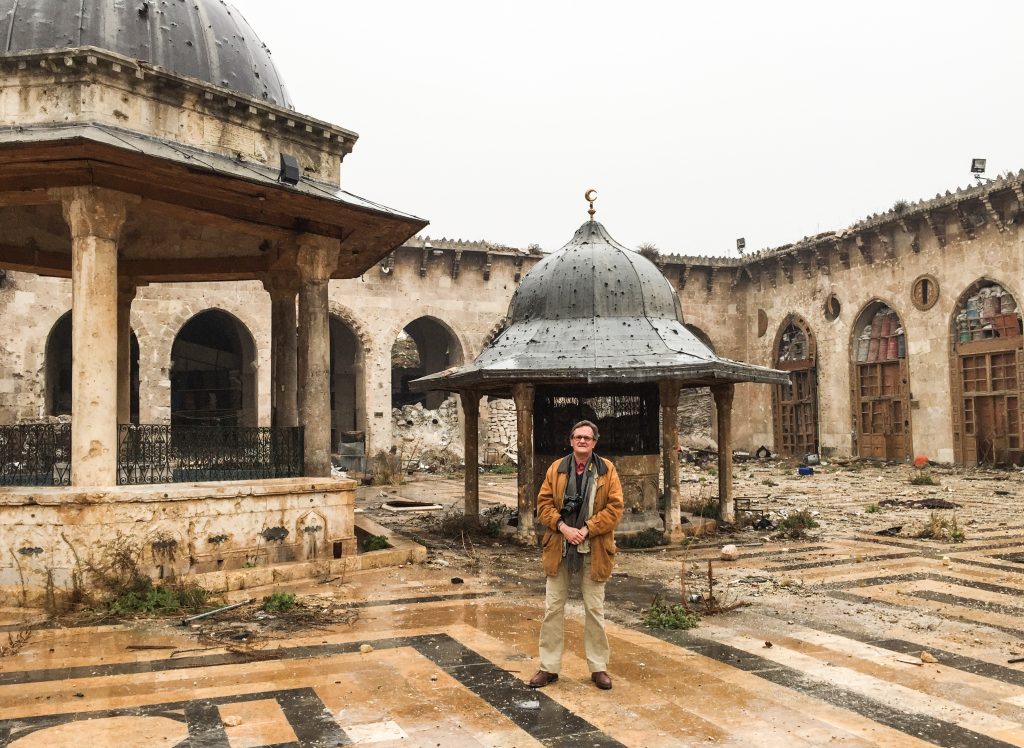
Its primary occupier over 4,5 long dark years had been al-Nusra – now the HTS that occupied all of Syria on December 8, took control of the country and sent its president running – or, rather, flying – to Moscow.

While al-Nusra/HTS may have changed or become less extreme or whatever, this author has no illusions about Syria’s future under its occupation.

Hanano, Aleppo, December 2016 © Jan Oberg

Below is a collection of what we wrote from 2013 and, in particular in 2016 and well into 2017. It was extremely controversial, as you may see from the article about Western media’s refusal to publish what would normally have been a scoop because they had no one present there themselves. Further, it was in the spring of 2017 that TFF’s articles and sites began to be de-ranked in Google, censored and saw all posts on, e.g. Facebook, reach only a small fraction of what we reached before. Again, we have no illusions about what was once upon a time called free media.

Before you delve into TFF’s research-based, genuine library of Syria materials, let us point your attention in the direction of a couple of crucial background readings, which are short, very readable, American and totally different from the mass media’s mass deception:

Robert F. Kennedy Jr. 2016
Why the Arabs Don’t Want Us in Syria.
They don’t hate ‘our freedoms.’ They hate that we’ve betrayed our ideals in their own countries – for oil.

Gary Busch 2019
Oil and Water -The Immiscible Solution To The War in Syria

William R. Polk 2013
Understanding Syria: From Pre-Civil War to Post-Assad
How drought, foreign meddling, and long-festering religious tensions created the tragically splintered Syria we know today
.

Chas Freeman 2024 (Video)
Syria Collapse: Israel Wins, Russia Setback, Iran Isolated & Closer to Bomb

First, TFF’s present main site, The Transnational from 2018:

If you search “Syria,” you will get around 370 articles and videos.
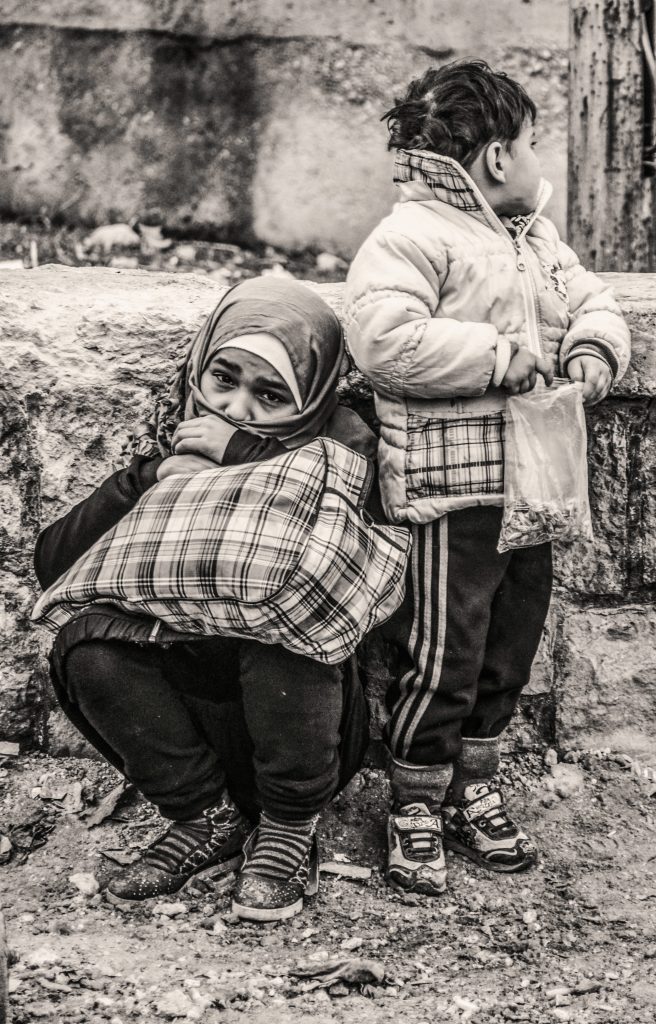
Waiting to get to safety © Jan Oberg 2016
But today?

Second, TFF’s archive homepage 2011-2017:

December 2017
TFF PressInfo # 438: Aleppo’s Liberation one year ago – Anybody ashamed today?

November 2017
Israel’s Ploy Selling a Syrian Nuke Strike

October 2017
Establish an International Tribunal or Commission on the International War In Syria

September 2017
Have We Been Deceived Over Syrian Sarin Attack?

July 2017
How CIA and Allies trapped Obama in the Syrian Arms Debacle

June 2017
What’s offensive and defensive in Syria

Russians and Aleppo students provide a little food after the liberation © Jan Oberg 2016

June 2017
Washington’s new threat against Syria, Russia and Iran: Invitation to false flag operation

June 2017
Washington’s new threat against Syria, Russia and Iran: Invitation to false flag operation

May 2017
Safe zones in Syria – very problematic

Down from the Aleppo Citadel © Jan Oberg 2016

May 2017
What is wrong with Trump’s attack on Syria?

May 2017
Safe Zones in Syria: A double-edged sword

May 2017
TFF PressInfo # 414 (B): Trump in Riyadh – A Gulf NATO to gang up against Iran and Syria

May 2017
TFF PressInfo # 414 (A): Trump in Riyadh – A Gulf NATO to gang up against Iran and Syria

April 2017
Syria – two perspectives illustrated

April 2017
US/NATO increasing tension with Russia – focus Syria: New frosty Cold War

April 2017
TFF Live: US bombing Syria – How could they be so sure?

March 2017
TFF PressInfo # 410: The meaninglessness of war: Aleppo Photo Series # 6

March 2017
Vittnesrapport från Aleppo, en annorlunda konfliktanalys och vägar till fred i Syrien

February 2017
TFF PressInfo # 405: Keep focus on Aleppo and global dimensions of Syria

Already suffered more than anyone should in a lifetime © Jan Oberg

February 2017
TFF PressInfo # 404: Unique Aleppo photos seen by over 100.000 people but not in mainstream media

February 2017
If you want peace, don’t focus on the violence and the evil guy

February 2017
School in an Aleppo factory

February 2017
The more I wonder about Aleppo…

January 2017
Comments on the Syria ceasefire talks in Astana

January 2017
TFF PressInfo # 399: US Congresswoman Tulsi 
Gabbard (D) visits Syria

January 2017
TFF Photo Story: Faces of Aleppo. Just out of 4,5 years of occupation hell

January 2017
TFF PressInfo # 398: Syria and Aleppo – Old news media falling

January 2017
TFF Photo Story: Aleppo’s evil humanitarians

© Jan Oberg 2016

December 2016
Photo Story: Humans in liberated Aleppo

December 2016
Photo story: The destruction of Eastern Aleppo

December 2016
TFF PressInfo # 397: Syria’s destruction – When everybody thinks power and no one thinks peace

December 2016
Impressions of Damascus and its amazing, kind people

December 2016
TFF Peace and Conflict Mission to Syria # 1

November 2016
TFF PressInfo # 392: Just how grey are the White Helmets and their backers?

November 2016
Syria: Change the Russia-NATO discourse

October 2016
Syria: Why the Lausanne meeting would fail – predictably

September 2016
TFF PressInfo # 388: The War On Terror – A predictable fiasco

April 2016
Danmark skal heller ikke bombe i Syrien – 6 artikler

March 2016
TFF PressInfo # 369 – A Sunni-Salafist-Zionist Coalition Changing Middle East?

March 2016
TFF PressInfo # 365: Denmark to attack in Syria – too

February 2016
TFF PressInfo # 363: Can we give meaning to the destruction of Syria?

Six gripping photo series © Jan Oberg

February 2016
Syria talks suspended: Open Letter

January 2016
TFF PressInfo 355: The deeper reason Syria negotiations are doomed

January 2014
TFF PressInfo – Geneva will fail but don’t blame only the Syrian parties

January 2014
TFF PressInfo – Why is everybody ignoring Syria’s people?

December 2013
Syria – how surprising!

September 2013
Syrien – hvad kunne være gjort og hvad kan stadig gøres?

On TFF’s Associates’ Blog 2011-2017, you find 190 entries: those above in thi section and other articles which mention Syria in a larger framework but do not have Syria as their main focus.

Victory for Syria & Syrians: Two green stars, not three. Eastern Aleppo, December 2016 © Jan Oberg 2016

Peace & future researcher + ‌Art Photographer

Share

Leave a Reply

Your email address will not be published. Required fields are marked *

Related Posts

Officially, the drones were not identified. By simply thinking critically – which journalists and selected experts no longer do – there may be a good reason for that. And this article will never be mentioned in Denmark… Drones over Denmark. No damage. No trace. No answers. Yet the headlines scream “Russian threat,” and Prime Minister Mette Frederiksen speaks with a certainty that defies logic: “We don’t know they were Russian—but we know Russia is the biggest threat to Europe.” It could be nobody else – unless you make an interest analysis which I did two days ago. This is not security policy. It’s theatre. And the audience is being played. Let’s rewind. These drones—unphotographed, untracked, unclaimed—appear and vanish like ghosts. Airports shut down. Panic spreads. Military budgets swell. And the narrative hardens: Russia is behind it. But what if that’s not just wrong but deliberately misleading? Here’s a hypothesis for...
And why the world, especially the EU, must now declare itself independent of the United States. UN’s 80th anniversary This year, the United Nations celebrates the 80th anniversary of its founding. The UN was formed after the scourge of the Second World War, in which 70 to 85 million people were killed and many countries were destroyed. That war came on the heels of the First World War, which also killed between 15 and 22 million people. After the Second World War, especially after the use of nuclear weapons by the United States, which marked a turning point in the history of warfare that could result in the end of civilisation as we know it, humanity decided to move away from the era of empires and big power politics and usher in a new era of peace, freedom and cooperation. These were the principles enshrined in the UN Charter. The United States...
Drones over Nordic airports. No damage. No trace. No answers. Most assume Russia—but what if that’s not so? Why is there so much we are not told? This article explores the strategic ambiguity behind recent drone incursions and asks: Who else might benefit from sending drones into NATO airspace? From Ukraine’s surprising drone supremacy to Russia’s possible signalling, the silence itself may be the loudest message. These are the kinds of questions decent, intelligent investigative journalists and commentators could easily research. Why don’t they? Did you, dear reader, know or think of this? That the most powerful weapon in today’s conflicts might be the one that leaves no trace – and no answers. Just enough fear to justify the next move? Recently, drones have repeatedly appeared over Nordic airports and near some military facilities. They cause no damage – for which reason the designation “hybrid attack” is misleading but serves a purpose. These...

Recent Articles

In response to an urgent Appeal from all the living Nobel Peace Prize Laureates, the General Assembly of the United Nations, on November 1998, unanimously declared the first decade of the twenty-first century to be The Decade for a Culture of Peace and Nonviolence. While people are naturally concerned about the amount of violence in our world and how it threatens our future, the Nobel Laureates are right to remind us of the potential of nonviolence and our calling to build a culture of peace and nonviolence.  The twentieth century is instructive in the way that the philosophy and practice of nonviolence have begun to flourish and in the way that nonviolent movements have had an exponential growth across the world. Mohandas Gandhi and Martin Luther King, Jr. are the most famous nonviolent leaders but many have built upon the paths they charted as in country after country, tyrannies and...
We know that medical personnel have failed to report to higher authorities wounds that were clearly caused by torture and that they have neglected to take steps to interrupt this torture. In addition, they have turned over prisoners’ medical records to interrogators who could use them to exploit the prisoners’ weaknesses or vulnerabilities. We have not yet learned the extent of medical involvement in delaying and possibly falsifying the death certificates of prisoners who have been killed by torturers. A May 22 article on Abu Ghraib in the New York Times states that “much of the evidence of abuse at the prison came from medical documents” and that records and statements “showed doctors and medics reporting to the area of the prison where the abuse occurred several times to stitch wounds, tend to collapsed prisoners or see patients with bruised or reddened genitals.” http://www.truthout.org/docs_04/080604J.shtml#16 According to the article, two doctors who...
Jan Øberg behandler i artiklen en lang række faktorer, som ligger til grund for den måde vores samfund er organiseret på – og derfor også for konflikter. Artiklen introducerer således sammenhængen mellem familien, foreninger, regeringer, NGO’ er, nation, stat, nationalstat og alliancer for på denne måde bedre at kunne forstå konflikter og i sidste ende blive klogere mht. at løse disse. Øberg, der er fortaler for global bevidsthed, hvilket skal ses i lyset af den øgede globalisering, skelner mellem kulturkamp og kulturdialog. Endelig behandles begrebet magt og magtesløshed: giver magt ret til at udøve magt – fordi man mener at have ret? Litteraturliste og arbejdsspørgsmål efter artiklen. Ordene vi bruger om verden I satellitperspektiv kan man godt tale om den menneskelige familie eller menneskeheden. Udtrykket understreger, at der eksisterer – eller burde eksistere – et fællesskab fordi vi alle er mennesker og sammen bebor denne klode og ingen anden. Og...

TFF on Substack

Discover more from TFF Transnational Foundation & Jan Oberg.

Most Popular

In response to an urgent Appeal from all the living Nobel Peace Prize Laureates, the General Assembly of the United Nations, on November 1998, unanimously declared the first decade of the twenty-first century to be The Decade for a Culture of Peace and Nonviolence. While people are naturally concerned about the amount of violence in our world and how it threatens our future, the Nobel Laureates are right to remind us of the potential of nonviolence and our calling to build a culture of peace and nonviolence.  The twentieth century is instructive in the way that the philosophy and practice of nonviolence have begun to flourish and in the way that nonviolent movements have had an exponential growth across the world. Mohandas Gandhi and Martin Luther King, Jr. are the most famous nonviolent leaders but many have built upon the paths they charted as in country after country, tyrannies and...
We know that medical personnel have failed to report to higher authorities wounds that were clearly caused by torture and that they have neglected to take steps to interrupt this torture. In addition, they have turned over prisoners’ medical records to interrogators who could use them to exploit the prisoners’ weaknesses or vulnerabilities. We have not yet learned the extent of medical involvement in delaying and possibly falsifying the death certificates of prisoners who have been killed by torturers. A May 22 article on Abu Ghraib in the New York Times states that “much of the evidence of abuse at the prison came from medical documents” and that records and statements “showed doctors and medics reporting to the area of the prison where the abuse occurred several times to stitch wounds, tend to collapsed prisoners or see patients with bruised or reddened genitals.” http://www.truthout.org/docs_04/080604J.shtml#16 According to the article, two doctors who...
Jan Øberg behandler i artiklen en lang række faktorer, som ligger til grund for den måde vores samfund er organiseret på – og derfor også for konflikter. Artiklen introducerer således sammenhængen mellem familien, foreninger, regeringer, NGO’ er, nation, stat, nationalstat og alliancer for på denne måde bedre at kunne forstå konflikter og i sidste ende blive klogere mht. at løse disse. Øberg, der er fortaler for global bevidsthed, hvilket skal ses i lyset af den øgede globalisering, skelner mellem kulturkamp og kulturdialog. Endelig behandles begrebet magt og magtesløshed: giver magt ret til at udøve magt – fordi man mener at have ret? Litteraturliste og arbejdsspørgsmål efter artiklen. Ordene vi bruger om verden I satellitperspektiv kan man godt tale om den menneskelige familie eller menneskeheden. Udtrykket understreger, at der eksisterer – eller burde eksistere – et fællesskab fordi vi alle er mennesker og sammen bebor denne klode og ingen anden. Og...
Read More
Imagen-thumbnail-The-Transnational-1
In response to an urgent Appeal from all the living Nobel Peace Prize Laureates, the General Assembly of the United Nations, on November 1998, unanimously declared the first decade of the twenty-first century to be The Decade for a Culture of Peace and Nonviolence. While people are naturally concerned about the amount of violence in our world and how it threatens our future, the Nobel Laureates are right to remind us of the potential of nonviolence and our calling to build a culture of peace and nonviolence.  The twentieth century is instructive in the way that the philosophy and practice of nonviolence have begun to flourish and in the way that nonviolent movements have had an exponential growth across the world. Mohandas Gandhi and Martin Luther King, Jr. are the most famous nonviolent leaders but many have built upon the paths they charted as in country after country, tyrannies and...
Imagen-thumbnail-The-Transnational-1
We know that medical personnel have failed to report to higher authorities wounds that were clearly caused by torture and that they have neglected to take steps to interrupt this torture. In addition, they have turned over prisoners’ medical records to interrogators who could use them to exploit the prisoners’ weaknesses or vulnerabilities. We have not yet learned the extent of medical involvement in delaying and possibly falsifying the death certificates of prisoners who have been killed by torturers. A May 22 article on Abu Ghraib in the New York Times states that “much of the evidence of abuse at the prison came from medical documents” and that records and statements “showed doctors and medics reporting to the area of the prison where the abuse occurred several times to stitch wounds, tend to collapsed prisoners or see patients with bruised or reddened genitals.” http://www.truthout.org/docs_04/080604J.shtml#16 According to the article, two doctors who...
Imagen-thumbnail-The-Transnational-1
Jan Øberg behandler i artiklen en lang række faktorer, som ligger til grund for den måde vores samfund er organiseret på – og derfor også for konflikter. Artiklen introducerer således sammenhængen mellem familien, foreninger, regeringer, NGO’ er, nation, stat, nationalstat og alliancer for på denne måde bedre at kunne forstå konflikter og i sidste ende blive klogere mht. at løse disse. Øberg, der er fortaler for global bevidsthed, hvilket skal ses i lyset af den øgede globalisering, skelner mellem kulturkamp og kulturdialog. Endelig behandles begrebet magt og magtesløshed: giver magt ret til at udøve magt – fordi man mener at have ret? Litteraturliste og arbejdsspørgsmål efter artiklen. Ordene vi bruger om verden I satellitperspektiv kan man godt tale om den menneskelige familie eller menneskeheden. Udtrykket understreger, at der eksisterer – eller burde eksistere – et fællesskab fordi vi alle er mennesker og sammen bebor denne klode og ingen anden. Og...
Imagen-thumbnail-The-Transnational-1
Kapitel 2: Forskellige sider af Europa og USA…fortsat 2.5 Militære relationer I forbifarten har vi allerede sagt nogle ting om USA’s militære situation. Kig lige en gang til på afsnit 2.3. Nu skal vi uddybe det militære forhold mellem USA og EU. Der er en række ligheder mellem visse europæiske landes og USA’s militær. Næsten alle er med på en eller anden måde i NATO, direkte som medlem – selv Island, der ikke har et forsvar – eller indirekte i Partnerskab for Fred. USA og Canada er med i OSCE (på dansk OSSE), Organisationen for Sikkerhed og Samarbejde i Europa, der tæller over 50 lande. USA samt England og Frankrig er kernevåbenstater og de har styrker til intervention langt borte fra hjemlandet, om end USA’s er tifold større. Alle har også en omfattende våbeneksport og bruger den som et middel til at tjene penge og få loyale venner på, det...
Imagen-thumbnail-The-Transnational-1
Background Christian Harleman and Jan Oberg conducted a fact-finding mission to Burundi between November 26 and December 6, 2003. (See websites about the country here). The first TFF mission took place in March 1999. Unfortunately, since then it has not been practically possible to implement the co-operation with Burundi’s Ministry of Education and Burundian NGOs that was planned at the time. The 2003 mission had three purposes. First, to do fact-finding in general about the situation and, in particular, the progress under the Arusha Peace Process. Second, to explore the possibilities for co-operation between the government and relevant NGOs on the one hand and TFF on the other, in order to develop and deepen the existing competence in fields such as conflict-understanding, reconciliation and peace-building. Finally, third, to find out whether it would be possible, in co-operation with the Swedish Rescue Services Agency (Statens Räddningsverk), to establish a health care unit that...
Imagen-thumbnail-The-Transnational-1
Former UN Under-Secretary-General with special responsibility for peacekeeping operations TFF associate August 20, 2003 YRINGHAM, Mass.- Ralph Bunche was born in Detroit 100 years ago today (August 7, 2003). His passionate determination to get results did not extend to seeking credit for them, so his work is better remembered than he is. Of all his many accomplishments – civil rights pioneer, Nobel Peace Prize laureate, chief drafter of two chapters of the United Nations charter, negotiator of the armistices that ended the first Arab-Israeli war – Bunche said he was proudest of developing what came to be known as peacekeeping. Setting up the United Nations Truce Supervision Organization in Palestine in 1948, Bunche formulated the principles that have governed peacekeeping operations ever since. In the 1956 Suez crisis, working with Secretary General Dag Hammarskjold and Lester Pearson of Canada, he organized the first peacekeeping force, the United Nations Emergency Force...


