
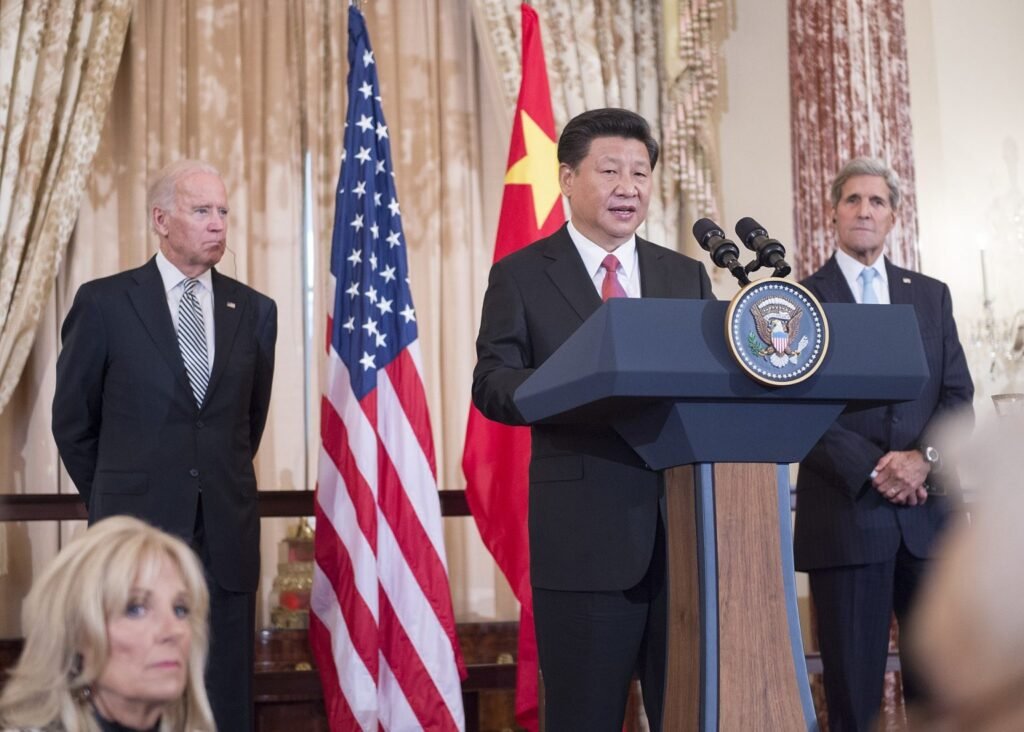
U.S. Department of State/Chinese President Xi Delivers Remarks at a State Luncheon in His Honor at the State Department
December 29, 2020
Across the political spectrum, there is widespread agreement that America must get serious about the threat posed by China. As the Trump administration comes to a close, the State Department has just released a document called ‘The Elements of the China Challenge’.
A distillation of conventional wisdom among national security experts and government officials, it argues that the U.S. needs a concerted effort to push back against Beijing. On its first page, the document tells us that “the Chinese Communist Party (CCP) has triggered a new era of great-power competition.”
If there was a major intellectual thread running through Trump’s foreign policy, or at least that of the people he appointed, it was that confronting China was the national security issue of our time. America during the Trump era was single-minded in its focus on turning up the pressure on Beijing, including unprecedented support for Taiwan, sending ships more often through the South China Sea, and attempting to stop the spread of the telecom giant Huawei.
Originally published at Palladiummag
The idea of the China threat will not end with the Trump administration. Michèle Flournoy, once thought to be the frontrunner to become Biden’s Secretary of Defense, argued in Foreign Affairs that the U.S. has not been steadfast enough in its military commitments in East Asia.
Sometimes, great power competition is presented as an imperative of history; in the formulation of Graham Allison, a former Pentagon official and the current professor at Harvard’s Kennedy School of Government, the two powers are involved in a “Thucydides Trap.” Looking at the last 500 years of world history, Allison believes that when the ambitions of a rising power conflict with those of an established power, war becomes likely.
But what are we afraid of China actually doing? Reading foreign policy analysis can often be frustrating to those who believe arguments should proceed in a straight line, with clearly defined terms, and logical connections between ends being sought and the means being recommended.
One can read op-eds and government reports on “great power competition” or the “China challenge” and never understand clearly what the U.S. and China are actually competing for.
‘The Elements of the China Challenge’ from the State Department adopts a strategy of throwing everything at the wall and seeing what sticks, accusing China of everything from being too successful in trade, to trying to dominate the world, and being racist against African migrants.
This kind of ambiguity about what a conflict is actually about has not existed throughout most of history. The two world wars nominally centered around rivalries between Germany and its neighbors over specific territories one could locate on a map, such as Alsace-Lorraine.
The Cold War was a struggle between the capitalist and communist systems. But why, exactly, are the U.S. and China rivals? Beneath the comparisons to any number of classical or modern conflicts, the reality is very different.
China is not a threat in the way traditionally understood. There is nothing vital to American security or prosperity that China threatens. While the U.S. will be less powerful in the coming decades in relative global terms, that is inevitable with the rise of the developing world more generally, a trend Washington has encouraged.
China’s true menace is neither military nor geopolitical, but rather ideological. Its continuing success, even if it in no way harms the prosperity or security of most Americans, poses a major threat to the American political establishment, how it justifies its own power, and its understanding of the U.S. role in the world.
What is the China threat?
In the last three decades, China has experienced a rate of economic growth unprecedented in modern history. Between 1990 and 2019, GDP per capita increased 32 times. In terms of total GDP, China may become wealthier than the U.S. in the next two decades—and by some measures, already is. For the sake of comparison, in 1980 the Soviet Union had a GDP that was about 40% that of the U.S., with the trendlines actually favoring the West.
Recently, when the economist Branko Milanovic suggested that the Nobel Prize in his field should go to scholars who study the most important questions out there, he pointed to Chinese growth as an example, calling it “40 years of the most extraordinary increase in income for the largest number of people ever.”
This would be frightening if the U.S. and China coveted territory from one another. Azerbaijan’s recent military victory over Armenia in the conflict over Nagorno-Karabakh can be attributed to the former growing economically, and therefore militarily, stronger than the latter over the last two decades.
Yet the two modern superpowers are on opposite sides of the world and have no similar dispute between them. It is true that the U.S. seeks to preserve the territorial integrity of allies and partners, such as Taiwan and Japan, that may be threatened by Beijing.
The incoming Biden administration will likely have a policy of willingness to defend the Senkaku Islands, an uninhabited five rocks and three reefs that the U.S. considers part of Japan. But why America should risk nuclear war over this issue is rarely explained.
To the extent such objections are addressed, they are buried under appeals to morality that forgo any kind of cost-benefit analysis, and buzzwords such as preserving an undefined sense of American credibility or the broad goal of reinforcing deterrence.
Another idea, popular among pundits and the general public, is that Chinese growth is necessarily bad for the U.S. But in reality, Chinese growth has so far directly benefited U.S. consumers: it is undisputed among economists that trade with China made America better off by lowering the price of goods.
Despite the temptation to political amnesia, the fact is that U.S. policy privileged these economic gains for many years, and its relationship with China was explicitly informed by these political decisions.
While this has undermined U.S. economic capacity in important ways, the cause wasn’t cheating, trickery, or even growth on the part of China. Instead, the cause was the success of American policy priorities. If there is a problem, it is most immediately that those priorities were misguided.
The U.S. has the right to conduct trade on its own terms. It can choose what kind of strategy it wants in trade negotiations, and is free to deal with the downsides of neglecting domestic industry and increased competition for jobs through whatever means it considers appropriate. To see China as a civilizational enemy over such issues, however, is bizarre.
The same is true regarding IP theft. While the practice has been estimated to cost the U.S. hundreds of billions of dollars a year, it is nonetheless normal for developing economies, with South Korea and Taiwan having had similarly bad records as their economies began to grow.
No other state was considered a fundamental threat to the U.S. over the issue, with a mix of external pressure and internal incentives leading them to ultimately develop more rigorous patent laws and enforcement. Many corporations, the parties most directly affected, treat the problem as the price of doing business.
Perhaps, then, the threat is that China seeks to remake the world in its own image? This is a popular trope among the national security establishment.
H.R. McMaster, perhaps the quintessential representative of this class, says China is “leading the development of new rules and a new international order that would make the world less free and less safe.”
When one scratches the surface of these arguments, it is clear that most of the indictment against China involves things that every country does, but only looks frightening if you completely ignore American behavior. Chinese loans to poor countries are said to trap them in debt, but the evidence doesn’t bear this out.
The same criticisms don’t often extend to the sorts of loan programs offered by the International Monetary Fund, even though these have often been as controversial as, and much more comprehensive than, any Chinese financial aid.
But despite the growth of this position among the American establishment, still others accuse it of strategically respecting the sovereignty of other states. In March, Daniel Tobin of the Center for Strategic and International Studies testified to Congress that China continues to promote the normative principles of “mutual respect for each other’s territorial integrity and sovereignty, mutual nonaggression, mutual noninterference in each other’s internal affairs, equality and cooperation for mutual benefit, and peaceful coexistence.” Ted Piccione of the Brookings Institution writes of China under Xi putting forth “orthodox interpretations of national sovereignty and noninterference in internal affairs…”
While China is not blameless, one could reasonably make the argument that, from an international perspective, it has had easily the most peaceful rise to great power status of any nation of the last several hundred years.
While China has carried out the re-annexation of Tibet, blockaded Taiwan diplomatically, and launched internal colonization of territories like Xinjiang, such actions always occur under the ideologically important claim that they are internal to China.
The U.S., conversely, undertook external colonial ventures during its rise and still regularly sanctions unquestionably sovereign nations. China’s territorial claims are naturally controversial internationally, but are modest compared to those sought by other powers—not least the U.S. itself, which early in its history declared the entire Western Hemisphere as off limits to the nations of Europe.
Its interventionist policies since then have led to the overthrow of governments, the killing of leaders, and the economic sanctioning of entire nations.
Perhaps, as the McMasters of the world claim, this is all because Beijing is biding its time in hopes of world domination. Alternatively, China may be an inwardly focused civilization that, while it may have disputes with its neighbors, is not on a mission to fundamentally remake the world.
While it would naturally prefer rules that favor it and resists any principles that would legitimize regime change supported from abroad, Beijing does not seek to fundamentally replace the U.N. or rewrite international law.
Its strategy has mostly sought stability and growth within the rules of the system developed by Western democracies in the aftermath of the Second World War. While its current position of strength is recent, it has not yet broken from this precedent.
This interpretation is most consistent with past behavior and, given the costs of American militarism abroad, with common sense about how a rational actor should be expected to act.
It is also consistent with the arguments of the most honest kind of “China hawk,” who argues that the real problem with Beijing is not that it wants to dominate the world, but that it might stop the U.S. from doing so in a unipolar manner.
The threat to the national security elite
Given the incoherence of these arguments, one must look below the surface to see what motivates political hysteria towards China. To understand the motivations of analysts, think tank fellows, and generals, one must comprehend how they see themselves and the American role in the world.
For decades, the ideology of the American government in its dealings abroad has been based on the necessity of creating a liberal democratic world—a necessity which, as the Soviet model proved an ineffective threat and the Cold War ultimately ended, became seen as ever more natural. The assumptions supporting this view have, in various ways, driven American leaders since the post-WWII era.
The collapse of the Berlin Wall increased this confidence. While the possibility of nuclear war had to be managed, and it was assumed that communists might hold on to their captive populations indefinitely, the spread had been contained. During the entire Cold War, the trend was towards more democratic governance and the opening of markets.
The 1990s saw the U.S. engage in what can be described as mop-up operations against the few holdouts against the trend towards democratic capitalism like Saddam Hussein and Slobodan Milosevic. Academics even before Francis Fukuyama saw democratization as a natural consequence of people demanding more of a voice in their governments, as incomes rose, and as they became more educated. Countries like Chile, South Korea, and Taiwan seemed to validate this view.
None of this meant that the U.S. was to stand back and let history unfold. An expansive military presence abroad was necessary for all these projects, and even after the Cold War to address WMD proliferation and protect civilians abroad from human rights violations, and to stop Islamic terrorism after 9/11.
The assumption was that, while the move towards democratic capitalism was natural and maybe even inevitable, it could be delayed by communists, terrorists, or Baathists if the U.S. did not lead.
The result was a paradox. The greater the inevitability of this grand historical arc, the more urgently it had to be backed up by force, and the more unreasonable and deviant all resistance seemed.
Even the language of a “clash of civilizations” as the War on Terror commenced did not radically depart from the larger story.
This justified a large military establishment with costs that dwarfed those of every other potential rival combined. American global leadership was pushing on an open door.
China versus Western political science
China is something completely new. The Soviet Union had military power and appealed to Western intellectuals, but was clearly an economic basket case that could not deliver on its promise of rising standards of living.
Islamic terrorists could kill Westerners and destabilize countries, but had little overall effect on American security, and did not threaten either U.S. hegemony or its justifications. Modern day Russia can seek to have an influence on our culture and politics, but nobody looks to it as a model, and it nominally accepts the legitimacy of competitive elections.
China, however, rejects liberal democracy—the idea that leaders should be chosen on a one-person, one-vote basis—even as an ideal or ultimate destination.
As Daniel Bell explains in The China Model: Political Meritocracy and the Limits of Democracy, Chinese leaders have implemented a system in which government officials are selected and promoted based on examinations, performance reviews, and the meeting of objective criteria at lower levels. Its political qualification is not electoral support, but party membership and loyalty. This system is not justified on the grounds simply that the Chinese people or their institutions are “not ready for democracy,” a line sometimes taken even by Middle Eastern dictators like Bashar al-Assad.
Critiques of democracy certainly are not foreign to the West; Plato is possibly the most famous anti-democratic thinker in history, and today modern skeptics use the language of economics when they talk about concepts like the influence of interest groups and the “rational irrationality” of voters. Yet opposition to the principle of democracy as such is unthinkable for an American leader, and even for most prominent intellectuals.
What went wrong with political science models that generalized from a moderately large number of cases in which economic growth led to democratization?
To see how they erred, one could imagine a social scientist at the end of the first millennium arguing that the whole globe would become Christian because princes across Europe had all adopted that religion. If statistical models existed then, one could have done a regression and “proved” this hypothesis.
The most common statistical models used today rely on the assumed independence of observations. The logic of regression analysis and hypothesis testing as applied to political development says that if we see the same patterns across time and space, then we may be able to infer a causal chain of events.
But the spread of economic and social systems operates in the realm of path dependence and network dynamics. Under this view, the move towards democratization after the Second World War depended on the power and missionary zeal of the U.S. more than the laws of history.
If American power declines, its focus on world affairs wanes, or democracy loses its luster due its perceived shortcomings, the connection between economic growth and democratization can break down.
China is not simply passing the U.S. in overall GDP. Other measures one might use to measure the health of society also indicate that leaders in Beijing have been doing a better job than those in Washington in recent years.
Are dictatorships more conflict prone at home? China’s murder rate is a fraction of that of the U.S., and the country has practically none of the rioting and political violence Americans have gotten used to.
Are dictatorships more likely to menace countries abroad? China has not been to war since 1979, while the U.S. has been at war almost every year since that date.
Are dictatorships less innovative? In 2020, China passed the U.S. in publications in the natural sciences, and its children score higher than American students on IQ tests and international standardized exams.
While in 2008, the U.S. recorded over 16 times as many international patents as China, already by 2018 the gap had shrunk to 2.4 times as many, with trend lines indicating that China could surpass the U.S. before long.
With the American post-war liberal consensus having staked much of its legitimacy on providing better results, China’s development is an ideological threat regardless of how benevolent its rulers might theoretically be.
American elites can tolerate a more successful system on a smaller scale. Lee Kuan Yew, the founder and long-time leader of Singapore, was explicitly anti-democratic, and horrified American elites with stances like his belief in eugenics. Yet his nation’s population has never even approached that of the largest American cities, and Lee was happy to geopolitically align his country with the U.S.
China’s ideology, and the success it is achieving, is ultimately threatening because of its size. Of course, as a country moves from Third World status to the most powerful nation in the world, it should be expected to become more geopolitically confident.
Recently, China has begun asserting its will in a century-old border dispute with Bhutan, a country of 800,000 people, after 24 rounds of previous talks. Such results in this dispute and others like it are inevitable.
So, what question should American leaders be asking? It is not whether China will become more powerful, which it certainly will, or whether it will democratize, which is out of American hands and not relevant to its security anyway.
Rather, it’s whether China has ambitions beyond what the U.S. can live with.
All else equal, a few rocks in the South China Sea are not worth the possibility of war, or even worth forgoing the benefits of trade and potential collaboration on issues of global importance like climate change and containing pandemics.
In that case, what about Chinese financing? What about IP theft? What about Taiwan? Rather than invoking concerns about ethereal leadership or precedent, it would behoove American leaders well to explicitly set out their red lines, and tie their arguments for action to why crossing them threatens America’s fundamental interests.
This also requires honesty about why certain actions are provoking concern. If the real worry is ideological, it should not be cloaked in rumors about predatory debt.
The answer to the China question would therefore be easier if American leaders were simply looking after the economic or security interests of the nation, or even the concrete concerns of a formalized alliance.
Unfortunately, they also have financial, bureaucratic, and ideological reasons for being opposed to China’s rise. If universal democratization is not the ultimate endpoint of history—or even an imperative for development, peace, and prosperity—how can the American role in the world be justified?
What will it say about the American system if the U.S. is no longer the wealthiest and most powerful nation in the world, having been surpassed by a country that became the dominant power in East Asia without even paying lip service to democratic ideals?
Ultimately, Americans themselves might begin asking themselves difficult questions about how well they have been served by their own system, including the sacrifices in blood and treasure they are regularly asked to make abroad.
How will the U.S. manage its decline?
The rise of China is based on long-term economic trends. Washington can no more stop or contain it than European powers in the mid-twentieth century could hope to hold on to their colonies in the midst of population growth in Asia and Africa, the rise of mass media, and their national declines relative to the U.S. and the Soviet Union.
American leaders debate questions such as whether to reduce trade with China, call Beijing out on human rights violations, ban apps like TikTok, or undertake more naval missions through the South China Sea.
Even if the hawks get their way on each of these issues—like they did under Trump and are unlikely to under Biden—none of these policies are going to significantly impede the rise of China.
At present, Beijing has demonstrated no desire for territory far from its borders; nor does it seem to want veto power over what governments do in distant lands, as the U.S. has exercised over large swaths of the world.
Chinese leaders have always reasonably acted as if such entanglements are not worth the cost. While we cannot predict what future opportunists may attempt, it would be a mistake to craft our approach to the Chinese relationship as if this was not the case.
Understanding this, perhaps the most important question becomes the extent to which the U.S. is to play a game of chicken in the South China Sea.
This is the real Thucydides Trap, though the concept only applies if both sides consider hegemony in an area important. China has built an impressive collection of fortified artificial islands in the South China Sea that will be useful in any dispute in Taiwan.
Nonetheless, an all-out invasion is unlikely. Rather, Chinese economic strength should be enough to make most countries of the region take its side in any disputes and isolate Taiwan. At that point, various scenarios are imaginable, from an indefinite continuation of the status quo, to overwhelming economic pressure and attempts to force the island nation into submission, to a blockade or invasion.
Only the very last of these risks war with the U.S. Assuming we avoid such a scenario, American leaders can be expected to easily forget about Taiwanese independence and democracy and move on.
Recent even


