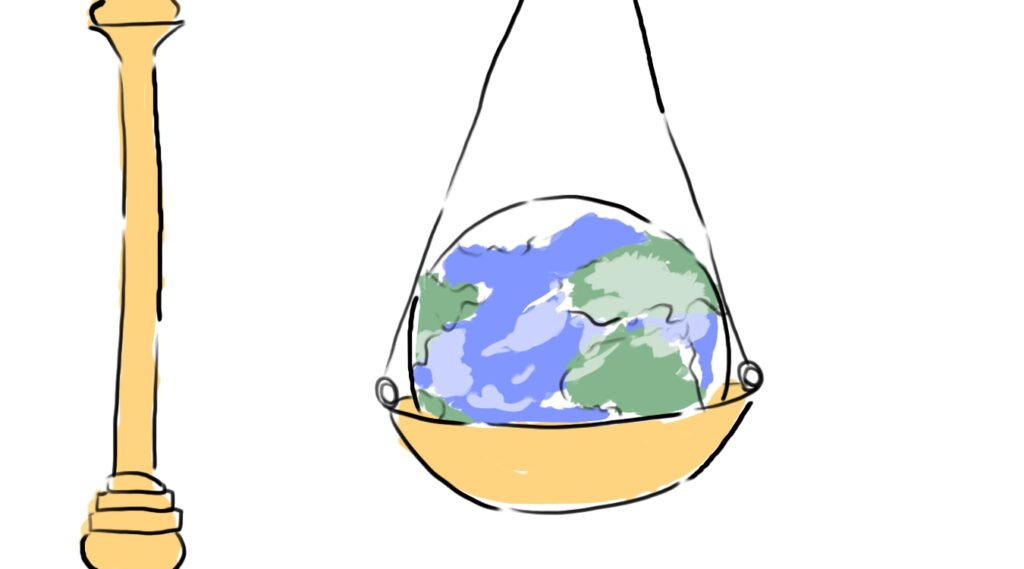
Illustration by Shenuka Corea
Prefatory Note
International law –
This essay in a slightly modified form was written at the request of Fikir Turu, an online source of commentary operating from Turkey, and published in Turkish. An English version was also published in Transcend Media Service, TMS, 17 February 2020.
Published at Richard Falk’s personal blog
Respecting International Law: A Practical Argument
International law disappoints in so many ways, making it easy to overlook why, despite its flaws, it remains valuable and indeed vital for human wellbeing. I put here to one side its usefulness for managing the touristic, trade and investment, maritime, and networking dimensions of international and transnational life, which most of us take for granted until something goes wrong.
And I also take note of the inability of international law to fulfil the hopes of idealists who suppose that law on its own can banish war or ensure that international disputes are resolved by applying law rather than through power leveraging.
If we are attentive to current events, as the media reports war/peace issues, we would quickly conclude that invoking international law in these high profile settings is to be out of touch with how sovereign states go about pursuing their most important economic and political interests, which in areas touching on security is by trusting their military capabilities and alliance relations, and not by believing that as long as their actions and policies stay on the right side of the law, they have nothing to worry about.
Against such a background, my assessment suggests that international law is more relevant even in war/peace settings than what the men who still make most of the big foreign policy decisions realize. A major point here is a reflection of the global turn toward governments led by anti-democratic political figures who gained power by winning free elections.
The voting public in many leading countries seems ready to support governments that do away with civil liberties, the protection of basic human rights, and even move to subvert the independence of the judiciary and legislative branches of government.
Some of the policies of such autocratic leaders violate fundamental norms of international law
In such circumstances, it remains useful for supporters of true freedom to be able to appeal to international law as an authoritative yardstick by which to assess the government behaviour alleged as being abusive.
In this regard, the recourse of Gambia to the International Court of Justice to challenge the genocide of the Rohingya by the government of Myanmar is an example.
Similarly, the current effort of Palestine to persuade the International Criminal Court to investigate alleged crimes against humanity committed by Israel against the Palestinian people is illustrative of the political significance of international law even if unable to regulate the offending behaviour.
These are both high-profile instances of apparent international crimes that could otherwise be hidden behind the heavy curtain of national sovereignty.
The guidelines of international law are crucial in raising the voices of public opinion and even some government on such issues of moral salience in an effective manner, and essential to gain access to international institutions in some circumstances of state crime so as to challenge, and at least document, criminality in an influential manner.
By pointing out such options, it is not meant to suggest that the leadership in Myanmar or Israel will necessarily repudiate their past policies, or alter their abusive behaviour.
What is achieved is some lessening of legitimacy, and this may matter enough to moderate and deter, if not transform behaviour. More liberally inclined governments may be less likely to enter favourable relationships or agree to participate in cultural or sporting events with gross offenders of human rights and basic legal norms.
These kinds of subtle acknowledgements of wrongdoing do have an impact, although rarely acknowledged, until some momentous change unexpectedly takes place, as for example when South African apartheid submitted to international pressure and dismantled apartheid.
An interesting legal example occurred back in the 1980s when the United States was mining the harbours of Nicaragua to exert unlawful pressures on a Marxist-oriented government in control of this tiny country.
The Nicaraguan Government could not hope to challenge by force American policies that seemed to violate the rule of international law that condemned all uses of international force other than in carefully defined instances of self-defense, but it did have recourse to the International Court of Justice due to an obscure treaty that conferred such an option if a dispute between the two governments could not be settled by direct negotiations.
The U.S. refused to participate in such a judicial proceeding, but despite this, the World Court in The Hague accepted the case, and a majority of its judges agreed that Nicaragua had a convincing legal grievance, and so declared.
The U.S. judge on the highest UN judicial tribunal defended the American policies, and Washington denounced the decision. And yet, a few months later the U.S. stopped mining Nicaragua’s harbours, and in effect, covertly complied with the decision upholding the applicability of international law.
“Having law and morality on one’s side has proved a bigger overall asset in violent political conflicts since 1945 than dominating the battlefield. The United States lost the war in Vietnam during the 1960s despite controlling the conventional military dimensions of the conflict, as did the Soviet Union when it intervened more than a decade later in Afghanistan.”
Even Myanmar mounts its strongest possible defence by hiring a team of Western international law experts to present its case. Israeli strategists and think tanks warn the government that attacks on the legitimacy of Israel, that is undertakings complaining about its flagrant lawlessness, are bigger threats to Israeli security than is the Palestinian armed struggle.
Having law and morality on one’s side has proved a bigger overall asset in violent political conflicts since 1945 than dominating the battlefield. The United States lost the war in Vietnam during the 1960s despite controlling the conventional military dimensions of the conflict, as did the Soviet Union when it intervened more than a decade later in Afghanistan.
The major governments in the world are slow to learn from this kind of failure because militarism is embedded in their governing DNA. This reflects the outmoded faith in military superiority as the principal engine of history as well as the bedrock of national security.
What is overlooked is that ever since World War II, people – not armies – have won the characteristic conflicts of the last 75 years, and their highest aspirations for self-determination and independent political statehood have been aligned with international law.
In this sense, large states, as well as small and medium states, would themselves be much better off if their policies in the war/peace and security areas adhered to international law guidelines rather than followed the discretionary dictates and spending priorities of hard power realists.
To the extent this assessment of the changed role of power in international relations is correct, China stands out as comprehending the benefits of embracing soft power realism, by way of trade, investment, and clever diplomacy is the manner to expand influence and raise stature in the 21st century.
In this fundamental sense, international law, which can be conceived of as a soft power calculus in relation to the use of force, has an untested potential to guide governments and their citizens toward a peaceful, prosperous, and ecologically sustainable future, but only if militarist myths and military/industrial/media complexes are discarded.
International law also provides the weak and vulnerable with a means to build support for their struggles against abusive uses of state power, including finding law-related ways to resist autocratic leaders who rely on regressive ‘lawfare’ to stifle political dissent and suppress freedom of expression.
For instance, those victimized can appeal their cases to special rapporteurs of the UN Human Rights Council who can give political visibility, moral/legal credibility, and sometimes exert effective pressure on governments alleged to be violating basic rights.
The elected autocrat of the Philippines, Rodrigo Duterte, uses his manipulation of the legislative and judicial branches of government to frame and imprison political opponents and dissenters, while solidarity initiatives respond by invoking international law standards and procedures to challenge such unlawful behaviour, in effect, recourse to progressive lawfare tactics.
Finally, civil society activism formulates its agendas, and builds its support, by illuminating the lawlessness of governments, especially in relation to geopolitical actors that enjoy effective impunity under international law.
There are many such uses of international law, going back to the tribunals on the Vietnam War organized in the late 1960s with the backing of Bertrand Russell, passing legal judgment on the violations of Vietnamese sovereignty by American-led military intervention.
Another notable example was the Iraq War Tribunal of 2005 held in Istanbul, bringing together legal experts and moral/cultural personalities to pass judgment on the spurious claims that the U.S./UK military attack and occupation of Iraq were consistent with fundamental norms of international criminal law.
“In the end, we can and should still lament the shortcomings of international law, but if we seek an international order that respects rights and is more peaceful, it is vital to appreciate the present and potential role of international law.”
Such a legal proceeding did not end the occupation but it strengthened the political will of those who opposed such policies as well as providing a documentary record of geopolitical lawlessness that could not be compiled if an international legal framework did not exist and enjoy the formal endorsement of those states whose behaviour was being judged.
In the end, we can and should still lament the shortcomings of international law, but if we seek an international order that respects rights and is more peaceful, it is vital to appreciate the present and potential role of international law.
It can offer constructive policy guidelines for policymakers and leaders, better aligning foreign policy with national interests given the increasing limits on the utility of military force under contemporary condition.
It also allows civil society activism to ground their solidarity initiatives on a foundation of international law rather than on mere political passion, and can serve to deter some governments from pursuing policies that violate international human standards and would likely weaken their reputation as responsible members of world society.
The work of some international NGOs, such as Amnesty International and Human Rights Watch, not only depends on the existence of legal standards, but shows that many powerful governments care enough about their reputations at home and abroad to curb their lawlessness if confronted by prospects of exposure.
Of course, it would be wrong to expect too much from a reliance on international law in this period when even those states that claim the legitimacy of political democracy are choosing leaderships and adopting policies that defy such values and practices.
Many of us are discovering that procedural democracy, as principally expressed by free elections and independent political parties, offers little assurance that the political winners will adhere to the rule of law, that is, the norms and institutional arrangements of substantive democracy, when in positions of political authority.
Such disillusionment is accentuated by the growing evidence that such leaders retain their popularity with the citizenry even when they are unscrupulous lawbreakers.
And, of course, less political and moral friction is present when the laws being twisted or broken pertain to foreign policy.
International law is not reinforced at this point by strong populist expectations of compliance, although rule of law considerations may be invoked when a state is targeted for intervention or sanctions.
Originally published at Richard Falk’s personal blog