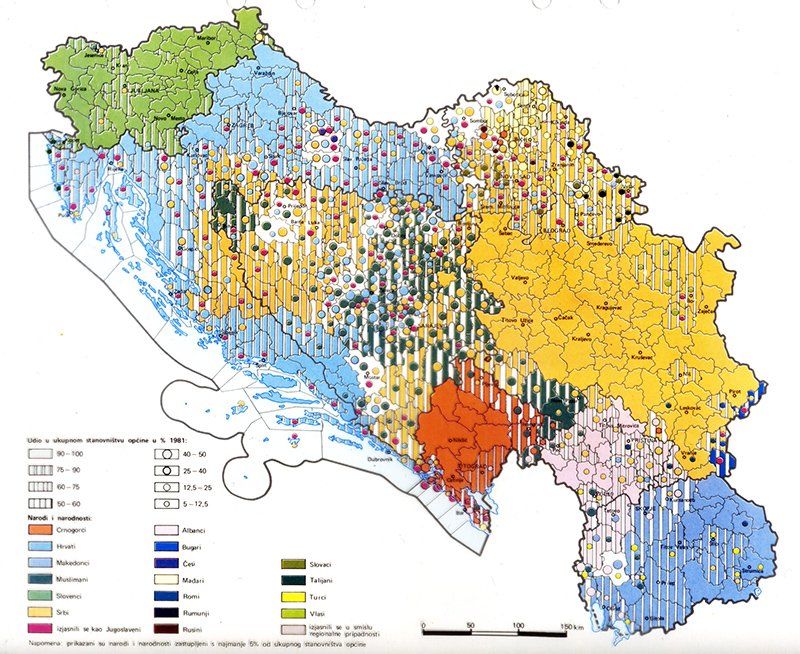
The ethnic map few understood. Should make it clear that cutting up Yugoslavia in independent republics could not be done without bloodshed. (1)
Yellow = Serbs, Dark Green = Muslims, Light Blue = Croats, Light Green = Slovenes, Orange = Montenegrins, Pink = Albanians, Darker Blue = Macedonians
, marks the 19th anniversary of NATO illegal and illegitimate bombing of Yugoslavia, Serbia and its Kosovo, province during 78 days. It has – one is tempted to say: of course – been conveniently forgotten by the West itself.
It was masterminded by the United States under Bill Clinton and Secretary of State Madeleine Albright after the so-called negotiations between Serbs and Albanians in Rambouillet outside Paris (the parties never met face-to-face)
While Clinton may be best remembered for his relations with Monica Lewinsky and his wife, Hillary Clinton, some of us also remember him (and Albright) for bombing Afghanistan, Sudan, Bosnia-Hercegovina and contributions to the proportionately largest ethnic cleansing in Yugoslavia – of Croatian Serbs out of Croatia’s Krajina, Eastern and Western Slavonia where they had lived for about 400 years, in Operations “Storm” and “Flash” in 1995.
Clinton was also the President who started the expansion of NATO against assurances about never doing so given by leading NATO politicians to Mikhael Gorbachev and former Yugoslav republics are now NATO members (Slovenia, Croatia and Montenegro) and upheld the sanctions on Iraq’s innocent citizens even after 500 000 had died.
By an objective analysis of the contemporary history of interventionism and militarism, Russia’s response to the de facto coup d’etat in Kiev by annexing Crimea would, one should expect, be compared with such fundamentally important and international law-violating policies and, likely, found to be minor in comparison. But that, naturally, is impossible for those who have reasons to be in denial of their own wrongdoings and large parts, therefore, of the post-Cold War history.
With a history like that – and more since then – it is no wonder that the NATO/West must blame everything evil on virtually everybody else: Russia, Syria, Iran, North Korea and China in particular. In psycho-political terms, it’s called projection while others might call it amnesia or attention-diversion that fit new crimes.
• •
Yugoslavia’s dissolution was surely caused by internal dynamics accumulating over a decade after Josip Broz Tito’s death. But the international so-called community’s involvement could, in the macro-historical perspective, be viewed as at least as destructive, if not more. The understanding of the hugely complex conflict formations in the Yugoslav space was unknown to 99% of the Western governments and their diplomats – having no other mental patterns than the Cold War and, thus, casting the Serbs as the evil, expansive Orthodox Russians and the rest as freedom-seeking peoples who ought to belong to “us”.
They thought it was about ethnicity while ethnicity was just a vehicle for mobilisation of warfighting energies and exploitation of traumas from the Second World War. They thought that conflict-resolution was about reducing complexity down to two parties, one good and one evil and that peace-making would succeed if they supported the former and punish the latter.
With such a deficient intellectual toolbox, with such amateurish Diagnosis of Yugoslavia’s problems, it shouldn’t surprise anyone that the Prognosis was wrong too and that the kind of final Solution – dissolution, split-and-rule and rewarding extremist nationalism and humiliating Russia – turned out catastrophic.
A good doctor causes as little pain and blood loss. Western conflict doctors, accompanied by their arms traders, spilt as much blood as possible, on top of what the various domestic governments, private warlords and paramilitaries of Yugoslavia were able and willing to do to each other.
• •

To make this Western – remember, Russia was on its knees and could play no role – quackery succeed, at least in their own eyes, the self-appointed peacemakers of our world had to produce a number of novel tricks – all of which makes the longterm effects of this Yugoslavia’s dissolution more significant than the fall of The Wall.
Among such politico-military inventions on would perhaps in particular point to these:
• Since this was the first larger conflict after the dissolution of the Soviet Union and the Warsaw Pact, everything seemed possible, no need to take into account what Russia might do because it could do virtually nothing.
• Splitting with violent means an existing founding member state of the Non-Aligned Movement and of the UN;
• Bombing without a UN Security Council mandate (and where there were one, making it blurred and never finding the funds for the UN to succeed);
• Recognising Slovenia and Croatia out of Yugoslavia against while the criteria for declaration of independence (such as control over a territory) were not met;
• Recognising these two republics out of Yugoslavia while not having the slightest idea about what to do with Rest-Yugoslavia and, thereby, making the war in Bosnia-Hercegovina impossible to avoid.
• Inventing the peace enforcement idea in the UN Agenda for Peace report that contravened everything the UN stood for and enabled one-sided military action by outsiders;
• Inventing the idea of humanitarian intervention – and using it there where there were no genocide (or plan of it, certainly not in Kosovo either) or other historically, uniquely huge, humanitarian catastrophe while never since contemplating such interventions to really stop such mass-killing calamities elsewhere;
• Bombing relentlessly and shamelessly over 78 days one country, Serbia, in order to create a new state out of it, Kosovo – the second Albanian state in Europe;
• And threaten the destruction of the capital, Belgrade, unless President Slobodan Milosevic withdrew from Kosovo;
• Establishing a special Tribunal in the Hague for only this conflict and Rwanda, a tribunal which, to the very end, was marked by strange procedures and biases that, hardly surprisingly, fit the political patterns and deficient conflict diagnosis practised by the West.
• While one can certainly argue that the UN was undermined by many other wars before those in Yugoslavia, Vietnam not the least, it can be argued that it was here the UN became a victim of systematic marginalisation and accused of being useless and even complicit in its policies and on-the-ground missions – to the extent that the UN has not been thought of as a central peacekeeper, – maker and -builder in any of the large conflict zones since 1999.
• And it is, finally, the conflict in which commercial marketing companies – such as Ruder Finn – were brought in to secure an advantageous but deceptive global image of Croatia, Bosnian Muslims and Kosovo-Albanians. Powerful narratives that serve certain interests but not truth in any sense didn’t start with Syria. Neither did mainstream media’s loyalty to their governments and addiction to simplifying two-party narratives that were particularly misleading here, in one of the world’s most complex conflict formations.
Those of us who were more or less permanently on the ground in all parts of Yugoslavia – had been there decades before and followed it closely after, tended to see things in rather different perspectives and would maintain that the outside “help” Yugoslavia received from the international so-called community was a kind of cynical euthanasia rather than a genuine help to recover.
• •
Kosovo and TFF’s mediation and peace plan
This author served as goodwill mediator/adviser to three governments in Belgrade and to the non-violent leadership team of Dr Ibrahim Rugova in Kosovo. They wanted an independent state but only through non-violent means – and therefore soon marginalised by the West which, with the particular contribution of the German intelligence service BND and the American CIA instead invested in the darkest and most criminal circles in Kosovo and set up the Kosovo Liberation Army (KLA/UCK) which later served as a kind of army on the ground for NATO’s bombing raids.
We developed a plan for a negotiated solution to the conflict based on a total ceasefire, UN presence and monitoring and a three-year negotiation process. It was shaped like an international law document. As far as we know, it is the only plan that was widely discussed and presented in in details in both Serbian and Albanian media.
It turned out soon to be all in vain. The US and NATO allies had other plans – and they were not about peace. The Rambouillet meetings were totally fake, meant only to secure that Belgrade would say No and the Albanian Yes. Then Assistant Secretary of State, James Rubin, formulated it so well – people thought: Today the Serbs have chosen war and the Albanians peace. He said it to his wife, Christiane Amanpour on CNN – State war policies and mainstream media already then in symbiosis.
How was it done? Well, in the first round of talks the Albanians had stalled while the Serb team went along with a plan presented by Madeleine Albright. That was not what they wanted, so she later produced an Appendix to the text – to be used to turn the talk results around 180 degrees: The Appendix stipulated that NATO forces should be deployed to Serbia, should not be legally responsible for damage it may cause to Serbian property and not pay for the use of harbours and airfields.
Who would not have smelled a rat here? Either NATO could then have started a war from inside Serbia itself, having already a first contingent on the ground. Or they could move to arrest President Milosevic at some point. Surprise, surprise: The Serbs said no and the Albanians were enthusiastic.
That was the pretext to NATO bombings 19 years ago. Plus the – presumably nicely staged – massacre in the village of Racak. A US head of the OSCE-related KVM monitoring mission, Mr William Walker, with a less than clean-handed past in the CIA, arrived immediately and, before any analyses had been made, declared it the work of the Serbian government.
• •
TFF’s team of Yugoslavia experts, psychologists, media people, peacemakers etc. was on the ground everywhere, conducted interviews on all sides (some 3000) and roamed around with flak jackets also where no embassies were found. No Western government ever took any interest, except former US Secretary of State, Cyrus Vance and his team whom we had a long conversation with in a late evening at his hotel suite. A delightful intellectual with a heart, a moral man – who was quickly sidelined by the Clinton administration and one of the students Vance had taught diplomacy – Warren Christopher.
TFF’s first report, After Yugoslavia – What? in September 1991 was published at the same time as Vance’s team was working on the idea to deploy UN peacekeeping missions in Croatia. That was also a central proposal of the mentioned report.
Over the years, three TFF Associates – Johan Galtung, Hakan Wiberg and Jan Oberg who in total had about 130 man-years of experience with Yugoslavia – wrote the equivalent of about 2000 A4 pages – main comprehensive conflict analyses and peace proposals and some debate articles and press releases. They’re all gathered – as they were written at the time – in the blog (1) report “Yugoslavia – What Should Have Been Done” which is not only the largest peace research publication about Yugoslavia but also a frontal criticism – with alternatives point by point – of how the West practised what must be termed peace prevention.
Yes, there were alternatives.
But those who mastermind wars are not exactly the best listeners.
Back then as today, somebody else paid a high price.
We don’t want to contribute to the special war crimes amnesia of the West.
And we want to remind our audiences that there are always alternatives to warfare.
Note 1
There are only three cases in the 20th century where dividing states were done without bloodshed: Norway from Sweden in 1905; Singapore from Malaysia in 1965 and the division of Czechoslovakia in 1993. All others were violent. Where those who advocated that Yugoslavia be divided by force unaware of history or just cynical?
Note 2
The advantage of a blog, compared with a book or a series of volumes as this would have been, is that it lasts much longer in the public domain, being available to concerned citizens, students and researcher everywhere. Sadly, academic books today mostly end up in libraries (and photocopiers), too expensive for students to acquire. A blog is also much handier for students with a search engine instead of the notes and index at the end of a book (which often doesn’t have that detail you’re looking for…).
Further, it is free where academic books are now in the price range of hundreds of dollars. While academic publishing houses hardly pay authors honorarium anymore, we authors at least have the deep joy of knowing we a) are being read widely and b) do not contribute to making corporate profits even higher. Our work is for the public good instead.
If you respect and like that basic idea, you may consider making a donation towards TFF’s peace research and policy work. All the above was made possible thanks to people-funding which we are extremely grateful for. You can assist us in doing more genuine and critical-constructive peace research in the future here. Thanks a lot.