
Will Putin Attack Poland & the Baltics?

Given their lack of information about the Ukraine-Russia deal scuttled by Boris Johnson early in the war, many Americans will be inclined to believe Biden’s evidence-free claims in last week’s CNN debate.

Ray McGovern
Special to Consortium News, July 2, 2024

July 5, 2024

At Thursday’s debate with Donald Trump, President Joe Biden, calling Russian President Vladimir Putin a “war criminal,” claimed that he “wants all of Ukraine. … Do you think he’ll stop? … What do you think happens to Poland and other places?”

Spoiler Alert: Official Ukrainian sources confirm that Putin did stop in March 2022, after Ukrainian President Volodomyr Zelensky agreed to forswear membership in NATO. This was the key provision in the Ukraine-Russia deal initialed by Davyd Arakhamia, who at the time was Zelensky’s chief negotiator (and his party’s faction leader in the Rada) at the talks in Istanbul at the end of March, hardly a month into the war.

The Russians lifted their objection to Ukraine joining the EU, as the Ukrainians agreed to neutrality. Security guarantees sought by Kyiv (short of NATO membership) would be worked out. The fighting would stop. Agreement on the status of Crimea would be put off to the future.

Putin and Zelensky reportedly were micromanaging the March 2022 negotiations, and at that early stage the Russians expressed readiness for the two to meet. 

At the same time that Biden and other Western leaders raise the alarm that Putin will attack other parts of Europe when he’s through with Ukraine, they claim Russia can’t even take the Ukrainian province of Kharkiv, has lost more than 500,000 men to just 30,000 Ukrainians and its economy is faltering (none of which is true.)  But Cold War Western power was based on an exaggerated Soviet threat and the same is true today. 

In a November 2023 Kyiv Post report titled “Russia Offered to End War in 2022 If Ukraine Scrapped NATO Ambitions – Zelensky Party Chief,”  Arakhamia confirmed that in the March 2022 negotiations Russia proposed ending the war on the condition that Ukraine abandon its NATO aspirations and adopt a neutral stance.

Arakhamia continued:

“Neutrality was the biggest thing for them, they were ready to end the war if we took — as Finland once did — neutrality and made commitments that we would not join NATO. This was the key point. 

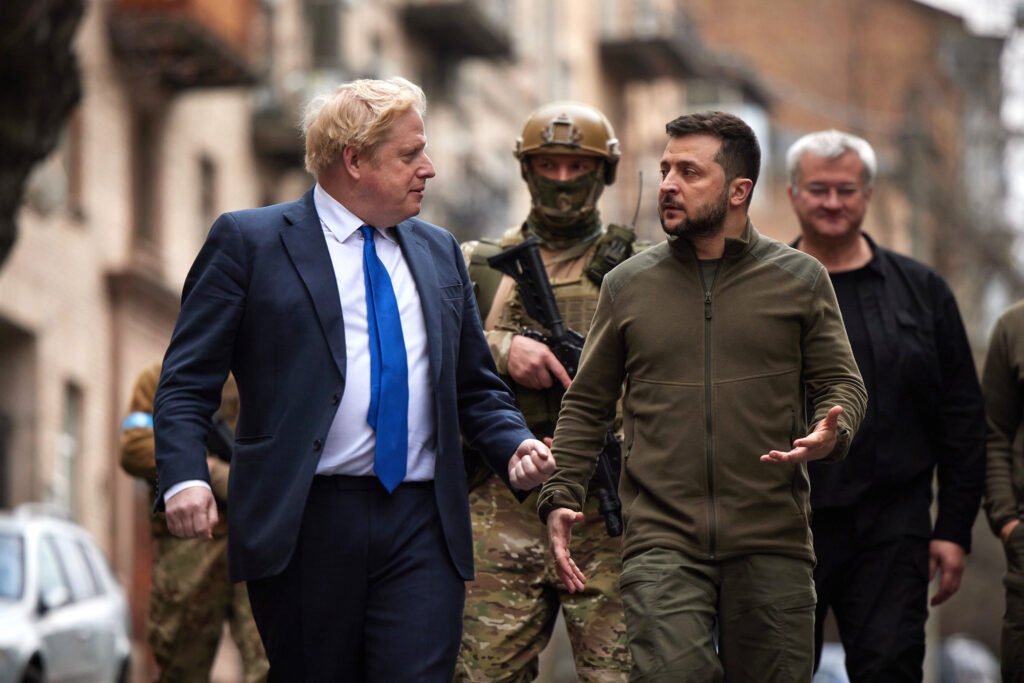
While negotiations continued in Istanbul, former U.K. Prime Minister Boris Johnson unexpectedly arrived in Kyiv on April 9 and said that Ukraine shouldn’t sign anything with them at all – and ‘let’s just fight.’ ”

Arakhamia’s candor was refreshing. But it came as no surprise to those of us following Ukraine in early 2022. On May 5, 2022 — a year and a half before Arakhamia spilled the beans to the Kyiv Post Ukrainska Pravda ran a report under the title “Possibility of talks between Zelensky and Putin came to a halt after Johnson’s visit:

“According to sources close to Zelenskyy, the Prime Minister of the United Kingdom, Boris Johnson, who appeared in the capital almost without warning, brought two simple messages.

The first is that Putin is a war criminal, he should be pressured, not negotiated with. And the second is that even if Ukraine is ready to sign some agreements on guarantees with Putin, they [the West] are not. The collective West felt that Putin was not really as powerful as they had previously imagined, and that here was a chance to press him.”

Three days after Johnson left Kyiv, Putin publicly stated that talks with Ukraine had “turned into a dead end.” Putin expressed confidence that Russia would ultimately prevail and added that it would “rhythmically and calmly” continue conducting the operation in Ukraine.

In his major speech to the Russian Foreign Ministry on June 14, Putin said the Russian troops approaching Kyiv in February-March 2022 were there “to push the Ukrainian side to negotiations.” 

From Feb. 24 on, the Russians had expressed readiness for diplomacy. Interestingly, Zelensky appointed Arakhamia chief negotiator on Feb. 28.

Putin continued:

“Surprisingly, as a result, agreements that satisfied both Moscow and Kyiv were indeed reached and initialed in Istanbul. … The document was titled ‘Agreement on Permanent Neutrality and Security Guarantees for Ukraine’. It was a compromise but  resolved the problems that were stated as major ones even at the start of the special military operation.

But the path to peace was rejected again. … The former UK prime minister said directly during his visit to Kyiv – no agreements. Russia must be defeated on the battlefield. … Thus they began to intensively pump Ukraine up with weapons and started talking about the need to inflict a strategic defeat on Russia.”

Who has been telling Biden that Putin “will not stop at Ukraine?” Exhibit A would be Fiona Hill, disciple of arch-Russophobe historian Richard Pipes, and national intelligence officer for Russia (2006-09). 

Her insights appeared in The New York Times exactly a month before Russia invaded Ukraine.

On Jan. 24, 2022, the Times featured a guest essay by Hill titled “Putin has the U.S. Right Where He Wants It”:

“This time, Mr. Putin’s aim is bigger than closing NATO’s ‘open door’ to Ukraine and taking more territory — he wants to evict the United States from Europe. As he might put it: ‘Goodbye, America. Don’t let the door hit you on the way out.’”  [Emphasis added.]

Fiona Hill’s NYT essay about Putin driving the U.S. out of Europe had a short (two-month) shelf life, as Putin’s negotiators in Istanbul extracted a Ukrainian commitment not to seek NATO membership and a stop in hostilities. Hill admitted as much in a September/October 2022 Foreign Affairs article which included, briefly, the substance of the Istanbul agreement.

This may be damning with faint praise but, in this respect, Fiona Hill showed far more integrity than the Times, which continues to deny its readers the facts about the Istanbul accord and how it showed that in March-April 2022 Putin did stop once Ukrainian negotiators agreed to forswear membership in NATO.

With Putin having provided, in his June 14 speech, chapter and verse on the (aborted by Boris Johnson) “Agreement on Permanent Neutrality and Security Guarantees for Ukraine,” the Times wasted no time distorting the terms of the Istanbul accord, mostly by omission and turgid obfuscation, in publishing two highly deceptive articles on June 15. 

Neither article mentions  Johnson’s wrecking-ball role in scuttling the Istanbul accord. And even the subsequent admissions of Ukrainian negotiators are mangled.

Thus, New York Times readers, and the thousands of media outlets that take their lead from the Times, are once again misled on a crucial issue — one for which there is ample official Ukrainian testimony that the Times chooses to omit or fudge. And many Americans will be inclined to believe Biden’s evidence-free claims about Putin’s ultimate objectives, and to acquiesce in the dangerously growing tension with Russia — malnourished as they are on accurate information.

For many it will come down to: Between Biden and Putin, Americans “know” whom to believe!


Speaking to Western journalists on June 5, Putin cautioned: 

“You should not make Russia out to be the enemy. You’re only hurting yourself with this … They thought that Russia wanted to attack NATO. Have you gone completely crazy? … Who came up with this? It is just complete nonsense, you know? Total rubbish.”

Sadly, it is the kind of nonsense that could mislead Americans, conditioned to believe the worst of Russia, into supporting some kind of risky escalatory move by an administration determined to show how tough it is, as the November election inches closer and closer. Strap on your seatbelts.


Ray McGovern works with Tell the Word, a publishing arm of the ecumenical Church of the Saviour in inner-city Washington. His 27 years as a C.I.A. analyst included leading the Soviet Foreign Policy Branch and conducting the morning briefings of the President’s Daily Brief. In retirement he co-founded Veteran Intelligence Professionals for Sanity (VIPS).

Views expressed in this article and may or may not reflect those of Consortium News.

Share

Leave a Reply

Your email address will not be published. Required fields are marked *

Related Posts

Jan Oberg, TFF director April 9, 2026 I was recently invited to have a good, long talk about the world – and, of course, about peace too – with Boris Malagurski on his Weight of Chains Channel on YouTube. It was a real joy and seems to have been greatly appreciated by the viewers too. Mr Malagurski and I shall of course be grateful if you share this conversation in your circles – of course, only if you like what you see and hear  And remember that this one – like hundreds of others with TFF Associates – can be enjoyed at our TFF Video Collection.
By Jan ObergTFF co-founder and director February 11, 2026 PART 3 — ECONOMICS, TRADE & FINANCIAL SOVEREIGNTY A. Trade Measures & Market Signaling Economic pressure can be applied instantly and scaled without violence. Immediate Measures (within a week) Government boycott US goods and services  A very powerful signal which over time will be felt. Targeted tariffs on selected U.S. goods Symbolic but high-visibility sectors send a clear message. Suspend trade facilitation talks A peaceful pause that signals deep concern. Freeze U.S. participation in public procurement – military procurement in particular A nonviolent way to reduce influence. Competition law review of U.S. corporations A legal tool to scrutinise market dominance. Longer-Term Measures EU–Asia–Africa trade corridors Reducing reliance on U.S. markets. European supply chains for critical minerals Strategic autonomy in resource access. European Strategic Trade Authority Monitoring coercive practices globally. Euro-denominated commodity markets Weakening the dollar’s pricing monopoly. The EU must resume contacts and negotiations with Russia, focusing on energy cooperation To...
PART 2 — Diplomacy, Law and Nonviolent Power By Jan ObergTFF co-founder and director January 26, 2026 This is the second of four TFF-created idea portfolios designed to curb the global reach of the United States and, in both the short and long term, help catalyse a worldwide nonviolent resistance to what many observers describe as the Trump administration’s uniquely confrontational, destructive and world-threatening policies. These portfolios outline what governments and citizens across the world can do through dynamic diplomacy, creative initiatives, and strictly nonviolent means. They are typical TFF works in that we do not only tell what the problem is and how bad it will go – as 90+% of all commentators, experts and scholars do – we tell what we think can be done, inviting you to think of what you think you can do. It seems painfully clear to me that the current political dynamics in Washington increasingly resemble the most dangerous...

Recent Articles

2003 The capital Bujumbura 2006 The capital Bujumbura 2006 Gitega, the second largest town& its surroundings 2007 Muramvia Back to Oberg’s Photography main page
By JONATHAN POWER August 16, 2000 LONDON – Remember the summer of ’98? In the sweltering, torpid heat of a Roman august, charged with exhaust fumes, the international community gave its overwhelming approval to the establishment of an International Criminal Court that will enable those accused of “crimes against humanity” to be tried and, if convicted, sentenced. Only seven nations opposed or abstained from the motion, including Israel, China, India and the U.S.A. where the Pentagon had successfully waged bureaucratic guerrilla war to undermine the initially sympathetic stance of President Bill Clinton. Two years on we can now see what an epochal event that was. In a the stroke of 120 pens it changed the climate on political thuggery. After numerous half-starts and false starts ever since the Nuremberg and Tokyo trials that convicted the war criminals of the Second World War, the world at last had agreed en masse a common...
By Jonathan Power April 8th 2004 LONDON – There is a widely held opinion abroad that Brazil never had the chance of profoundly changing for the better- shedding its widespread poverty and dire income distribution- until Lula (President Luiz Inácio da Silva) came along last year. This is not entirely false, but neither is it entirely true. Brazil has long made a kind of progress- in the last century it was second only to Taiwan as the fastest growing economy in the world- but it has been appallingly uneven. Part of the story of contemporary Brazil is clear to the eye in this small village of 7,000 people in the arid north east, along with the Amazon the poorest part of this vast country. Twenty five years or so ago I used to come to Pilõezinhos regularly when I had a close friend living here, Valéria Rezende, a radical, grass roots-stirring...

TFF on Substack

Discover more from TFF Transnational Foundation & Jan Oberg.

Most Popular

2003 The capital Bujumbura 2006 The capital Bujumbura 2006 Gitega, the second largest town& its surroundings 2007 Muramvia Back to Oberg’s Photography main page
By JONATHAN POWER August 16, 2000 LONDON – Remember the summer of ’98? In the sweltering, torpid heat of a Roman august, charged with exhaust fumes, the international community gave its overwhelming approval to the establishment of an International Criminal Court that will enable those accused of “crimes against humanity” to be tried and, if convicted, sentenced. Only seven nations opposed or abstained from the motion, including Israel, China, India and the U.S.A. where the Pentagon had successfully waged bureaucratic guerrilla war to undermine the initially sympathetic stance of President Bill Clinton. Two years on we can now see what an epochal event that was. In a the stroke of 120 pens it changed the climate on political thuggery. After numerous half-starts and false starts ever since the Nuremberg and Tokyo trials that convicted the war criminals of the Second World War, the world at last had agreed en masse a common...
By Jonathan Power April 8th 2004 LONDON – There is a widely held opinion abroad that Brazil never had the chance of profoundly changing for the better- shedding its widespread poverty and dire income distribution- until Lula (President Luiz Inácio da Silva) came along last year. This is not entirely false, but neither is it entirely true. Brazil has long made a kind of progress- in the last century it was second only to Taiwan as the fastest growing economy in the world- but it has been appallingly uneven. Part of the story of contemporary Brazil is clear to the eye in this small village of 7,000 people in the arid north east, along with the Amazon the poorest part of this vast country. Twenty five years or so ago I used to come to Pilõezinhos regularly when I had a close friend living here, Valéria Rezende, a radical, grass roots-stirring...
Read More
Generic thumbnail
2003 The capital Bujumbura 2006 The capital Bujumbura 2006 Gitega, the second largest town& its surroundings 2007 Muramvia Back to Oberg’s Photography main page
By JONATHAN POWER August 16, 2000 LONDON – Remember the summer of ’98? In the sweltering, torpid heat of a Roman august, charged with exhaust fumes, the international community gave its overwhelming approval to the establishment of an International Criminal Court that will enable those accused of “crimes against humanity” to be tried and, if convicted, sentenced. Only seven nations opposed or abstained from the motion, including Israel, China, India and the U.S.A. where the Pentagon had successfully waged bureaucratic guerrilla war to undermine the initially sympathetic stance of President Bill Clinton. Two years on we can now see what an epochal event that was. In a the stroke of 120 pens it changed the climate on political thuggery. After numerous half-starts and false starts ever since the Nuremberg and Tokyo trials that convicted the war criminals of the Second World War, the world at last had agreed en masse a common...
By Jonathan Power April 8th 2004 LONDON – There is a widely held opinion abroad that Brazil never had the chance of profoundly changing for the better- shedding its widespread poverty and dire income distribution- until Lula (President Luiz Inácio da Silva) came along last year. This is not entirely false, but neither is it entirely true. Brazil has long made a kind of progress- in the last century it was second only to Taiwan as the fastest growing economy in the world- but it has been appallingly uneven. Part of the story of contemporary Brazil is clear to the eye in this small village of 7,000 people in the arid north east, along with the Amazon the poorest part of this vast country. Twenty five years or so ago I used to come to Pilõezinhos regularly when I had a close friend living here, Valéria Rezende, a radical, grass roots-stirring...
Mearsheimer-800x418-1
A friendly quarrel while we agree that the US sanctions are a weapon of mass destruction and kill more people than wars do. And that we must talk much more about sanctions than we have so far. Jan Oberg, TFF director March 16, 2026 John Mearsheimer recently stated that U.S. sanctions murdered around 38 million people between 1971 and 2021 – see the video below. It is a dramatic figure, and it has spread quickly because it captures, in one sentence, the enormous human cost of modern sanctions. I share his concern about the destructive effects of economic coercion. But the specific number he cites — and the way he attributes it — deserves a friendly academic clarification. The figure comes from a 2023 Lancet Global Health article estimating the mortality effects of unilateral U.S. and EU sanctions over the past half‑century. This is the first point where Mearsheimer’s shorthand diverges from the text: the study...
Screenshot-2026-05-15-103534
Jan Oberg May 15, 2026 Go to this Fox News page and scroll the whole way down: President Donald Trump tells the world that his meeting with President Xi Jinping yielded a lot of very concrete political and economic results – of course, only where the Chinese side, according to him, agreed with him. He does not mention the Taiwan issue, but Secretary of State, Marco Rubio, says that it did not feature prominently in their talks and that the US policy on Taiwan has not changed. Then go to China Daily – or Global Times – and you will see that for the Chinese it is framework, principles, structure of cooperation etc. that matters – all embedded in the overall idea of “constructive bilateral relationship of strategic stability.” Nowhere is any concrete agreement or deal – all that Trump refers to – mentioned. At the general level, this gives you insights into the very different social...
Screenshot-2026-05-12-104023
Lena Petrova of “World Affairs In Context” with more than half a million subscribers on YouTube wanted to explore what a peace researcher like me has to say about, among other things, the First and the Second Cold War and why eethics has disappeared from politics. I am particularly happy about this conversation that also yielded an amazing number of very appreciative comments on YouTube. No doubt, people are longing for alternatives, including peace perspectives.