
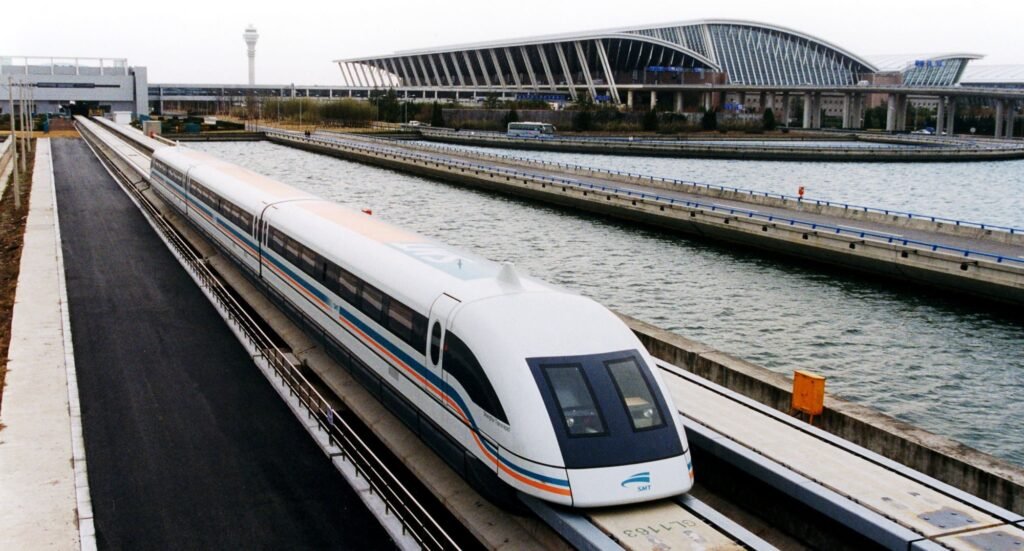
Why don't we have China trains in Norway?

Thore Vestby & Arild Vollan

Visiting today’s China is like travelling into the future. So much has happened in the last 20-30 years that we should travel to China to learn and see what is happening. It’s incredible what the country has achieved in just a few years.

Soon, China will have built 50,000 kilometres of high-speed train lines. Just travelling by train in China is such a great experience that it’s worth the visit. These trains are completely silent and offer a level of comfort you’ll find in first-class aeroplanes—an enchanting and must-experience travel experience.

Strangely, we in Norway can’t make “pirate copies” of Chinese trains. We are told that Chinese companies are happy to build new high-speed train lines in Norway. But we ran into problems when we tried to explain to the Chinese that we in Norway have introduced “Bus for Train”. It’s a term that doesn’t exist in the Chinese language. We didn’t really manage to explain what we meant.

Trains are too expensive

Those who don’t want to invest in trains in Norway say that they will be too expensive. This argument was also used in China, but here, politicians did not consider what “transport economists” thought. The policy in China means that infrastructure must be developed to create development in a country. Our travels around China show that this is precisely what has happened. The country has been developed and modernised with a well-functioning infrastructure, which has created development and jobs even outside China.

A 2020 study showed that China’s net benefit of the high-speed rail system is approximately USD 378 billion. This gives an annual return on investment of 6.5%. The development of high-speed rail has also led to a significant reduction in domestic air traffic.

With high-speed trains in Norway, domestic air routes will no longer be needed. The new China trains have a speed of 300 to 400 km/h. China’s new Maglev trains recently completed demonstration tests at up to 1000 km/h speeds. Even a train journey from Oslo-Tromsø will take a long time. Why can’t we get China to build the Northern Norway Railway?
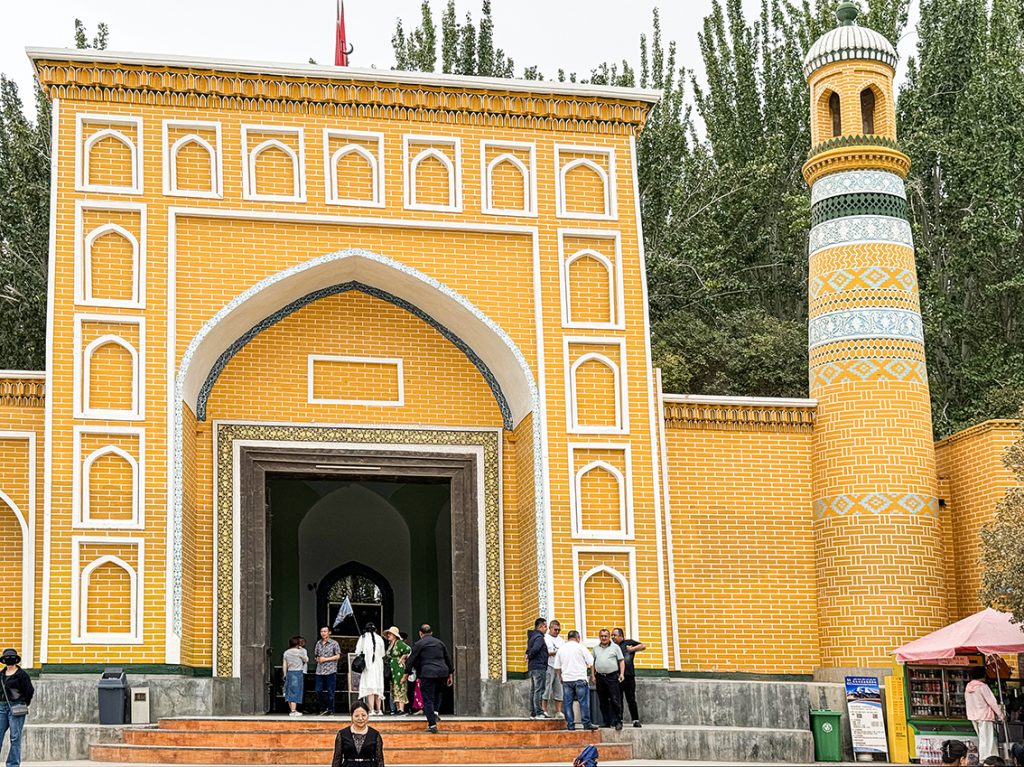
The central mosque in Kashi, Xinjiang © Jan Oberg 2024

Is China a security threat?

Unfortunately, it’s unlikely that rail cooperation will occur between Norway and China. China has suddenly become a significant security threat to the West. According to NATO, even the Chinese are coming to take our “values” from us.

From China’s point of view, these are incredible claims. China has no ambitions to threaten the Western world or to seek hegemony. The generally negative attitude towards China in our media, research and politics stems not from China, but from the West itself.
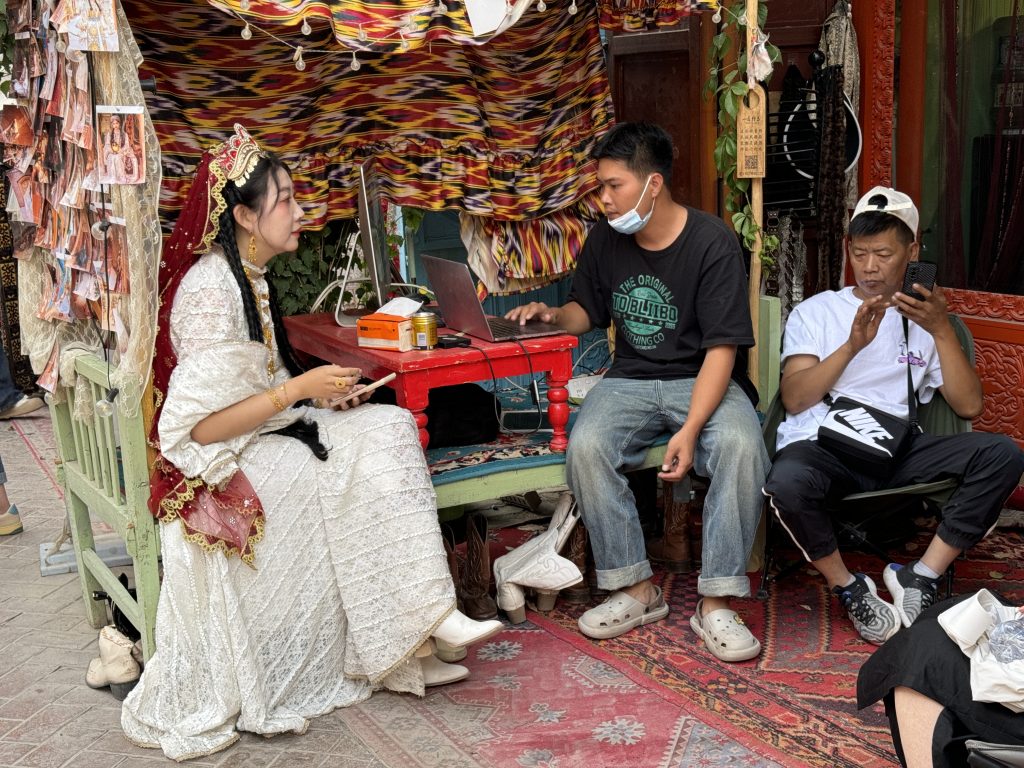
Street shot from Kashi/Kashgar in Xinjiang © Jan Oberg 2024.

Chinese foreign policy is founded on the Five Principles of Peaceful Coexistence – mutual respect for territorial integrity and sovereignty, non-aggression, non-interference in each other’s internal affairs, equality and mutual benefit, and peaceful coexistence. These principles are recognised by important legal instruments such as the UN Charter, but not by most countries in their daily decisions.

It is wrong to judge China by Western criteria, not by its own criteria and achievements.

Recently, the US Congress has allocated no less than US $ 1.6 billion to influence operations aimed at creating negative images of China.

The propaganda war

In a carefully planned propaganda war, China is portrayed as a threat to the rest of the world. The US aims to turn public opinion in the West and Africa against China. Perhaps this shows how weak the West has become? It’s indeed sad for everyone who used to fight for free media and free expression of opinion.

To understand and see what’s happening in China, we need to visit China. We cannot rely on being informed through a carefully planned propaganda war.

We recently visited the province of Xinjiang, strategically located in the northwest as a gateway to Eurasia and Europe. About two-thirds of the province’s 26 million people are members of numerous ethnic minorities – and it is a crucial province for the Belt and Road Initiative. This is where the US claims China maintains concentration camps and where genocide against minorities is taking place.
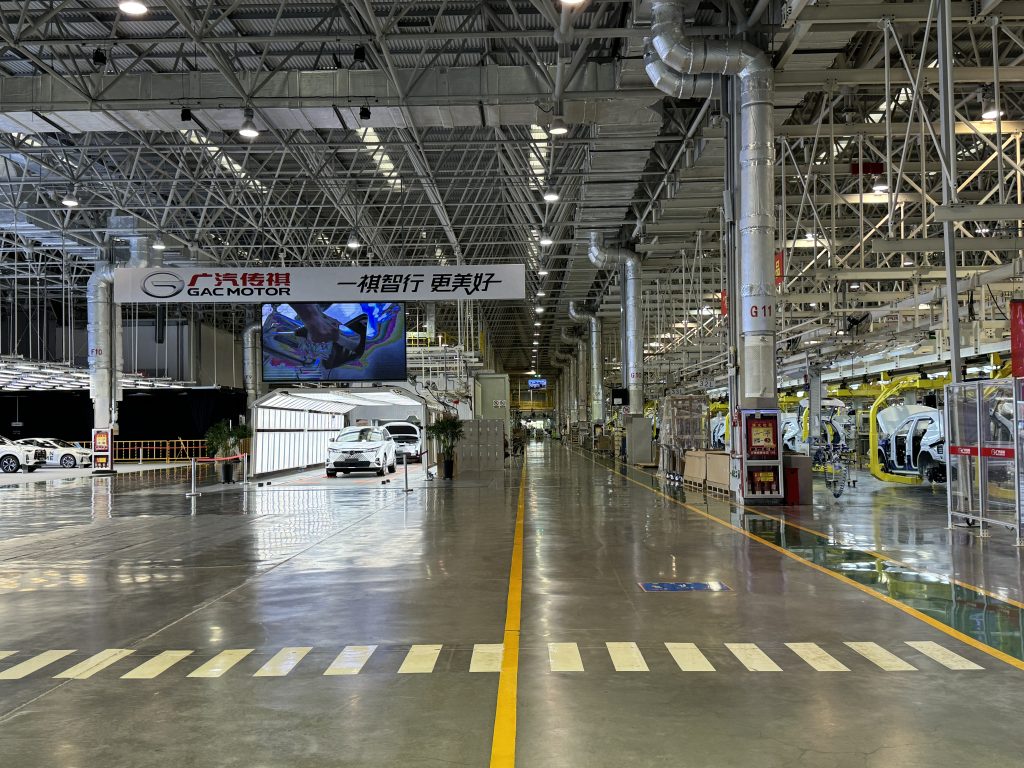
The GAC Passenger Vehicle Factory in Xinjiang © Jan Oberg 2024

A dynamic province

But where is the genocide? We met a dynamic province that is busy with its development. We didn’t find a trace of genocide, forced labour, or arbitrary detentions, but we did visit a documentation centre showing the numerous terrorist acts and China’s fight against terrorism.

The US has no case to present regarding any of these accusations. What the US seems to have latched onto, and even today refers to, is China’s anti-terrorism campaign.

This was an anti-separatist and anti-religious extremism campaign to stop Isis, al-Qaeda and other terrorists. China defeated terrorism in Xinjiang in 2019.

Should China also be criticised for its fight against terrorism?

The authors

Thore Vestby
– former Member of the Norwegian Parliament (H), former mayor and present TFF Board member. Private photo.

Arild Vollan
– a partner in Arctic Development, Ibestad/Oslo, Norway. Private photo.

Comment
The article above is a translation of the authors’ article in Norwegian in Nordnorsk Debatt here with some photos added. Since I participated in the same delegation, I can add that in response to our questions, we were told that China had practised legal processes against the perpetrators of terrorism and established re-orientation/de-radicalisation institutions and vocational training centres as well as promoted reintegration into society’s economic development to solve the terrorism problem and prevent it from coming back in the future.

Jan Oberg – TFF director and editor.

Urumqi, the capital of the Xinjiang Province, by night © Jan Oberg 2024.


1972-2003 IT and business-related education by IBM in economy, sales, marketing and business development.1971-1972 Military service1968-1971 Gymnasium, mathematics and physics1965-1968 High-school

Share

Leave a Reply

Your email address will not be published. Required fields are marked *

Related Posts

Launched on November 17, 2024Updated with new materials regularly TFF Board members Thore Vest. Everywhere, the delegation was met with a sincere wish to develop knowledge, dialogue, cooperative projects, and initiatives based on citizens’ diplomacy – in general, but with the West in particular. For more, see “Report from the Nordic delegation to China’s Xinjiang Province, September 7-15, 2024.” While the delegation was in Xinjiang, various ideas were already being discussed from the local to the top level, i.e., with the governor and party leaders of Xinjiang. The two TFF Associates suggested that TFF set up a special section – in addition to its “China and Silk” – where various quality materials about Xinjiang would regularly be published to promote public education about Xinjiang, particularly its contemporary development – worldwide but in the West in particular. This is now a reality – as can be seen below – but it...
Photo Jan Oberg China has recently garnered significant attention due to its advancements in various technological fields, such as quantum physics and artificial intelligence. In media discussions and my lectures on China, it is common to encounter objections asserting that the West, particularly the United States, is certainly ahead of China. These assertions appear to be more emotional than factual. However, a more fundamental consideration is whether this question holds any significance. Cultural Perspective One aspect that Westerners often overlook is the cultural variation in understanding the relationship between abstract academic insights and practical applications of those insights. To comprehend the origin and significance of discussions on technological superiority, it is essential to acknowledge cultural and social differences between China and the West. I have explored this topic before in some of my previous articles published on the TFF website. Particularism On the cultural dimension universalist – particularist, China exhibits...
Foreword The Board of The Transnational Foundation in Sweden has decided to publish an easy-to-read, scholarly anthology that addresses one of the most important – and potentially dangerous – issues of our time: Why are the political, economic, and medialised Western images of China so consistently negative – and what can you do to understand China better? These images may be expressions of a political will to present only various shades of grey and black with the aim of building a consciousness about China as an enemy and not a partner. They may also be seen as a sort of world-dominating ethos of ignorance based upon the assumption that “we’ve-got-nothing-to-learn-from-others,’ we are the teacher. Another possibility is that the West, deep down, feels that it is getting relatively weaker from a macro-historical perspective and comforts itself with denial and accusations against “the other” of being the reason for its manifest...

Recent Articles

Jan Oberg May 15, 2026 Go to this Fox News page and scroll the whole way down: President Donald Trump tells the world that his meeting with President Xi Jinping yielded a lot of very concrete political and economic results – of course, only where the Chinese side, according to him, agreed with him. He does not mention the Taiwan issue, but Secretary of State, Marco Rubio, says that it did not feature prominently in their talks and that the US policy on Taiwan has not changed. Then go to China Daily – or Global Times – and you will see that for the Chinese it is framework, principles, structure of cooperation etc. that matters – all embedded in the overall idea of “constructive bilateral relationship of strategic stability.” Nowhere is any concrete agreement or deal – all that Trump refers to – mentioned. At the general level, this gives you insights into the very different social...
Lena Petrova of “World Affairs In Context” with more than half a million subscribers on YouTube wanted to explore what a peace researcher like me has to say about, among other things, the First and the Second Cold War and why eethics has disappeared from politics. I am particularly happy about this conversation that also yielded an amazing number of very appreciative comments on YouTube. No doubt, people are longing for alternatives, including peace perspectives.
The MIMAC – Military-Industrial-Media-Academic Complex – drives the world’s rampant militarism and wars without end. Here is a short reflection of how it works against all interests of humanity. #5 deals with why there is no real enemy or threat images/analysis. It’s all ex-post constructions. And, btw, theTFF Peace Pulse is now on Rumble.

TFF on Substack

Discover more from TFF Transnational Foundation & Jan Oberg.

Most Popular

Jan Oberg May 15, 2026 Go to this Fox News page and scroll the whole way down: President Donald Trump tells the world that his meeting with President Xi Jinping yielded a lot of very concrete political and economic results – of course, only where the Chinese side, according to him, agreed with him. He does not mention the Taiwan issue, but Secretary of State, Marco Rubio, says that it did not feature prominently in their talks and that the US policy on Taiwan has not changed. Then go to China Daily – or Global Times – and you will see that for the Chinese it is framework, principles, structure of cooperation etc. that matters – all embedded in the overall idea of “constructive bilateral relationship of strategic stability.” Nowhere is any concrete agreement or deal – all that Trump refers to – mentioned. At the general level, this gives you insights into the very different social...
Lena Petrova of “World Affairs In Context” with more than half a million subscribers on YouTube wanted to explore what a peace researcher like me has to say about, among other things, the First and the Second Cold War and why eethics has disappeared from politics. I am particularly happy about this conversation that also yielded an amazing number of very appreciative comments on YouTube. No doubt, people are longing for alternatives, including peace perspectives.
The MIMAC – Military-Industrial-Media-Academic Complex – drives the world’s rampant militarism and wars without end. Here is a short reflection of how it works against all interests of humanity. #5 deals with why there is no real enemy or threat images/analysis. It’s all ex-post constructions. And, btw, theTFF Peace Pulse is now on Rumble.
Read More
Screenshot-2026-05-15-103534
Jan Oberg May 15, 2026 Go to this Fox News page and scroll the whole way down: President Donald Trump tells the world that his meeting with President Xi Jinping yielded a lot of very concrete political and economic results – of course, only where the Chinese side, according to him, agreed with him. He does not mention the Taiwan issue, but Secretary of State, Marco Rubio, says that it did not feature prominently in their talks and that the US policy on Taiwan has not changed. Then go to China Daily – or Global Times – and you will see that for the Chinese it is framework, principles, structure of cooperation etc. that matters – all embedded in the overall idea of “constructive bilateral relationship of strategic stability.” Nowhere is any concrete agreement or deal – all that Trump refers to – mentioned. At the general level, this gives you insights into the very different social...
Screenshot-2026-05-12-104023
Lena Petrova of “World Affairs In Context” with more than half a million subscribers on YouTube wanted to explore what a peace researcher like me has to say about, among other things, the First and the Second Cold War and why eethics has disappeared from politics. I am particularly happy about this conversation that also yielded an amazing number of very appreciative comments on YouTube. No doubt, people are longing for alternatives, including peace perspectives.
Screenshot-2026-04-13-154551 (2)
The MIMAC – Military-Industrial-Media-Academic Complex – drives the world’s rampant militarism and wars without end. Here is a short reflection of how it works against all interests of humanity. #5 deals with why there is no real enemy or threat images/analysis. It’s all ex-post constructions. And, btw, theTFF Peace Pulse is now on Rumble.
Screenshot-2026-04-13-154551 (1)
Jan Oberg, TFF director April 28, 2026 In this third TFF Peace Pulse, I make the important distinction between the violence and the conflict that violence is a symptom of. If you want peace, focus on the underlying conflict because that is the key to resolution, peacemaking, and a better future for the parties. The West is obsessed with violence, just look around you – and 90+ per cent of the public debate is about military issues and other violence – totally wasted for peace. These Peace Pulses will only be published here a few times. You will also not find them on YouTube and Vimeo because both platforms have blocked TFF and me; you know, peace is dangerous these days. Most TFF’s videos since 2007 are now on Rumble.
Screenshot-2026-04-13-154551
In contrast to most, we’ll bring alternatives, solutions, hope and strategies for a better future. Times are dangerous, yes, but that only intensifies the need for constructive thinking and action! Jan Oberg, TFF director April 13, 2026 The new TFF Peace Pulse uses video messages in a new way: Max 3-5-minute-long comments, ideas or perhaps mini-lectures, all about peace – positive peace. We launch them today on April 13, 2026 with a carefully crafted visual aesthetic fitting the content. We hope to publish them regularly from now on. We launch Peace Pulse (PP) – for a number of reasons. The world is in chaos, and there are countless reasons to feel concerned, frustrated, even angry. The atmosphere is saturated with doom and gloom, with negative energy and rear‑mirror thinking, while vision, imagination, alternatives, strategies and genuine future‑mindedness remain in short supply. And without them, we simply can’t save the world. Looking at problems from a hundred angles will...
IMG_5165 (1)
PART II — Publishing Peace in a System That Prioritises Militarism Jan Oberg, TFF director April 10, 2026 How TFF Maintains a Daily Voice in a Digital World Built for Noise This article is part of the series “TFF at 40″ and it invites you to learn about Four Decades of Publishing Peace. It takes a look at how a small, people‑financed peace foundation has communicated across four generations of technology — from wax stencils and fax machines to mass email and Substack — and why TFF continues to publish every single day in a system that rewards noise, conflict, and militarism. ◆ What it means to publish peace every single day in a digital system built for 24/7 news and other noise, confrontation, and militarism. How TFF’s independence, continuity, and global readership defy algorithms, donor cycles, and Western media censorhip — and why the Majority World keeps listening. When the...

