
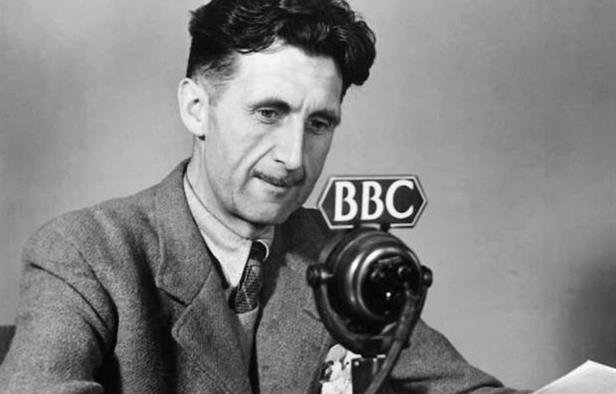
We Need Their Voices Today: George Orwell

Introduction

This is a collection of biographical sketches showing people whose wise voices from the past can help to guide us today. All of the women and men, brief glimpses of whose lives and ideas are portrayed here, gave a high place to compassion. None of them was a slave to greed. We need their voices today!

A Lower-Upper Middle Class Family and Education

Eric Arthur Blair (1903-1950), better known by his pen name George Orwell, was the great-grandson of Charles Blair, a wealthy country gentleman, and Lady Mary Fane, daughter of the Earl of Westmorland. Over the generations that separated Eric Blair from his great-grandparents, some of the gentility remained but most of the wealth disappeared, and he described his family as being “lower-upper middle class”.

Eric Blair was born in British India where his father was working, but when he was one year old his mother took the family to England. Eric attended a Catholic boarding school called St. Cyprians, where his work in history and his writing won him scholarships to both Wellington and Eton. He attended both schools, because at first there was no place available at Eton.

Burmese Days

While at Eton, Eric Blair paid more attention to extra-curricular activities than to his studies, and his family, who could not afford to send him to university without a scholarship, decided that he would never win owe. Instead of attending a university, Eric Blair joined the Imperial Police. He chose Burma, where his maternal grandmother was still living.

After serving several years in Burma in positions of increasing responsibility, Orwell became seriously ill in 1927, and he was allowed to return to England. By this time, he had become disillusioned with colonialism. He now saw it as a system whereby the soldiers held the poor Indian of Burmese citizen down, while the merchant went through his pockets. Orwell described his experiences as a colonial police officer in his book, “Burmese Days.”

Down and Out in Paris and London (1933)

After Orwell returned from Burma, he became interested in the lives of very poor people in Europe. On a visit to Paris, he experienced the theft of all his money. He could have written to his guardian in England to ask for help, but instead he decided to find out for himself what it was like to be completely destitute. Returning to London, he later continued his personal experiment with extreme poverty.

After living at the extreme lower edge of society for several years, Orwell described his experiences in “Down and Out in Paris and London”. Orwell’s descriptions are so vivid and his sense of humor so sharp that the book is both riveting and enjoyable to read. Other excellent books by Orwell describing not quite so extreme poverty include “Keep the Aspidistra Flying” (1936), and “The road to Wigan Pier” (1937).

Homage to Catalonia (1938)

This book describes Orwell’s experiences during the Spanish Civil War. He served as a soldier in the unsuccessful struggle to prevent Franco’s fascist army from overthrowing the elected government.
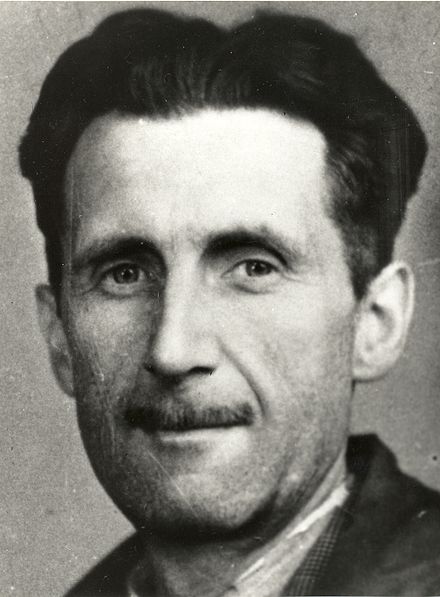
George Orwell

Animal Farm (1945)

This brilliant satiric and allegorical novella reflects Orwell’s disillusionment with Russia’s post-revolutionary government under Stalin. Orwell saw Stalinism as a brutal dictatorship. In his essay “Why I Write” (1946) Orwell says that “Animal Farm” is the first book in which he tried “to fuse political purpose and artistic purpose into one whole”.

At the start of  “Animal Farm” an old boar called Major (Marx and/or Lenin ?) teaches the animals to sing “Beasts of England” (the “Internationale”?). Orwell describes the tune as being halfway between “La Cucaratcha” and “My Darling Clementine”. Here are the words of the song:

 “Beasts of England, Beasts of Ireland,
Beasts of every land and clime,
Hearken to my joyful tidings
Of the Golden future time.

“Soon or late the day is coming,
Tyrant Man shall be o’erthrown,    
And the fruitful fields of England
Shall be trod by beasts alone.

“Rings shall vanish from our noses,
And the harness from our back,
Bit and spur shall rust forever,
Cruel whips no more shall crack.

“Riches more than mind can picture,
Wheat and barley, oats and hay,
Clover, beans, and mangel-wurzels
Shall be ours upon that day.

“Bright will shine the fields of England,
Purer shall its waters be,
Sweeter yet shall blow its breezes
On the day that sets us free.

“For that day we all must labour,
Though we die before it break;
Cows and horses, geese and turkeys,
All must toil for freedom’s sake.

“Beasts of England, Beasts of Ireland,
Beasts of every land and clime,
Hearken well, and spread my tidings
Of the Golden future time.”

After a successful revolution by the animals, Farmer Jones is expelled, and the Seven Principles of Animalism are established, the most important of which is:

“All animals are equal.”

The pigs, being (as they say themselves) the most intelligent of the animals, gradually take over the running of the farm. Meetings of all the animals are replaced by meetings of the pigs. The faithful hardworking old horse, Boxer, is sold to the gluemaking knacker in order to buy whisky for the pigs. The first principle of Animalism is replaced by:

“All animals are equal, but some animals are more equal than others.”

Finally, the pigs start to carry whips and to walk on two legs. They become indistinguishable from humans.

“Animal Farm”, published at the start of the Cold War, was a great commercial success, and it was translated into many languages.

Nineteen Eighty-Four (1949)

George Orwell’s famous dystopian novel “Nineteen Eighty-four” (often published as “1984”) has changed the English language and added new words, for example  “Orwellian”,

“doublethink”, “thoughtcrime”, “Big Brother”, “newspeak”, “nonperson” and “memory hole”. Like “Animal Farm”, it expresses Orwell’s deep dislike of Stalin’s brutal dictatorship. However, the novel also so aptly describes recent conditions in the United States and elsewhere that today it has hit the top of the best-seller lists.

The novel follows the life of Winston Smith, who lives in Airstrip One (formerly known as Great Britain). Airstrip One is part of the superstete Ociania, which is perpetually at war with two other superstates. Pictures of the ruler of Ociania, Big Brother, are everywhere and a cult of personality surrounds him, although he may not even exist.

Winston Smith belongs to the Outer Party, and he works in the Ministry of Truth (Minitruth), where his job is to rewrite history so that it will conform to the constantly-changing doctrines of the Inner Party, He changes written records, alters photographs, and converts people who are out of favour to “nonpersons” by destroying every record of their existence. Winston is good at his job, but he gradually come to detest the whole system. This, of course is a “thoughtcrime”.

Another worker in the Ministry of Truth is Julia, who runs Minitruth’s novel-writing machines. She hands Winston a note telling him that she is in love with him. Winston finds out that Julia shares his detestation of the system, and an affair blossoms between them. The meet in a rented room in a proletarian district where they believe they will be free from survelience.

Later Winston is approached by O’Brian, a member of the Inner Party who is believed by Winston to be a member of the Brotherhood, a secret society that opposes the Party. Winston and Julia tell O’Brian of their detestation of the whole system. But O’Brian is not a member of the Brotherhood. He is actually a member of the Thought Police. Winston and Julia are arrested and tortured to such an extent that they finally betray each other.

Winston is tortured again and again. Simultaneously he is brainwashed to such an extent that he becomes a believer in the system, and can be sent back into society. The new, brainwashed Winston believes wholeheartedly in the doctrines of the Party, and he has finally learned to love Big Brother.

During the writing of “Nineteen Eighty-four”, Orwell was very ill with tuberculosis, and he died soon afterwards from the disease.

Some Quotations from “1984 – Nineteen Eighty-Four”

“Now I will tell you the answer to my question. It is this. The Party seeks power entirely for its own sake. We are not interested in the good of others; we are interested solely in power, pure power. What pure power means you will understand presently. We are different from the oligarchies of the past in that we know what we are doing. All the others, even those who resembled ourselves, were cowards and hypocrites.

The German Nazis and the Russian Communists came very close to us in their methods, but they never had the courage to recognize their own motives. They pretended, perhaps they even believed, that they had seized power unwillingly and for a limited time, and that just around the corner there lay a paradise where human beings would be free and equal. We are not like that. We know that no one ever seizes power with the intention of relinquishing it. Power is not a means; it is an end. One does not establish a dictatorship in order to safeguard a revolution; one makes the revolution in order to establish the dictatorship. The object of persecution is persecution. The object of torture is torture. The object of power is power. Now you begin to understand me.”

“War is peace.
Freedom is slavery.
Ignorance is strength.”

Politics and the English Language, and Other Essays

George Orwell was a perceptive and prolific essayist. Here is a link to some of his essays that have been made available by Project Gutenberg.

A Few Things That George Orwell Said:

“Actions are held to be good or bad, not on their own merits, but according to who does them. There is almost no kind of outrage -torture, imprisonment without trial, assassination, the bombing of civilians – which does not change its moral color when it is committed by ‘our’ side. The nationalist not only does not disapprove of atrocities committed by his own side, he has a remarkable capacity for not even hearing about them.”

“The essence of oligarchical rule is not father-to-son inheritance, but the persistence of a certain world-view and a certain way of life … A ruling group is a ruling group so long as it can nominate its successors… Who wields power is not important, provided that the hierarchical structure remains always the same.”

“In a time of deceit telling the truth is a revolutionary act.”

“The creatures outside looked from pig to man, and from man to pig, and from pig to man again; but already it was impossible to say which was which.”

“The most effective way to destroy people is to deny and obliterate their own understanding of their history.”

“If you want a picture of the future, imagine a boot stamping on a human face forever.”

“But if thought corrupts language, language can also corrupt thought.”

“If liberty means anything at all, it means the right to tell people what they do not want to hear.

“Doublethink means the power of holding two contradictory beliefs in one’s mind simultaneously, and accepting both of them.”

“Until they became conscious they will never rebel, and until after they have rebelled they cannot become conscious.”

“The essence of being human is that one does not seek perfection.”

“Being in a minority, even in a minority of one, did not make you mad. There was truth and there was untruth, and if you clung to the truth even against the whole world, you were not mad.”

“The great enemy of clear language is insincerity.”

“To see what is in front of one’s nose requires a constant struggle.”

“Advertising is the rattling of a stick inside a swill bucket.”

“War is a way of shattering to pieces, or pouring into the stratosphere, or sinking in the depths of the sea, materials which might otherwise be used to make the masses too comfortable, and hence, in the long run, too intelligent.”

Originally published by the Transcend Media Service here.

Share

Leave a Reply

Your email address will not be published. Required fields are marked *

Related Posts

Jan Oberg May 15, 2026 Go to this Fox News page and scroll the whole way down: President Donald Trump tells the world that his meeting with President Xi Jinping yielded a lot of very concrete political and economic results – of course, only where the Chinese side, according to him, agreed with him. He does not mention the Taiwan issue, but Secretary of State, Marco Rubio, says that it did not feature prominently in their talks and that the US policy on Taiwan has not changed. Then go to China Daily – or Global Times – and you will see that for the Chinese it is framework, principles, structure of cooperation etc. that matters – all embedded in the overall idea of “constructive bilateral relationship of strategic stability.” Nowhere is any concrete agreement or deal – all that Trump refers to – mentioned. At the general level, this gives you insights into the very different social...
The MIMAC – Military-Industrial-Media-Academic Complex – drives the world’s rampant militarism and wars without end. Here is a short reflection of how it works against all interests of humanity. #5 deals with why there is no real enemy or threat images/analysis. It’s all ex-post constructions. And, btw, theTFF Peace Pulse is now on Rumble.
Jan Oberg, TFF director April 28, 2026 In this third TFF Peace Pulse, I make the important distinction between the violence and the conflict that violence is a symptom of. If you want peace, focus on the underlying conflict because that is the key to resolution, peacemaking, and a better future for the parties. The West is obsessed with violence, just look around you – and 90+ per cent of the public debate is about military issues and other violence – totally wasted for peace. These Peace Pulses will only be published here a few times. You will also not find them on YouTube and Vimeo because both platforms have blocked TFF and me; you know, peace is dangerous these days. Most TFF’s videos since 2007 are now on Rumble.

Recent Articles

Burundi – hopp om fred Burundi, var är det nu det ligger? Det är nånting med Hutsier och Tutuer – eller vad de nu heter – som mördar varandra med machete-knivar, nånting med fattigdom, korruption, militärdiktatur, nöd och elände? Det hopplösa, mörka Afrika i ett bananskal, eller hur? Tja. Jag har precis varit där. Det ligger naturligtvis någonting i det. Och det finns en del orsaker till att vi inte ser mycket om landet i massmedia. En av dem är att det inte försiggår något folkmord just nu, ingen naturkatastrofer, ingen kupp. Det finns ingen misslyckad FN-mission, USA och EU har få intressen, Madeleine Halfbright har inte sagt något om det nyss, NATO:s Solana ser inte bombningar i Burundi som viktiga för firandet av alliansens 50-årsdag i april. För en tid sedan då 50 människor mördades strömmade hundratals journalister med CNN i spetsen till Burundi…men för att snabbt försvinna till Kongo...
Burundi – håb forude Burundi, hvor er det nu det ligger? Det er noget med Hutsier og Tutuer – eller hvad de nu hedder – der laver folkemord med machete-knive på hinanden, noget med fattigdom, korruption, militærdiktatur, nød og elendighed? Det håbløse, mørke Afrika i en bananskal, ikke? Tjah. Jeg har lige været der. Der er selvfølgelig noget om snakken. Der er en del årsager til at man ikke hører særligt meget om livet i dette lille land. En af dem er at der ikke foregår noget folkemord for tiden, ingen naturkatastrofer, intet kup. Der er ingen mislykket FN-mission, USA og EU har ingen interesser, Madeleine Halfbright har ikke sagt noget om det, NATO’s Solana ser ikke bombinger i Burundi som afgørende forud for alliancens 50årsdag. For nogen tid siden da et halvt hundrede mennesker var blevet dræbt valfartede hundreder af journalister med CNN i spidsen dertil . . . men...
Rambouillet (Rambo-Yeah) og Rashid Vi skriver fredag den 19. januar. For få dage siden kom jeg hjem fra små tre uger i Skopje, Beograd og Kosovo. Min analyse og min intuition siger mig dét, jeg ikke vil høre: bombningerne nærmer sig. Det var 34. besøg siden 1991. Jeg er delvist uddannet i Dubrovnik, fra 1974. Jeg kan ikke slippe det. Det er altså også mit land, der atter trues af den kulturkreds, jeg tilhører. Radmila og Peca i Beograd, venner siden 1974, intellektuelle der har valgt ikke at forlade landet og netop har sagt nej til et ophold i udlandet. Datteren Anja på 9 skal vokse op hér. "Jeg rejste ned nu," siger jeg, "fordi der enten ville falde bomber eller blive en eller anden slags ‘forhandling’ og jeg vil være hér hvis I blir bombet, for jeg skammer mig over hvad Danmark og andre lande gør." Hun får tårer...

TFF on Substack

Discover more from TFF Transnational Foundation & Jan Oberg.

Most Popular

Burundi – hopp om fred Burundi, var är det nu det ligger? Det är nånting med Hutsier och Tutuer – eller vad de nu heter – som mördar varandra med machete-knivar, nånting med fattigdom, korruption, militärdiktatur, nöd och elände? Det hopplösa, mörka Afrika i ett bananskal, eller hur? Tja. Jag har precis varit där. Det ligger naturligtvis någonting i det. Och det finns en del orsaker till att vi inte ser mycket om landet i massmedia. En av dem är att det inte försiggår något folkmord just nu, ingen naturkatastrofer, ingen kupp. Det finns ingen misslyckad FN-mission, USA och EU har få intressen, Madeleine Halfbright har inte sagt något om det nyss, NATO:s Solana ser inte bombningar i Burundi som viktiga för firandet av alliansens 50-årsdag i april. För en tid sedan då 50 människor mördades strömmade hundratals journalister med CNN i spetsen till Burundi…men för att snabbt försvinna till Kongo...
Burundi – håb forude Burundi, hvor er det nu det ligger? Det er noget med Hutsier og Tutuer – eller hvad de nu hedder – der laver folkemord med machete-knive på hinanden, noget med fattigdom, korruption, militærdiktatur, nød og elendighed? Det håbløse, mørke Afrika i en bananskal, ikke? Tjah. Jeg har lige været der. Der er selvfølgelig noget om snakken. Der er en del årsager til at man ikke hører særligt meget om livet i dette lille land. En af dem er at der ikke foregår noget folkemord for tiden, ingen naturkatastrofer, intet kup. Der er ingen mislykket FN-mission, USA og EU har ingen interesser, Madeleine Halfbright har ikke sagt noget om det, NATO’s Solana ser ikke bombinger i Burundi som afgørende forud for alliancens 50årsdag. For nogen tid siden da et halvt hundrede mennesker var blevet dræbt valfartede hundreder af journalister med CNN i spidsen dertil . . . men...
Rambouillet (Rambo-Yeah) og Rashid Vi skriver fredag den 19. januar. For få dage siden kom jeg hjem fra små tre uger i Skopje, Beograd og Kosovo. Min analyse og min intuition siger mig dét, jeg ikke vil høre: bombningerne nærmer sig. Det var 34. besøg siden 1991. Jeg er delvist uddannet i Dubrovnik, fra 1974. Jeg kan ikke slippe det. Det er altså også mit land, der atter trues af den kulturkreds, jeg tilhører. Radmila og Peca i Beograd, venner siden 1974, intellektuelle der har valgt ikke at forlade landet og netop har sagt nej til et ophold i udlandet. Datteren Anja på 9 skal vokse op hér. "Jeg rejste ned nu," siger jeg, "fordi der enten ville falde bomber eller blive en eller anden slags ‘forhandling’ og jeg vil være hér hvis I blir bombet, for jeg skammer mig over hvad Danmark og andre lande gør." Hun får tårer...
Read More
Burundi – hopp om fred Burundi, var är det nu det ligger? Det är nånting med Hutsier och Tutuer – eller vad de nu heter – som mördar varandra med machete-knivar, nånting med fattigdom, korruption, militärdiktatur, nöd och elände? Det hopplösa, mörka Afrika i ett bananskal, eller hur? Tja. Jag har precis varit där. Det ligger naturligtvis någonting i det. Och det finns en del orsaker till att vi inte ser mycket om landet i massmedia. En av dem är att det inte försiggår något folkmord just nu, ingen naturkatastrofer, ingen kupp. Det finns ingen misslyckad FN-mission, USA och EU har få intressen, Madeleine Halfbright har inte sagt något om det nyss, NATO:s Solana ser inte bombningar i Burundi som viktiga för firandet av alliansens 50-årsdag i april. För en tid sedan då 50 människor mördades strömmade hundratals journalister med CNN i spetsen till Burundi…men för att snabbt försvinna till Kongo...
Burundi – håb forude Burundi, hvor er det nu det ligger? Det er noget med Hutsier og Tutuer – eller hvad de nu hedder – der laver folkemord med machete-knive på hinanden, noget med fattigdom, korruption, militærdiktatur, nød og elendighed? Det håbløse, mørke Afrika i en bananskal, ikke? Tjah. Jeg har lige været der. Der er selvfølgelig noget om snakken. Der er en del årsager til at man ikke hører særligt meget om livet i dette lille land. En af dem er at der ikke foregår noget folkemord for tiden, ingen naturkatastrofer, intet kup. Der er ingen mislykket FN-mission, USA og EU har ingen interesser, Madeleine Halfbright har ikke sagt noget om det, NATO’s Solana ser ikke bombinger i Burundi som afgørende forud for alliancens 50årsdag. For nogen tid siden da et halvt hundrede mennesker var blevet dræbt valfartede hundreder af journalister med CNN i spidsen dertil . . . men...
Rambouillet (Rambo-Yeah) og Rashid Vi skriver fredag den 19. januar. For få dage siden kom jeg hjem fra små tre uger i Skopje, Beograd og Kosovo. Min analyse og min intuition siger mig dét, jeg ikke vil høre: bombningerne nærmer sig. Det var 34. besøg siden 1991. Jeg er delvist uddannet i Dubrovnik, fra 1974. Jeg kan ikke slippe det. Det er altså også mit land, der atter trues af den kulturkreds, jeg tilhører. Radmila og Peca i Beograd, venner siden 1974, intellektuelle der har valgt ikke at forlade landet og netop har sagt nej til et ophold i udlandet. Datteren Anja på 9 skal vokse op hér. "Jeg rejste ned nu," siger jeg, "fordi der enten ville falde bomber eller blive en eller anden slags ‘forhandling’ og jeg vil være hér hvis I blir bombet, for jeg skammer mig over hvad Danmark og andre lande gør." Hun får tårer...
Konflikthåndtering – den ny kolde krig Det internationale såkaldte “samfund” er tilstede som fredsskabere i snart sagt hver eneste konflikt og krig med sine diplomater, soldater, genopbygningshjælp, monitorer, jurister, ambassadører, fredsbevarere, mæglere, politi, eksperter, forhandlere og med agenter, satelliter, hangarfartøjer og kampfly på alert. Fredsforstyrrende fraktioner skal bringes til det berømte forhandlingsbord omkring hvilket de under det internationale samfunds pres skal sige ja til fredsplaner, Den generelle, tidstypiske mediedækning af politiske konflikter og krige befæster mere eller mindre bevidst to dybt misvisende, men funktionelle, opfattelser. (A) Konflikter handler om gode versus mindre gode aktører og konfliktløsning er følgelig et spørgsmål om at straffe de onde og belønne de gode, ofrene. (B) Verden er opdelt i to parter, ja der er to verdener: På den ene side er der "fredsforstyrrerne" – slyngelstater, hitleristiske diktatorer, forfejlede stater, primitive og onde aktører, terrorister, folk der ikke forstår andet end store bogstaver og bomber...
Försoningens tid Att förlåta någon innebär att man accepterar den som handlat felaktigt och som ångrar det. Försoning är ett klarläggande och en accept av det som hänt, ett viljesmässigt beslut om att komma vidare och se framåt. Vi kan förlåta en annan människa hans eller hennes gärningar och därmed erbjuda en ny start. Vi försonas med fakta och med den skyldige och eventuellt också med att vi själva kan ha varit en medverkande orsak till att det gick som det gick. Förlåtelse och försoning handlar emellertid inte om att glömma. Ett par av mina kväkarvänner miste för några år sedan sin son och blivande svärdotter i en bilolycka, ett resultat av en annan bilists helt oansvariga manöver. Det var viktigt för dem att träffa den människa som förvållat dem så stor smärta. Straffet i sig var inte viktigt för dem utan de sade till honom: "vi kan förlåta Dig...
Ett expanderande NATO är konfliktbevarande Nato expanderar i en värld där de samlade militärutgifterna motsvarar årsinkomsten för jordens 49 procent fattigaste, skriver fredsforskaren Jan Øberg. Satsningen på Nato:s utvidgning går ut på att kämpa mot fiktiva hot och skapar exakt det man säger sig vilja undvika, ekonomisk kris, instabilitet och nya hot. Nato expanderar. De globala militära utgifterna har årligen fallit med några få procent. Men den nya teknologins slagkraft ökar. Kärnvapenindustrins forskare hotas inte av arbetslöshet. Enbart USA har en militär budget på drygt 250 miljarder dollar och världens samlade militärutgifter motsvarar årsinkomsten för de 49 procent fattigaste på klotet. Tyskland expanderar. En gång i tiden förstod man att ett förenat Tyskland måste vara neutralt. Men Gorbatjov, som gav Sovjetunionens och Warszawapaktens upplösning till Västvärlden i tron att han skulle få någonting i gengäld, serverade också ett förenat Tyskland till Nato på en silverbricka. Delvis kärnvapen-nedrustning följde liksom ryska...